Vitalik Buterin Argues Merging DAOs and Prediction Markets Is Good for Creators as SUBBD Token Soars

bitcoinistPublicado em 2026-02-03Última atualização em 2026-02-03

Resumo

Ethereum co-founder Vitalik Buterin proposes merging DAOs with prediction markets, a concept he calls "info finance," to improve on-chain governance and content curation by using market-based truth-seeking mechanisms. This shift could benefit creators by replacing opaque Web2 algorithms with transparent, capital-backed systems. Meanwhile, SUBBD Token ($SUBBD) is highlighted as a practical implementation, combining AI tools and Web3 payments to reduce platform fees and empower creators. It has raised over $1.4M in its presale, offering staking rewards and aiming to disrupt the $85 billion creator economy by decentralizing monetization and operational workflows.

Ethereum co-founder Vitalik Buterin is at it again.

This time, he’s pivoting the crypto conversation toward the intersection of decentralized autonomous organizations (DAOs) and prediction markets, a concept he calls ‘info finance.’

In recent commentary on the evolution of on-chain governance, Buterin suggested that prediction markets offer a truth-seeking mechanism that standard DAO voting lacks. By requiring participants to have ‘skin in the game,’ these markets can filter noise from signal.
That distinction matters because the current creator economy is bloated with intermediaries.

When Buterin talks about merging these technologies, the implication for creators is profound: a shift away from opaque Web2 algorithms toward transparent, market-driven curation. Instead of a platform like YouTube or TikTok deciding which creators gain visibility based on black-box ad metrics, a prediction-market-based DAO could surface high-quality content based on crowd sentiment backed by capital.

It’s a move from attention farming to value verification.

But let’s be real, theoretical governance models are only half the equation. The other half is infrastructure that actually empowers creators to bypass rent-seeking platforms today.

While Ethereum’s architect sketches out the future of on-chain coordination, new challengers are already dismantling the Web2 monopoly on content monetization. Leading this charge is SUBBD Token ($SUBBD), a project specifically engineered to disrupt the $85 billion creator economy by mixing AI tools with permissionless payments.

Get your $SUBBD here.

AI-Driven Tools Lower Barriers in The $85 Billion Creator Economy

The structural weakness of the legacy creator economy isn’t just governance, it’s extraction. Platforms routinely snatch cuts ranging from 20% to 50% of a creator’s earnings. Vitalik’s vision of “info finance” attacks the curation layer, but SUBBD Token ($SUBBD) attacks the operational layer.

By merging Web3 infrastructure with advanced AI, the platform offers a tangible solution to the friction that stifles independent creators.

The project distinguishes itself through utility that goes beyond simple transactions. SUBBD provides an AI Personal Assistant for automated interactions and proprietary AI Voice Cloning technology, allowing creators to scale their output without burning out.
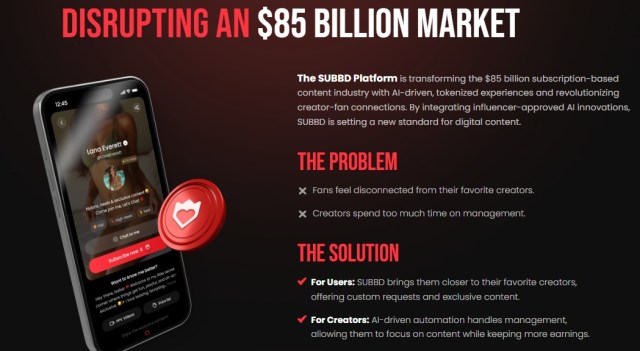
This is critical. In a market where consistency is currency, AI tools that optimize workflow are just as valuable as the payment rails themselves.

Plus, the platform introduces a governance model where the $SUBBD token dictates feature rollouts. This aligns with the broader industry trend of moving control back to the users, mirroring the ethos of Buterin’s DAO-centric proposals. By removing the 70% revenue cuts common in Web2, the project effectively redistributes value from the platform back to the talent.

Check out the SUBBD whitepaper for more details.

You can buy $SUBBD here.

Presale Data Shows Demand for Decentralized Content Platforms

Market sentiment is shifting toward utility-driven assets, and the capital flows prove it. According to official reporting, SUBBD Token ($SUBBD) has raised over $1.4M in its ongoing presale. This level of early-stage liquidity indicates strong investor appetite for projects that bridge the gap between AI technology and crypto-economic incentives.
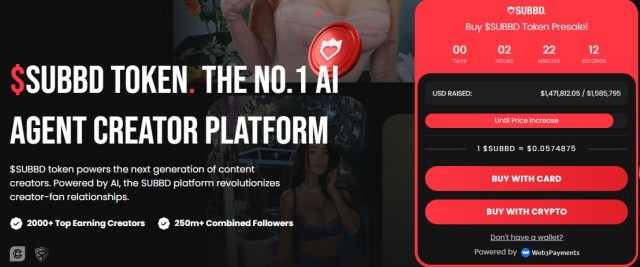
Smart money is watching the entry price carefully. With tokens currently priced at $0.05749, the valuation allows for accessible entry before potential listing volatility kicks in. Unlike meme coins driven purely by hype cycles, this capital raise appears underpinned by a clear revenue model and a staking protocol designed to lock up supply.

The protocol offers a fixed 20% APY for the first year of staking. This incentivizes long-term holding, stabilizing the token economy while the platform scales its user base. For investors, the combination of high-yield staking and exclusive access to ‘HoneyHive’ benefits, such as beta access and XP multipliers, creates a dual value proposition: immediate yield and future utility.

As the creator economy continues to expand, platforms that offer financial sovereignty combined with operational AI tools are positioned to capture significant market share.

Visit the official site to view the presale.

The content provided here is for informational purposes only and does not constitute financial advice. Crypto assets are high-risk investments. Always conduct independent due diligence before investing.


Perguntas relacionadas

QWhat does Vitalik Buterin call the concept of merging DAOs and prediction markets, and what is its purpose?

AVitalik Buterin calls the concept 'info finance.' Its purpose is to provide a truth-seeking mechanism for on-chain governance by requiring participants to have 'skin in the game,' which can filter noise from signal and shift content curation from opaque Web2 algorithms to transparent, market-driven systems.

QHow does SUBBD Token ($SUBBD) aim to disrupt the creator economy according to the article?

ASUBBD Token ($SUBBD) aims to disrupt the $85 billion creator economy by merging Web3 infrastructure with advanced AI tools, such as an AI Personal Assistant and AI Voice Cloning technology, to lower operational barriers, remove high platform revenue cuts (up to 70%), and provide permissionless payments, thereby redistributing value from platforms back to creators.

QWhat are some key features of the SUBBD platform mentioned in the article?

AKey features of the SUBBD platform include AI-driven tools like an AI Personal Assistant for automated interactions, proprietary AI Voice Cloning technology, a governance model where the $SUBBD token dictates feature rollouts, and a staking protocol offering a fixed 20% APY for the first year to incentivize long-term holding.

QWhat does the presale data for SUBBD Token ($SUBBD) indicate about investor sentiment?

AThe presale data, which shows that SUBBD Token has raised over $1.4M, indicates strong investor appetite for utility-driven projects that bridge AI technology with crypto-economic incentives. This reflects a market shift towards assets with clear revenue models and practical applications, rather than those driven purely by hype.

QHow does the article contrast Vitalik Buterin's vision with the approach of SUBBD Token?

AThe article contrasts Vitalik Buterin's vision, which focuses on improving the curation layer of the creator economy through 'info finance' and prediction-market-based DAOs, with SUBBD Token's approach, which targets the operational layer by providing AI tools and Web3 infrastructure to reduce friction, eliminate high platform fees, and empower creators directly.

Leituras Relacionadas

Apple's Desired On-Device AI Sees a Dark Horse Emerge: The First Cognitive Model is Born, 4B Matches GPT-5.4

A Chinese company, Tomorrow's Journey (Nextie), has introduced what it is calling the industry's first "cognitive model" for edge devices. Named New Journey Alpha, this 4-billion-parameter model reportedly matches the performance of trillion-parameter giants like GPT-5.4 in group intelligence tasks such as debate and collective decision-making. The development follows Andrej Karpathy's vision of stripping vast factual knowledge from large language models to retain only a smaller "cognitive core" capable of reasoning, planning, and knowing its own limits. This approach directly addresses the soaring computational costs and token expenses hindering AI's widespread deployment, as highlighted by incidents like Amazon shutting down an internal AI tool due to prohibitive costs. Trained via reinforcement learning on a corpus of academic papers from 1800-2020 to enhance generalization, the model enables three key advancements: 1) Improved decision quality in multi-agent systems, 2) Drastically reduced compute costs, allowing for cost-effective cloud or on-device (e.g., MacBook) deployment, and 3) The feasibility of "proactive" AI agents that act autonomously without user prompts, unlocking new commercial possibilities beyond today's reactive models. Built by the former Microsoft Xiaoice team—known for creating a 3.6B model that outperformed a 65B Llama model—the company is now focusing on the multi-agent systems sector, a field gaining significant investor interest. The model's economic impact is profound; by achieving high-level performance with minimal parameters, it fundamentally alters the cost structure of AI services, challenging the prevailing model of ever-larger parameter counts.

marsbitHá 47m

Apple's Desired On-Device AI Sees a Dark Horse Emerge: The First Cognitive Model is Born, 4B Matches GPT-5.4

marsbitHá 47m

OpenAI's 'Blueprint for the Future': Making AI Beneficial for Every Person on the Planet

A new transformative technology emerges every few generations. OpenAI draws a parallel with the advent of electricity in the 1920s, which initially brought convenience but ultimately enabled unprecedented progress in medicine, engineering, and living standards by empowering people to create new possibilities. AI is poised to recreate this phenomenon. Its true significance lies not in the technology itself, but in what people can achieve with it—from understanding a medical bill or starting a business to aiding scientific discovery. OpenAI believes AI should be universally accessible, allowing everyone to use it according to their own needs. This future, however, is not guaranteed. While transformative tech can centralize power, OpenAI's philosophy is that AI must serve humanity, augmenting human capabilities and broadly distributing its benefits. The company's first commitment is to build AI for human service, aiming to empower the many rather than concentrate power in a few. Safety, alignment with human intent, and oversight are paramount. OpenAI is optimistic about AI's potential to expand human welfare but remains clear-eyed about risks. The goal is to help people achieve more, not to replace them. Full automation is not the desired future; human judgment, values, and direction will become even more critical. OpenAI outlines three core goals: 1. Build automated AI researchers to accelerate and increasingly automate the research process itself, maintaining close human collaboration. The internal projection is that by March 2028, a significant portion of their research will be conducted by AI systems working alongside human researchers. 2. Accelerate economic development by advancing science, boosting productivity, and fostering growth, while ensuring the fruits are widely shared. 3. Provide a personal AGI for everyone on Earth, allowing individuals to benefit from this transformative technology in their own way. The company is entering its third phase, moving from foundational AGI research (Phase 1) to product deployment and learning from real-world use (Phase 2). The current challenge is making advanced AI abundant, affordable, safe, practical, and usable for all individuals and organizations. OpenAI concludes that a widely distributed power structure leads to a more resilient, adaptable, and free society. A positive AI future should not be controlled by a handful of entities but built, benefited from, and owned by many. If realized correctly, AI can become a cornerstone for enhancing global productivity, creativity, scientific advancement, and economic opportunity, fulfilling the mission to ensure AGI benefits all of humanity.

marsbitHá 1h

OpenAI's 'Blueprint for the Future': Making AI Beneficial for Every Person on the Planet

marsbitHá 1h

Arthur Hayes' New Article: AI Bubble Nears Bursting, Crypto Market Faces Short-Term Pressure

In a new essay, Arthur Hayes argues that the AI market bubble is approaching a rupture, which will place significant short-term pressure on crypto assets. He identifies rising oil prices, a trio of massive tech IPOs (SpaceX, Anthropic, OpenAI), and potential anti-AI political rhetoric from Trump as the three key catalysts for a correction. Hayes posits that the prolonged blockage of the Strait of Hormuz will drive energy prices higher, increasing operational costs for data centers and squeezing AI company profits. Simultaneously, the market may struggle to absorb the upcoming wave of multi-trillion dollar tech IPOs. Furthermore, with high inflation hurting his election chances, Trump could pivot to attacking the AI sector with proposals for heavy taxation and regulation to win over voters, spooking the market. Hayes notes that nearly all new dollar liquidity since 2022 has flowed into the AI sector, leaving little for Bitcoin, explaining its recent underperformance. He believes an AI stock crash would trigger a broad risk-off sentiment and credit contraction, dragging down crypto in the near term. Consequently, his fund, Maelstrom, has sold all AI-related stocks and non-core cryptocurrencies, retaining only Bitcoin and Ethereum while building positions in traditional energy stocks. He anticipates Bitcoin will bottom and resume its bull run only after the AI bubble pops and a new monetary easing cycle begins.

marsbitHá 1h

Arthur Hayes' New Article: AI Bubble Nears Bursting, Crypto Market Faces Short-Term Pressure

marsbitHá 1h

Trading

Spot
Futuros
活动图片




