Visca Crypto! Top Exchange Signs 5-Year Agreement With Spanish Giant FC Barcelona

bitcoinistPublicado em 2026-04-24Última atualização em 2026-04-24

Resumo

European cryptocurrency exchange WhiteBIT has renewed its strategic partnership with FC Barcelona for an additional five years, extending their collaboration until 2030. As the club's Official Cryptocurrency Exchange Partner, WhiteBIT will expand its role across Barça's men's first team, women's team, and basketball team, while also partnering with the Barça Innovation Hub. The alliance aims to integrate cryptocurrency into the sports ecosystem by developing practical applications for millions of fans worldwide. Initiatives include a co-branded debit card, fan engagement programs, and digital education efforts. The partnership seeks to bridge the gap between technology and sports, moving crypto beyond the industry into everyday use.

European crypto exchange WhiteBIT has unveiled a five-year agreement with FC Barcelona to extend its strategic alliance, aiming to take digital assets beyond the industry and support global innovation in sports.

WhiteBIT Until 2030, Here We Go!

On Friday, Spanish football giant FC Barcelona and crypto exchange WhiteBIT announced the renewal of their partnership. The club, also known as Barça, has signed a partnership agreement with Europe’s largest crypto exchange by traffic volume for an additional 5 years.

WhiteBIT has collaborated with Barça since 2022 and will remain one of the club’s Global Partners and its Official Cryptocurrency Exchange Partner until 2030. Last year, the exchange displayed the name of its first International Crypto Trading Cup (ICTC 2025) winner on the LED boards during El Clásico, Spain’s biggest football match between Real Madrid and Barcelona.

According to the announcement, the strategic alliance will bring together the crypto world and FC Barcelona to “set new standards for how technology is integrated into global ecosystems and how the future relationship between digital finance, fans and sport takes shape.”

WhiteBIT and FC Barcelona's CEOs unveil five-year partnership agreement. Source: WhiteBIT

Following the partnership extension, WhiteBIT will also take on an expanded role across FC Barcelona’s men’s first team, women’s team, and basketball team. In addition, it will partner with the Barça Innovation Hub (BIHUB).

Manel del Río, CEO of FC Barcelona, affirmed that the renewal strengthens Barça’s commitment to strategic alliances with globally leading companies:

This renewal highlights the strength and appeal of our brand, as well as our ability to connect with innovative sectors. In this case, the cryptocurrency sector, a growing field with significant strategic potential for the coming years.

Meanwhile, Volodymyr Nosov, President and Founder of W Group, which includes WhiteBIT, emphasized the exchange’s mission to support mass crypto adoption “by bringing technology to everyone, everywhere.”

Taking Crypto Beyond The Industry

The alliance seeks to make cryptocurrencies a “practical, everyday tool for millions of fans around the world,” the announcement noted, moving the partnership beyond visibility to execution by developing real-world crypto applications designed to scale across the sports industry.

Therefore, both brands will collaborate on new initiatives, including fan engagement, digital education, and interactive experiences, with the goal of bridging the gap between technology and the global audience.

“Together with Barça, we are taking crypto beyond the industry and into everyday life—creating experiences that millions of fans can actually use. This is how adoption happens,” Nosov stated.

Notably, they will introduce an FC Barcelona-themed design for the exchange’s WhiteBIT Nova debit card, allowing fans to personalize their card with the club’s visual identity. The card will also offer benefits beyond the design update, including special features and future partner advantages linked to the collaboration.

Moreover, WhiteBIT has launched a promotion to give away 52 Spotify Camp Nou tickets for El Clásico on May 10, 2026. Users must complete a series of actions on the exchange between April 24 and May 4 for a chance to win.

As of this writing, WhiteBIT’s token, WBT, is trading at $55.4, a 1.1% increase in the monthly timeframe.
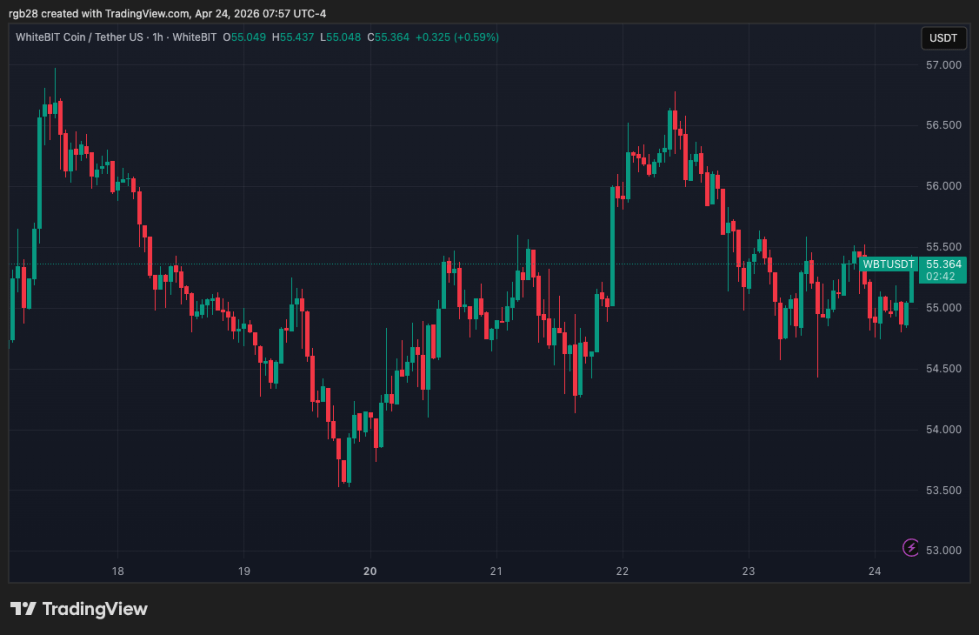
WBT's performance in the one-week chart. Source: WBTUSDT on TradingView


Perguntas relacionadas

QWhat is the duration of the renewed partnership between WhiteBIT and FC Barcelona?

AThe renewed partnership between WhiteBIT and FC Barcelona is for an additional 5 years, extending their alliance until 2030.

QWhich specific teams within FC Barcelona will WhiteBIT have an expanded role with following the partnership extension?

AFollowing the partnership extension, WhiteBIT will have an expanded role across FC Barcelona’s men’s first team, women’s team, and basketball team.

QWhat is the name of the FC Barcelona-themed product that WhiteBIT will introduce for its users?

AWhiteBIT will introduce an FC Barcelona-themed design for its WhiteBIT Nova debit card.

QWhat is one of the key goals of the strategic alliance between WhiteBIT and FC Barcelona, as stated in the announcement?

AOne of the key goals of the alliance is to make cryptocurrencies a practical, everyday tool for millions of fans and to develop real-world crypto applications designed to scale across the sports industry.

QWhat promotional activity is WhiteBIT running in relation to the El Clásico match in May 2026?

AWhiteBIT is running a promotion to give away 52 Spotify Camp Nou tickets for the El Clásico on May 10, 2026, where users must complete a series of actions on the exchange between April 24 and May 4 for a chance to win.

Leituras Relacionadas

Will the Next Crypto Bull Run Start with On-Chain Trading of SpaceX?

This article presents a scenario-based forecast for the crypto industry from 2026 to 2029, arguing that the next major cycle will be driven not by technological narratives but by legal access to real-world assets. The author predicts that by mid-2026, pre-IPO perpetual contracts for top private companies like SpaceX, OpenAI, and Anthropic on platforms like Hyperliquid will become the primary gateway for accessing quality assets, as most crypto-native tokens fail to capture real value. The much-hyped AI x Crypto intersection largely fails except for prediction markets, which thrive on betting on AI model supremacy. By 2027, public blockchain foundations are forced to choose between catering to retail speculation or building compliant infrastructure for institutions, with many opting for the latter. Growth in stablecoins and tokenized private credit/equity hits a "triple ceiling" due to regulatory and political uncertainty rather than market demand. The pivotal shift is forecast for 2028. A major liquidation event in pre-IPO perpetuals exposes the structural flaw of synthetic markets lacking a real underlying asset anchor. In response, regulatory changes finally allow the public solicitation of private securities resales to verified accredited investors. This creates a legitimate secondary market for real company equity, which then becomes the core asset class of the new bull market, relegating synthetic perps to a niche role. By 2029, the industry becomes "boring" but foundational. Tokens without claims on real cash flows or assets cease trading. Stablecoin growth is steady but politically capped. Crypto infrastructure fades from view as it gets absorbed into traditional finance backends. The article's central thesis is that the key bottleneck for crypto's next phase is legal and regulatory channels for real asset ownership, not technology.

marsbitHá 22m

Will the Next Crypto Bull Run Start with On-Chain Trading of SpaceX?

marsbitHá 22m

The Value Distribution of Stablecoins

**Summary: The Value Distribution of Stablecoins** The article argues that stablecoins are evolving from mere trading tools into broader channels for dollar access. It divides the stablecoin ecosystem into four layers to analyze how value is distributed: 1. **Issuance Layer:** Mints stablecoins, holds reserve assets, and captures the spread between reserve yield and user costs (e.g., Tether, Circle). This layer currently earns the largest profit margin. 2. **Infrastructure Layer:** Connects stablecoins to the traditional financial system, handling fiat on/off-ramps, banking integration, compliance (KYC/AML), and asset management (e.g., Bridge, BVNK). This is the "unglamorous" but critical work, building the essential bridges between crypto and real-world finance. 3. **Acquiring/Distribution Layer:** Integrates stablecoins into merchant systems, manages payment flows, and provides enterprise financial software (e.g., Stripe, Coinbase). They act as the access point for businesses. 4. **Application Layer:** The end-users and businesses that ultimately use stablecoins for payments, settlements, or as a store of value. They benefit from convenience but have little pricing power. The core thesis is that while the issuance layer currently dominates profits, the often-overlooked **infrastructure layer holds significant long-term potential**. The real challenge and barrier to mass adoption is not the on-chain transfer of stablecoins (which is simple), but the complex "last mile" integration into existing business workflows, banking systems, and regulatory frameworks across different countries. Companies in this layer are currently in a "land grab" phase, investing heavily to build networks, secure bank partnerships, and establish compliance pathways. While their position is currently pressured by the profitable issuers above and distribution platforms below, the article suggests that if stablecoins become a default financial rail for businesses, the infrastructure providers who have done the hard work of integration will ultimately gain strong pricing power and become entrenched, essential players.

marsbitHá 7h

The Value Distribution of Stablecoins

marsbitHá 7h

The Value Distribution of Stablecoins

The Value Distribution of Stablecoins The article argues that stablecoins are evolving from a mere trading tool into a broad "dollar channel." It analyzes the industry's value chain through four layers: 1. **Issuance Layer (e.g., Tether, Circle):** The top layer that mints stablecoins, holds reserve assets, and captures the thickest interest rate spread. 2. **Infrastructure Layer (e.g., Bridge, BVNK):** Connects stablecoins to the traditional financial system, handling critical but complex "dirty work" like fiat on/off-ramps, banking integration, compliance (KYC/AML), and cross-border settlement. 3. **Acquiring/Distribution Layer (e.g., Stripe, Coinbase):** Embeds stablecoins into merchant systems, manages payment flows, and integrates with enterprise software. 4. **Application Layer:** End-users and businesses that ultimately use stablecoins for payments, settlement, or storing value. The author posits that while the issuance layer currently captures the most profit, the most overlooked and potentially critical layer is infrastructure. The core challenge for stablecoin adoption isn't the on-chain transfer (which is simple), but bridging the gap between blockchain and the real-world financial system. This involves solving practical problems for businesses: fiat conversion, reconciliation, tax handling, and user onboarding. Infrastructure companies are currently in a difficult "land-grab" phase—building networks, securing banking relationships, and achieving compliance country-by-country. They face pressure from both the profitable issuance layer above and distribution platforms below. However, the author suggests this layer is building a crucial moat. Once stablecoins become a default business rail, the infrastructure players who have done the hard work of integration may gain significant, durable value and pricing power.

链捕手Há 7h

The Value Distribution of Stablecoins

链捕手Há 7h

Trading

Spot
Futuros
活动图片