VISA Steps Up Stablecoin Settlement Efforts, The Path for Crypto Payments Becomes Increasingly Clear

marsbitPublicado em 2026-05-19Última atualização em 2026-05-19

Resumo

VISA continues to expand its global pilot for stablecoin settlement, adding support for five more blockchain networks (Arc, Base, Canton, Polygon, Tempo) to bring the total to nine. More significantly, the program's annualized settlement volume has grown 50% quarter-over-quarter to $7 billion. This move highlights a key shift: stablecoins are increasingly being integrated not as a front-end consumer novelty but as a foundational infrastructure for back-end settlement between issuers, acquirers, and the payment network itself. Against a backdrop where many Web3 narratives have lost momentum, crypto payments stand out due to their tangible utility. The core value proposition is clear: enabling faster, cheaper, and more accessible value transfer, especially for cross-border business, payroll, and B2B transactions. Stablecoins like USDC and USDT have evolved into a de facto on-chain dollar network, creating sustained demand for related payment, exchange, and compliance services. While major players like VISA are building the underlying networks, opportunities remain for specialized service providers in areas like cross-border payments for e-commerce, payroll for Web3 companies, or fiat on/off-ramps for exchanges. However, this growing legitimacy also raises the regulatory bar. Touching monetary flows inevitably attracts scrutiny regarding licensing, KYC/AML, and the precise classification of activities (e.g., custody, money transmission). Success in this increasingly defined se...

Original Author: Lawyer Shao Jiadin

This article discusses global trends in crypto payments and stablecoin settlement, with a primary focus on observing entities such as Visa and other overseas payment institutions, overseas stablecoin payment infrastructure, and relevant international regulatory frameworks. The terms "crypto payments," "stablecoin payments and receipts," "U Cards," etc., mentioned herein, are not targeted at the Chinese mainland market and do not constitute advice for Chinese mainland residents to participate in virtual currency transactions, payments, investments, or related activities. The Chinese mainland has clear regulatory requirements for virtual currency-related businesses. Relevant institutions and individuals should strictly comply with current laws, regulations, and supervisory policies.

Visa recently added more fuel to the crypto payments industry. On April 29, 2026, Visa announced the continued expansion of its global stablecoin settlement pilot, adding 5 new blockchain networks. This brings the total number of blockchains supported in its stablecoin settlement pilot to 9. Concurrently, Visa disclosed that the annualized stablecoin settlement volume for this pilot has reached $70 billion, representing a 50% increase compared to the previous quarter.
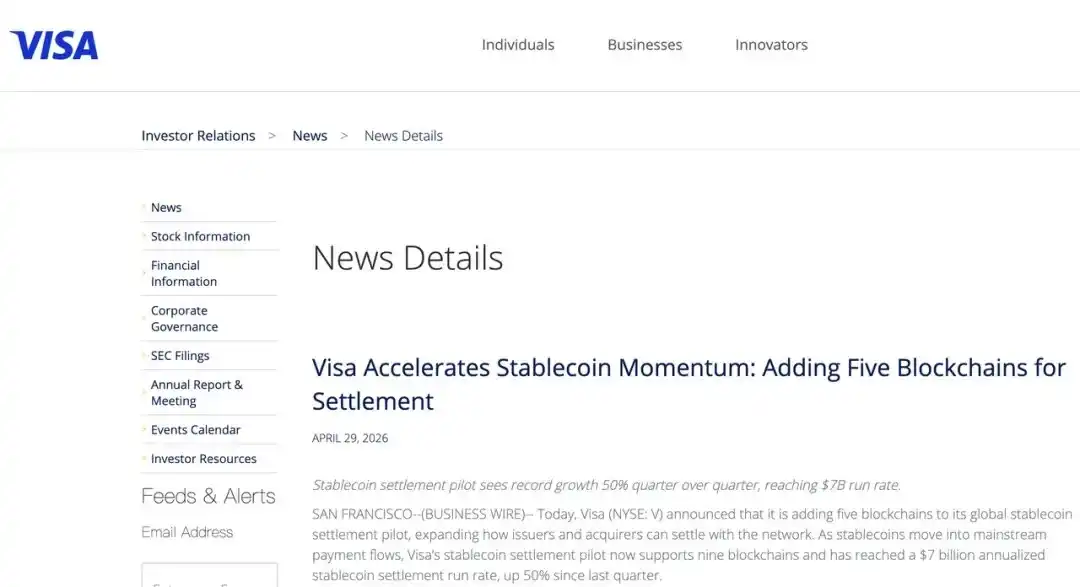
The image above is from the VISA official website.

If you view this news simply as "Visa is also doing stablecoins," you're missing the depth. Visa didn't just start experimenting with stablecoin payments now. It has long been conducting pilots around USDC, issuers, acquirers, and on-chain settlement. As early as January this year, Reuters reported that Visa was integrating stablecoins into its existing payment systems and had initiated a pilot in the US allowing some banks to use USDC to settle with Visa. At that time, the disclosed annualized stablecoin settlement volume was approximately $4.5 billion.

Therefore, what's truly noteworthy this time is not that Visa "suddenly embraced stablecoins," but rather that it is persistently increasing its investment, and this investment is not focused on front-end hype but on the more foundational settlement layer of the payment network. This indicates that crypto payments are evolving from being a product story within the Web3 circle into a direction for infrastructure that traditional payment giants are seriously investing in.

In today's market where many Web3 narratives are no longer captivating, this shift is ironically more worthy of a serious look from entrepreneurs and investors.

Visa Continues to Double Down, Stablecoin Settlement Is No Longer Just an Experiment

Many Web3 news stories generate buzz for a few days and then fade away. A strategic partnership today, an ecosystem partner tomorrow, a technical integration the day after. They all sound significant, but when it comes to actual business operations, nothing may have happened.

This Visa news is different. Because it's not a one-off PR piece, but a continuation of an ongoing effort. The new blockchains Visa added support for include Arc, Base, Canton, Polygon, and Tempo. Combined with the previously supported Avalanche, Ethereum, Solana, and Stellar, this forms a stablecoin settlement pilot network across 9 chains.

The signal behind this is clear: Visa is not betting on a single chain, nor is it conducting a one-time experiment. It is building a multi-chain settlement network. More crucially, the scenario Visa emphasizes this time is not "users spending stablecoins," but issuer/acquirer settlement—the settlement arrangements between card issuers, acquirers, and the Visa network. This is particularly interesting. Front-end payments are often easily packaged as marketing stories, but back-end settlement is difficult to sustain on concepts alone. Questions like cost reduction, efficiency improvement, transaction transparency, risk management, and acceptance by financial institutions are unavoidable.

If stablecoins remain solely within exchanges, they are just liquidity tools for the crypto asset market. But when stablecoins enter the settlement layer of payment networks, they begin to transform into financial infrastructure. This is the most noteworthy aspect of Visa's latest move. It's not about revisiting the question "Can stablecoins be used for payments?" but rather a mainstream payment network answering in its own way: stablecoins can become a complementary settlement tool for traditional payment systems. This answer carries more weight than any self-promotion from Web3 projects.

Many Web3 Stories Are Hard to Tell, But Payments Still Hold Up

There is a noticeable change in the Web3 industry today: many stories are hard to tell. Layer-1 chains are too competitive, DeFi is too old, NFTs are too cold, GameFi is too abstract, and AI + Crypto often feels like conceptual stitching. The era where a grand narrative, a polished whitepaper, or an ecosystem fund alone could sustain market expectations is at least not as easy as it once was.

But payments are different. Payments are not a story; payments are cash flows.

A foreign trade company needing to receive payments from overseas clients—that's not a narrative.

A Web3 company paying its global employees—that's not a narrative.

An exchange managing local on-ramps and off-ramps—that's not a narrative.

An RWA project handling investor subscriptions and redemptions—that's not a narrative.

A wallet connecting users' stablecoin balances to real consumption scenarios—that's not a narrative either.

These are all real business needs that occur daily.

This is also why crypto payments are actually more worth watching today. They may not be the sexiest, but they are closest to money; they may not be the easiest to weave myths around, but they are the easiest to generate revenue from; they may not excite the market overnight, but they can attract daily use from customers.

The challenge for many Web3 projects is: Why must users use you?

But the logic of payment business is more direct: as long as you can make money move faster, cheaper, more stably, and more accessibly, there is business value. This value doesn't require much imagination.

Issues like high cross-border payment costs, slow arrival times, lengthy banking chains, weekend and holiday uncertainties, account freezing risks, and insufficient financial infrastructure in emerging markets have always existed. Stablecoins are not a panacea, but they do provide a new path for value transfer.

Therefore, Visa continuing to invest in stablecoin settlement is not an isolated event. It simply makes a prevailing trend more evident: stablecoin payments are transitioning from "crypto circle tools" to "payment infrastructure."

Why Crypto Payments Remain One of the Few Directions Still Worth Investing In

Crypto payments are worth pursuing not because they are new, but because they are practical. This statement might sound underwhelming, but it's important.

Many Web3 startups today are still searching for "the next narrative," but payments don't need to be invented as a new narrative. Business receipts, user payments, merchant settlement, platform profit sharing, cross-border remittances, stablecoin on-ramps/off-ramps, RWA subscription/redemption—these scenarios already exist. Crypto payments simply recombine stablecoins, wallets, on-chain transfers, fiat channels, payment networks, and compliance systems to make cash flows operate in a new way.

This sector has at least three reasons that warrant continued investment.

The first reason is that demand is sufficiently real.

Regardless of market bull or bear cycles, businesses need to receive, pay, and settle funds. Especially in cross-border scenarios, the traditional banking system isn't always cheap, fast, stable, or friendly. For SMEs, cross-border e-commerce sellers, Web3 teams, freelancers, overseas service providers, and users in emerging markets, stablecoin payments are no longer an abstract concept but a tangible alternative.

The second reason is that stablecoins have effectively formed a de facto on-chain dollar network.

Stablecoins like USDT and USDC have long ceased to be mere pricing tools within exchanges. They are becoming the dollar liquidity tool for many on-chain applications, cross-border transactions, capital flows in emerging markets, and Web3 corporate operations. As long as stablecoins continue to be used, there will be demand for related services around their payment, exchange, custody, settlement, risk control, and compliance.

The third reason is that the entry of giants won't eliminate entrepreneurial opportunities; instead, it will mature the market.

Institutions like Visa, Mastercard, Circle, and Stripe are more adept at building underlying networks, establishing clearing standards, serving large institutional clients, and forming global partnerships. However, for specific countries, industries, clients, and scenarios, numerous mid-layer and application-layer service providers are still needed.

Some will work on U Cards, some on merchant acquiring, some on corporate wallets, some on OTC channels, some on stablecoin on-ramps/off-ramps, some on cross-border B2B payments, some on RWA subscription/redemption, some on on-chain payroll, some on payment APIs, some on stablecoin clearing networks.

These directions may seem different, but at their core, they all revolve around one question: how to enable stablecoins to complete receipt, payment, exchange, and settlement in the real business world.

The future of the crypto payments industry likely won't be winner-takes-all but rather a multi-layered structure: the bottom layer consists of stablecoin issuers, blockchains, and clearing networks; the middle layer comprises licensed payment institutions, issuers, acquirers, and liquidity providers; the top layer includes wallets, merchants, enterprise clients, industry-specific scenarios, and user interfaces.

Startups don't necessarily need to operate at the very bottom layer but can go deep within a specific region, customer type, or scenario. For example, specializing in stablecoin payment services for cross-border e-commerce sellers; payroll and expense reimbursement for Web3 companies; subscription and redemption services for RWA projects; wallet on-ramp/off-ramp services for exchanges; stablecoin settlement for foreign trade enterprises; or stablecoin-to-fiat liquidity management for high-net-worth clients.

These are not purely narrative-driven businesses. As long as they solve real client cash flow problems, there is room for charging fees. In this current phase where the overall Web3 industry narrative is cooling down, crypto payments have ironically become one of the few directions with increasing certainty due to real demand, investment from giants, and regulatory co-option. Hype may fade, but cash flows won't disappear.

The More Promising the Sector, the Less Room for Unregulated Approaches

However, crypto payments is not a sector that can be sustained long-term through unregulated approaches. The reason is simple: it deals with money. Once you touch money, you inevitably touch regulation.

Even within "stablecoin payments," some models might constitute only technical services, while others may already fall under virtual asset services, money transmission, currency exchange, merchant acquiring, or even trigger regulations for stored value facilities, e-money, or payment institutions.

The most typical example is U Cards. Many assume U Cards are just "users top up with U, then swipe to spend." But when broken down, numerous questions arise: Who issues the card? Who holds the user's stablecoins? Who completes the stablecoin exchange? What exactly is the nature of the user's balance? What does the merchant receive? Who bears refunds and chargebacks? Who is responsible for KYC? Which country's users cannot be served? Can the app be listed in local stores?

The same applies to merchant stablecoin receipt. If a platform merely provides a plugin, the risk is relatively limited. But if the platform helps merchants receive stablecoins, aggregate funds, exchange them for local fiat currency, and then transfer to the merchant, it's no longer simple technical service. It may simultaneously involve custody, exchange, payment settlement, and merchant acquiring.

Therefore, the increasing certainty of crypto payments does not mean lower barriers to entry.

On the contrary, the more established the sector, the more serious regulation becomes; the more giants participate, the harder it is for unregulated approaches to survive.

If you genuinely want to enter this sector, you can't just focus on products and channels. You must first clarify the business structure: Are you operating a wallet, an exchange service, a remittance service, an acquirer, an issuer, a clearinghouse, a custodian, or a technical service? Which part of the cash flow do you control? Which entity contracts with users? Which partners bear the licensed obligations? Which countries can you serve, and which must you block? How should user agreements, risk disclosures, AML policies, and on-chain risk controls be embedded into the business process? These are not formalities; they are part of the business model.

When engaging in crypto payments today, the biggest fear isn't lack of opportunity. The biggest fear is seeing the opportunity, building the product, only to realize you've been operating the business under a flawed structure from day one. Visa's moves indicate the road for stablecoin payments is widening. But a wider road doesn't mean you can drive with your eyes closed.


Perguntas relacionadas

QWhat is the main significance of Visa expanding its stablecoin settlement pilot program, according to the article?

AThe main significance is not that Visa is newly embracing stablecoins, but that it is deepening its commitment by focusing on the core settlement layer of the payment network, not just front-end features. This shift signals that stablecoin payments are evolving from niche Web3 concepts into a serious infrastructure direction being integrated by traditional financial giants. The pilot's growth to a $7 billion annualized settlement volume and support for 9 blockchains indicates a move towards building a multi-chain settlement network as a complementary tool to traditional payment systems.

QWhy does the article argue that the crypto payment sector remains a viable investment direction despite a cooling Web3 narrative?

AThe article argues crypto payment remains viable for three key reasons: 1) It addresses real, persistent needs like cross-border business payments, payroll, and fund settlement that exist regardless of market cycles. 2) Stablecoins like USDT and USDC have formed a de facto on-chain dollar network, creating ongoing demand for related services. 3) The entry of major players like Visa helps mature the market, creating opportunities for specialized middle and application-layer service providers in specific regions, industries, or use cases (e.g., cross-border B2B, payroll, merchant acquisition). Its value is based on utility—enabling faster, cheaper, and more accessible value transfer—rather than speculative narratives.

QWhat specific area of the payment process is Visa focusing on with its stablecoin pilot, and why is this noteworthy?

AVisa is focusing on the issuer/acquirer settlement layer, which is the backend arrangement between card-issuing banks, merchant-acquiring banks, and the Visa network itself. This is noteworthy because front-end payment features can often be marketing stories, but the settlement layer involves core infrastructure dealing with cost reduction, efficiency, transaction transparency, and risk management. By targeting this foundational layer, Visa demonstrates a serious, operational commitment to integrating stablecoins as a financial infrastructure tool within the traditional payment ecosystem.

QAccording to the article, what is a major risk for companies entering the crypto payment space without proper preparation?

AA major risk is operating with an incorrect or non-compliant business structure from the start. Since crypto payments involve handling money, they inevitably attract regulatory scrutiny. Companies must clearly define their role—whether as a wallet, exchanger, money transmitter, payment processor, or technical service provider—and understand the corresponding licensing and compliance obligations (e.g., KYC, AML) in different jurisdictions. The article warns that as the sector gains legitimacy and attracts giants, regulatory oversight intensifies, making unsustainable for 'wild' or unlicensed approaches to survive long-term.

QHow does the article contrast the current state of crypto payment with other Web3 sectors like DeFi or GameFi?

AThe article contrasts them by highlighting utility versus narrative. Many Web3 sectors like DeFi, GameFi, or AI+Crypto are seen as struggling with cooling narratives, being overly conceptual, or lacking sustained user demand. In contrast, crypto payment is not primarily a 'story' but is driven by real-world capital flow needs—businesses collecting payments, platforms handling settlements, individuals making cross-border transfers. Its value proposition is based on solving practical problems of speed, cost, and access in moving value, making it less dependent on speculative hype and more on daily, tangible use.

Leituras Relacionadas

After Three Consecutive Quarters of Decline, Can the Crypto Market Find a Window for Stabilization in Q3?

The cryptocurrency market has just concluded its worst-performing quarter since 2022, with total capitalization dropping 12.6% to $2.1 trillion. All core metrics indicate capital is leaving the sector, not just rotating within it. Bitcoin fell 14.2% and Ethereum dropped 25.4% in Q2, breaking their previous correlation with US tech stocks. A key driver is the reversal in US spot Bitcoin ETF flows, which saw a net outflow of approximately $4.67 billion in Q2, including a record monthly outflow near $4.5 billion in June. While recent data suggests long-term holders are accumulating again, sustained ETF outflows mean continued selling pressure. Market focus is now singularly on the Federal Reserve. The upcoming July FOMC meeting is seen as the most critical event for Q3. A dovish signal could support Bitcoin reclaiming a $68,000-$84,000 range, while a hawkish stance might establish a new trading band around $50,000-$56,000. Additionally, regulatory uncertainty persists, with the progress of the crucial *CLARITY Act* stalling in the Senate, reducing its perceived 2026 passage probability to 40-45%. Despite the broad downturn, a few sectors showed growth. Prediction markets saw nominal volume surge 48.7% year-over-year to $113.8 billion, and tokenized collectibles transaction volume rose 143% quarterly to $1.4 billion. The Real-World Asset (RWA) tokenization sector also continued steady growth, now representing ~$28.1 billion in on-chain value. The market's foundation for an extreme crash appears limited, with Bitcoin price hovering near its 200-week moving average. However, the trading paradigm has shifted from narrative-driven speculation to decisions based on price action, policy developments, and interest rate expectations, making a broad sentiment-driven rally unlikely in the near term.

marsbitHá 2h

After Three Consecutive Quarters of Decline, Can the Crypto Market Find a Window for Stabilization in Q3?

marsbitHá 2h

BIT Trading Moment: BTC Still Suppressed by Weekly 200 EMA, Rejection May Restart Decline; Storage and Semiconductors that Surged Last Night Begin Falling in Evening Trading

**Crypto & Stock Market Wrap: Bitcoin Tests Resistance, Stocks Retreat After AI Surge** Bitcoin consolidates around $66,000, facing key resistance near $68,000—an area seen as a major psychological and technical hurdle where previous rallies have failed. Analysts note the cryptocurrency is caught between its 200-week moving average (~$63,333) and 200-week EMA (~$68,328). A clear break above $68k is needed to signal a stronger bullish trend, while a rejection could lead to a retest of $63k support. Market sentiment remains cautious, with low futures open interest pointing to a low-liquidity rebound rather than a full bull market. Bitcoin spot ETFs saw another $203 million inflow. US stock futures pointed lower after a strong Tuesday session led by a massive rebound in semiconductors and memory stocks. The rally was fueled by renewed optimism about AI-driven hardware demand, with Micron, SanDisk, and SK Hynix surging. However, those gains reversed in pre-market trading. Super Micro Computer (SMCI) soared over 20% after hours on strong guidance and a record backlog. Other standouts included Rocket Lab and nuclear energy plays Oklo and X-Energy. Rising oil prices (Brent above $91) and climbing Treasury yields (10-year near 4.64%), however, are reigniting inflation concerns and acting as a headwind for equities. In Asia, markets were mixed. South Korea's KOSPI pared early gains to close slightly higher as semiconductor stocks like SK Hynix gave back initial surges. Japan's Nikkei edged lower as the yen hit a fresh 38-year low against the dollar, raising fears of potential market intervention. Key events to watch include the Samsung Galaxy launch, AMD's AI event, and a slew of major tech earnings from Alphabet, Tesla, and IBM after the close on Wednesday, followed by the ECB meeting and Intel's earnings on Thursday.

marsbitHá 3h

BIT Trading Moment: BTC Still Suppressed by Weekly 200 EMA, Rejection May Restart Decline; Storage and Semiconductors that Surged Last Night Begin Falling in Evening Trading

marsbitHá 3h

Former CFTC Chairman, Circle President Tarbert: Preaching Long-Termism While Cashing Out $30 Million Himself

Former CFTC Chairman and Circle President Heath Tarbert has consistently advocated for a long-term vision in public, urging patience from investors as Circle’s stock price has fallen significantly from its peak. However, it has been revealed that since Circle’s IPO, Tarbert has continuously sold his CRCL shares through pre-arranged trading plans, cashing out approximately $30 million, without making any public market purchases. This contrast between his public messaging and personal actions has drawn criticism. Tarbert joined Circle in July 2023 as Chief Legal Officer, leveraging his regulatory experience to help guide the company through its IPO and expansion. Despite promoting stablecoins as long-term infrastructure, he established a 10b5-1 trading plan just before Circle went public, leading to substantial stock sales over the following year. In March 2026, he initiated another plan to sell more shares. His career trajectory highlights a pattern of moving between high-level regulatory roles and influential positions in the financial sector. After resigning as CFTC Chairman in early 2021, he joined Citadel Securities as Chief Legal Officer just 27 days later, during a period of intense regulatory scrutiny for the firm. He later joined Circle, aiding its efforts to navigate regulatory challenges for its public listing. While Tarbert's expertise in policy and compliance is valuable to companies like Circle, his actions—advocating long-term confidence while personally divesting—raise questions about the alignment between his public statements and his private financial decisions, leaving investors who followed his advice to bear the market risks.

marsbitHá 3h

Former CFTC Chairman, Circle President Tarbert: Preaching Long-Termism While Cashing Out $30 Million Himself

marsbitHá 3h

Gate Research Institute: The 'Wall Street-ization' Wave of Crypto Financial Products – Competition or Integration?

The article titled "Gate Research Institute: Are Crypto Financial Products Sparking a 'Wall Street' Wave—Competition or Convergence?" explores the evolving relationship between the crypto ecosystem and traditional finance (TradFi). The piece begins by reflecting on Bitcoin's original 2009 vision of decentralization, disintermediation, and moving away from banks. It then contrasts this with the 2024 landscape, where key crypto assets like Bitcoin are increasingly held through Wall Street products like ETFs issued by giants like BlackRock. The article questions whether this signifies that TradFi is systematically taking over the rights to issue, price, custody, and distribute crypto financial assets. The core argument is that this is not a zero-sum takeover but rather a bidirectional convergence where each side addresses the other's weaknesses. Crypto offers 24/7 global markets, programmable settlement, and open access but lacks compliant channels, institutional-grade custody, deep fiat liquidity, and mainstream distribution. TradFi possesses these but is constrained by legacy systems, limited operating hours, and slow settlement. Two primary convergence paths are highlighted: * **Path A (CEX to TradFi):** Exemplified by Gate, which has progressed from offering tokenized stocks and CFDs to providing direct, real stock trading (US, Hong Kong, South Korea) within its platform, using USDT. * **Path B (TradFi to Crypto):** Exemplified by Robinhood, which has integrated crypto trading, acquired exchanges like Bitstamp, and is moving traditional assets like stocks onto the blockchain via tokenization and its own Layer 2. Both paths are ultimately competing to become the next-generation, unified financial account—a "super account" where users can seamlessly trade cryptocurrencies, stocks, ETFs, RWA (Real World Assets), and tokenized treasury products in one interface. The growth of RWA and tokenized treasuries (e.g., BlackRock's BUIDL) is presented as the asset-layer fusion, providing stable, yield-bearing assets on-chain and acting as a bridge between the two worlds. In conclusion, the "Wall Street-ization" of crypto is framed as a mutual transformation. Decentralized ideals persist in the protocol layer, while at the application layer, a more efficient, global, and accessible unified capital market is emerging from this convergence. The future competition lies not between crypto exchanges and stockbrokers, but between platforms vying to offer the most comprehensive asset coverage, liquidity, and user experience within a single account.

marsbitHá 3h

Gate Research Institute: The 'Wall Street-ization' Wave of Crypto Financial Products – Competition or Integration?

marsbitHá 3h

Trading

Spot
活动图片




