Visa Effect

marsbitPublicado em 2026-01-15Última atualização em 2026-01-15

Resumo

Visa Effect: A Blueprint for Stablecoin Network Growth The article draws parallels between the fragmented early days of the credit card industry and the current state of stablecoins. In the 1960s, numerous banks operated isolated payment networks, creating settlement chaos. Visa succeeded not just through technology, but by creating a cooperative, independent structure that aligned incentives. It acted as a neutral third party, allowing member banks to share profits proportionally, have governance rights, and initially adhere to exclusivity clauses. This fostered powerful network effects. Today, stablecoins face similar fragmentation, with over 300 stablecoins listed on Defillama. Services that enable protocols to issue their own branded stablecoins (e.g., Ethena, Anchorage Digital) are compared to the failed BankAmericard model, which only fractures liquidity and prevents any single stablecoin from achieving mainstream network effects. The proposed solution is a Visa-like model for stablecoins: an independent, third-party cooperative. Issuers and applications supporting a specific asset class would join, share in reserve yields, and have governance rights over the stablecoin's development. This structure would consolidate liquidity, create internal compounding network effects, and drive widespread adoption.

Author: Nishil Jain

Compiled by: Block unicorn

Preface

In the 1960s, the credit card industry was in chaos. Banks across the United States were trying to establish their own payment networks, but each network operated independently. If you held a Bank of America credit card, you could only use it at merchants that had a cooperation agreement with Bank of America. When banks tried to expand their business to other banks, all credit card payments encountered the problem of interbank settlement.

If a merchant accepted a card issued by another bank, the transaction had to be settled through its original check settlement system. The more banks that joined, the more settlement problems arose.

Then Visa emerged. Although the technology it introduced undoubtedly played a huge role in the credit card payment revolution, the more important success lay in its global universality and its success in getting global banks to join its network. Today, almost every bank in the world has become a member of the Visa network.

While this seems very normal today, imagine trying to convince the first thousand banks, both inside and outside the United States, that joining a cooperation agreement instead of building their own network was a wise move. Then you begin to realize the scale of this endeavor.

By 1980, Visa had become the dominant payment network, processing about 60% of credit card transactions in the United States. Currently, Visa operates in over 200 countries.

The key was not more advanced technology or more funding, but the structure: a model that could coordinate incentives, decentralize ownership, and create compound network effects.

Today, stablecoins face the same fragmentation problem. And the solution may be the same as what Visa did fifty years ago.

Experiments Before Visa

Other companies that appeared before Visa failed to develop.

American Express (AMEX) tried to expand its credit card business as an independent bank, but its scale expansion was limited to continuously adding new merchants to its banking network. On the other hand, BankAmericard was different; Bank of America owned its credit card network, and other banks only utilized its network effects and brand value.

American Express had to approach each merchant and user individually to open their bank accounts, while Visa achieved scale by accepting banks itself. Each bank that joined the Visa cooperative network automatically gained thousands of new customers and hundreds of new merchants.

On the other hand, BankAmericard had infrastructure issues. They did not know how to efficiently settle credit card transactions from one consumer bank account to another merchant bank account. There was no efficient settlement system between them.

The more banks that joined, the worse this problem became. Thus, Visa was born.

The Four Pillars of Visa's Network Effects

From the story of Visa, we learn about 2-3 important factors that led to the accumulation of its network effects:

Visa benefited from its status as an independent third party. To ensure that no bank felt threatened by competition, Visa was designed as a cooperative independent organization. Visa did not participate in competing for the distribution pie; the banks competed for it.

This incentivized participating banks to compete for a larger share of the profits. Each bank was entitled to a portion of the total profits, proportional to the total transaction volume it processed.

Banks had a say in the network's functions. Visa's rules and changes had to be voted on by all relevant banks and required 80% approval to pass.

Visa had exclusivity clauses with each bank (at least initially); anyone joining the cooperative could only use Visa cards and the network and could not join other networks—thus, to interact with Visa banks, you also needed to be part of its network.

When Visa's founder, Dee Hock, traveled across the United States to persuade banks to join the Visa network, he had to explain to each bank that joining the Visa network was more beneficial than building their own credit card network.
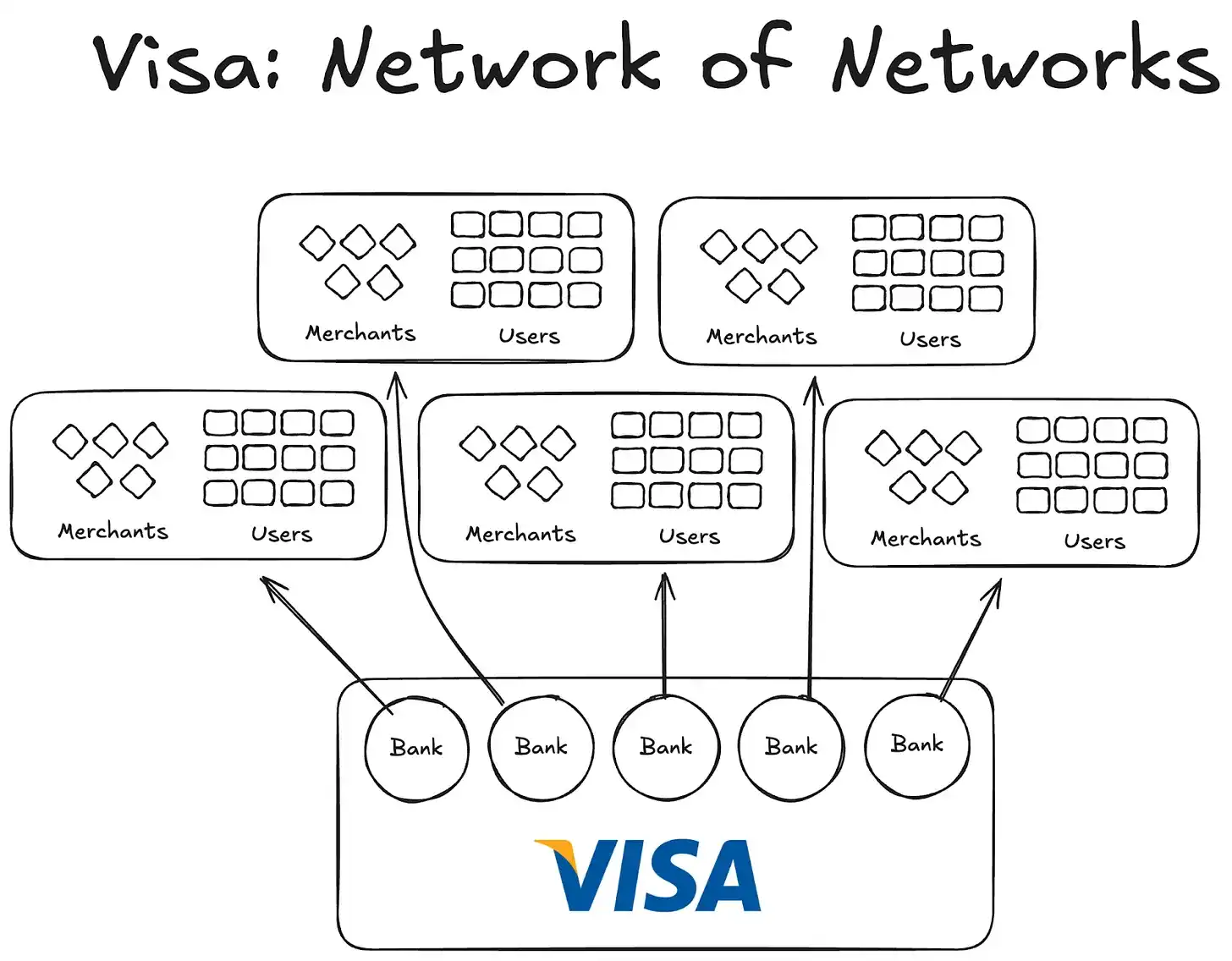
He had to explain that joining Visa meant more users and more merchants would be connected to the same network, which would promote more digital transactions globally and bring more benefits to all participants. He also had to explain that if they built their own credit card network, their user base would be very limited.

Implications for Stablecoins

In a sense, Anchorage Digital and other companies now offering stablecoin-as-a-service are replaying the BankAmericard story in the stablecoin space. They provide the underlying infrastructure for new issuers to build stablecoins, but liquidity continues to fragment into new tokens.

Currently, over 300 stablecoins are listed on Defillama. Moreover, each newly created stablecoin is limited to its own ecosystem. As a result, no single stablecoin can generate the network effects needed to go mainstream.

Since the same underlying assets support these new coins, why do we need more coins with new code?

In our Visa story, these are like BankAmericards. Ethena, Anchorage Digital, M0, or Bridge—each allows a protocol to issue its own stablecoin, but this only exacerbates industry fragmentation.

Ethena is another similar protocol that allows yield transmission and white-label customization of its stablecoin. Just like MegaETH issuing USDm—they issued USDm through tools that support USDtb.

However, this model failed. It only fragments the ecosystem.

In the credit card case, the brand differences between banks did not matter because it did not create any friction in user-to-merchant payments. The underlying issuance and payment layer was always Visa.

However, for stablecoins, this is not the case. Different token codes mean an infinite number of liquidity pools.

Merchants (or in this case, applications or protocols) will not add all stablecoins issued by M0 or Bridge to their list of accepted stablecoins. They will decide based on the liquidity of these stablecoins in the open market; the coins with the most holders and the highest liquidity should be accepted, while the rest will not.

The Way Forward: The Visa Model for Stablecoins
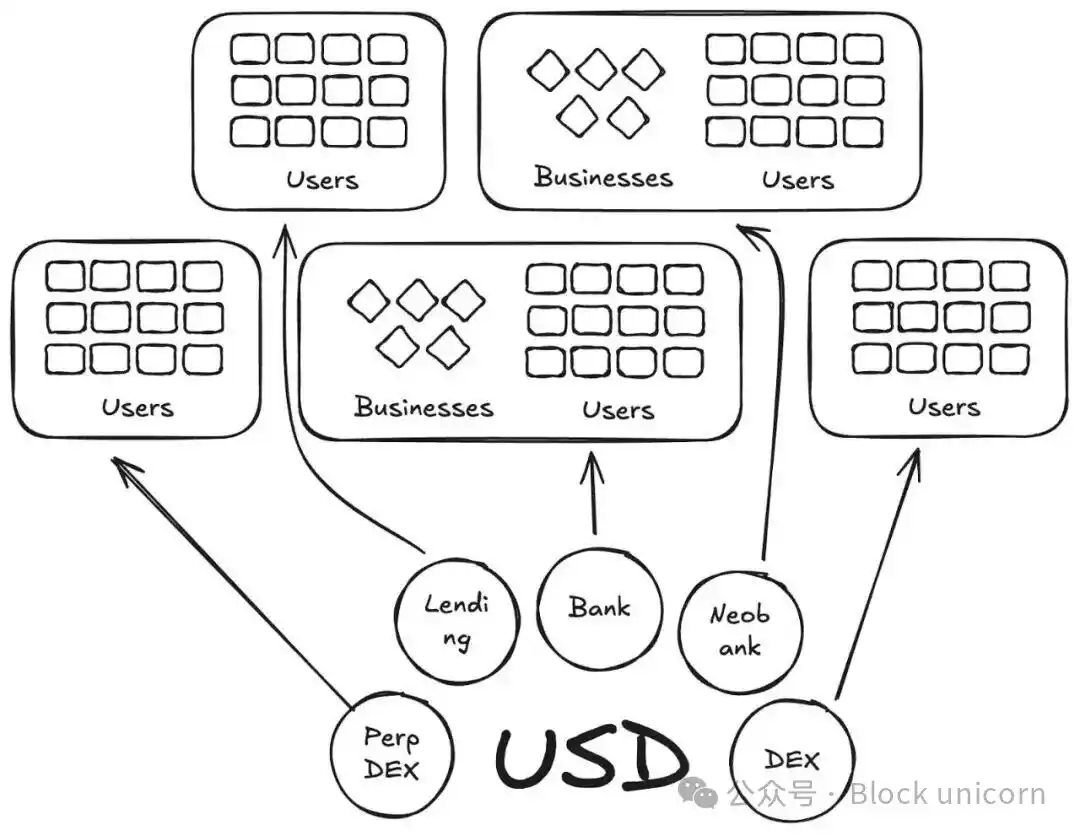
We need independent third-party institutions to manage stablecoins of different asset classes. Issuers and applications supporting these assets should be able to join cooperatives and access reserve earnings. At the same time, they should also have governance rights and be able to vote on the direction of their chosen stablecoin.

From a network effects perspective, this would be a superior model. As more issuers and protocols join the same token, it will facilitate the widespread adoption of a token that retains earnings internally rather than flowing into others' pockets.


Perguntas relacionadas

QWhat was the main challenge faced by the credit card industry in the 1960s, and how did Visa address it?

AThe main challenge was fragmentation, with each bank operating its own isolated payment network. Visa addressed this by creating a cooperative network that allowed banks to join and share infrastructure, enabling universal acceptance and efficient interbank settlement.

QHow did Visa's structure differ from competitors like American Express and BankAmericard, and why was it more successful?

AVisa operated as an independent, cooperative organization where banks shared ownership and governance, avoiding competition among members. In contrast, American Express acted as a single bank expanding alone, and BankAmericard had infrastructure issues with interbank settlement. Visa's model incentivized participation and scaled network effects more effectively.

QWhat are the key pillars of Visa's network effects as described in the article?

AThe key pillars are: 1) Visa's independent third-party status to avoid competition among banks, 2) Profit sharing proportional to transaction volume, 3) Governance through voting by member banks requiring 80% approval, and 4) Initial exclusivity clauses preventing members from joining other networks.

QHow does the current stablecoin landscape resemble the pre-Visa credit card era, and what problem does this create?

AThe stablecoin landscape is fragmented, with over 300 stablecoins on Defillama, each limited to its own ecosystem. This prevents network effects, causes liquidity fragmentation, and hinders mainstream adoption, similar to how isolated bank networks struggled before Visa.

QWhat solution does the article propose for stablecoins, inspired by Visa's model?

AThe article proposes an independent third-party cooperative for stablecoins, where issuers and applications join to share reserve yields and governance rights. This would unify liquidity, enhance network effects, and keep benefits within the ecosystem rather than fragmenting them.

Leituras Relacionadas

Should You Buy SpaceX Stock at $1.7 Trillion? Here's What the Market Is Worried About

SpaceX is preparing for a massive IPO aiming to raise around $75 billion at a valuation of approximately $1.75 trillion. While its achievements in reusable rockets and the profitable Starlink satellite internet service are clear, the market is concerned about the aggressive valuation. Key issues include: the current $1.75 trillion valuation, which is about 94 times 2025 revenue, seems to price in not just existing businesses but also unproven future ventures like AI infrastructure and orbital data centers. Financially, while Starlink is profitable, the AI division, bolstered by the acquisition of xAI, is incurring massive losses and consuming the majority of capital expenditures. This acquisition also introduced complex related-party financing arrangements and debt onto SpaceX's balance sheet. Furthermore, corporate governance poses a challenge. SpaceX's dual-class share structure ensures founder Elon Musk retains absolute control, limiting ordinary shareholders' influence over high-risk, long-term strategic decisions. The future success of ambitious projects like the Starship rocket—critical for lowering costs and enabling new services—remains a significant variable for the valuation. In summary, the market's apprehension (FUD) centers not on doubting SpaceX's past technological triumphs but on questioning how much premium public investors should pay for a future that combines proven profits with highly speculative and capital-intensive new ventures, all under a governance structure that offers limited shareholder oversight.

marsbitHá 41m

Should You Buy SpaceX Stock at $1.7 Trillion? Here's What the Market Is Worried About

marsbitHá 41m

Breaking the DeFi Cascading Liquidation Curse: Vitalik Proposes a New Solution

Vitalik Buterin has proposed a new DeFi design to eliminate the automatic liquidation mechanism that causes market instability during sharp downturns. The current system, used by protocols like Aave, triggers forced sales when collateral value falls below a threshold, often exacerbating price drops and creating systemic selling pressure. Buterin's alternative model is based on splitting an asset like ETH into two synthetic option-like tokens, P and N, pegged to a price index. Their combined value always equals one ETH. Instead of sudden liquidation, a position's value gradually drifts from its target peg if the market moves. Users must proactively rebalance their holdings to maintain their desired exposure, transferring the management burden from the protocol to the user or automated tools. A key advantage is the reduced reliance on real-time oracles. Pricing decisions are deferred until contract expiry, allowing for more robust, fault-tolerant oracle designs. This removes a clear liquidation threshold that speculators can target for manipulation or MEV extraction. However, significant challenges remain. Frequent rebalancing could incur high slippage and transaction costs, necessitating new liquidity provider models. The design is better suited for hedging instruments than for stablecoins requiring a rigid 1:1 peg. While not an immediate replacement for existing systems, the proposal challenges the foundational assumption that instantaneous forced liquidation is an unavoidable necessity in DeFi, opening the door for fundamentally different risk management architectures.

marsbitHá 45m

Breaking the DeFi Cascading Liquidation Curse: Vitalik Proposes a New Solution

marsbitHá 45m

The End of Single-Factor Cryptography

The article "The End of Single-Factor Crypto" posits a fundamental shift in the cryptocurrency ecosystem. It argues the era where crypto asset valuations were predominantly driven by, and correlated with, Bitcoin's price is ending. The space is bifurcating into two distinct economies: endogenous and exogenous. The endogenous economy represents traditional crypto, where token and project values are directly tied to crypto market prices. The emerging exogenous economy comprises projects and businesses that may utilize blockchain technology or tokens but derive their fundamental value from external, non-crypto factors like consumer demand, subscription revenue, or real-world utility. Examples include AI inference platforms like Venice, fintech lenders using blockchain for efficiency, and stablecoin/payment infrastructure companies acquired by giants like Mastercard and Stripe. This shift means investment analysis must change. For exogenous assets, evaluating traditional business fundamentals—such as revenue streams, unit economics, and competitive moats—becomes more critical than tracking Bitcoin charts. While endogenous assets like Bitcoin remain relevant, the growth of the exogenous category is driven by measurable demand independent of crypto price cycles, paving the way for a new, more diversified market phase. Consequently, crypto is evolving from a single-factor, reflexive asset class into a multifaceted ecosystem with varied drivers and investment theses.

marsbitHá 46m

The End of Single-Factor Cryptography

marsbitHá 46m

Morning Post | Bitmine Plans to Raise $300 Million Through Preferred Stock Issuance; Polymarket Accuses Kalshi of Commercial Espionage

ChainCatcher's Daily Crypto Brief: Key developments from the past 24 hours include significant funding moves, regulatory actions, and market predictions. Bitmine announced a $300 million preferred stock fundraising. Polymarket accused rival prediction platform Kalshi of corporate espionage, citing numerous suspicious coincidences in product launches, a claim Kalshi strongly denied. The U.S. Department of Justice, in a joint "Disruption Week" anti-fraud operation with companies like Coinbase and Meta, froze over $3.8 million in cryptocurrency linked to scams. In infrastructure news, Macau completed its integration with the multi-central bank digital currency bridge, mBridge, aiming to build efficient cross-border payment channels. Cosmos Labs acquired the block explorer Mintscan. Market-wise, Geoffrey Kendrick, Standard Chartered's Head of Digital Assets Research, stated Bitcoin is nearing a bottom around $63,000, maintaining a year-end target of $100,000. He noted stability in U.S. spot Bitcoin ETF holdings. Ahead of SpaceX's anticipated IPO, internal insiders at Rocket Lab (RKLB) sold over $18.41 million in stock. In tokenization, Goldman Sachs partnered with Apex and Archax to launch a tokenized real estate fund. The meme token tracker GMGN reported the top trending tokens: on Ethereum, HEX, SHIB, LINK, PEPE, mUSD; on Solana, TROLL, swarms, WORLDCUP, neet, Buttcoin; and on Base, PEPE, toby, ODDS, ELSA, SKI.

链捕手Há 1h

Morning Post | Bitmine Plans to Raise $300 Million Through Preferred Stock Issuance; Polymarket Accuses Kalshi of Commercial Espionage

链捕手Há 1h

Trading

Spot
Futuros
活动图片