VIRTUAL surges 12% as bulls align – But downside risk still lurks

ambcryptoPublicado em 2026-03-17Última atualização em 2026-03-17

Resumo

VIRTUAL surged 12% in 24 hours, driven by strong bullish sentiment across both spot and futures markets. Futures activity showed a positive funding rate of 0.0022%, with $12 million inflows boosting open interest to $102.42 million, indicating dominant long positioning. Spot market demand also accelerated sharply, with net purchases rising nearly tenfold from $72,000 to $697,140 within a day, reflecting growing investor confidence. However, liquidity clusters above and below the current price suggest potential downside risk, making near-term price direction dependent on sustained momentum.

VIRTUAL continues to gain strength as market sentiment shifts decisively in its favor. The asset recorded a 12% increase over the past 24 hours, reflecting growing bullish positioning.

AMBCrypto’s analysis highlights a rare alignment between Spot and Futures markets, with participants across both segments actively accumulating the asset.

Futures market drives capital inflow

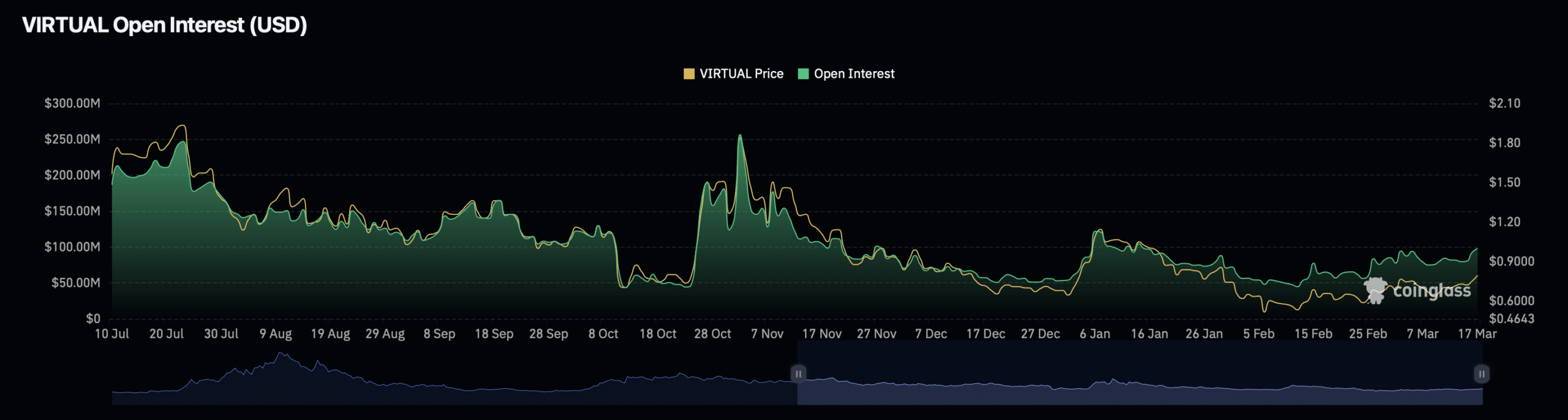
The recent surge in Virtual [VIRTUAL] has been largely fueled by bullish activity in the Futures market. This bias is reinforced by a positive Funding Rate of 0.0022%, indicating that long traders are paying a premium to maintain their positions.

In effect, long positions dominate capital flows into VIRTUAL contracts, signaling strong expectations of continued upside.
Source: CoinGlass

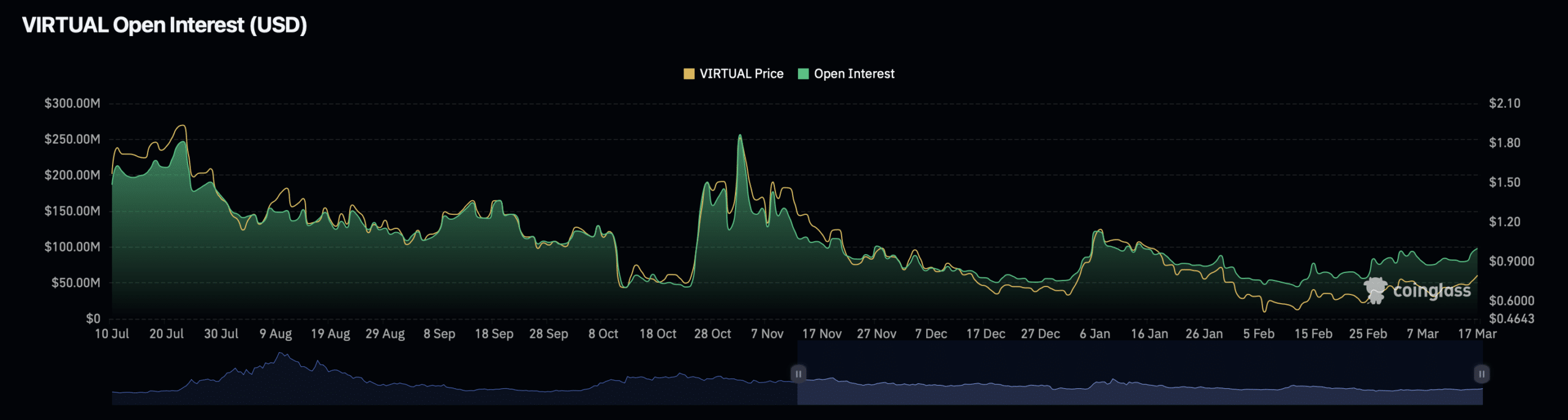
Within the last 24 hours, capital inflows totaled $12 million, pushing Open Interest to $102.42 million. This sharp increase reflects rising participation and conviction among derivatives traders.

With most of this capital concentrated in long positions, bullish momentum remains firmly intact—at least in the short term.

Spot demand strengthens conviction

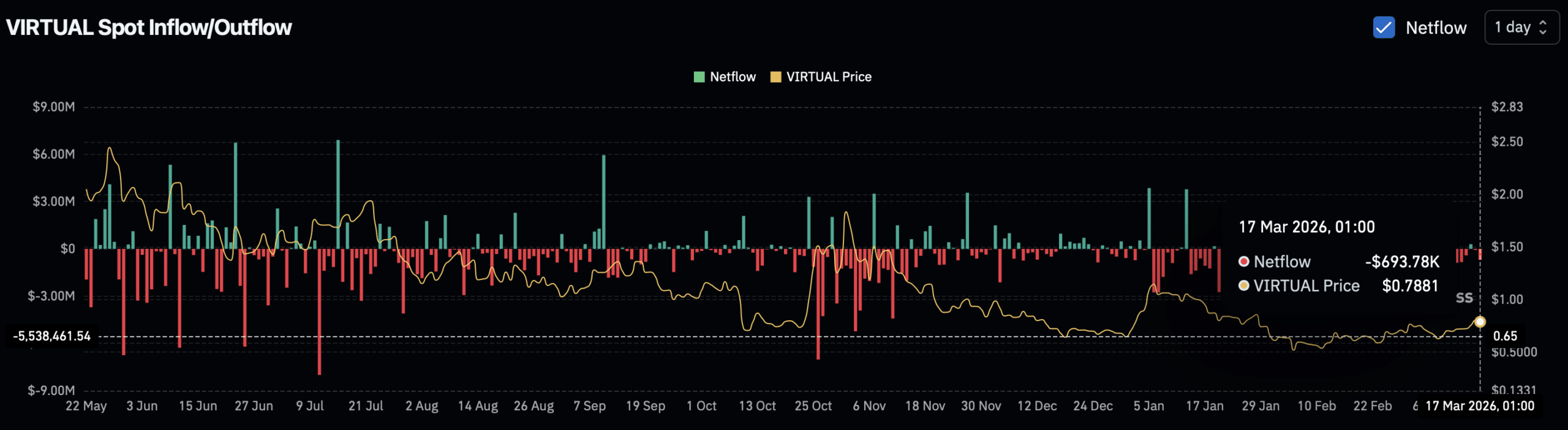
Spot market activity has also accelerated, reinforcing the broader bullish outlook. Accumulation began modestly on the 16th of March, with net inflows of just $72,000, according to CoinGlass data.

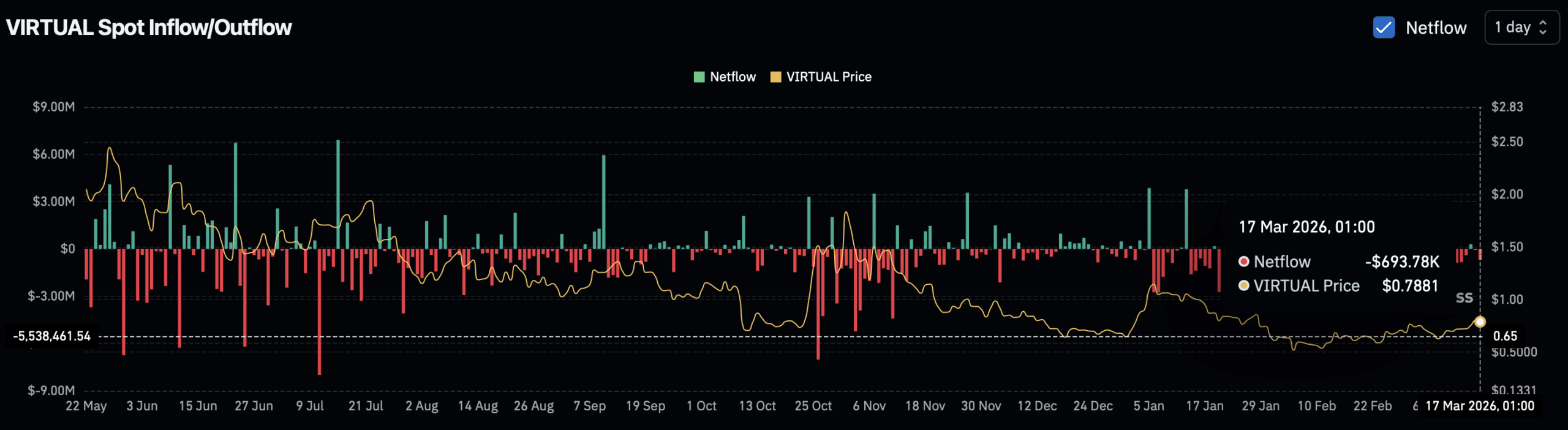
However, this quickly scaled. By the 17th of March, total purchases surged to $697,140—nearly ten times the previous day’s volume.
Source: CoinGlass

This sharp increase signals renewed investor confidence. When capital inflows expand at this pace, it typically reflects stronger conviction and a growing expectation of sustained price appreciation.

If this level of demand persists, it could provide the structural support needed to extend the rally. A slowdown, however, would weaken that foundation and expose the asset to downside pressure.

Liquidity clusters leave direction open

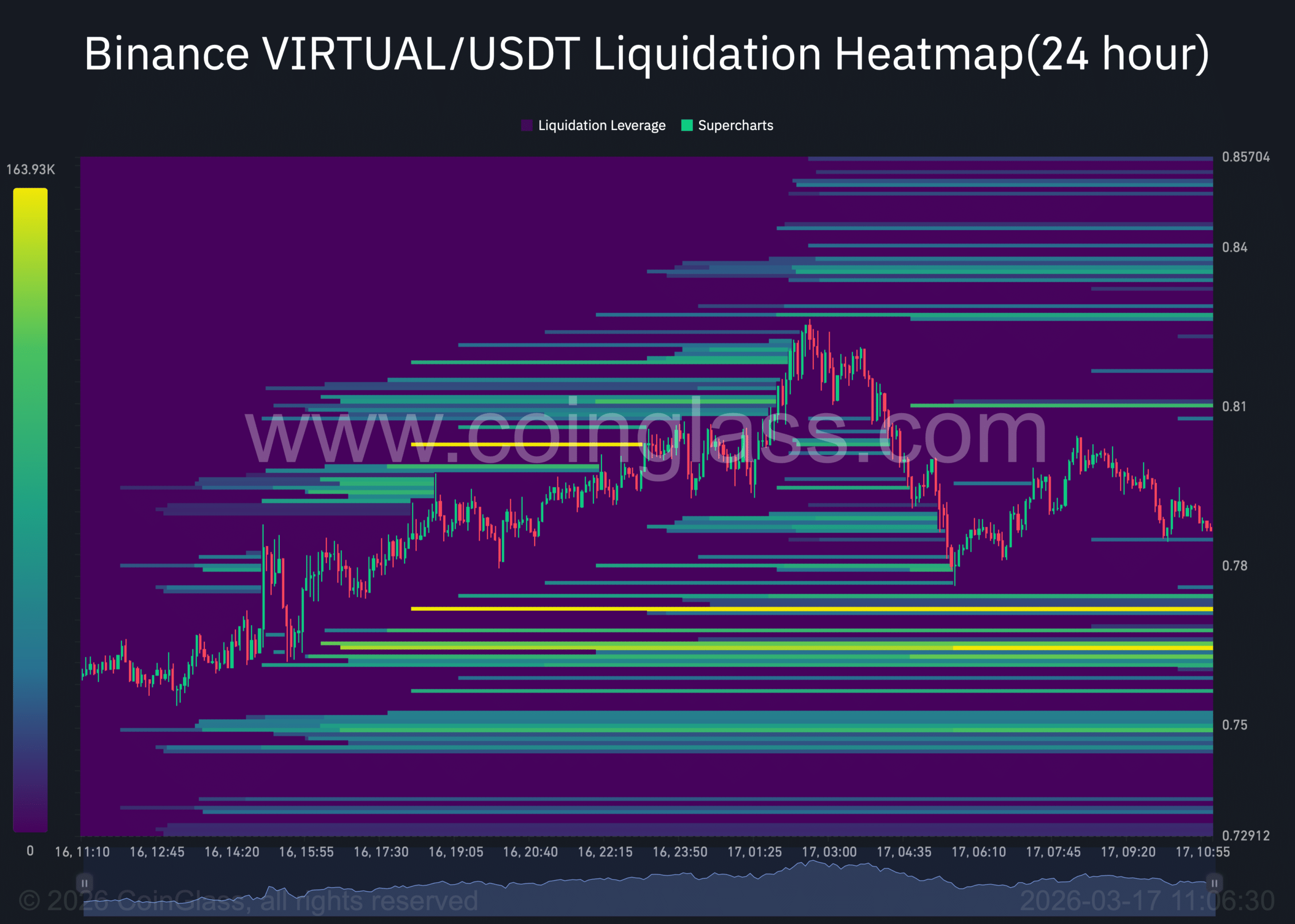
Despite the bullish buildup, liquidation data suggests the next move is not yet fully determined.

The heatmap shows liquidity clusters both above and below the current price. These clusters—visible as dense shaded zones—tend to attract price action.
Source: CoinGlass

While liquidity remains split, the clusters below price appear more concentrated, suggesting stronger downside pull.

This creates a balanced but fragile setup. As a result, the next phase of price action will depend heavily on momentum, with VIRTUAL likely to move toward the dominant liquidity zone in the near term.


Final Summary

  • VIRTUAL’s price rally and capital inflows were driven primarily by long traders in the perpetual market.
  • Spot investors intensified accumulation, with purchases rising nearly tenfold day-over-day.
Leituras Relacionadas

Can Generative Models Finally Be Trained End-to-End? The Core Is a For Loop

This article introduces a novel training paradigm for generative models called Explorative Modeling (XM), which enables true end-to-end training. Traditionally, powerful generative models like autoregressive and diffusion models are not trained end-to-end. They are trained to predict a single small step but require iterative multi-step sampling for inference. This "exposure bias" leads to error accumulation and limits performance. The core challenge XM addresses is "mode blurring." In generative tasks, a single input (e.g., "generate a dog") corresponds to many valid outputs (multiple modes). Standard training objectives like reconstruction loss force the model to average these modes, producing unrealistic, blurry outputs. To avoid this, existing models break generation into many small, almost deterministic steps, sacrificing end-to-end training. XM tackles this by restructuring the training loop itself. Its key insight is to amplify "generative expressivity." For each training input, instead of generating one sample, the model generates K candidate outputs. Only the candidate closest to the real data is used for computing the loss and updating the model via backpropagation. This simple "best-of-K" mechanism is implemented as a short for-loop. By exploring multiple possibilities, the model learns to distribute its guesses across different modes rather than collapsing to their uninformative average. The paper demonstrates that "exploration" acts as a new, powerful scaling axis. Gains from XM increase with model size, data scale, and compute. Experiments show improvements in FID scores for image generation and significant efficiency gains, sometimes outperforming larger models without exploration. When pushed to the limit, XM enables fully single-step, end-to-end generative models. In robotics tasks, an "Explorative Policy" matched the performance of a 100-step Diffusion Policy with a single forward pass, drastically improving inference speed. While the best-of-K concept is not entirely new, the authors' contribution lies in formally understanding it as a direct method to boost generative expressivity without fragmenting the generation process. This work suggests that as models scale, enhancing exploration during training may become crucial for overcoming fundamental performance bottlenecks.

marsbitHá 7m

Can Generative Models Finally Be Trained End-to-End? The Core Is a For Loop

marsbitHá 7m

Annual Salary of Millions Competing for Electricians, Meta Rushes to Open Its Own Technical School

The AI boom is facing an unexpected bottleneck: a severe shortage of skilled construction workers and electricians. As tech giants like Meta, OpenAI, and Alphabet race to build massive data centers—such as OpenAI's $16 billion "Stargate" project—they are hitting a critical labor wall. The U.S. needs an estimated 130,000 more electricians, 240,000 construction workers, and 150,000 supervisors by 2030 for AI infrastructure alone, but tens of thousands of electrician jobs go unfilled each year. While AI companies offer high premiums, with electricians earning up to $280,000 annually, worker scarcity still causes massive losses—delays on a single project can cost $14.2 million per month. The complexity of building AI data centers, which require immense power (equivalent to powering hundreds of thousands of homes), sophisticated electrical systems, and advanced liquid cooling solutions, demands highly skilled technicians who are in short supply. To combat this, companies are investing heavily in training. Meta has committed $115 million to a free training school offering tuition, housing, and stipends, targeting 5,000 new workers. OpenAI is partnering with unions to secure skilled labor. These efforts are paying off, with a significant rise in Gen Z interest in trade schools over college. However, the power demands are staggering. AI data centers are driving a rapid surge in electricity consumption, projected to account for up to 12% of U.S. power use by 2028 and raising costs for consumers. Furthermore, the construction boom is project-based, leading to a potential future glut of trained workers once building peaks, which could depress wages industry-wide. The race for AI supremacy now depends as much on skilled hands as on advanced chips.

marsbitHá 1h

Annual Salary of Millions Competing for Electricians, Meta Rushes to Open Its Own Technical School

marsbitHá 1h

Trading

Spot
活动图片