Author: Joe Zhou, Foresight News
Original Title: I Bought Seafood with USDT in Vietnam: Has Web3 Truly Achieved Mass Adoption?
Vietnam, a fascinating country repeatedly mentioned in countless Web3 research reports.
It boasts one of the world's youngest population structures, an extremely high mobile internet penetration rate, and a financial vitality that grows almost wildly. In the "Global Cryptocurrency Adoption Index" released by Chainalysis, Vietnam has consistently ranked at the top or near the top for many years.
As a long-time observer of the crypto industry, I have always wanted to figure out one question: when grand concepts like "crypto payments," "stablecoins," and "Mass Adoption" written in PPTs and research reports are actually deployed into the streets and alleys of Vietnam, what kind of chemical reaction will occur?
At the end of 2025, I set foot on this land. During my two weeks in Vietnam, I did not visit high-end exchanges or attend industry cocktail parties filled with clinking glasses. Instead, I acted as an ordinary tourist, taking taxis, getting massages, and eating at street stalls.
I recorded five small incidents from my journey. They may not represent the full picture, but they are the most authentic slices of Vietnam's current Web3 landscape.
One: 'No International Credit Cards, Cash and USDT Only'
At a SPA shop in Nha Trang, Vietnam, our group of 12 spent $320. When settling the bill, the merchant stated bluntly: a 10% discount for cash payment, full price for Visa or Mastercard.
I was initially displeased, as carrying large amounts of Vietnamese dong cash is inconvenient, and I suspected the owner might be "ripping off" familiar customers. But the owner's patient explanation cleared up my misunderstanding.
In Vietnam, international credit card fees are high, typically 3% or more. More importantly, using a card means funds enter the banking system, requiring additional tax payments, while cash can avoid these. From a very pragmatic small business owner's perspective, she explained her difficulties.
In the end, we paid with $300 cash. The owner paid less tax, and we saved dozens of dollars—a win-win. Of course, the losers were the credit card organizations and banks, the "middlemen."
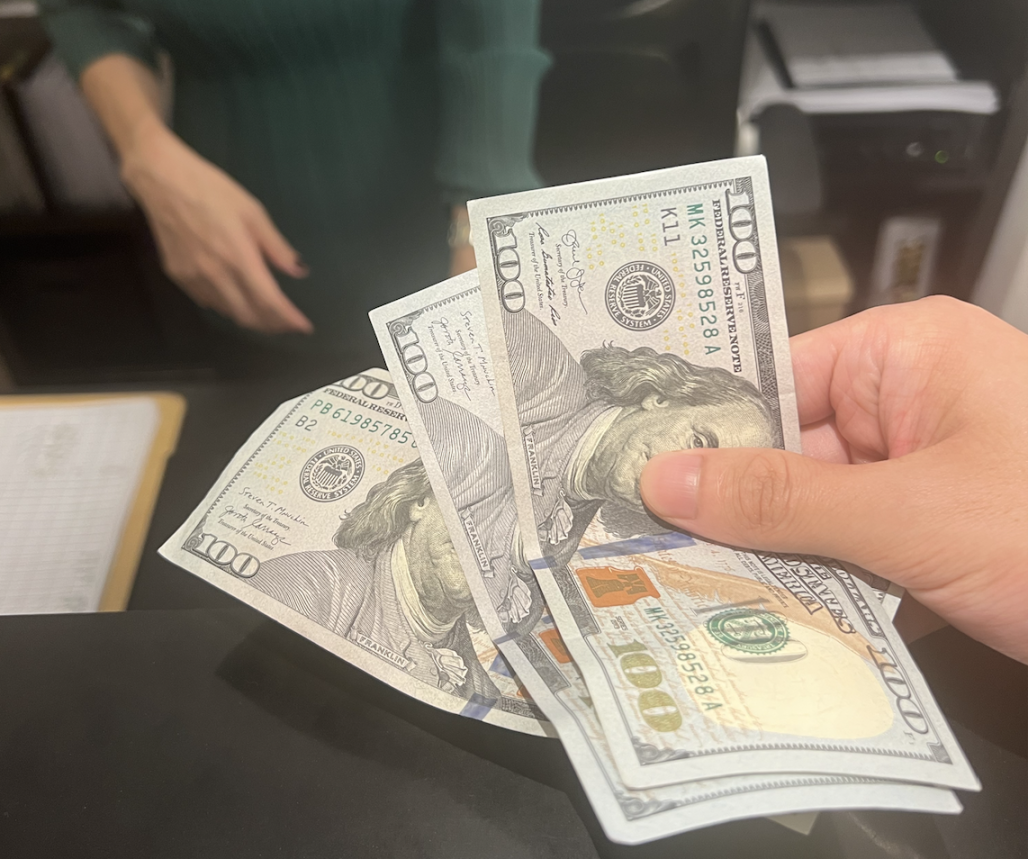
Caption: The author paying with US dollar cash
This deeply resonated with me: the global credit card payment system has long been monopolized by a few giants, not only charging a 3% "toll" per transaction but also imposing ATM withdrawal fees as high as 4% or more. For merchants, this is not just a financial cost but also a compliance cost.
Since merchants have a natural preference for "US dollars," theoretically, their acceptance of "digital dollars" (stablecoins) is also worth anticipating—as long as the payment tool can help them solve the "last mile" problem, instantly converting USDT into the Vietnamese dong they need.
With this verification logic, I began my subsequent experience with crypto payments in Vietnam.
Two: Vietnam's Stablecoin Payments, the Dawn of Mass Adoption Emerges
When Vietnamese merchants accept US dollar bills, are they ready to accept US dollar stablecoins?
During the next leg of the journey, I deliberately tried to live solely using Bitget Wallet. Grab rides, buying pho at street stalls, SPA massages, seafood dinners... I was surprised to find that as long as the merchant had a VietQR (Vietnam's universal payment QR code), I could basically use the wallet to scan and pay directly, with funds converted and arriving in real-time. And VietQR can be seen almost everywhere in Vietnam.
I use the word "basically" because I discovered a significant bug in crypto payments, which will be mentioned in Chapter Three.
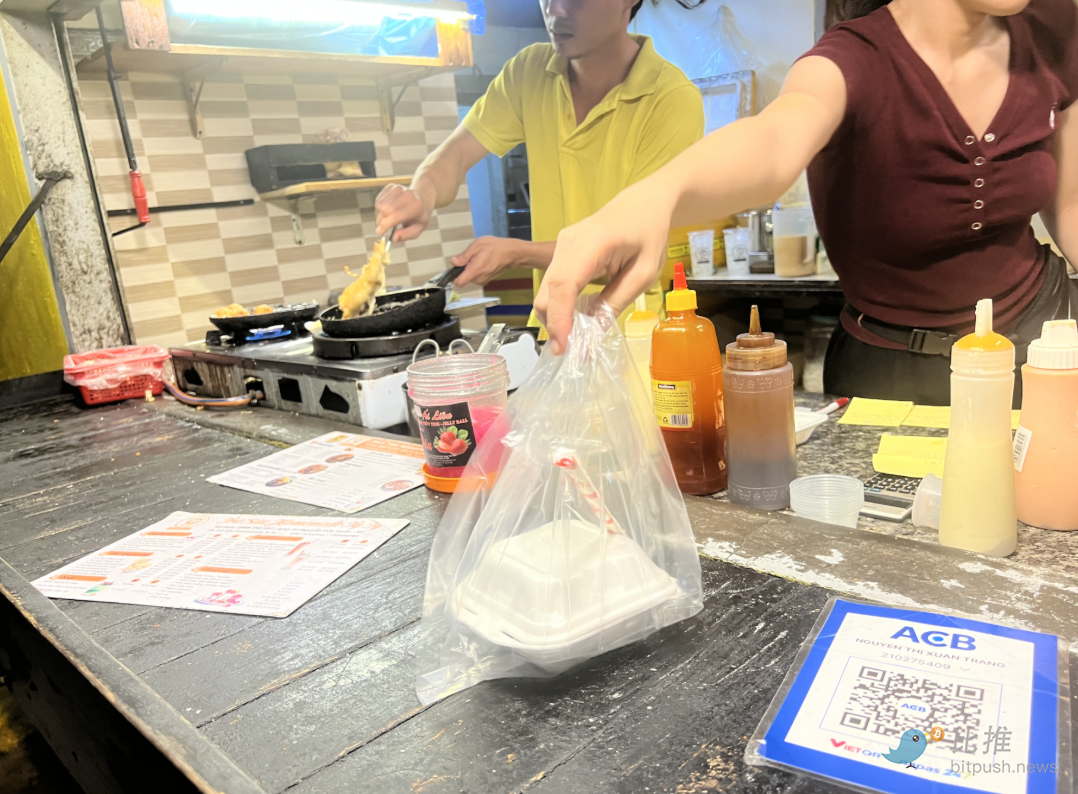
Caption: VietQR (bottom right corner) ubiquitous throughout Vietnam's streets and alleys, can be scanned directly for payment using Bitget Wallet
It's no exaggeration to say that in Vietnam, the experience of crypto payment is infinitely close to that of Alipay.
Although I had heard about it before, the shock of experiencing it firsthand was still strong. Crypto wallets like Bitget Wallet have underlying access to aggregated payment networks like Aeon Pay, which transforms cryptocurrency from a "speculative asset" into real "purchasing power," directly reaching tens of millions of merchants in Vietnam and surrounding countries.
Of course, all this smooth experience is built on Vietnam having a highly unified and popular QR code payment system (VietQR). It is the infrastructure, while crypto payment is the new blood running on it.
However, frequent use finally made me realize that Bitget Wallet scan-to-pay is not omnipotent. I really did find a bug once.
Three: A Failed Crypto Payment Revealed the 'Real-World Bug' to Me
On December 20, 2025, I dined again at the famous restaurant Moc Seafood in Nha Trang. The first two times I used cash and a credit card respectively; the third time, I decided to challenge myself to pay using Bitget Wallet.
However, this "challenge" failed.
The reason was that the store presented not a standard VietQR aggregated code, but a printed QR code from an internal bank or old system. My wallet scanned the code and showed a successful deduction, but after the on-chain funds were transferred, the store side had no voice broadcast or receipt notification for a long time.
The other party also demonstrated to me that when she used her mobile phone to pay, she received the money arrival notification immediately.
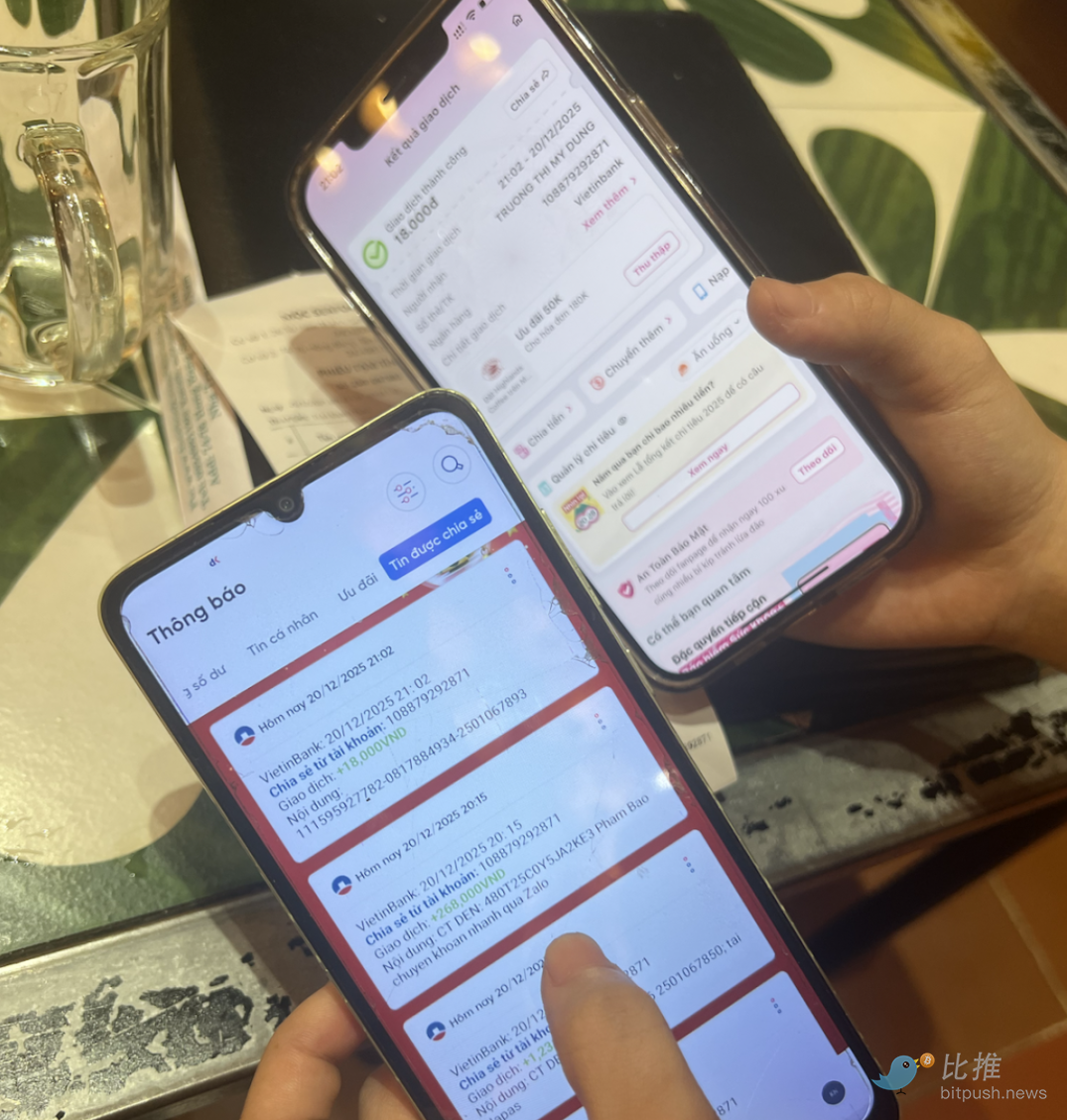
Caption: The author's attempt at crypto payment failed, but the staff completed it smoothly using a local bank scan
The store owner helplessly showed me their verification method: scanning with a local financial App, instant arrival.
The loss of these few dollars was the "tuition fee" I paid for this experience. This small episode made me realize that the "last mile" of crypto payments in the real world is still fragile. The lack of compatibility protocols, confirmation delays on the merchant side, and the cognitive time difference between the user side's "deduction equals success" and the merchant side's "arrival counts" are all pits that must be filled on the road to Mass Adoption.
Four: In the Minds of Ordinary People, Cryptocurrency is Still 'Grey'
The commercialization of technology depends not only on the maturity of the code but also on cultural acceptance.
Although Vietnam has an extremely young population, in the general public's eyes, Crypto's image is not glorious, especially in northern cities of Vietnam, where this situation is more obvious. The author spoke with several locals in Hanoi—including currency exchangers, motorbike taxi drivers, and university students—and their first reaction to cryptocurrency was surprisingly consistent: money laundering tool, grey industry, gambling.
In their view, this is not some "future of the internet" or "future of finance," but a means to evade regulation.
On the bustling streets of Hanoi and Nha Trang, the author could hardly find any Bitcoin ATMs or offline OTC exchange shops. This creates a strong visual contrast with places like Hong Kong, Japan, or Georgia—where the neon signs of Crypto Exchanges have long openly occupied the C位 (center stage) of commercial streets.
On one hand, it ranks first globally in on-chain data; on the other hand, it's hard to find in the physical world. This complete disconnect between online and offline vividly演绎 (dramatizes) a kind of "Vietnamese crypto fold."
Five: In the Driver's Car, I Found a Binance Cap
An accidental discovery tore open a corner of Vietnam's crypto world.
During a Grab ride, my colleague敏锐地 (sharply) noticed that this young driver had a cap with the Binance logo casually placed on his dashboard. Seeing we noticed, the driver grinned and skillfully took out his phone, showing us the Binance App he was running.
This scene made me realize that cryptocurrency in this country is not just an underground undercurrent; it is permeating ordinary people's lives in a highly vital way. Multiple public data show that over 20 million people in Vietnam hold or have used digital assets, and a large proportion of Vietnam's population is young (e.g., the 10-24 age group accounts for a significant share of the total population), which significantly promotes the acceptance of digital assets and the formation of Web3 usage habits.
This penetration shows an interesting "North-South difference" geographically.
A university student in Hanoi, Vietnam, told me that the north and south of Vietnam have截然不同的 (distinctly different) views on money: people in the north, represented by the capital Hanoi, are conservative,倾向于 (inclined towards) saving, preparing for rainy days; while people in the south, led by the economic center Ho Chi Minh City, are deeply influenced by Western business culture, accustomed to spending in advance, and have an extremely high acceptance of new things.
This also explains why the vast majority of Chinese Web3 practitioners—whether media, VCs, or blockchain game developers—mostly choose to settle in Ho Chi Minh City among Vietnamese cities.
Here, low labor costs collide with the high returns of the crypto economy, making Vietnam a heaven for geographical arbitrage in "play-to-earn" mining. Many young people are ordinary office workers during the day and turn into "gold-mining worker ants" on the chain at night.
If the fourth point of the travelogue showed me the "prejudice" of the public in northern Vietnamese cities towards cryptocurrency, then on the streets of Ho Chi Minh City, my friends described to me the "enthusiasm" for cryptocurrency in this country.
Vietnam has a strong coffee culture, and in those crowded Highlands Coffee or The Coffee House shops, my friend witnessed an extremely hardcore scene: on the screens of rows of young people tapping on laptops, not all were games or social software; frequently, Binance's K-line charts, or even the black window of a Solidity code editor, were seen.
Data doesn't lie. According to Chainalysis's "Global Cryptocurrency Adoption Index," Vietnam has consistently ranked at the top or near the top for many years. It has the perfect "golden population structure," tens of millions of young people渴望 (yearning for) class leapfrogging, proficient in digital technology, and unlike the older generation, they do not迷信 (blindly believe in) the traditional banking system.
This gives Vietnam a wonderful sense of "folding":
On the street, a motorbike taxi driver might tell you Crypto is a "money laundering tool"; but in a café at the end of the alley, a young developer might be building the next Axie Infinity (a phenomenal Web3 game born in Vietnam).
This bottom-up vitality is perhaps the most authentic底色 (background color) of Vietnam's Web3. There are no高大上的 (high-end) financial centers here, but every crowded coffee shop could be a Web3 node; every Grab穿梭 (shuttling) through the rainstorm might have a young person waiting for the Bitcoin bull market in the driver's seat.
Conclusion: Searching for the Next Decade's 'Alpha'
These five small incidents are just the tip of the iceberg of my observations of Vietnam.
The chapters of the journey are far from over. Next, I will delve into the "Southern Economic Heart" Ho Chi Minh City, climb the highlands of "Vietnam's Dali" Da Lat, traverse the coastal hub Da Nang, and finally arrive at Phu Quoc Island in the south.
Having traveled to dozens of countries and after repeated exchanges with multiple friends who have long been deeply involved locally and with Vietnamese locals, I am increasingly convinced of one judgment: in the next decade, Vietnam will be one of the world's most promising economies, perhaps even the most promising. The young population structure, continuously restless desire for upward mobility, and a relatively open social attitude towards foreign things together constitute a rare soil, and these are the best soil for nurturing new technologies.
I will continue to walk on this hot land and surrounding countries, not just as a tourist, but as an observer, to explore the real growth state of Web3 in Southeast Asia.
Please stay tuned, our exploration continues.
Twitter:https://twitter.com/BitpushNewsCN
Bitpush TG Discussion Group:https://t.me/BitPushCommunity
Bitpush TG Subscription: https://t.me/bitpush



















