VCs Sticking to the Primary Market: How Much Money Do They Still Have?

Odaily星球日报Publicado em 2026-04-22Última atualização em 2026-04-22

Resumo

The article discusses the current state of the cryptocurrency venture capital (VC) market, based on a debate among investors from firms like Pantera Capital, Crucible Capital, and others. Key insights reveal that while VC funds are not short on capital, there is a scarcity of high-quality investment opportunities. The discussion highlights a structural shift: early-stage funding is more dispersed and competitive, with many smaller funds active, but later-stage growth capital is highly concentrated among a few large players like Paradigm and Pantera. Data indicates that over 80% of funding in 2026 went to later rounds, but this includes "graduated" fintech projects that have entered traditional VC realms. The core issue is not the availability of money, but its distribution and accessibility—early-stage founders face intense competition for funding, while later-stage funding is gatekept by a handful of major firms. This reflects a broader trend where VCs are being more selective, prioritizing long-term, proven projects over narrative-driven investments, and founders must demonstrate substantial progress and resilience to secure capital.

Original | Odaily Planet Daily (@OdailyChina)

Author | Azuma (@azuma_eth)
Who knows the current state of the cryptocurrency primary market best? Naturally, it's the VCs still active in the market.

In recent days, several investors from Pantera Capital, Crucible Capital, Blockworks, and Varys Capital engaged in a small-scale discussion on X about the industry's primary market situation. Although there were some differences in their views on the market's current state, their debate might help us understand the primary market's condition a step further.

Counterintuitive Reality: VCs Aren't Short on Money, But There Aren't Many Worthwhile Investment Opportunities

On the evening of April 20, Crucible Capital Partner and GP Meltem Demirors published a short post on X explaining why the number of financing deals in the cryptocurrency industry is significantly decreasing.

Demirors believes that, overall, the "supply side" of early-stage founders and projects in the cryptocurrency industry is not as large as in other high-growth industries. Over the past 4 years, this gap has become increasingly apparent, which is why this VC has started to shift its attention outside the cryptocurrency market.

The venture capital business in the cryptocurrency market has been developing for 10 years, but the truly proven directions that can generate "VC-level returns" are actually just a few — stablecoins/payments, exchanges, and financial products. For VC investors and frontline founders, the industry now has fewer blockbusters, longer cycles, so the requirements for industry insight, resilience, and long-termism are higher, which is why the barrier from seed round to Series A is also increasing.

Although there are still some "era-defining" founders building category-defining companies (the VC's job is to find them and win the opportunity to invest in them), the reality is that there is a clear gap between "the stories founders are telling" and "what VCs can reasonably invest in."

After Demirors' short post was published, it sparked discussion among many VC peers on the topic.

Several investors replied below agreeing with Demirors' view. Among them, Blockworks Co-founder Mippo followed up summarizing, agreeing with Demirors, the current problem in the primary market is the insufficient number of excellent founders and projects; actually, the VC side has plenty of funds to invest — but at the same time, early-stage VC funding is oversupplied, while funding focused on later-stage growth is still noticeably lacking.

Partial Disagreement: Where Exactly Is the Money Concentrated?

Regarding whether VC funds are concentrated in the early discovery stage or the later growth stage, Pantera Capital investor Mason Nystrom and Varys Capital Venture Lead Tom Dunleavy held completely opposite views, and the two engaged in a heated debate.

Dunleavy first stated that he disagreed with Mippo's view that "early-stage funds are oversupplied, later-stage funds are lacking": "I would take the completely opposite view. There is actually a lot of mid-to-late stage cryptocurrency VC money right now — mostly from recently raised and currently fundraising funds, like Paradigm, Multicoin, Pantera, Dragonfly, etc., and that's not even counting traditional VCs that partially dabble in the crypto market. Conversely, funding for seed and earlier stages focused on the industry is lacking...... As long as you haven't completely switched to looking at AI, there are actually many interesting projects to invest in."

But as an insider at one of the later-stage VCs listed by Dunleavy (Pantera), Nystrom strongly refuted Dunleavy's claim. He believes that VC funds in the industry are now more concentrated in the early stages, rather than Series A, Series B, or beyond.

Nystrom did the math: if a fund wants to focus on Series A or Series B financing, they need to invest in at least 20-25 projects, each requiring a large sum — about $15 million for Series A, about $40 million for Series B — by this calculation, a fund focused on Series A needs at least $300 million in assets under management (AUM), and a fund focused on Series B needs at least $800 million. This hasn't even accounted for reserve capital, which typically requires keeping 10% - 50% cash on hand. How many funds in the industry meet this requirement?

So the reality is, there might be at least 50 funds in the industry with AUM less than $100 million, but at the same time, there might only be about 15 funds with AUM over $400 million. There are extremely few big players in the industry that can participate in Series B and beyond; there might indeed be more Series B and later-stage funding in fintech (like stablecoins), but these projects have long "graduated" into the traditional VC system and can no longer be simply considered cryptocurrency market projects.

But Dunleavy was not convinced. In his response, he posted Galaxy's Q1 primary market financing report, mentioning that the number of industry-wide financing deals in Q1 fell by 49% year-on-year, but the average deal size increased by 76% (about $36 million) — the total financing amount for seed and earlier stages was only $268 million; Series A had $370 million; Series B was even higher at $1.1 billion; later stages were as high as $2.72 billion (mainly from Kalshi and Polymarket).

Dunleavy thus rebutted, saying the data proves that in 2025, over 50%+ of the industry's investment went to later stages (already a historical high), and in 2026 it has already reached 80%+.
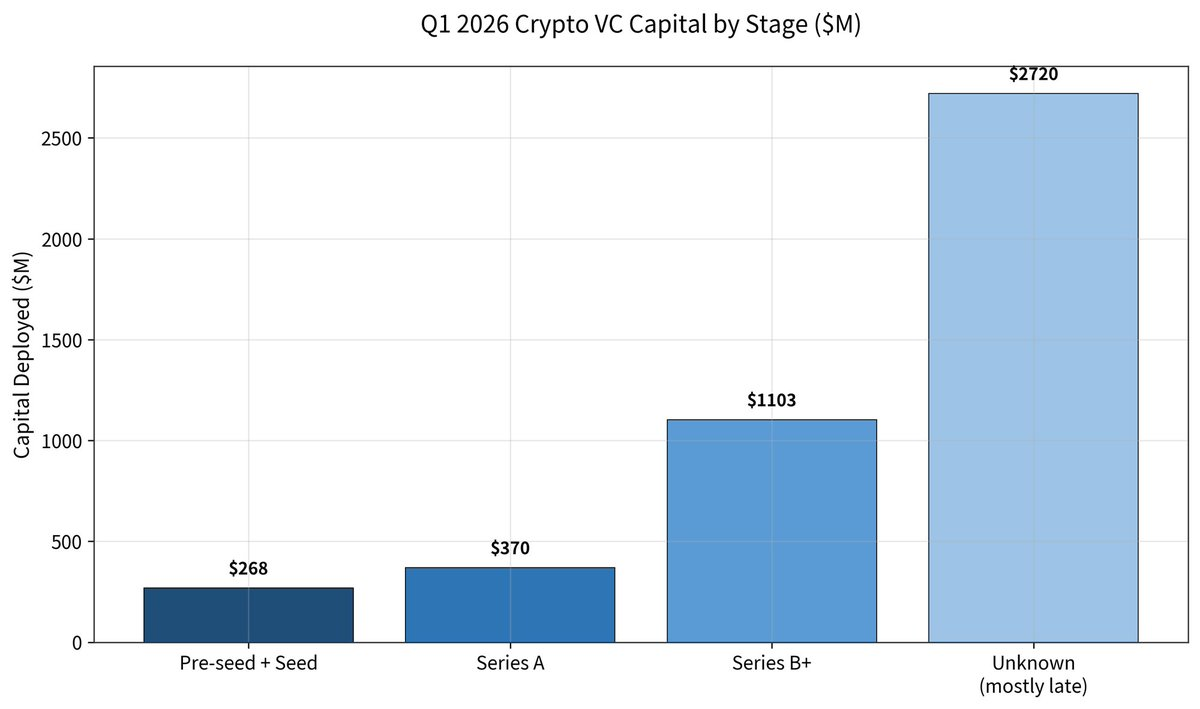
Dunleavy finally estimated the current funding situation in the primary market — available funds for Series A and later stages are about $6 to $7 billion, concentrated in 5 to 6 large institutions; available funds for seed and earlier stages are about $1 to $2 billion, scattered across dozens of smaller, more dispersed funds.

Nystrom responded again, stating that in the data posted by Dunleavy, the vast majority of later-stage investments actually come from fintech-related "graduated" projects, but such projects have long entered the sight of traditional VCs and received investment, and should no longer be counted within the industry.

Nystrom then continued to argue based on Dunleavy's conclusion that "only 5-6 funds can invest in Series A and beyond, but dozens of funds can invest in seed stage": "This means if you can't convince 1 of those 6, you're basically out of luck; but in the early stage, as long as 1 of the dozens of funds is willing to invest, you can survive. The 'accessibility' of these two is completely unequal."

Furthermore, funds like Pantera Capital that have the ability to invest in mid-to-late stages actually also invest in seed rounds, but the reverse is not true. Additionally, more and more VCs are turning into liquidity funds, so the scale of funds in the industry that can truly invest in mid-to-late stages is much smaller than the numbers suggest.

Compared to "Is There Money", the Real Question Is "Where Is the Money, Can It Be Accessed"

In short, neither side could convince the other, but based on the direct confrontation between these two frontline investors, we got a further glimpse into the reality of the cryptocurrency primary market — "is there money" does not seem to be the core problem of the primary market; "where is the money, can it be accessed" is.

Superficially, the data shows the industry's funds are still ample, even highly concentrated in later rounds; but from actual experience, both VCs and entrepreneurs are facing a more "structurally tightened" market — early-stage funds appear dispersed but competition is fierce, mid-to-late stage funds appear ample but the threshold is extremely high. This also means the rules of the game in the primary market are changing. The era of relying on narratives, traffic, and short-cycle realization to complete the financing loop is quickly fading away; replaced by a financing environment that relies more on real business progress, long-term capabilities, and deterministic growth paths.

For VCs, this is a cycle of "making fewer moves, focusing more on judgment"; for entrepreneurs, it is a survival test that must cross a longer cycle and a higher barrier.


Perguntas relacionadas

QAccording to the article, what is the main reason for the decrease in the number of cryptocurrency financing deals?

AThe main reason is a shortage of high-quality founders and projects, not a lack of VC capital. There is a significant gap between the stories founders are pitching and what VCs can reasonably invest in.

QWhat is the key disagreement between Mason Nystrom and Tom Dunleavy regarding VC funding?

AThey disagree on where the VC funding is concentrated. Nystrom argues that funding is more abundant in the early stages (seed), while Dunleavy contends that the majority of capital is concentrated in the later stages (Series A and beyond), held by a few large funds.

QBased on the Galaxy Q1 report cited, what was the trend in deal size and number of deals in Q1?

AThe number of financing deals in Q1 decreased by 49% year-over-year, but the average deal size increased by 76%, to approximately $36 million.

QWhat does Tom Dunleavy estimate is the total amount of available capital for Series A and later stages, and how is it distributed?

ATom Dunleavy estimates that there is approximately $6-7 billion in available capital for Series A and later stages, concentrated in the hands of 5 to 6 large institutions.

QWhat is the article's conclusion about the core problem in the current primary market?

AThe core problem is not whether there is money available, but rather where the money is located and whether founders can access it. The market is structurally tighter, with intense competition for early-stage funding and extremely high barriers to accessing later-stage capital.

Leituras Relacionadas

Xiaohongshu's Second Great Voyage, This Time Sailing Towards AI

Xiaohongshu's Second Voyage: Navigating Towards AI Since ChatGPT's emergence, Xiaohongshu's founder Mao Wenchao has been acutely aware of AI's potential threat, recognizing that the life advice people seek from chatbots overlaps directly with his platform's core business. Founded in 2013 as a PDF shopping guide for Chinese tourists, Xiaohongshu evolved into a massive community where millions share authentic, personal experiences—from product reviews to travel tips. This vast repository of "I've tried this" human judgment became its most valuable asset. However, the rise of AI, which delivers instant answers, challenges the very need for users to sift through numerous personal notes. Fearing its treasure trove of lived experience could become mere training data for others, Xiaohongshu is proactively adapting. In 2026, it established a dedicated AI division (Dots), launched RED Skill to turn user experiences into usable AI tools, and acquired the AI search product "Diandian." Its investments now extend to AI firms like MiniMax and hardware startups, moving upstream to address needs before they even become search queries. The platform's commercialization strategy is also evolving. With a newly acquired payment license and tools like the AIPS model to track consumer decision journeys, Xiaohongshu aims to seamlessly integrate recommendations with transactions, embedding commerce within AI-generated answers. Yet, a critical tension remains. While building smarter machines to organize and leverage its human experiences, Xiaohongshu must prevent AI from drowning out the authentic, flawed, and trustworthy "I've tried this" voices that built its community. Its core challenge is to harness AI's power without letting the map—the machine's perfect, synthesized answer—replace the territory of genuine human experience. This balance between technological advancement and preserving human trust defines its current journey and its future.

marsbitHá 19m

Xiaohongshu's Second Great Voyage, This Time Sailing Towards AI

marsbitHá 19m

SharpLink CEO: How to Understand Ethereum Developers Just Exceeded 1 Million?

SharpLink CEO reflects on the milestone of Ethereum surpassing 1 million historical developers, emphasizing that this figure represents the largest pool of technical talent ever assembled around an open, permissionless blockchain network. While approximately 232,000 developers remain active, the key question for the crypto industry is not which chain is fastest, but where the best builders choose to build long-term. Ethereum's advantage lies in a decade-long accumulation of infrastructure, standards, tools, liquidity, and a cohesive culture, making it the default operating system for programmable finance. This developer base is tackling complex challenges: the Glamsterdam upgrade aims to enhance scalability while preserving core principles; synchronous composability seeks to unify Rollup ecosystems; and significant efforts are underway for post-quantum security. Ethereum's deeper network effects stem from composability and shared standards (like the EVM and Solidity), creating a flywheel of more developers, tools, and liquidity. Three reinforcing strengths cement Ethereum's lead: credible neutrality (secured by ~900k validators), a modular architecture with interconnected Rollups, and a culture that attracts top researchers. The ecosystem is consolidating as the trusted coordination layer for internet-native finance, favored by large institutions valuing security and liquidity. The future of Ethereum is being built by this global community of founders and architects.

链捕手Há 34m

SharpLink CEO: How to Understand Ethereum Developers Just Exceeded 1 Million?

链捕手Há 34m

A Clod of Chinese Soil Chokes Two Japanese Giants

"Chinese Soil Chokes Japanese Giants" The production of a key electronic specialty gas, tungsten hexafluoride (WF6), vital for manufacturing AI chips, was halted by two leading Japanese producers—Kanto Denka and Central Glass. Their shutdown was not due to a technological failure but a sudden, critical shortage of a raw material they had long taken for granted: ultra-high-purity (6N-grade) tungsten powder, which is almost entirely sourced from China. Following a quiet Chinese export announcement in January 2026, tungsten powder shipments to Japan dropped to zero for months. Despite frantic efforts, Japanese companies found no viable alternative; imported powder was three times more expensive and lacked the required purity. Their existing stockpiles were exhausted by mid-2026. WF6 is essential for depositing tungsten into the microscopic contact holes of High Bandwidth Memory (HBM) chips, which are crucial for advanced processors like those from Nvidia. While Japanese firms had mastered producing ultra-pure WF6 gas, their entire supply chain relied on China's 6N tungsten powder—a dependency now revealed as a fatal vulnerability. China's dominance in this "soil" results from decades of painstaking R&D by companies like Xiamen Tungsten and China Tungsten & Hightech. They overcame immense technical hurdles, such as separating chemically similar molybdenum from tungsten, to achieve mass production of the world's purest tungsten powder. With their primary suppliers gone, Kanto Denka and Central Glass announced a permanent halt to WF6 production starting July 1, 2026. This immediately created a supply crisis for major semiconductor manufacturers like Samsung and SK Hynix, forcing them to urgently seek and certify new Chinese suppliers for WF6 itself. The reversal marks a dramatic shift: China has moved from exporting low-value raw materials to controlling the high-purity foundation of a critical global tech supply chain, upending a long-established industrial hierarchy.

marsbitHá 1h

A Clod of Chinese Soil Chokes Two Japanese Giants

marsbitHá 1h

Trading

Spot
Futuros
活动图片