VCs on 2025 Crypto Investments: 84% of 118 Tokens Break Issue Price, Only One Type of Company is Quietly Making Money

marsbitPublicado em 2026-04-22Última atualização em 2026-04-22

Resumo

Crypto investor Ching Tseng categorizes the market into four quadrants based on two axes: crypto-native vs. traditional finance (TradFi)-oriented, and having traction vs. no traction. In 2025, 84.7% of 118 tracked token launches fell below their issuance price, with a median fully diluted valuation drop of 71%. Crypto-native projects without traction are experiencing massive capital destruction, often relying on speculative narratives without sustainable revenue or user retention. Crypto-native teams with traction, often built in prior cycles, generate real revenue but face structural challenges with their tokens lacking direct value capture mechanisms. While some have implemented successful buyback programs, the core issue remains finding growth beyond crypto volatility. TradFi-oriented startups without traction face long, costly enterprise sales cycles but benefit from a robust M&A environment, with crypto acquisitions reaching a record $8.6 billion in 2025. The current winners are TradFi-oriented companies with traction, particularly in the Real World Asset (RWA) tokenization space, which grew from $5.5B to $18.6B in 2025. They are winning through enterprise sales, building alliances, and improving unit economics on established compliance stacks. Their main risk is being bypassed by large incumbent institutions building their own infrastructure. The overarching theme is market maturation, where narrative alone is insufficient for long-term success.

Author: Ching Tseng

Compiled by: Deep Tide TechFlow

Deep Tide Guide: Investor Ching Tseng categorizes crypto companies into four quadrants: crypto-native/traditional finance-oriented, with traction/without traction. In 2025, 84.7% of 118 token issuances broke their issue price. Crypto-native projects without traction are massively destroying capital, while traditional finance-oriented companies with traction are capturing the $18 billion RWA market. This article clarifies where the money is flowing and which tokenomics models have failed.

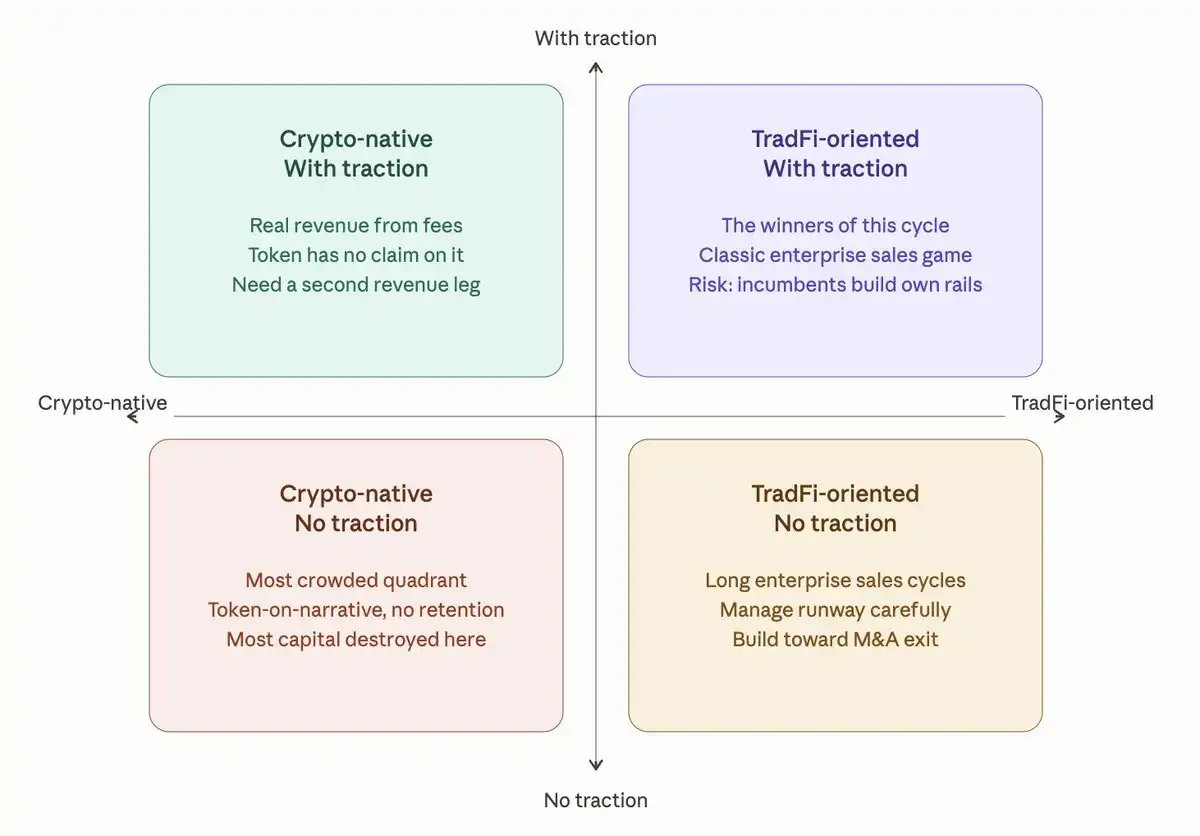
Sitting on the investor side this year, I found that almost every crypto founder I met can be classified into one of four categories. The two axes are simple: crypto-native vs. traditional finance-oriented, with traction vs. without traction. Four quadrants, covering about 75% of the market.

The challenges faced by each quadrant are completely different. Here is my breakdown.
Crypto-Native, Without Traction

This is the most crowded quadrant and the area where capital is being destroyed most severely.

These teams are still showcasing TVL numbers that were inflated in the last cycle but cannot explain why they worked back then. They ask for valuations of $20 million, $30 million, sometimes even $200 million, with only a utility token and a roadmap, claiming the token has a "clear use case" because it is used to pay fees or for governance voting.

The data is brutal. Among the 118 token issuances tracked in 2025, 84.7% fell below their issue price, with the median fully diluted valuation dropping by 71%. Some of the most hyped "native DeFi L1s" of this cycle saw their TVL drop by over 90% in the first year after launch, with tokens following a similar trend. AI-related token groups saw an average annual return of -50%, with several top performers of 2024 pulling back over 80% from their peaks.

The pattern is consistent. Initial traction comes from users seeking quick profits rather than genuinely liking your product. Tokens priced based on narratives, without revenue or user retention to support their valuations, bled in 2025. Massive emissions exposed that on-chain activity was primarily mercenary behavior.

What this quadrant needs to internalize is: the long-term value of a token comes from the team's ability to generate revenue and return capital to holders, not from artificial utility that forces users to spend it. Regulation still prevents anyone from publicly saying "the token is equity," but empirically, that is the only model that works. Everything else is, at best, a cyclical trade.

If you are here, the honest approach is not to issue another token. It is to return to the basics: who are your real users, what are they willing to pay for, and how can you capture a portion of that?

Crypto-Native, With Traction

This quadrant is full of teams that built something real many years ago, often in the last cycle, and have been quietly earning decent revenue from trading, lending, or exchange fees. The teams are small, cash flow covers salaries, and the product works.

Sounds good? But they also have challenges to overcome.

Most issued tokens early and are now stuck with a structural problem: revenue exists, but the token has no mechanical claim to it. Some of the largest products in the market handle monthly trading volumes of tens or even hundreds of millions of dollars, but for years the direct value captured by the token has been zero. No matter how good the revenue/profits are, the market does not truly trade the token at a consistent multiple; the market prices expected growth, not current economic conditions.

The buyback debate is the other half of the story for this quadrant. Some protocols that promised weekly fee-funded buybacks in early 2025 saw their prices rise over 40% in the following month. Others running automated, fee-funded buyback programs cumulatively bought back over $1 billion in tokens within seven months, with single-day buybacks nearing $4 million at their peak. DeFi buybacks totaled approximately $2 billion in 2024-2025.

Buybacks sound like the answer. Sometimes they are. But for teams in this quadrant without excess revenue, buying back tokens is just burning future runway to defend a price that may not hold. The harder and better question is, can you grow a second revenue line not tied to crypto volatility? Because if traditional finance-oriented competitors build better distribution into institutions while you are still surviving on altcoin traders, your moat will quickly turn into commodity-priced infrastructure.

Traditional Finance-Oriented, Without Traction

This group ballooned in 2024-2025. Custody tools, compliance middleware, tokenization rails, on-chain forex, institutional settlement—all genuinely useful. All expensive. All have enterprise sales cycles measured in quarters, not weeks.

The problem is not the product. It's the math. Founders raised $15 million to $30 million assuming institutions would come, but even onboarding a tier-1 bank client can take 12-18 months and requires compliance infrastructure that eats a year of burn before the first dollar of revenue lands.

The good news is that the exit environment for this quadrant is exceptionally healthy. Crypto M&A hit a record $8.6 billion in 2025, with over 140 VC-backed crypto companies acquired, a 59% jump year-over-year. Several of the largest deals saw existing giants paying hundreds of millions to billions of dollars for distribution, licenses, and enterprise relationships in derivatives, trading infrastructure, and payment rails.

If you are in this quadrant, the cool-headed play is: manage valuation and cash runway like your life depends on it, aim for a meaningful M&A outcome, because it is real. Don't price yourself out of the acquirer pool. Don't burn 24 months of runway chasing one enterprise logo. Build complementary partnerships with larger players who might ultimately want to acquire you.

Traditional Finance-Oriented, With Traction

The winners of the current regime.

Tokenized real-world assets grew from $5.5 billion at the start of 2025 to $18.6 billion by year-end, a 3.4x growth in twelve months. The largest tokenization platforms now handle billions in institutional liquidity, with market leaders holding around 20% share, supporting one of the world's largest tokenized treasury funds with nearly $3 billion AUM.

These companies aren't trying to convince anyone crypto is the future. Their institutional clients have already decided. The game now is straightforward enterprise sales: win more banks, more asset managers, more issuers; build alliance structures where an institution buying one of your products naturally buys three more from your partners; compress unit economics on the compliance and custody stack you've already built.

If the team is a pure service provider, this becomes a classic enterprise software war: sales velocity, net retention, integration depth.

The primary risk for this quadrant is not from crypto-native competition. It's from existing behemoths, large asset managers and global banks, eventually building their own rails, bypassing the startups that helped them adapt to the chain. The window is real, but not infinite.

The four quadrants appear different on the surface but are all navigating the same underlying shift: the market is maturing.

This doesn't mean narrative is dead. Institutions also chase hot themes, as anyone who has watched semiconductor and AI valuations over the past two years knows. But in a mature market, the half-life of pure narrative is shorter. It can still get you started, but it cannot keep you going.


Perguntas relacionadas

QAccording to the article, what percentage of the 118 token launches tracked in 2025 fell below their issuance price?

A84.7% of the 118 token launches tracked in 2025 fell below their issuance price.

QWhich quadrant of crypto companies is described as the current winners of the system and is capitalizing on the RWA market?

AThe 'Traditional Finance-Oriented, With Traction' quadrant is described as the current winners, capitalizing on the tokenized real-world asset (RWA) market which grew to $18.6 billion.

QWhat is the primary risk for companies in the 'Traditional Finance-Oriented, With Traction' quadrant?

AThe primary risk is not from crypto-native competitors, but from existing giants like large asset managers and global banks who may build their own on-chain infrastructure, bypassing the startups that helped them adapt.

QWhat does the data suggest is the only empirically working model for a token's long-term value?

AThe data suggests that the only empirically working model is one where the token is treated as equity, meaning the team generates revenue and returns capital to holders, rather than forcing artificial utility.

QWhat was the total value of crypto M&A (Mergers and Acquisitions) in 2025, as stated in the article?

ACrypto M&A reached a record $8.6 billion in 2025.

Leituras Relacionadas

Apple Also Has to Pay Rent Now

Apple Pays Rent Too: The Two-Way Flow of "Traffic Tax" and "AI Capability Rent" Between Tech Giants For over two decades, Google has paid Apple an estimated $20 billion annually to remain the default search engine on Safari, a "traffic tax" for a critical user entry point. However, in 2026, the direction of this cash flow partially reversed. Apple agreed to pay Google roughly $1 billion per year to license its Gemini AI models, as Apple's own models reportedly struggled with complex tasks. This creates a unique dynamic: Apple acts as the "landlord" in the established search ecosystem, collecting rent from Google for access. Simultaneously, in the emerging AI arena, Apple becomes the "tenant," paying Google for access to cutting-edge AI capabilities it cannot currently match internally. While Apple claims its new models are "distilled" from Gemini outputs and contain "not a drop" of Google's original code, core dependencies remain. Its knowledge base is refined using Gemini's outputs, and its most powerful cloud model runs on Google's infrastructure. Apple has structured the deal as non-exclusive, allowing it to theoretically switch AI suppliers—a hedge against over-reliance. The future hinges on whether advanced AI models become a commodity (cheap and abundant) or remain a concentrated, scarce resource (expensive and controlled by few). Apple is betting on the former, leveraging its massive device ecosystem to be a powerful, choosy customer. If the latter proves true, its bargaining power could erode. This power dynamic is extending to developers. Apple, Google, and WeChat are all pushing for apps to expose their core functions as standardized "actions" or "intents" that their respective AI assistants (Siri, Gemini, WeChat AI) can directly call. The new scarce resource is no longer just app store visibility, but "being selected by the AI." The currency of "rent" has changed from a 30% revenue share to ceding control over how users interact with an app's functions.

marsbitHá 1h

Apple Also Has to Pay Rent Now

marsbitHá 1h

Missed the SpaceX IPO? WEEX's "First Trade Protection" Lets You Experience US Stock Trading Risk-Free.

With the excitement around SpaceX's recent public listing reigniting interest in the US stock market, Chinese investors face significant challenges accessing compliant and convenient trading channels following regulatory actions against major online brokers. This article explores the available options, highlighting their risks and limitations. Traditional paths for US stock investments remain problematic. Qualified Domestic Institutional Investor (QDII) and Listed Open-Ended Fund (LOF) products, while compliant, suffer from high fees, significant purchase premiums, and a very limited selection of assets. Small, unregulated offshore brokers pose substantial risks, including potential insolvency. While secure, VIP accounts at banks in Hong Kong or Singapore require high minimum deposits (often 1-2 million RMB) and in-person visits, placing them out of reach for most retail investors. The article positions cryptocurrency exchanges, specifically their TradFi (traditional finance on-chain) offerings, as a compelling alternative. Platforms like WEEX are noted for providing access to a wide range of US stocks and ETFs, including SpaceX (SPCXON), through tokenized assets. This method offers advantages such as a single account for both crypto and traditional assets, USDT-based settlement avoiding fiat complexities, flexible leverage, and robust risk management. To attract users, WEEX is promoting a "First Trade Guarantee" campaign. Running from June 15 to July 8 (UTC+8), it features a $30,000 prize pool. Users who trade $500 worth of US stock contracts can qualify for a guarantee on their first eligible trade: 100% loss coverage up to $30 or a 20% bonus on profits up to $30. The campaign is presented as a low-risk opportunity for both crypto natives and traditional investors to experience US stock trading.

marsbitHá 1h

Missed the SpaceX IPO? WEEX's "First Trade Protection" Lets You Experience US Stock Trading Risk-Free.

marsbitHá 1h

How Difficult is Chip Making? A Division Error Costs 475 Million Dollars

How Hard Is It to Make a Chip? A Division Error Cost $475 Million Chip expert Shi Kan, a researcher at the Chinese Academy of Sciences and a popular tech creator, explains the immense challenges of chip development. Chips are foundational to modern technology, but their creation is extraordinarily difficult. The journey from sand to a functional chip involves complex design and manufacturing, but a critical bottleneck is verification—ensuring the design works flawlessly before costly production. A single, undetected bug can have catastrophic consequences, as illustrated by the infamous 1994 Intel Pentium FDIV bug. A flaw in the floating-point division unit forced a recall costing $475 million. Unlike software, chips cannot be easily patched after manufacture, making "first-time success" paramount. However, industry surveys show only 24% of chip projects achieve this; over three-quarters require at least one costly re-spin due to design flaws. Verification has thus become the dominant phase, consuming up to 70% of the design cycle. The core challenge is a "verification impossible triangle" between high performance, good debuggability, and low cost. Exhaustively verifying a modern CPU core could take 15,000 years with software simulation, or 30 years with advanced hardware emulation—timeframes utterly impractical for development. Despite being essential, verification is often seen as unglamorous "dirty work," receiving less academic attention than fields like AI. Shi and his team are tackling this by developing an agile verification research framework called ENCORE, based on FPGA technology, to improve verification efficiency and debug capability. Beyond research, Shi engages in public science communication through long-form video content, aiming to demystify chip technology, AI, and computer science. He argues for the value of pursuing "hard and long-term" endeavors, whether in the meticulous world of chip verification or in creating substantive educational content, believing such sustained effort is likely the right path forward.

marsbitHá 1h

How Difficult is Chip Making? A Division Error Costs 475 Million Dollars

marsbitHá 1h

Trading

Spot
Futuros

Artigos em Destaque

Como comprar ONE

Bem-vindo à HTX.com!Tornámos a compra de Harmony (ONE) simples e conveniente.Segue o nosso guia passo a passo para iniciar a tua jornada no mundo das criptos.Passo 1: cria a tua conta HTXUtiliza o teu e-mail ou número de telefone para te inscreveres numa conta gratuita na HTX.Desfruta de um processo de inscrição sem complicações e desbloqueia todas as funcionalidades.Obter a minha contaPasso 2: vai para Comprar Cripto e escolhe o teu método de pagamentoCartão de crédito/débito: usa o teu visa ou mastercard para comprar Harmony (ONE) instantaneamente.Saldo: usa os fundos da tua conta HTX para transacionar sem problemas.Terceiros: adicionamos métodos de pagamento populares, como Google Pay e Apple Pay, para aumentar a conveniência.P2P: transaciona diretamente com outros utilizadores na HTX.Mercado de balcão (OTC): oferecemos serviços personalizados e taxas de câmbio competitivas para os traders.Passo 3: armazena teu Harmony (ONE)Depois de comprar o teu Harmony (ONE), armazena-o na tua conta HTX.Alternativamente, podes enviá-lo para outro lugar através de transferência blockchain ou usá-lo para transacionar outras criptomoedas.Passo 4: transaciona Harmony (ONE)Transaciona facilmente Harmony (ONE) no mercado à vista da HTX.Acede simplesmente à tua conta, seleciona o teu par de trading, executa as tuas transações e monitoriza em tempo real.Oferecemos uma experiência de fácil utilização tanto para principiantes como para traders experientes.

312 Visualizações TotaisPublicado em {updateTime}Atualizado em 2026.06.02

Como comprar ONE

Discussões

Bem-vindo à Comunidade HTX. Aqui, pode manter-se informado sobre os mais recentes desenvolvimentos da plataforma e obter acesso a análises profissionais de mercado. As opiniões dos utilizadores sobre o preço de ONE (ONE) são apresentadas abaixo.

活动图片












