Using AI for Weather Prediction: Earn $200 a Day While Doing Nothing?

marsbitPublicado em 2026-03-18Última atualização em 2026-03-18

Resumo

Using AI for Weather Prediction: Can You Really Earn $200 a Day? This article explores how to leverage AI and data analysis to profit from weather prediction markets like Polymarket, focusing on Shanghai’s temperature forecasts. The system relies on Shanghai Pudong Airport (ZSPD) weather station data, sourced via Wunderground, rather than general city forecasts. Key insights include: - Temperature data is reported in whole Fahrenheit values in METAR format, not Celsius, affecting precision. - Historical data shows daily high temperatures most frequently occur between 11:00-13:00, peaking at 12:00 in summer (27.6% of days). Three effective prediction methods were implemented: 1. **Integrated Forecasting**: Combines Weather Company (WC) and ECMWF model data, weighted by weather conditions (e.g., sunny days favor WC). 2. **Real-Time Correction**: Uses morning temperature rise data and historical patterns to extrapolate the daily high, adjusted for cloud cover and wind. A Kalman filter dynamically weights real-time data vs. forecasts. 3. **Temperature Trend Model**: Predicts whether the day will be warmer/cooler than the previous day using pre-dawn data (pressure changes, wind, cloud cover, recent trends). It performs best in winter (clear signals) but poorly in autumn (63.7% accuracy). Two failed methods—Fourier analysis (systematic underestimation) and ERA5 peak-time prediction (insufficient precision)—were discarded. Case studies demonstrate the system...

Weather is not like elections—it has no stance; it's not like the NBA—it has no home team. But it is precisely this market that has attracted domestic users. The reason is simple: everyone has a feeling about it, and everyone thinks they understand Shanghai's weather.

But "feeling like you understand" and "being able to make money" are two different things.

Biteye shares three things today:

1. Understand the settlement rules

2. Establish a method for weather prediction

3. Use a system to find trading opportunities others can't see

1. First, Figure Out: How Exactly Does This Weather Market Settle?

1. The temperature settled is not what you think it is

Many people make a mistake when participating for the first time: they check their phone's weather app and bet on the highest temperature accordingly. But the app shows the temperature in downtown Shanghai, while Polymarket settles using the actual measured data from Shanghai Pudong International Airport (ZSPD weather station). This data is publicly available through the American weather platform Wunderground, and PM directly reads the records on WU as the basis for settlement.

Two locations, two numbers. Pudong Airport is located on the east side of the city, right next to the Yangtze River estuary, and is affected by sea breezes, so the temperature is usually lower than in the city center. This difference isn't usually noticeable, but near the threshold boundaries, it can be the difference between a correct and incorrect bet.

So you can see this kind of confusion in the weather market comments: "It clearly felt warmer today than yesterday, why is the displayed maximum temperature lower?"

2. The number is correct, but the unit isn't what you think

WU's data comes directly from the METAR reports (the global aviation standard meteorological telegraph format) reported hourly by the airport.

There's a detail hidden here: METAR records temperatures in whole Fahrenheit numbers, and WU displays this number without conversion or correction.

Most weather forecast systems and meteorological models output temperatures with decimal points. The more refined your model is, the easier it is to overlook this crude detail.

3. Shanghai Temperature Patterns

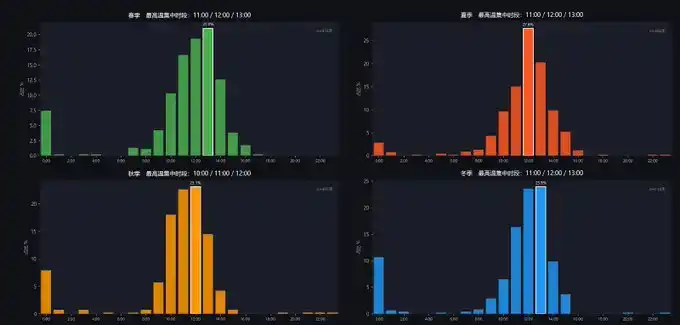
After scraping nearly 1900 days of data from the ZSPD station, the occurrence period of Shanghai's highest temperature is more concentrated than imagined:

· Highly concentrated between 11:00-13:00 across all four seasons,

· The concentration is highest at 12:00 in summer, with that single hour accounting for 27.6% of the entire season.

· The peak period in autumn is slightly earlier, with 10:00 also being one of the high-frequency periods.

Knowing the pattern is the first step, but patterns don't watch the market themselves. When the daily high temperature appears, whether it has been broken, and how far it is from the threshold.

So the editor built this system: to predict as accurately as possible which Celsius threshold the day's maximum temperature will fall into before daily settlement.
2. Five Methods, Three Worked

After understanding the market rules, the next question is: how to predict the day's maximum temperature?

As a weather novice, the first step was to ask ChatGPT: How does the meteorological industry actually calculate the day's maximum temperature, and what are the mature methods? ChatGPT provided a theoretical framework, and Claude turned the framework into code. Using the two AIs together, the system was built over a weekend.

Five methods were tried in total, but only three ended up working.

Those that worked:

1. WC + ECMWF Ensemble Forecast

Predicting the maximum temperature first requires data. Two sources were adopted:

· Weather Company (WC) is a commercial weather API providing hourly forecast data with high precision;

· ECMWF is the global meteorological model from the European Centre for Medium-Range Weather Forecasts, more sensitive to large-scale weather systems.

The two sources have their own pros and cons, so they were made to vote with weighted averages. The weights are dynamically adjusted based on the day's weather type: trust WC more on sunny days, trust ECMWF more on days with high cloud cover and wind speed.

2. Real-time Correction: Estimating the Peak Using Warming Data

The forecast was calculated last night, but today's weather is constantly changing. So what this module does is: use the actual measured data that has already happened this morning to estimate how high it can go today.

The logic isn't complicated; the editor found that 8-9 AM in Shanghai is the fastest warming period. After the system gets the measured temperature at this time, it checks historical data: for the same season, at the same time, how much higher did it get on average in the past.

Then add two corrections:

· Apply a discount for more clouds; the cloudier it is, the more the warming is hindered.

· Apply a discount for stronger wind; strong wind accelerates heat loss. This calculates an "extrapolation estimate."

Pressure, dew point, and humidity were also included in the calculation, but they were removed after backtesting showed these factors had a smaller, lower correlation impact.

But relying solely on extrapolation isn't stable enough. Here, a concept similar to Kalman gain is used. Simply put, it takes a weighted average between the "extrapolation result" and the "original forecast," and this weight changes automatically over time.

· At 6 AM, extrapolation only accounts for 20%, mostly still trusting the forecast

· By noon 12 PM, extrapolation accounts for 72%

· After 1 PM, it almost entirely trusts the actual measurements, accounting for 85%

The later it is, the more important the current events are; the earlier it is, the more reference value the historical forecast has.

After 2 PM, the system judges that the peak has most likely passed, directly takes the day's highest temperature from the historical record to lock in the result, and stops extrapolating.

3. Is Today a Warming Day?

This is the most satisfying module in the entire system. It makes a judgment every early morning: Will today's maximum temperature be higher than yesterday's?

Every day between 2-4 AM, the system collects a batch of meteorological data and feeds it to this model:

· Changes in air pressure over the past 3 hours and 12 hours

· Wind direction and speed in the early morning, cloud conditions

· The magnitude of warming/cooling yesterday, the temperature trend over the past three days, whether yesterday's temperature was above or below average

· Plus the month, season, the day of the year, whether it rained yesterday

The model output is divided into five levels: Warming Day, Slightly Warming, Flat, Slightly Cooling, Cooling Day, along with a confidence level.

However, the accuracy of this method varies greatly by season.

Most accurate in winter: When cold air arrives, pressure rises sharply, north winds strengthen—the signals are extremely clear, and the model can spot it instantly.

Worst in autumn: Cold and warm air masses repeatedly wrestle, temperatures rise today only to fall back tomorrow—historical patterns fail fastest in this season.

Eliminated methods:

1. Fourier Numerical Prediction

Initially tried using Fourier analysis to fit the periodic patterns of historical temperatures to see if it could directly predict the day's maximum temperature.

The result found that all it could tell you was "what the historical average is for this season." Shanghai's weather is too random; the Fourier fit produced a smooth average curve, not the real daily fluctuations. The error was 3.6°C, and it was 100% systematically underestimated, so it was deleted.

2. ERA5 Peak Time Prediction

ERA5 is the global historical reanalysis dataset from the European Climate Centre, used to predict what time the day's maximum temperature will occur.

Backtest results:

· ≤1 hour accuracy 59.6%

· ≤2 hours accuracy 81.3%

It sounds okay, but the problem is that PM's precision is higher, leaving traders with a very short time window for judgment. If it can't predict the peak within half an hour, it's better to just watch Polymarket's data, so this method was淘汰 (eliminated).

3. System in Practice: Two Cases and Shortcomings Reflection

Polymarket's weather market opens for trading 4 days in advance. Popular temperature thresholds are usually fully priced early in the market opening. Buying directly on high-probability thresholds offers a poor risk-reward ratio.

So the strategy the editor adopted is: wait for the signal, wait for the time window after warming, and then enter the market.

Based on the self-built weather system, the following two operations were performed:

Case 1:
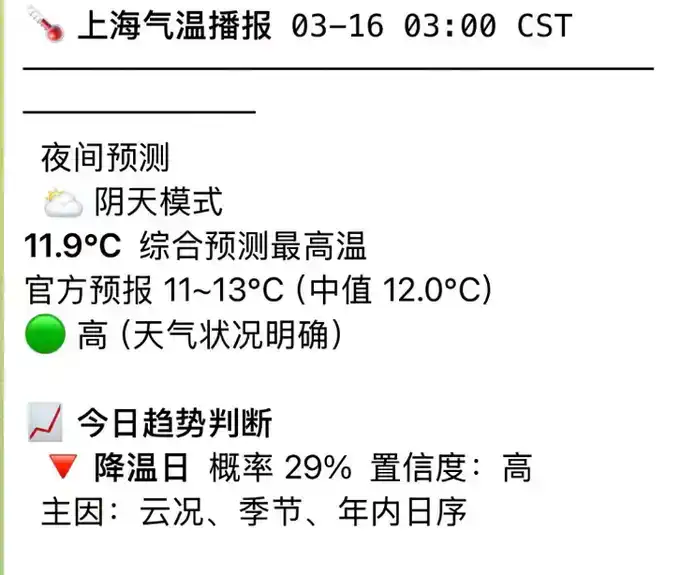
On the early morning of the 16th, the Telegram channel pushed a report from the night mode: tomorrow is a cooling day. The reasons were that the cloud cover was thick that night, and both the season and the day of the year pointed towards cooling.

The editor did not bet immediately at this point. The early morning signal was just the first layer of reference.

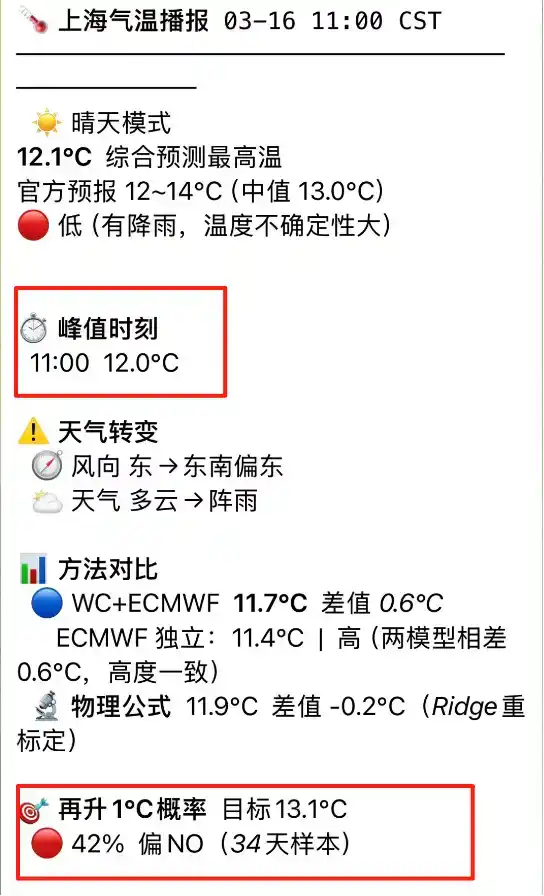
By 11 AM, the system pushed a real-time report during the warming period. The actual measured high temperature had already reached 12°C, and the +1°C probability score gave a result: the probability of rising another 1°C today was 42%, leaning towards not warming further.

Combined with the slightly cooling signal from the early morning logistic regression, the two modules were in agreement. The signal was much clearer now than in the early morning. So a bet was placed that the 16th's maximum temperature would not exceed 13°C.

Settlement that day: 12°C. The previous day, the 15th, was 15°C, a drop of 3 degrees.

Case 2:
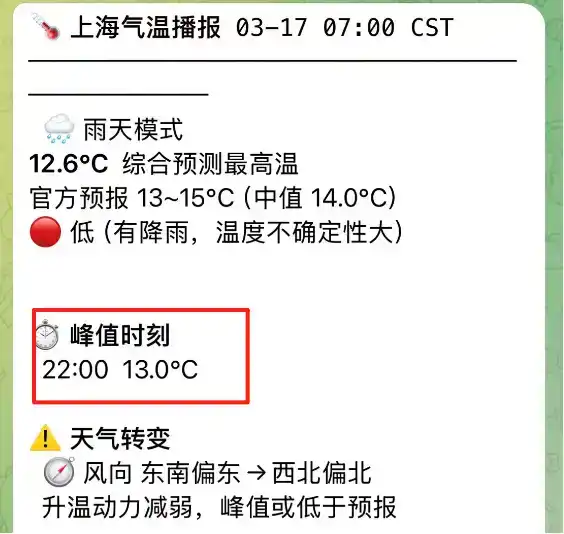
Another example is Shanghai's weather on the 17th (today). The weather system can also serve as an early warning: the push received at 7 AM showed an abnormal peak time: 22:00

Normally, the peak temperature on a sunny day appears between 1-3 PM, but today's peak is at 10 PM, indicating this is not solar heating but warm, moist air transport at night. It rained all day, with cloud cover 97-100%, and almost zero sunshine.

At this point, opening Polymarket, the price for 12°C was still at 53%. Someone in the community was confused: It's already afternoon, the temperature is only 11°C, the normal peak period is long gone, why are people still buying 12°C?

Behind this confusion is that people are still using sunny day logic to judge a rainy day market.

The system is not confused. It identified today's weather type clearly in the morning: abnormal peak time, obvious deviation between the current temperature and market expectations. This is an information gap, and the information gap is a trading opportunity.

This is precisely the meaning of building this system: Easier to identify opportunities; faster to warn of risks.
What are the system's shortcomings?

A system built over a weekend cannot be without flaws:

· Autumn accuracy is only 63.7%, close to a coin toss.

· Cold and warm air masses wrestle repeatedly this season, temperatures rise today and fall back tomorrow—historical patterns fail fastest in autumn.

· Pressure characteristics are not available in live trading. Pressure changes were used as a feature when training the model, and backtest results were good.

· The signal of cold air passing through is very clear. But during live operation, the current interface cannot obtain real-time pressure data.

· Coastal correction is still waiting for more data activation. The sea breeze effect at Pudong Airport is real, and the system has built a corresponding correction module, but there aren't enough backtest samples yet.

For a system that has only been running for a weekend, finding these problems is already a gain. Next step: fix it while running.

4. Conclusion

Meteorology has developed for hundreds of years, using satellites, supercomputers, and global models, yet weather forecasts still dare not guarantee 100% accuracy for tomorrow. It's not that scientists aren't trying hard enough; it's that the atmospheric system itself is chaotic. A one-degree difference in initial conditions can lead to completely different results.

This system, which has only been running for a weekend, will of course make mistakes. Autumn accuracy is nearly a coin toss, the system might not react in time if cold air arrives early, and the sea breeze effect hasn't been fully captured yet.

But that's not important. Participating in prediction markets doesn't require being right every time; it only requires having one more layer of information than the market when the odds are advantageous.


Perguntas relacionadas

QWhat is the key difference between the temperature data used by Polymarket for settlement and the data shown on typical weather apps?

APolymarket uses the actual measured data from Shanghai Pudong Airport (ZSPD weather station) provided by Wunderground, which is typically lower than the temperature in the city center due to its coastal location. Weather apps often show the temperature for the urban area of Shanghai.

QWhat are the three methods that were successfully implemented in the AI weather prediction system?

AThe three successful methods are: 1. WC + ECMWF ensemble forecast, 2. Real-time correction using morning warming data to extrapolate the peak temperature, and 3. A model to predict if the day will be a warming day compared to the previous day.

QWhy was the Fourier numerical prediction method eliminated from the system?

AThe Fourier numerical prediction was eliminated because it had a high error of 3.6°C and systematically underestimated the temperature. It only provided a smooth average curve for the season and couldn't capture the real daily fluctuations of Shanghai's highly random weather.

QHow does the system's confidence in its 'real-time correction' forecast change throughout the day?

AThe system uses a Kalman gain concept to weight the 'extrapolated result' from real data against the 'original forecast'. In the early morning (6 AM), it relies 80% on the forecast and 20% on real-time extrapolation. By noon (12 PM), it relies 72% on extrapolation, and after 1 PM, it relies 85% on实测 (actual measurements), almost fully trusting the real data as the peak time has likely passed.

QWhat is the main trading opportunity the system is designed to identify on Polymarket?

AThe system is designed to identify information gaps or mispricings on Polymarket by providing more accurate and timely predictions of the day's maximum temperature. This allows the user to place bets on temperature brackets when the market's expectation, based on conventional logic (e.g., for a sunny day), differs from the system's prediction based on a deeper analysis of real-time data and weather patterns (e.g., for a rainy day with a late peak time).

Leituras Relacionadas

a16z: AI's 'Amnesia', Can Continuous Learning Cure It?

The article "a16z: AI's 'Amnesia' – Can Continual Learning Cure It?" explores the limitations of current large language models (LLMs), which, like the protagonist in the film *Memento*, are trapped in a perpetual present—unable to form new memories after training. While methods like in-context learning (ICL), retrieval-augmented generation (RAG), and external scaffolding (e.g., chat history, prompts) provide temporary solutions, they fail to enable true internalization of new knowledge. The authors argue that compression—the core of learning during training—is halted at deployment, preventing models from generalizing, discovering novel solutions (e.g., mathematical proofs), or handling adversarial scenarios. The piece introduces *continual learning* as a critical research direction to address this, categorizing approaches into three paths: 1. **Context**: Scaling external memory via longer context windows, multi-agent systems, and smarter retrieval. 2. **Modules**: Using pluggable adapters or external memory layers for specialization without full retraining. 3. **Weights**: Enabling parameter updates through sparse training, test-time training, meta-learning, distillation, and reinforcement learning from feedback. Challenges include catastrophic forgetting, safety risks, and auditability, but overcoming these could unlock models that learn iteratively from experience. The conclusion emphasizes that while context-based methods are effective, true breakthroughs require models to compress new information into weights post-deployment, moving from mere retrieval to genuine learning.

marsbitHá 46m

a16z: AI's 'Amnesia', Can Continuous Learning Cure It?

marsbitHá 46m

Can a Hair Dryer Earn $34,000? Deciphering the Reflexivity Paradox in Prediction Markets

An individual manipulated a weather sensor at Paris Charles de Gaulle Airport with a portable heat source, causing a Polymarket weather market to settle at 22°C and earning $34,000. This incident highlights a fundamental issue in prediction markets: when a market aims to reflect reality, it also incentivizes participants to influence that reality. Prediction markets operate on two layers: platform rules (what outcome counts as a win) and data sources (what actually happened). While most focus on rules, the real vulnerability lies in the data source. If reality is recorded through a specific source, influencing that source directly affects market settlement. The article categorizes markets by their vulnerability: 1. **Single-point physical data sources** (e.g., weather stations): Easily manipulated through physical interference. 2. **Insider information markets** (e.g., MrBeast video details): Insiders like team members use non-public information to trade. Kalshi fined a剪辑师 $20,000 for insider trading. 3. **Actor-manipulated markets** (e.g., Andrew Tate’s tweet counts): The subject of the market can control the outcome. Evidence suggests Tate’sociated accounts coordinated to profit. 4. **Individual-action markets** (e.g., WNBA disruptions): A single person can execute an event to profit from their pre-placed bets. Kalshi and Polymarket handle these issues differently. Kalshi enforces strict KYC, publicly penalizes insider trading, and reports to regulators. Polymarket, with its anonymous wallet-based system, has historically been more permissive, arguing that insider information improves market accuracy. However, it cooperated with authorities in the "Van Dyke case," where a user traded on classified government information. The core paradox is reflexivity: prediction markets are designed to discover truth, but their financial incentives can distort reality. The more valuable a prediction becomes, the more likely participants are to influence the event itself. The market ceases to be a mirror of reality and instead shapes it.

marsbitHá 1h

Can a Hair Dryer Earn $34,000? Deciphering the Reflexivity Paradox in Prediction Markets

marsbitHá 1h

Trading

Spot
Futuros

Artigos em Destaque

O que é GROK AI

Grok AI: Revolucionar a Tecnologia Conversacional na Era Web3 Introdução No panorama em rápida evolução da inteligência artificial, a Grok AI destaca-se como um projeto notável que liga os domínios da tecnologia avançada e da interação com o utilizador. Desenvolvida pela xAI, uma empresa liderada pelo renomado empreendedor Elon Musk, a Grok AI procura redefinir a forma como interagimos com a inteligência artificial. À medida que o movimento Web3 continua a florescer, a Grok AI visa aproveitar o poder da IA conversacional para responder a consultas complexas, proporcionando aos utilizadores uma experiência que é não apenas informativa, mas também divertida. O que é a Grok AI? A Grok AI é um sofisticado chatbot de IA conversacional projetado para interagir com os utilizadores de forma dinâmica. Ao contrário de muitos sistemas de IA tradicionais, a Grok AI abraça uma gama mais ampla de perguntas, incluindo aquelas tipicamente consideradas inadequadas ou fora das respostas padrão. Os principais objetivos do projeto incluem: Raciocínio Fiável: A Grok AI enfatiza o raciocínio de senso comum para fornecer respostas lógicas com base na compreensão contextual. Supervisão Escalável: A integração de assistência de ferramentas garante que as interações dos utilizadores sejam monitorizadas e otimizadas para qualidade. Verificação Formal: A segurança é primordial; a Grok AI incorpora métodos de verificação formal para aumentar a fiabilidade das suas saídas. Compreensão de Longo Contexto: O modelo de IA destaca-se na retenção e recordação de um extenso histórico de conversas, facilitando discussões significativas e contextualizadas. Robustez Adversarial: Ao focar na melhoria das suas defesas contra entradas manipuladas ou maliciosas, a Grok AI visa manter a integridade das interações dos utilizadores. Em essência, a Grok AI não é apenas um dispositivo de recuperação de informações; é um parceiro conversacional imersivo que incentiva um diálogo dinâmico. Criador da Grok AI A mente por trás da Grok AI não é outra senão Elon Musk, um indivíduo sinónimo de inovação em vários campos, incluindo automóvel, viagens espaciais e tecnologia. Sob a égide da xAI, uma empresa focada em avançar a tecnologia de IA de maneiras benéficas, a visão de Musk visa reformular a compreensão das interações com a IA. A liderança e a ética fundacional são profundamente influenciadas pelo compromisso de Musk em ultrapassar os limites tecnológicos. Investidores da Grok AI Embora os detalhes específicos sobre os investidores que apoiam a Grok AI permaneçam limitados, é reconhecido publicamente que a xAI, a incubadora do projeto, é fundada e apoiada principalmente pelo próprio Elon Musk. As anteriores empreitadas e participações de Musk fornecem um forte apoio, reforçando ainda mais a credibilidade e o potencial de crescimento da Grok AI. No entanto, até agora, informações sobre fundações ou organizações de investimento adicionais que apoiam a Grok AI não estão prontamente acessíveis, marcando uma área para exploração futura potencial. Como Funciona a Grok AI? A mecânica operacional da Grok AI é tão inovadora quanto a sua estrutura conceptual. O projeto integra várias tecnologias de ponta que facilitam as suas funcionalidades únicas: Infraestrutura Robusta: A Grok AI é construída utilizando Kubernetes para orquestração de contêineres, Rust para desempenho e segurança, e JAX para computação numérica de alto desempenho. Este trio assegura que o chatbot opere de forma eficiente, escale eficazmente e sirva os utilizadores prontamente. Acesso a Conhecimento em Tempo Real: Uma das características distintivas da Grok AI é a sua capacidade de aceder a dados em tempo real através da plataforma X—anteriormente conhecida como Twitter. Esta capacidade concede à IA acesso às informações mais recentes, permitindo-lhe fornecer respostas e recomendações oportunas que outros modelos de IA poderiam perder. Dois Modos de Interação: A Grok AI oferece aos utilizadores a escolha entre “Modo Divertido” e “Modo Regular”. O Modo Divertido permite um estilo de interação mais lúdico e humorístico, enquanto o Modo Regular foca em fornecer respostas precisas e exatas. Esta versatilidade assegura uma experiência adaptada que atende a várias preferências dos utilizadores. Em essência, a Grok AI combina desempenho com envolvimento, criando uma experiência que é tanto enriquecedora quanto divertida. Cronologia da Grok AI A jornada da Grok AI é marcada por marcos fundamentais que refletem as suas fases de desenvolvimento e implementação: Desenvolvimento Inicial: A fase fundamental da Grok AI ocorreu ao longo de aproximadamente dois meses, durante os quais o treinamento inicial e o ajuste do modelo foram realizados. Lançamento Beta do Grok-2: Numa evolução significativa, o beta do Grok-2 foi anunciado. Este lançamento introduziu duas versões do chatbot—Grok-2 e Grok-2 mini—cada uma equipada com capacidades para conversar, programar e raciocinar. Acesso Público: Após o seu desenvolvimento beta, a Grok AI tornou-se disponível para os utilizadores da plataforma X. Aqueles com contas verificadas por um número de telefone e ativas há pelo menos sete dias podem aceder a uma versão limitada, tornando a tecnologia disponível para um público mais amplo. Esta cronologia encapsula o crescimento sistemático da Grok AI desde a sua concepção até ao envolvimento público, enfatizando o seu compromisso com a melhoria contínua e a interação com o utilizador. Principais Características da Grok AI A Grok AI abrange várias características principais que contribuem para a sua identidade inovadora: Integração de Conhecimento em Tempo Real: O acesso a informações atuais e relevantes diferencia a Grok AI de muitos modelos estáticos, permitindo uma experiência de utilizador envolvente e precisa. Estilos de Interação Versáteis: Ao oferecer modos de interação distintos, a Grok AI atende a várias preferências dos utilizadores, convidando à criatividade e personalização na conversa com a IA. Base Tecnológica Avançada: A utilização de Kubernetes, Rust e JAX fornece ao projeto uma estrutura sólida para garantir fiabilidade e desempenho ótimo. Consideração de Discurso Ético: A inclusão de uma função de geração de imagens demonstra o espírito inovador do projeto. No entanto, também levanta considerações éticas em torno dos direitos autorais e da representação respeitosa de figuras reconhecíveis—uma discussão em curso dentro da comunidade de IA. Conclusão Como uma entidade pioneira no domínio da IA conversacional, a Grok AI encapsula o potencial para experiências transformadoras do utilizador na era digital. Desenvolvida pela xAI e impulsionada pela abordagem visionária de Elon Musk, a Grok AI integra conhecimento em tempo real com capacidades avançadas de interação. Esforça-se por ultrapassar os limites do que a inteligência artificial pode alcançar, mantendo um foco nas considerações éticas e na segurança do utilizador. A Grok AI não apenas incorpora o avanço tecnológico, mas também representa um novo paradigma de conversas no panorama Web3, prometendo envolver os utilizadores com conhecimento hábil e interação lúdica. À medida que o projeto continua a evoluir, ele permanece como um testemunho do que a interseção da tecnologia, criatividade e interação humana pode alcançar.

352 Visualizações TotaisPublicado em {updateTime}Atualizado em 2024.12.26

O que é GROK AI

O que é ERC AI

Euruka Tech: Uma Visão Geral do $erc ai e as suas Ambições no Web3 Introdução No panorama em rápida evolução da tecnologia blockchain e das aplicações descentralizadas, novos projetos surgem frequentemente, cada um com objetivos e metodologias únicas. Um desses projetos é a Euruka Tech, que opera no vasto domínio das criptomoedas e do Web3. O foco principal da Euruka Tech, particularmente do seu token $erc ai, é apresentar soluções inovadoras concebidas para aproveitar as capacidades crescentes da tecnologia descentralizada. Este artigo tem como objetivo fornecer uma visão abrangente da Euruka Tech, uma exploração das suas metas, funcionalidade, a identidade do seu criador, potenciais investidores e a sua importância no contexto mais amplo do Web3. O que é a Euruka Tech, $erc ai? A Euruka Tech é caracterizada como um projeto que aproveita as ferramentas e funcionalidades oferecidas pelo ambiente Web3, focando na integração da inteligência artificial nas suas operações. Embora os detalhes específicos sobre a estrutura do projeto sejam um tanto elusivos, ele é concebido para melhorar o envolvimento dos utilizadores e automatizar processos no espaço cripto. O projeto visa criar um ecossistema descentralizado que não só facilita transações, mas também incorpora funcionalidades preditivas através da inteligência artificial, daí a designação do seu token, $erc ai. O objetivo é fornecer uma plataforma intuitiva que facilite interações mais inteligentes e um processamento eficiente de transações dentro da crescente esfera do Web3. Quem é o Criador da Euruka Tech, $erc ai? Neste momento, a informação sobre o criador ou a equipa fundadora da Euruka Tech permanece não especificada e algo opaca. Esta ausência de dados levanta preocupações, uma vez que o conhecimento sobre o histórico da equipa é frequentemente essencial para estabelecer credibilidade no setor blockchain. Portanto, categorizamos esta informação como desconhecida até que detalhes concretos sejam disponibilizados no domínio público. Quem são os Investidores da Euruka Tech, $erc ai? De forma semelhante, a identificação de investidores ou organizações de apoio para o projeto Euruka Tech não é prontamente fornecida através da pesquisa disponível. Um aspeto que é crucial para potenciais partes interessadas ou utilizadores que consideram envolver-se com a Euruka Tech é a garantia que vem de parcerias financeiras estabelecidas ou apoio de empresas de investimento respeitáveis. Sem divulgações sobre afiliações de investimento, é difícil tirar conclusões abrangentes sobre a segurança financeira ou a longevidade do projeto. Em linha com a informação encontrada, esta seção também se encontra no estado de desconhecido. Como funciona a Euruka Tech, $erc ai? Apesar da falta de especificações técnicas detalhadas para a Euruka Tech, é essencial considerar as suas ambições inovadoras. O projeto procura aproveitar o poder computacional da inteligência artificial para automatizar e melhorar a experiência do utilizador no ambiente das criptomoedas. Ao integrar IA com tecnologia blockchain, a Euruka Tech visa fornecer funcionalidades como negociações automatizadas, avaliações de risco e interfaces de utilizador personalizadas. A essência inovadora da Euruka Tech reside no seu objetivo de criar uma conexão fluida entre os utilizadores e as vastas possibilidades apresentadas pelas redes descentralizadas. Através da utilização de algoritmos de aprendizagem automática e IA, visa minimizar os desafios enfrentados por utilizadores de primeira viagem e agilizar as experiências transacionais dentro do quadro do Web3. Esta simbiose entre IA e blockchain sublinha a importância do token $erc ai, que se apresenta como uma ponte entre interfaces de utilizador tradicionais e as capacidades avançadas das tecnologias descentralizadas. Cronologia da Euruka Tech, $erc ai Infelizmente, devido à informação limitada disponível sobre a Euruka Tech, não conseguimos apresentar uma cronologia detalhada dos principais desenvolvimentos ou marcos na jornada do projeto. Esta cronologia, tipicamente inestimável para traçar a evolução de um projeto e compreender a sua trajetória de crescimento, não está atualmente disponível. À medida que informações sobre eventos notáveis, parcerias ou adições funcionais se tornem evidentes, atualizações certamente aumentarão a visibilidade da Euruka Tech na esfera cripto. Esclarecimento sobre Outros Projetos “Eureka” É importante abordar que múltiplos projetos e empresas partilham uma nomenclatura semelhante com “Eureka.” A pesquisa identificou iniciativas como um agente de IA da NVIDIA Research, que se concentra em ensinar robôs a realizar tarefas complexas utilizando métodos generativos, bem como a Eureka Labs e a Eureka AI, que melhoram a experiência do utilizador na educação e na análise de serviços ao cliente, respetivamente. No entanto, estes projetos são distintos da Euruka Tech e não devem ser confundidos com os seus objetivos ou funcionalidades. Conclusão A Euruka Tech, juntamente com o seu token $erc ai, representa um jogador promissor, mas atualmente obscuro, dentro do panorama do Web3. Embora os detalhes sobre o seu criador e investidores permaneçam não divulgados, a ambição central de combinar inteligência artificial com tecnologia blockchain destaca-se como um ponto focal de interesse. As abordagens únicas do projeto em promover o envolvimento do utilizador através da automação avançada podem diferenciá-lo à medida que o ecossistema Web3 avança. À medida que o mercado cripto continua a evoluir, as partes interessadas devem manter um olhar atento sobre os avanços em torno da Euruka Tech, uma vez que o desenvolvimento de inovações documentadas, parcerias ou um roteiro definido pode apresentar oportunidades significativas no futuro próximo. Neste momento, aguardamos por insights mais substanciais que possam desvendar o potencial da Euruka Tech e a sua posição no competitivo panorama cripto.

401 Visualizações TotaisPublicado em {updateTime}Atualizado em 2025.01.02

O que é ERC AI

O que é DUOLINGO AI

DUOLINGO AI: Integrar a Aprendizagem de Línguas com Inovação Web3 e IA Numa era em que a tecnologia transforma a educação, a integração da inteligência artificial (IA) e das redes blockchain anuncia uma nova fronteira para a aprendizagem de línguas. Apresentamos DUOLINGO AI e a sua criptomoeda associada, $DUOLINGO AI. Este projeto aspira a unir o poder educativo das principais plataformas de aprendizagem de línguas com os benefícios da tecnologia descentralizada Web3. Este artigo explora os principais aspectos do DUOLINGO AI, analisando os seus objetivos, estrutura tecnológica, desenvolvimento histórico e potencial futuro, mantendo a clareza entre o recurso educativo original e esta iniciativa independente de criptomoeda. Visão Geral do DUOLINGO AI No seu cerne, DUOLINGO AI procura estabelecer um ambiente descentralizado onde os alunos podem ganhar recompensas criptográficas por alcançar marcos educativos em proficiência linguística. Ao aplicar contratos inteligentes, o projeto visa automatizar processos de verificação de habilidades e alocação de tokens, aderindo aos princípios do Web3 que enfatizam a transparência e a propriedade do utilizador. O modelo diverge das abordagens tradicionais de aquisição de línguas ao apoiar-se fortemente numa estrutura de governança orientada pela comunidade, permitindo que os detentores de tokens sugiram melhorias ao conteúdo dos cursos e à distribuição de recompensas. Alguns dos objetivos notáveis do DUOLINGO AI incluem: Aprendizagem Gamificada: O projeto integra conquistas em blockchain e tokens não fungíveis (NFTs) para representar níveis de proficiência linguística, promovendo a motivação através de recompensas digitais envolventes. Criação de Conteúdo Descentralizada: Abre caminhos para educadores e entusiastas de línguas contribuírem com os seus cursos, facilitando um modelo de partilha de receitas que beneficia todos os colaboradores. Personalização Através de IA: Ao empregar modelos avançados de aprendizagem de máquina, o DUOLINGO AI personaliza as lições para se adaptar ao progresso de aprendizagem individual, semelhante às características adaptativas encontradas em plataformas estabelecidas. Criadores do Projeto e Governança A partir de abril de 2025, a equipa por trás do $DUOLINGO AI permanece pseudónima, uma prática frequente no panorama descentralizado das criptomoedas. Esta anonimidade visa promover o crescimento coletivo e o envolvimento das partes interessadas, em vez de se concentrar em desenvolvedores individuais. O contrato inteligente implementado na blockchain Solana indica o endereço da carteira do desenvolvedor, o que significa o compromisso com a transparência em relação às transações, apesar da identidade dos criadores ser desconhecida. De acordo com o seu roteiro, o DUOLINGO AI pretende evoluir para uma Organização Autónoma Descentralizada (DAO). Esta estrutura de governança permite que os detentores de tokens votem em questões críticas, como implementações de funcionalidades e alocação de tesouraria. Este modelo alinha-se com a ética de empoderamento comunitário encontrada em várias aplicações descentralizadas, enfatizando a importância da tomada de decisão coletiva. Investidores e Parcerias Estratégicas Atualmente, não existem investidores institucionais ou capitalistas de risco publicamente identificáveis ligados ao $DUOLINGO AI. Em vez disso, a liquidez do projeto origina-se principalmente de trocas descentralizadas (DEXs), marcando um contraste acentuado com as estratégias de financiamento das empresas tradicionais de tecnologia educacional. Este modelo de base indica uma abordagem orientada pela comunidade, refletindo o compromisso do projeto com a descentralização. No seu whitepaper, o DUOLINGO AI menciona a formação de colaborações com “plataformas de educação blockchain” não especificadas, com o objetivo de enriquecer a sua oferta de cursos. Embora parcerias específicas ainda não tenham sido divulgadas, estes esforços colaborativos sugerem uma estratégia para misturar inovação em blockchain com iniciativas educativas, expandindo o acesso e o envolvimento dos utilizadores em diversas vias de aprendizagem. Arquitetura Tecnológica Integração de IA O DUOLINGO AI incorpora dois componentes principais impulsionados por IA para melhorar as suas ofertas educativas: Motor de Aprendizagem Adaptativa: Este motor sofisticado aprende a partir das interações dos utilizadores, semelhante a modelos proprietários de grandes plataformas educativas. Ele ajusta dinamicamente a dificuldade das lições para abordar desafios específicos dos alunos, reforçando áreas fracas através de exercícios direcionados. Agentes Conversacionais: Ao empregar chatbots alimentados por GPT-4, o DUOLINGO AI oferece uma plataforma para os utilizadores se envolverem em conversas simuladas, promovendo uma experiência de aprendizagem de línguas mais interativa e prática. Infraestrutura Blockchain Construído na blockchain Solana, o $DUOLINGO AI utiliza uma estrutura tecnológica abrangente que inclui: Contratos Inteligentes de Verificação de Habilidades: Esta funcionalidade atribui automaticamente tokens aos utilizadores que passam com sucesso em testes de proficiência, reforçando a estrutura de incentivos para resultados de aprendizagem genuínos. Emblemas NFT: Estes tokens digitais significam vários marcos que os alunos alcançam, como completar uma seção do seu curso ou dominar habilidades específicas, permitindo-lhes negociar ou exibir as suas conquistas digitalmente. Governança DAO: Membros da comunidade com tokens podem participar na governança votando em propostas-chave, facilitando uma cultura participativa que incentiva a inovação nas ofertas de cursos e funcionalidades da plataforma. Cronologia Histórica 2022–2023: Conceituação O trabalho preliminar para o DUOLINGO AI começa com a criação de um whitepaper, destacando a sinergia entre os avanços em IA na aprendizagem de línguas e o potencial descentralizado da tecnologia blockchain. 2024: Lançamento Beta Um lançamento beta limitado introduz ofertas em línguas populares, recompensando os primeiros utilizadores com incentivos em tokens como parte da estratégia de envolvimento comunitário do projeto. 2025: Transição para DAO Em abril, ocorre um lançamento completo da mainnet com a circulação de tokens, promovendo discussões comunitárias sobre possíveis expansões para línguas asiáticas e outros desenvolvimentos de cursos. Desafios e Direções Futuras Obstáculos Técnicos Apesar dos seus objetivos ambiciosos, o DUOLINGO AI enfrenta desafios significativos. A escalabilidade continua a ser uma preocupação constante, particularmente no equilíbrio dos custos associados ao processamento de IA e à manutenção de uma rede descentralizada responsiva. Além disso, garantir a criação e moderação de conteúdo de qualidade num ambiente descentralizado apresenta complexidades na manutenção dos padrões educativos. Oportunidades Estratégicas Olhando para o futuro, o DUOLINGO AI tem o potencial de aproveitar parcerias de micro-certificação com instituições académicas, proporcionando validações verificadas em blockchain das habilidades linguísticas. Além disso, a expansão cross-chain poderia permitir que o projeto acedesse a bases de utilizadores mais amplas e a ecossistemas de blockchain adicionais, melhorando a sua interoperabilidade e alcance. Conclusão DUOLINGO AI representa uma fusão inovadora de inteligência artificial e tecnologia blockchain, apresentando uma alternativa focada na comunidade aos sistemas tradicionais de aprendizagem de línguas. Embora o seu desenvolvimento pseudónimo e o modelo económico emergente tragam certos riscos, o compromisso do projeto com a aprendizagem gamificada, educação personalizada e governança descentralizada ilumina um caminho a seguir para a tecnologia educativa no domínio do Web3. À medida que a IA continua a avançar e o ecossistema blockchain evolui, iniciativas como o DUOLINGO AI poderão redefinir a forma como os utilizadores interagem com a educação linguística, empoderando comunidades e recompensando o envolvimento através de mecanismos de aprendizagem inovadores.

385 Visualizações TotaisPublicado em {updateTime}Atualizado em 2025.04.11

O que é DUOLINGO AI

Discussões

Bem-vindo à Comunidade HTX. Aqui, pode manter-se informado sobre os mais recentes desenvolvimentos da plataforma e obter acesso a análises profissionais de mercado. As opiniões dos utilizadores sobre o preço de AI (AI) são apresentadas abaixo.

活动图片












