USDC vs. USDT: $70.2T volume drives shift as Circle expands into Africa

ambcryptoPublicado em 2026-03-25Última atualização em 2026-03-25

Resumo

Circle partners with Sasai Fintech (Cassava Technologies) to expand USDC into Africa, aiming to revolutionize cross-border payments by making them faster, cheaper, and more reliable. This integration into Sasai's mobile platform addresses high fees (often over 7%) and slow traditional systems. The move occurs as stablecoins process $70.2T in annual volume, with USDC gaining market share against USDT, signaling a shift toward reliable, transparent systems. However, Circle faces regulatory challenges in the U.S., including concerns from the upcoming CLARITY Act, which contributed to a recent 20% stock drop. The expansion highlights a strategic focus on high-growth markets like Africa despite domestic uncertainties.

While many are currently concerned about Circle’s stock performance on the NYSE, the company’s partnership with Sasai Fintech, a business of Cassava Technologies, tells an interesting story.

This move isn’t just about expanding into Africa; it’s aimed at tackling a long‐standing challenge: cross‐border payments that remain slow, costly, and inefficient. The plan is to bring USDC into Sasai’s mobile platform, which already supports payments and remittances across multiple African countries.

USDC x Sasai’s partnership: A green flag

Currently, fees can go above 7%, so using a stablecoin like USDC can make transactions faster, cheaper, and more reliable.

By adding USDC into a mobile platform that already supports fast-moving trade, it removes the delays and high costs of traditional systems, where transactions can take days.

Additionally, the partnership is also meant to offer a stable and transparent way to make cross-border payments. This would, in turn, help businesses avoid local currency swings while staying connected to the global market.

Executives weighing in

Remarking on the same, Strive Masiyiwa, Founder and Executive Chairman at Cassava Technologies, said,

Africa’s digital economy is entering a new era, propelled by entrepreneurship, a mobile-first generation, and the acceleration of intra-regional trade.

Adding more to the sentiment, Jeremy Allaire, co-founder and CEO at Circle, noted,

Working with Cassava, we can extend the benefits of USDC and onchain infrastructure into high-growth payment corridors to deliver always-on global connectivity.

Stablecoin’s market dynamics: USDC vs. USDT

The partnership comes at an important time for stablecoins, which have handled a huge $70.2 trillion in transactions over the past year. While USDT was leading for most of 2025, things started to change in early 2026.

Even though total activity slowed a bit in March after a strong February, USDC has started catching up and even briefly matched USDT’s share.
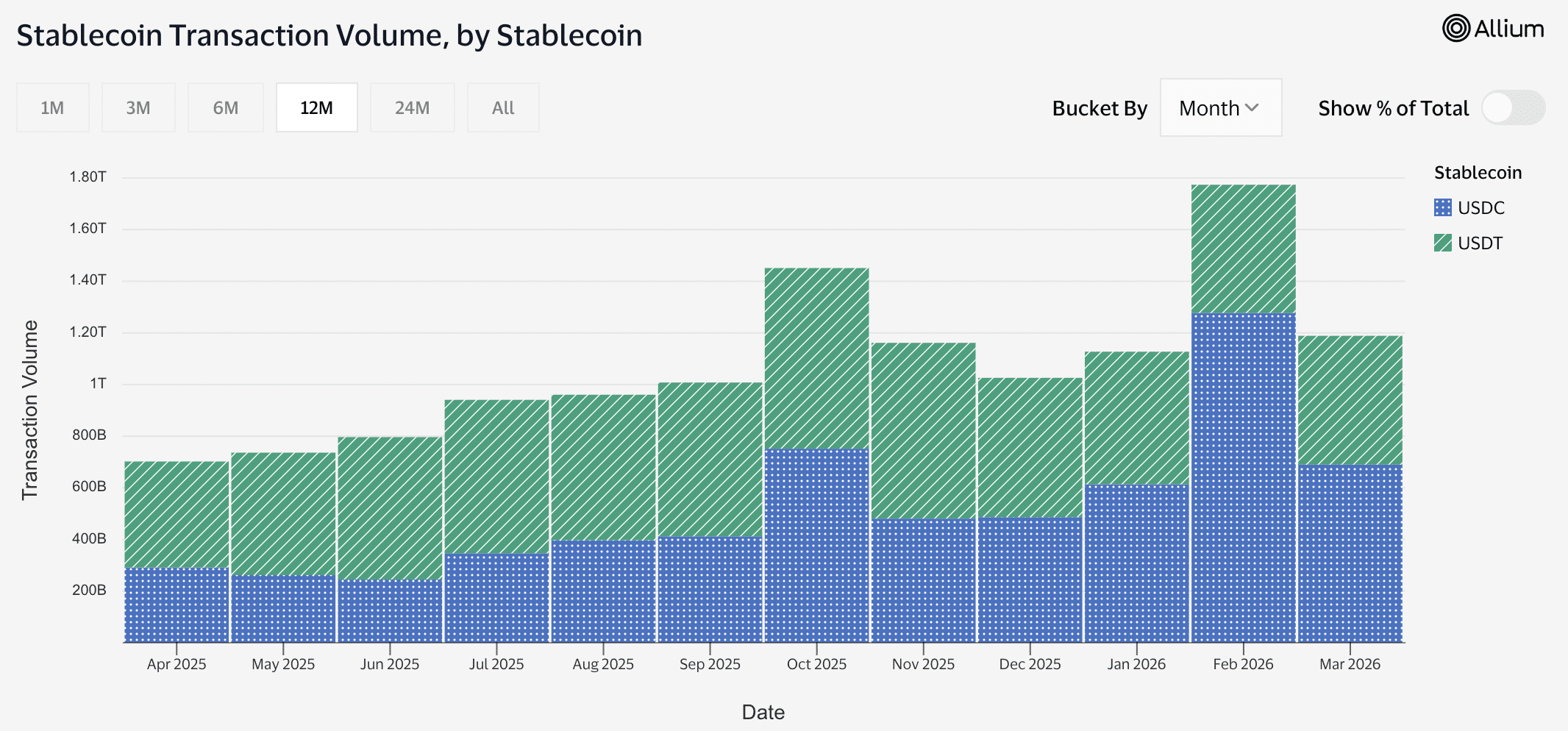
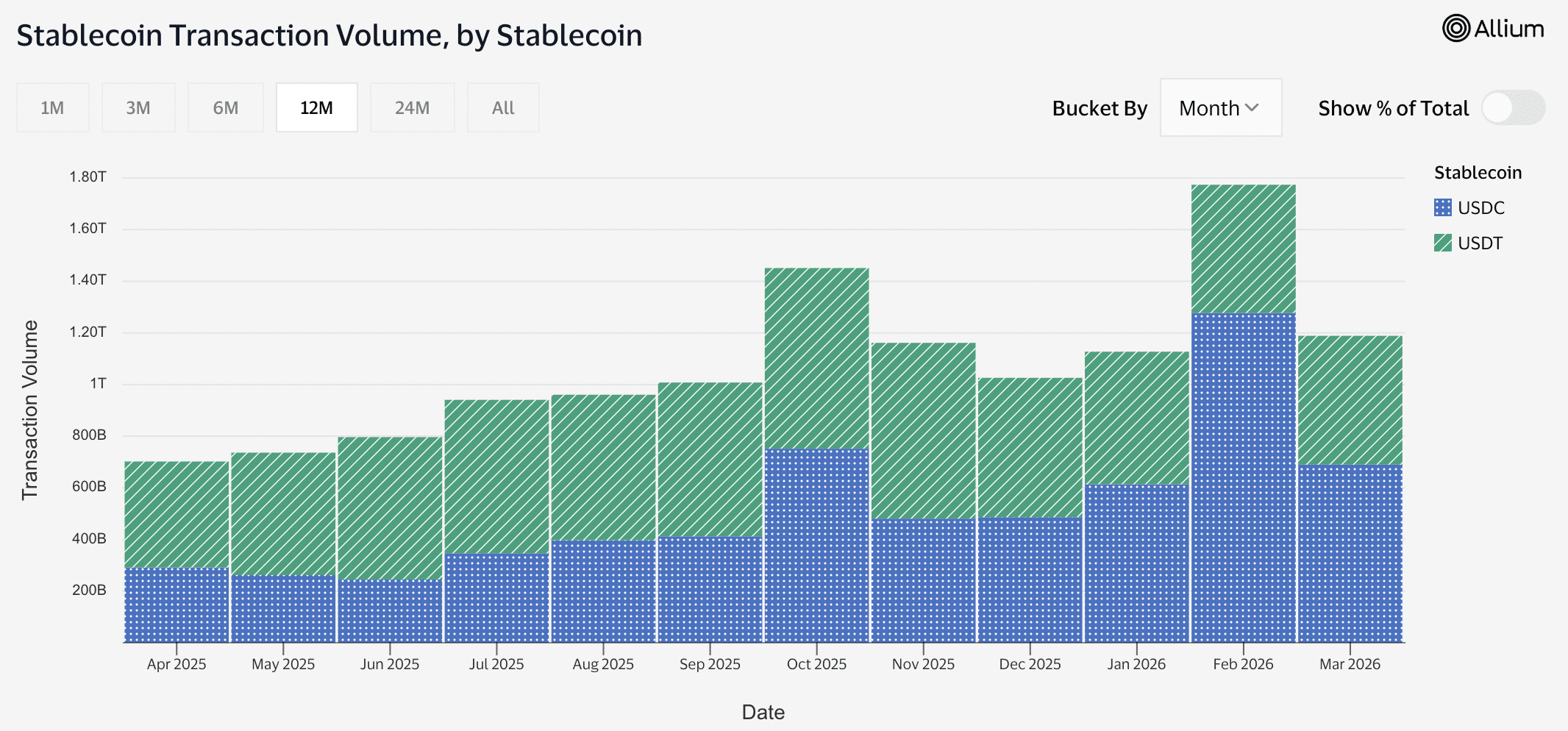
Source: Visa on-chain analytics

This rise in USDC signals a shift away from pure speculation toward more reliable systems, something Circle is now bringing to markets like Africa.

Regulatory clarity and more

While Circle expands into Africa, its position in the United States has become shaky due to new regulations.

In 2025, the GENIUS Act gave a positive direction for stablecoins by supporting dollar-backed digital assets. But now, the upcoming CLARITY Act is creating fresh concerns.

This has made investors nervous, as it could directly impact how companies like Circle generate revenue. As a result, Circle’s stock (CRCL) recently saw a sharp drop of nearly 20% on the 24th of March, closing at $101.17.

All this together shows that Circle is at a turning point, dealing with regulatory challenges in the U.S. while building a strong, usage-driven future in markets like Africa.


Final Summary

  • Integrating USDC into Sasai’s mobile network could cut remittance costs and speed up settlements.
  • The rising competition between USDC and USDT reflects demand for transparency and regulatory alignment.


Perguntas relacionadas

QWhat is the primary goal of Circle's partnership with Sasai Fintech in Africa?

AThe primary goal is to tackle the challenges of slow, costly, and inefficient cross-border payments by integrating USDC into Sasai's mobile platform to make transactions faster, cheaper, and more reliable.

QAccording to the article, what significant shift in the stablecoin market does the rise of USDC signal?

AThe rise of USDC signals a shift away from pure speculation toward more reliable and transparent systems for cross-border payments and remittances.

QWhat recent U.S. regulatory development has created concerns for Circle and its investors?

AThe upcoming CLARITY Act has created fresh concerns and investor nervousness, as it could directly impact how companies like Circle generate revenue, contributing to a sharp drop in its stock price.

QHow much transaction volume have stablecoins handled over the past year, as mentioned in the article?

AStablecoins have handled a huge $70.2 trillion in transactions over the past year.

QWhich two key benefits does the article suggest the USDC integration will bring to African markets?

AThe integration is expected to cut remittance costs and speed up settlement times for cross-border payments.

Leituras Relacionadas

Can a Hair Dryer Earn $34,000? Deciphering the Reflexivity Paradox in Prediction Markets

An individual manipulated a weather sensor at Paris Charles de Gaulle Airport with a portable heat source, causing a Polymarket weather market to settle at 22°C and earning $34,000. This incident highlights a fundamental issue in prediction markets: when a market aims to reflect reality, it also incentivizes participants to influence that reality. Prediction markets operate on two layers: platform rules (what outcome counts as a win) and data sources (what actually happened). While most focus on rules, the real vulnerability lies in the data source. If reality is recorded through a specific source, influencing that source directly affects market settlement. The article categorizes markets by their vulnerability: 1. **Single-point physical data sources** (e.g., weather stations): Easily manipulated through physical interference. 2. **Insider information markets** (e.g., MrBeast video details): Insiders like team members use non-public information to trade. Kalshi fined a剪辑师 $20,000 for insider trading. 3. **Actor-manipulated markets** (e.g., Andrew Tate’s tweet counts): The subject of the market can control the outcome. Evidence suggests Tate’sociated accounts coordinated to profit. 4. **Individual-action markets** (e.g., WNBA disruptions): A single person can execute an event to profit from their pre-placed bets. Kalshi and Polymarket handle these issues differently. Kalshi enforces strict KYC, publicly penalizes insider trading, and reports to regulators. Polymarket, with its anonymous wallet-based system, has historically been more permissive, arguing that insider information improves market accuracy. However, it cooperated with authorities in the "Van Dyke case," where a user traded on classified government information. The core paradox is reflexivity: prediction markets are designed to discover truth, but their financial incentives can distort reality. The more valuable a prediction becomes, the more likely participants are to influence the event itself. The market ceases to be a mirror of reality and instead shapes it.

marsbitHá 47m

Can a Hair Dryer Earn $34,000? Deciphering the Reflexivity Paradox in Prediction Markets

marsbitHá 47m

First Day Review of "Musk's WeChat" XChat: Even Worse Than Expected

Elon Musk's much-anticipated "WeChat-like" app, XChat, has officially launched after multiple delays. The initial review reveals a product that falls short of expectations, offering an experience largely similar to X Platform's (formerly Twitter) direct messages, despite being marketed as an encrypted communication tool. Key observations from the first-day test include: 1. The app's promoted "end-to-end encryption" and its claimed relation to Bitcoin's architecture were criticized by experts as a superficial attempt to capitalize on crypto buzz, with no real technical connection. 2. Musk's vision of an ad-free "secure communication system" is technically met, but only because the app is currently extremely basic, featuring only a single chat interface. 3. A promised anti-screenshot feature appears inconsistent; it works in X Platform group chats but fails within the XChat app itself, where screenshots still capture avatars. 4. The app supports 45 languages and has a 16+ age rating, indicating a broader tolerance for content compared to WeChat's 13+ rating. 5. A puzzling login process requires users to verify the email associated with their X account. 6. The touted encryption" feels minimal in practice, with its presence only indicated by a simple "Encrypted - Yes" label on messages. 7. Disappearing message timers for groups can be set from 5 minutes to 4 weeks, with the timer starting upon being read by a user. 8. Group invite links are shared with X Platform groups. 9. Group size limits are planned to be increased, aiming for 1000 members, a move that has drawn user criticism. 10. The app offers 8 different colored icons, and its chat bubbles are notably similar to WeChat's. Message deletion options mimic Telegram's. Crucially, many pre-announced features like importing X contacts, integrating Grok AI, X Money payments, and Cashtags are not yet available. The initial release is seen as a bare-bones and underwhelming first step.

Odaily星球日报Há 1h

First Day Review of "Musk's WeChat" XChat: Even Worse Than Expected

Odaily星球日报Há 1h

Trading

Spot
Futuros
活动图片




