US Treasury Starts GENIUS Act Rollout With Notice Of Proposed Rulemaking

bitcoinistPublicado em 2026-04-02Última atualização em 2026-04-02

Resumo

The US Treasury has published a Notice of Proposed Rulemaking (NPRM) to begin implementing the GENIUS Act, a federal law governing payment stablecoins. The 87-page proposal outlines how federal and state regulatory frameworks will interact, allowing states to adopt "substantially similar" rules with some discretion. The NPRM references the OCC’s flexible approach to regulating stablecoin issuers and sets a transition timeline: once the law takes effect, only authorized issuers can operate, and by July 2028, unlicensed stablecoin sales will be illegal. The proposal also preserves a state-option pathway for smaller issuers with under $10 billion in issuance, provided states certify regulatory alignment. Treasury is soliciting public feedback on the proposed rules.

The US Treasury on Wednesday published a notice of proposed rulemaking (NPRM) that launches the administration’s first formal effort to implement the GENIUS Act, the new federal law governing payment stablecoins that was signed by President Donald Trump last year.

The NPRM is the Treasury’s initial regulatory proposal to give effect to the statute’s requirements and solicits public comment on how the department intends to apply the law.

GENIUS Act’s Proposed Rules

Under the GENIUS Act — formally titled the Guiding and Establishing National Innovation for US Stablecoins Act — Treasury is charged with setting out, through notice-and-comment rulemaking, high-level principles for assessing whether a state regulatory regime is “substantially similar” to the federal framework.

The department’s 87-page proposed rule explains how it expects federal and state authorities to interact under the new regime and identifies matters on which Treasury seeks input from stakeholders.

Treasury’s proposal signals that it anticipates states will look to federal guidance, including standards the Office of the Comptroller of the Currency (OCC) has proposed, when deciding how prescriptive their own rules should be.

The NPRM cites the OCC’s approach, which the OCC says is intended to be flexible and calibrated to the nature, scope, and risks posed by a permitted payment stablecoin issuer’s activities.

Treasury’s draft leaves room for states to adopt principles-based requirements, indicating that state regulators will have discretion to design standards for issuers who qualify under a state regime.

The ultimate effects will depend on the specific content of each state’s regulatory regime, which the proposal anticipates could vary widely because the GENIUS Act grants states discretion in implementing their own frameworks.

Treasury Draft Sets Timeline

The draft rule also sets out the transition timeline and market consequences contemplated by the statute. Once the GENIUS Act takes effect, entities will be barred from issuing payment stablecoins in the United States unless they are authorized as permitted payment stablecoin issuers.

In addition, the statute makes it unlawful, beginning July 18, 2028, for digital asset service providers to offer or sell unlicensed stablecoins to persons located in the United States.

To preserve a state-option pathway for smaller issuers, the law allows a state to license payment stablecoin issuers with a consolidated total outstanding issuance of no more than $10 billion, but only if the state certifies that its regulatory regime is substantially similar to the federal framework.

Taken together, the department is seeking public input on the proposal’s details as it moves toward finalizing rules intended to implement the GENIUS Act’s structure for supervision, licensing, and consumer protections in the stablecoin market.

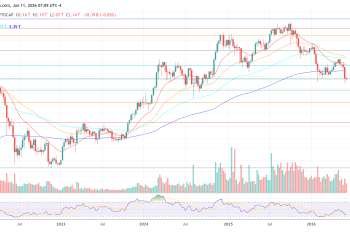
The daily chart shows the total crypto market cap’s recovery toward $2.35 trillion on Wednesday. Source: TOTAL on TradingView.com

Featured image from OpenArt, chart from TradingView.com

Perguntas relacionadas

QWhat is the GENIUS Act and what is its full formal title?

AThe GENIUS Act is a new federal law governing payment stablecoins. Its full formal title is the 'Guiding and Establishing National Innovation for US Stablecoins Act'.

QWhat action did the US Treasury take to begin implementing the GENIUS Act?

AThe US Treasury published a Notice of Proposed Rulemaking (NPRM), which is its initial regulatory proposal to implement the statute and is soliciting public comment on its application.

QWhat is the key deadline set by the statute for digital asset service providers regarding unlicensed stablecoins?

ABeginning July 18, 2028, it will be unlawful for digital asset service providers to offer or sell unlicensed stablecoins to persons located in the United States.

QWhat is the maximum issuance limit for a state to license smaller payment stablecoin issuers under the 'state-option pathway'?

AA state can license payment stablecoin issuers with a consolidated total outstanding issuance of no more than $10 billion, provided the state certifies its regulatory regime is substantially similar to the federal framework.

QWhich federal agency's approach does the NPRM cite as a model for states to consider when designing their own rules?

AThe NPRM cites the approach of the Office of the Comptroller of the Currency (OCC), which is intended to be flexible and calibrated to the risks of a stablecoin issuer's activities.

Leituras Relacionadas

Can Generative Models Finally Be Trained End-to-End? The Core Is a For Loop

This article introduces a novel training paradigm for generative models called Explorative Modeling (XM), which enables true end-to-end training. Traditionally, powerful generative models like autoregressive and diffusion models are not trained end-to-end. They are trained to predict a single small step but require iterative multi-step sampling for inference. This "exposure bias" leads to error accumulation and limits performance. The core challenge XM addresses is "mode blurring." In generative tasks, a single input (e.g., "generate a dog") corresponds to many valid outputs (multiple modes). Standard training objectives like reconstruction loss force the model to average these modes, producing unrealistic, blurry outputs. To avoid this, existing models break generation into many small, almost deterministic steps, sacrificing end-to-end training. XM tackles this by restructuring the training loop itself. Its key insight is to amplify "generative expressivity." For each training input, instead of generating one sample, the model generates K candidate outputs. Only the candidate closest to the real data is used for computing the loss and updating the model via backpropagation. This simple "best-of-K" mechanism is implemented as a short for-loop. By exploring multiple possibilities, the model learns to distribute its guesses across different modes rather than collapsing to their uninformative average. The paper demonstrates that "exploration" acts as a new, powerful scaling axis. Gains from XM increase with model size, data scale, and compute. Experiments show improvements in FID scores for image generation and significant efficiency gains, sometimes outperforming larger models without exploration. When pushed to the limit, XM enables fully single-step, end-to-end generative models. In robotics tasks, an "Explorative Policy" matched the performance of a 100-step Diffusion Policy with a single forward pass, drastically improving inference speed. While the best-of-K concept is not entirely new, the authors' contribution lies in formally understanding it as a direct method to boost generative expressivity without fragmenting the generation process. This work suggests that as models scale, enhancing exploration during training may become crucial for overcoming fundamental performance bottlenecks.

marsbitHá 48m

Can Generative Models Finally Be Trained End-to-End? The Core Is a For Loop

marsbitHá 48m

Annual Salary of Millions Competing for Electricians, Meta Rushes to Open Its Own Technical School

The AI boom is facing an unexpected bottleneck: a severe shortage of skilled construction workers and electricians. As tech giants like Meta, OpenAI, and Alphabet race to build massive data centers—such as OpenAI's $16 billion "Stargate" project—they are hitting a critical labor wall. The U.S. needs an estimated 130,000 more electricians, 240,000 construction workers, and 150,000 supervisors by 2030 for AI infrastructure alone, but tens of thousands of electrician jobs go unfilled each year. While AI companies offer high premiums, with electricians earning up to $280,000 annually, worker scarcity still causes massive losses—delays on a single project can cost $14.2 million per month. The complexity of building AI data centers, which require immense power (equivalent to powering hundreds of thousands of homes), sophisticated electrical systems, and advanced liquid cooling solutions, demands highly skilled technicians who are in short supply. To combat this, companies are investing heavily in training. Meta has committed $115 million to a free training school offering tuition, housing, and stipends, targeting 5,000 new workers. OpenAI is partnering with unions to secure skilled labor. These efforts are paying off, with a significant rise in Gen Z interest in trade schools over college. However, the power demands are staggering. AI data centers are driving a rapid surge in electricity consumption, projected to account for up to 12% of U.S. power use by 2028 and raising costs for consumers. Furthermore, the construction boom is project-based, leading to a potential future glut of trained workers once building peaks, which could depress wages industry-wide. The race for AI supremacy now depends as much on skilled hands as on advanced chips.

marsbitHá 2h

Annual Salary of Millions Competing for Electricians, Meta Rushes to Open Its Own Technical School

marsbitHá 2h

Trading

Spot
活动图片