US Tech Sector Volatility Catalyzes a 2026 Strategy Shift Toward $LIQUID Infrastructure

bitcoinistPublicado em 2026-02-09Última atualização em 2026-02-09

The narrative governing global capital markets is shifting. Violently. For the past eighteen months, the ‘AI trade,’ dominated by Nvidia, Microsoft, and the overarching US tech sector, sucked the oxygen out of every room in finance. But with recent earnings volatility and fears of a capex bubble, institutional allocators are eyeing the exit. The question isn’t if a rotation is coming; it’s where the money goes next.

Data suggests the answer isn’t traditional defensive stocks. It’s ‘liquid infrastructure.’

As US tech equities face headwinds from high interest rates, smart money is looking at the plumbing of the decentralized internet. The logic is simple (and overdue): while consumer apps like meme coins are volatile, the infrastructure connecting them acts as a toll road. In crypto, that means protocols solving the industry’s most expensive headache: fragmentation.

Right now, liquidity is trapped in silos. Bitcoin holds over $1.5T; Ethereum dominates DeFi; Solana owns the retail flow. They don’t speak to each other. The rotation predicted for 2026 isn’t just about buying tokens; it’s about investing in the unification layers that let capital move without friction. Enter the Layer 3 (L3) projects fusing these disparate chains to capture the value of the next cycle. Projects like LiquidChain ($LIQUID).

The New Risks of AI Disruption

Beyond infrastructure, investors are grappling with the fact that AI is beginning to ‘disrupt the disruptors.’ There is growing concern that new AI tools, such as recent automations in legal work, could eventually automate away the need for traditional software entirely. Furthermore, while current earnings remain stable, uncertainty is mounting regarding future profit margins due to the historic levels of capital expenditure required to sustain the AI boom.

The Institutional Case for Unified Liquidity Layers

Current friction costs are unsustainable. A trader moving assets from Bitcoin to Solana currently faces a gauntlet of wrapped asset risks, bridge hacks, and slippage that can erode margins by 3-5%. Sound efficient? Hardly. This fragmentation is the primary bottleneck choking off true mass adoption.

LiquidChain has emerged as the direct response. By architecting a Layer 3 protocol specifically as a ‘Cross-Chain Liquidity Layer,’ it creates a single environment where Bitcoin, Ethereum, and Solana exist on the same plane. That matters for one reason: it shifts the value proposition from pure speculation to actual utility.
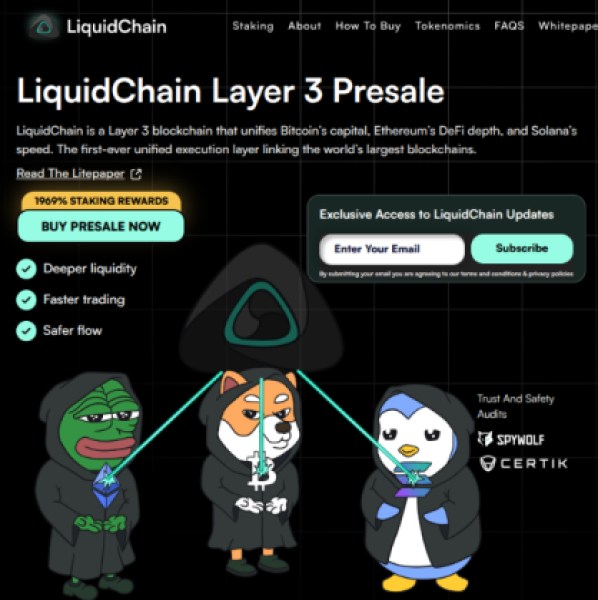
For developers, the appeal of LiquidChain’s ‘Deploy-Once Architecture’ is immediate. Instead of writing separate codebases for Rust and Solidity, builders can launch apps on LiquidChain that access users from both giants, plus Bitcoin. It effectively solves the ‘cold start’ problem for new dApps.

From a market structure perspective, this consolidation is critical. If 2024 was the year of the Layer 2 wars, 2026 is shaping up to be the era of Layer 3 aggregation. The protocol’s ability to offer ‘Single-Step Execution’ means complex strategies, previously impossible for compliance-focused institutions due to counterparty risk, finally become viable.

LEARN MORE ABOUT LIQUIDCHAIN ON ITS OFFICIAL PRESALE SITE

LiquidChain ($LIQUID) Presale Data Signals Early Infrastructure Demand

While the broader market stares at Bitcoin’s daily candles, early allocators are positioning themselves in infrastructure. The on-chain data for LiquidChain supports this rotation thesis.

$LIQUID has already raised over $532K. That number isn’t just significant for its size; it’s about timing. Raising over half a million dollars during macro uncertainty signals high-conviction capital. Investors are buying the thesis, not the hype.

At the current presale price of $0.0136, the market treats $LIQUID as a venture bet with asymmetric upside compared to established L1s. The tokenomics look designed to incentivize deep liquidity, a must for any protocol claiming to unify $BTC and $ETH. By using a Cross-Chain VM, the network uses the $LIQUID token as transaction fuel across the merged ecosystem. If usage scales, so does buy pressure.

The risk? Execution. Building a secure L3 that handles native Bitcoin assets without wrapping is technically demanding. But if the protocol succeeds in becoming the liquidity router for the 2026 cycle, that $0.0135 entry point might look like a steal relative to the value of the flows passing through the network.

BUY LIQUIDCHAIN ($LIQUID) HERE.

The content of this article is for informational purposes only and does not constitute financial advice. Cryptocurrency investments, particularly in presale stages and new infrastructure protocols, carry high risks, including total loss of capital. Always perform your own due diligence.


Perguntas relacionadas

QWhat is the main investment shift discussed in the article, and why is it happening?

AThe main investment shift is from the dominant 'AI trade' and US tech stocks towards 'liquid infrastructure.' This is happening due to recent earnings volatility in the tech sector, fears of a capex bubble, and the unsustainable fragmentation of liquidity across different blockchain silos like Bitcoin, Ethereum, and Solana.

QWhat problem does LiquidChain aim to solve in the crypto ecosystem?

ALiquidChain aims to solve the problem of fragmented liquidity and high friction costs in the crypto ecosystem. It addresses issues like wrapped asset risks, bridge hacks, and slippage that occur when moving assets between different blockchains by creating a unified Layer 3 cross-chain liquidity layer.

QWhat technological feature does LiquidChain offer to attract developers?

ALiquidChain offers a 'Deploy-Once Architecture,' which allows developers to launch applications that can access users and liquidity from multiple major blockchains (like Bitcoin, Ethereum, and Solana) without needing to write separate codebases for each, effectively solving the 'cold start' problem for new dApps.

QWhat does the article cite as a new risk associated with the AI sector?

AThe article cites that AI is beginning to 'disrupt the disruptors,' with growing concerns that new AI tools could automate away the need for traditional software. There is also mounting uncertainty about future profit margins due to the historic levels of capital expenditure required to sustain the AI boom.

QWhat does the early presale data for $LIQUID indicate about investor sentiment?

AThe early presale data, which shows over $532K raised during a period of macro uncertainty, indicates that investors are making high-conviction bets on the infrastructure thesis rather than speculative hype. It signals a strategic rotation of capital into projects that solve fundamental problems like liquidity fragmentation.

Leituras Relacionadas

Agents Take Over Traffic Distribution Power: What Are Tencent, ByteDance, and Alibaba Competing For?

In the race to dominate the AI era's entry point, China's tech giants—Tencent, ByteDance, and Alibaba—are aggressively deploying AI Agents to control the future of traffic distribution. Alibaba is pursuing a dual-track "closed loop + openness" strategy. Its Qianwen app is evolving into a super-Agent integrated across its ecosystem (Taobao, Alipay, etc.) to handle complex tasks like travel planning. Concurrently, it is opening its platform to external brands (Luckin Coffee, KFC) and has launched a B2B Agent platform, "Wukong," targeting enterprise automation. Its other flagship, Quark, aims to be an "AI super search box" for information and tasks. ByteDance is executing an omnipresent "sprawl strategy." Its Doubao app boasts over 300 million monthly active users and is evolving into a default AI entry point for daily life, with plans for paid versions and e-commerce integration. Its core weapon is the Kouzi platform, a visual "AI assembly factory" for developers to build custom Agents. ByteDance is also pushing hardware integration, collaborating on AI phones and developing smart glasses to embed Doubao everywhere. Tencent is playing its long-held "ultimate card" by quietly embedding an AI Agent directly into WeChat. This Agent, accessible via a swipe, can understand user commands and automatically execute tasks by calling upon WeChat's millions of mini-programs (e.g., finding and ordering coffee). This leverages WeChat's unparalleled 1.4-billion-user ecosystem to position the app as an AI-powered "service operating system," a move that could dramatically reshape the competitive landscape. The core battleground is shifting from competing for "user screen time" to competing to be the "default execution layer" for user intent. The business model is evolving from an "attention economy" to an "intent economy," where the Agent that can most efficiently fulfill a user's need gains control over service access and token flow. This represents a fundamental change in how users connect with digital services, making the fight for the Agent入口 (entry point) a pivotal moment for redefining industry leadership in the AI age.

marsbitHá 10m

Agents Take Over Traffic Distribution Power: What Are Tencent, ByteDance, and Alibaba Competing For?

marsbitHá 10m

From Banning Doubao to Embracing Honor: Why Did WeChat Suddenly 'Change Its Face'?

The article explores the sudden shift in WeChat's strategy towards AI assistants from mobile phone manufacturers, transitioning from strict opposition to active collaboration. For over a year, WeChat fiercely resisted attempts by phone AI assistants (like ByteDance's Doubao in late 2025) to control its features via GUI automation ("simulated clicking"), citing security and data control concerns. This stance created a significant barrier for system-level AI integration. Now, Tencent has initiated A2A (Agent-to-Agent) partnerships with major phone brands like Honor, Xiaomi, OPPO, and vivo. This model allows a phone's system AI (e.g., Honor's YOYO) to parse a user's voice command and send a structured request directly to WeChat's own internal AI agent via secure APIs. WeChat then executes the action (e.g., sending a message) and returns the result. The article attributes Tencent's "change of face" to strategic pressure. While leading in social app usage, Tencent trails rivals like ByteDance and Alibaba in standalone AI app popularity. WeChat, with its vast mini-program ecosystem, is Tencent's key asset for an AI comeback. The upcoming WeChat AI agent aims to handle tasks like booking and payments within the app. However, phone system assistants remain the primary AI entry point for most users. The A2A collaboration allows Tencent to extend WeChat's AI reach to this crucial system layer while maintaining control over its core functions and data. For phone manufacturers, embracing A2A is a pragmatic move. The GUI route proved unviable due to WeChat's blocks. A2A offers a compliant path to integrate a vital service, enhancing their AI assistants' usefulness. It allows them to focus on developing their own AI ecosystems for other services while cooperating on WeChat access. The collaboration is framed as a mutual, strategic necessity: Tencent gains a distribution channel, and manufacturers gain a key functionality. The partnership relies on a "dual authorization" mechanism for security, requiring both user and app consent for each action. While questions about long-term data privacy practices remain, experts note A2A is more secure and compliant than GUI automation. Ultimately, this cooperation is seen as a tentative, calculated truce. Tencent's long-term goal is to make WeChat an AI-powered "service OS." Phone manufacturers aim to make their system AI the central user interface. Their paths may converge or clash in the future, but for now, the A2A deal represents the opening chapter in the battle for the AI-era user入口, driven by necessity and strategic calculus on both sides.

marsbitHá 1h

From Banning Doubao to Embracing Honor: Why Did WeChat Suddenly 'Change Its Face'?

marsbitHá 1h

On-Chain Figures on the Eve of Kickoff: 1.6 Billion Traded Before the World Cup Even Begins

"On-Chain Numbers on the Eve of the World Cup: $1.6 Billion Traded Before Kick-off" Analysis of on-chain markets before the 2026 FIFA World Cup reveals significant crypto integration into football. The most striking figure is the approximately **$1.6 billion** in total trading volume on the single "World Cup Winner" contract on the Polymarket prediction market platform, accumulated before a single match was played. This represents explosive growth for a sector whose annual volume surged from ~$16B in 2024 to ~$64B in 2025. The ecosystem is maturing beyond speculation. Key developments include: 1) **Infrastructure upgrades** like Polymarket's migration to native, regulated USDC stablecoin for settlements; 2) **Reliable data oracles**, such as Chainlink, being used to resolve real-world match outcomes on-chain; and 3) **Official recognition**, with FIFA appointing its first-ever "Prediction Markets" partner. Over 100 contracts now cover everything from the outright winner to individual match results and even non-sporting risks like venue relocation. This evolution marks a fundamental shift. While crypto firms are absent from FIFA's top-tier sponsor list, the technology has deeply penetrated the tournament's financial and predictive infrastructure through regulated stablecoin settlements, decentralized oracles, and new official partnership categories. The regulatory landscape remains complex and varies by jurisdiction, but on-chain markets for the World Cup are already a multi-billion-dollar reality.

marsbitHá 2h

On-Chain Figures on the Eve of Kickoff: 1.6 Billion Traded Before the World Cup Even Begins

marsbitHá 2h

Trading

Spot
Futuros
活动图片




