US Stock Market Signal Master Serenity: Leading Institutions in Low Position Building, Annual Return 3840%

marsbitPublicado em 2026-05-26Última atualização em 2026-05-26

Resumo

Serenity, an anonymous online trading figure known as the "Stock Call King," has gained significant attention by reportedly achieving staggering annual returns of 3840% in 2026 and 2256% over two years. Operating primarily on social media platform X, he shares free investment insights focused on the AI and semiconductor supply chains. His core strategy, the "Chokepoint" investment theory, involves identifying small, critical "bottleneck" companies within the AI infrastructure that are essential yet undervalued before major institutional investment. Examples include his multi-year call on stock AXTI, which saw gains exceeding 10,000%. Despite his popularity, Serenity's true identity and the specific dollar amounts behind his percentage gains remain undisclosed, leading to some skepticism. Critics question if he manipulates low-market-cap stocks, while supporters see him as disrupting traditional finance by providing free, high-quality research. He advocates against paid communities and emphasizes that his goal is to empower retail investors with information before institutional players act. Whether Serenity represents a genuine market visionary or a sophisticated narrative-driven player remains an open question debated by his followers and observers.

Author|Golem(@web 3_golem)
As an investor focusing on US AI and semiconductor stocks, if you haven't heard of Serenity, chances are your investment research is still at a novice level.

Why do we say that? Because he is currently the hottest US stock signal master online. From retail investors to Wall Street, almost everyone is reading his reports and copying his trades. Some even package his publicly free insights into paid courses within communities.

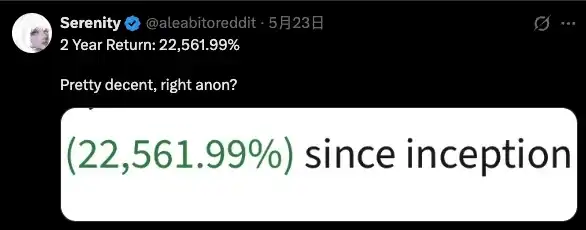
On May 24, Serenity announced his investment performance for the year on platform X: an annualized return rate of 3840.39%; just the day before, he also posted his investment return rate for the past two years, which reached as high as 2256.99%.
The "Far Ahead" Serenity

Serenity only joined X in July 2025, but by May this year, his follower count had surged to 358,000, with over 32,000 subscribers—less than 15,000 shy of Elon Musk's subscriber count. Yet, no one knows Serenity's real identity to this day. Public knowledge about his background comes only from his self-written bio:

  • Former famous trader from Reddit WSB, now on X (Odaily note: Wall Street Bets is the largest retail trading community in the US; Serenity was banned in 2022 for recommending a stock with the ticker AXTI, which has since risen over 700% year-to-date);
  • AI and semiconductor supply chain analyst, former RISC-V Foundation member, former AI research scientist;
  • Currently primarily trades "the overlooked bottlenecks."

From this bio, it's clear Serenity positions himself as an expert in the AI field. He has even claimed to have rejected an offer from Nvidia's AI team in 2018. Serenity once stated in a post that his investment approach is also based on a thorough understanding and research of the AI and semiconductor industries. His typical investment research process is: first, conduct initial thesis research; then transform these ideas into actionable plans and trades; followed by subsequent due diligence on the Alpha; and finally, celebrate when the stock price rises.

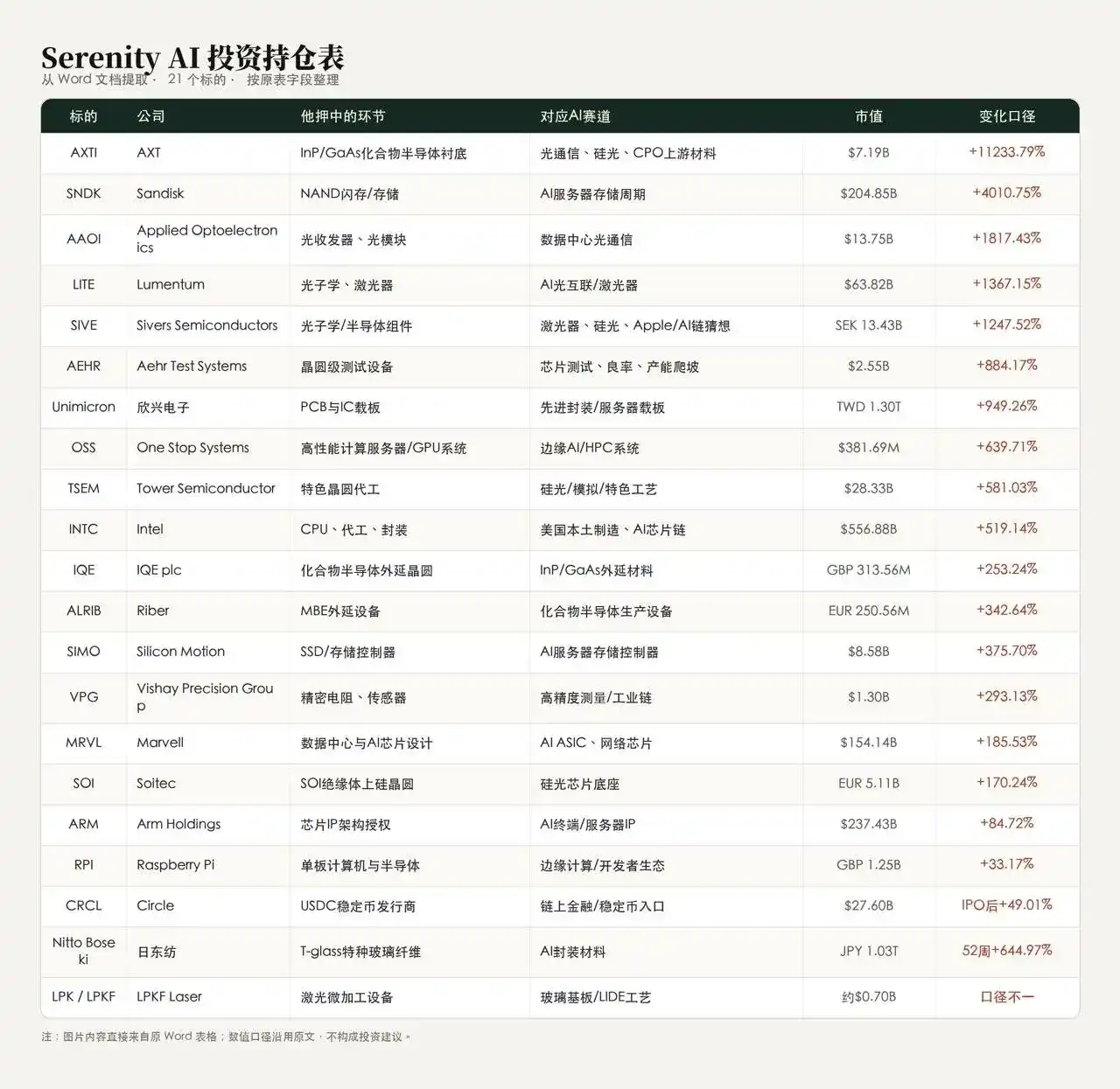
As shown in the image below, community user @kaikaibtc compiled a list of Serenity's main stock holdings, which are mainly concentrated in sectors within the AI industry chain such as optical modules, silicon photonics, storage, CPO, and substrates. None of these 21 stocks have returns below 100%, with AXTI—the stock Serenity most frequently mentions and has been signaling for over two years—showing returns even exceeding 10000%. He has publicly stated that AXTI is his most legendary trade.
However, what's perhaps more impressive than these exaggerated returns is that before Serenity identified these targets, not only had retail investors not noticed them, but institutional players hadn't entered the market either.

When Serenity posted signals for specific stocks in the past, he was often met with skepticism. It was only months or even a year later, when investors witnessed the stocks' dramatic performance, that they realized he was right—RPI, AXTI, SIVE, etc., are vivid examples. After such cases repeated, the Serenity account naturally became a must-read for retail investors, Wall Street, and even Silicon Valley investors daily.

How does Serenity always stay ahead of the market and unearth those undervalued stocks? The secret lies in his self-developed investment theory focusing on supply chain bottlenecks (Chokepoints).

The Chokepoint Investment Method

Chokepoint is the most frequently appearing word in Serenity's posts and is the core of his investment logic.

AI is undoubtedly the dominant global narrative today, but the AI industry faces a clear supply-demand imbalance. On one hand, internet giants are frantically investing in AI infrastructure in a "military-style arms race"; on the other hand, the supply side is clearly insufficient, with Nvidia orders even entering a "rationing system." Therefore, capital has also realized that the current stage of AI development is not about downstream applications but the upstream supply chain. Whoever occupies a crucial position in the AI supply chain, whoever achieves irreplaceability, deserves to be repriced.

Thus, over the past few months, the market's hype around the AI industry has been progressively deconstructing the supply chain from the initial GPU computing power. The second layer includes storage, data centers, optical modules; further down are power, materials, network equipment, etc. This layered deconstruction of the AI supply chain to find key "chokepoint" companies at each stage is essentially Serenity's Chokepoint investment method, except he acted on it much earlier than most retail and institutional investors.

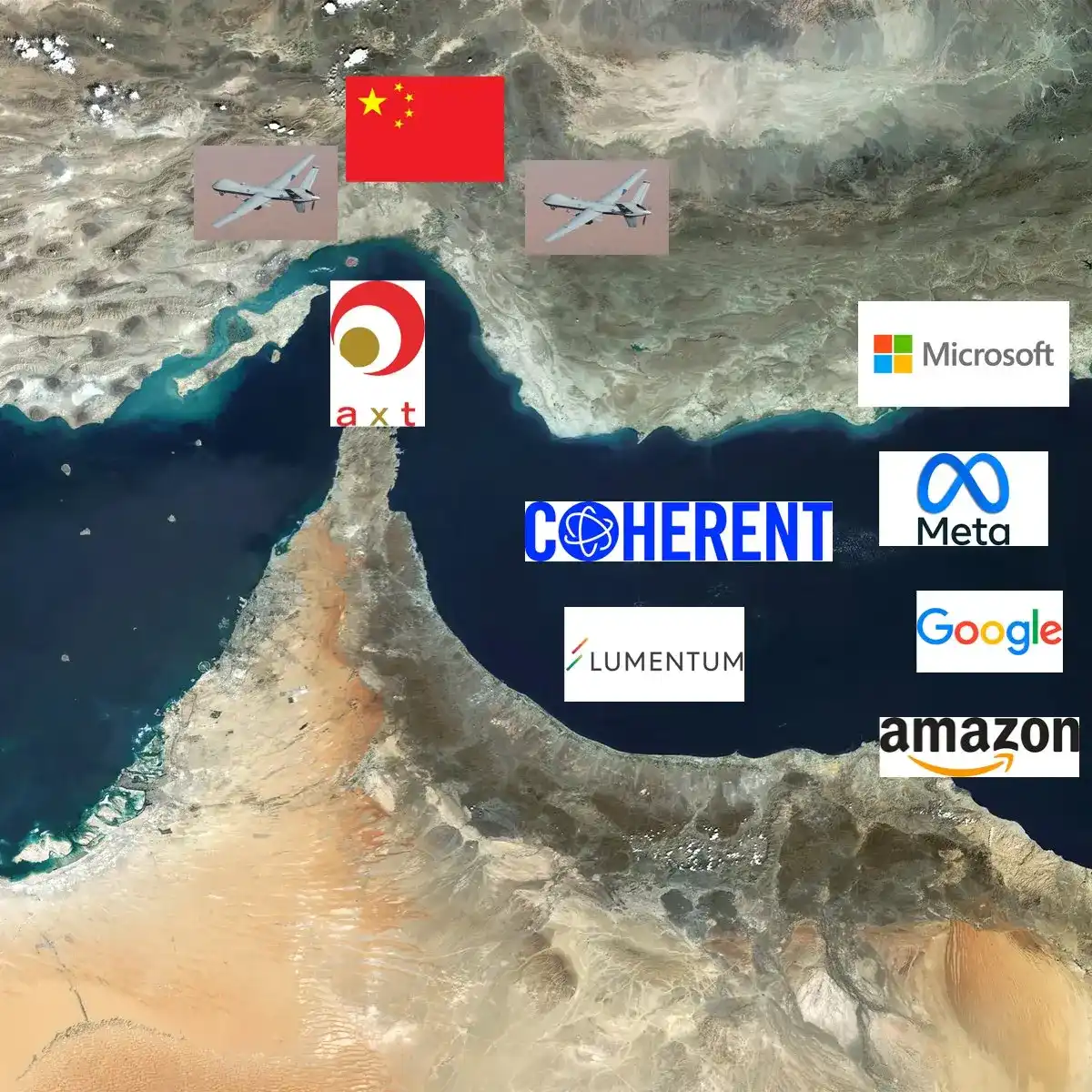
On March 31, when signaling AXTI, Serenity used an analogy to vividly explain what a chokepoint is. He compared it to the Strait of Hormuz. Over 20% of the world's crude oil supply passes through the Strait of Hormuz, making it a critical chokepoint in global energy trade. Similarly, AXTI's relation to AI optical module companies is akin to the Strait of Hormuz's relation to global energy trade.
The essence of Serenity's ability to obtain excess returns still stems from information asymmetry in the market. It's about using keen insight and foresight to find the "hidden champions" within the AI industry chain that are not fully priced in. These companies are not as glamorous as giants like Nvidia, Micron, or SK Hynix, but they are small-scale monopolies whose shortage or shutdown could cause an earthquake in the downstream trillion-dollar AI industry.

For example, when signaling IQE in February-March this year, Serenity repeatedly stated that both IQE and Landmark are major outsourced epitaxial wafer foundries for photonic chips. However, IQE's overall production capacity is much larger than Landmark's. At that time, Landmark's market cap was around $3.8 billion, while IQE's market cap was only $135 million.

It's worth mentioning that Serenity is not superhuman, knowing every detail of the AI supply chain. He frequently mentions using AI assistance for AI supply chain research, including dissecting the industry chain, uncovering suppliers, and debating ideas with AI.

True Legend or "Photoshop Master"

In the investment field, deifying any individual is extremely dangerous. Serenity's win rate is not 100%. Stocks he recommended earlier this year, like CPSH and INFQ, also experienced significant pullbacks in February and March. Rather than blindly copying his portfolio, retail investors and market participants should learn his research framework and mindset to develop their own systems and ultimately find their own Alpha.

Serenity is also a person with strong idealism and a mysterious aura. All his publicly available personal information lacks third-party verification, and no one even knows his gender. The only private information he has revealed is that he lives an international digital nomad life, currently in Japan learning Japanese; he also lived briefly in mainland China, so he knows some Chinese, and frequently travels to countries like South Korea, the UK, Singapore, and Canada, claiming to have visited at least 28 countries.

Since Serenity only shows return rates and not live trading records, some have questioned whether his profits might be fabricated. Serenity's response to this is: "The reason for not disclosing specific amounts is because the amount is not important." He only wants to prove that users can discover purely valuable information from free posts, and market return rates expressed as percentages are best suited to validate an argument. He also stated that he strongly dislikes traditional KOLs who flaunt money, luxury watches, cars, and private jets.

Opposing paywalls or paid communities is also a distinctive feature of Serenity. Most of Serenity's core market research is published on X, accessible for anyone to read for free—no barriers, no paid communities. His account subscription costs only $1 per month, and the content is just an Excel spreadsheet. Even without subscribing, it doesn't hinder understanding of his core viewpoints.

In this world where "all hustle and bustle is for profit," Serenity's behavior—seemingly uninterested in fame or profit, generously sharing his market views—appears unnaturally altruistic. Therefore, some speculate that Serenity is merely using his influence to manipulate the prices of these low-market-cap stocks: building positions at low prices, then pumping and dumping, leaving a token "ant position" in his account to mislead followers, especially since he never discloses actual profit amounts, only percentages.

This has a taste of "measuring the mind of a gentleman with one's own mean standard." Of course, Serenity has his own gentlemanly explanation.

He believes the stock market is a positive-sum game. His goal is to share key information before institutions "buy-in," allowing retail investors to also walk the right path and reap profits. He feels proud, especially when he sees them accessing wealth-creation insights without paying over $2000 to join any paid community. He claims to be changing the old model, stating that if he didn't tell the IQE story, institutions like AVGO would simply buy out IQE silently, leaving retail investors with no chance for profit.

Which version is the truth? Is Serenity someone who truly sees through the AI supply chain, or a top-tier player harvesting traders under the guise of a "chokepoint narrative"? Currently, we do not know. Whether Serenity will ultimately become a legend or a bubble, we can only leave it to time to answer.


Perguntas relacionadas

QWhat is Serenity's core investment strategy as described in the article?

ASerenity's core investment strategy is the 'Chokepoint' or 'Supply Chain Bottleneck' investment method. This involves identifying small, less-noticed companies that hold a critical, quasi-monopolistic position within the AI or semiconductor supply chain. These companies are essential to the industry but were previously undervalued by the market. The strategy leverages information asymmetry and in-depth industry research to find these key suppliers before major institutions do.

QWhy has Serenity gained significant popularity and attention in the investment community?

ASerenity has gained significant popularity because he claims exceptional investment returns, with a reported annual return of 3840%. More importantly, he shares his high-conviction investment research and stock picks publicly and for free on social media platforms like X. His past calls, such as for AXTI (which reportedly gained over 10000%), have proven successful, making many followers believe in his ability to identify high-performing stocks early, often before institutional investors.

QWhat is a major point of skepticism or controversy surrounding Serenity?

AA major point of skepticism is that Serenity only publishes his investment returns as percentages and does not show actual proof of his trading portfolio or the monetary value of his gains. This has led to speculation that he could be manipulating low-market-cap stock prices by promoting them to his large following (pump and dump), or that the returns he claims are fabricated. Critics argue that without verified real-money accounts, his performance is questionable.

QHow does Serenity's philosophy differ from many other financial influencers or 'KOLs'?

ASerenity's philosophy differs in three key ways: 1) He provides most of his core research and stock ideas for free, opposing paid communities and paywalls. His only paid subscription ($1/month) is for an Excel spreadsheet. 2) He claims his motivation is not to show off wealth (e.g., luxury cars, watches) but to empower retail investors by providing information before institutions act. 3) He focuses on the investment thesis and percentage returns rather than the absolute monetary value of his profits, which he claims is irrelevant to proving his strategy.

QWhat does the article suggest investors should learn from Serenity's story?

AThe article suggests that investors should not blindly follow Serenity's stock picks but should instead learn from his research framework, analytical process, and long-term perspective. While his picks can serve as a starting point, the ultimate goal should be to understand the 'Chokepoint' methodology and the logic behind identifying critical supply chain bottlenecks. This allows investors to develop their own independent research and investment system to find their own profitable opportunities ('Alpha') rather than just copying someone else's portfolio.

Leituras Relacionadas

After Three Consecutive Quarters of Decline, Can the Crypto Market Find a Window for Stabilization in Q3?

The cryptocurrency market has just concluded its worst-performing quarter since 2022, with total capitalization dropping 12.6% to $2.1 trillion. All core metrics indicate capital is leaving the sector, not just rotating within it. Bitcoin fell 14.2% and Ethereum dropped 25.4% in Q2, breaking their previous correlation with US tech stocks. A key driver is the reversal in US spot Bitcoin ETF flows, which saw a net outflow of approximately $4.67 billion in Q2, including a record monthly outflow near $4.5 billion in June. While recent data suggests long-term holders are accumulating again, sustained ETF outflows mean continued selling pressure. Market focus is now singularly on the Federal Reserve. The upcoming July FOMC meeting is seen as the most critical event for Q3. A dovish signal could support Bitcoin reclaiming a $68,000-$84,000 range, while a hawkish stance might establish a new trading band around $50,000-$56,000. Additionally, regulatory uncertainty persists, with the progress of the crucial *CLARITY Act* stalling in the Senate, reducing its perceived 2026 passage probability to 40-45%. Despite the broad downturn, a few sectors showed growth. Prediction markets saw nominal volume surge 48.7% year-over-year to $113.8 billion, and tokenized collectibles transaction volume rose 143% quarterly to $1.4 billion. The Real-World Asset (RWA) tokenization sector also continued steady growth, now representing ~$28.1 billion in on-chain value. The market's foundation for an extreme crash appears limited, with Bitcoin price hovering near its 200-week moving average. However, the trading paradigm has shifted from narrative-driven speculation to decisions based on price action, policy developments, and interest rate expectations, making a broad sentiment-driven rally unlikely in the near term.

marsbitHá 14h

After Three Consecutive Quarters of Decline, Can the Crypto Market Find a Window for Stabilization in Q3?

marsbitHá 14h

BIT Trading Moment: BTC Still Suppressed by Weekly 200 EMA, Rejection May Restart Decline; Storage and Semiconductors that Surged Last Night Begin Falling in Evening Trading

**Crypto & Stock Market Wrap: Bitcoin Tests Resistance, Stocks Retreat After AI Surge** Bitcoin consolidates around $66,000, facing key resistance near $68,000—an area seen as a major psychological and technical hurdle where previous rallies have failed. Analysts note the cryptocurrency is caught between its 200-week moving average (~$63,333) and 200-week EMA (~$68,328). A clear break above $68k is needed to signal a stronger bullish trend, while a rejection could lead to a retest of $63k support. Market sentiment remains cautious, with low futures open interest pointing to a low-liquidity rebound rather than a full bull market. Bitcoin spot ETFs saw another $203 million inflow. US stock futures pointed lower after a strong Tuesday session led by a massive rebound in semiconductors and memory stocks. The rally was fueled by renewed optimism about AI-driven hardware demand, with Micron, SanDisk, and SK Hynix surging. However, those gains reversed in pre-market trading. Super Micro Computer (SMCI) soared over 20% after hours on strong guidance and a record backlog. Other standouts included Rocket Lab and nuclear energy plays Oklo and X-Energy. Rising oil prices (Brent above $91) and climbing Treasury yields (10-year near 4.64%), however, are reigniting inflation concerns and acting as a headwind for equities. In Asia, markets were mixed. South Korea's KOSPI pared early gains to close slightly higher as semiconductor stocks like SK Hynix gave back initial surges. Japan's Nikkei edged lower as the yen hit a fresh 38-year low against the dollar, raising fears of potential market intervention. Key events to watch include the Samsung Galaxy launch, AMD's AI event, and a slew of major tech earnings from Alphabet, Tesla, and IBM after the close on Wednesday, followed by the ECB meeting and Intel's earnings on Thursday.

marsbitHá 14h

BIT Trading Moment: BTC Still Suppressed by Weekly 200 EMA, Rejection May Restart Decline; Storage and Semiconductors that Surged Last Night Begin Falling in Evening Trading

marsbitHá 14h

Former CFTC Chairman, Circle President Tarbert: Preaching Long-Termism While Cashing Out $30 Million Himself

Former CFTC Chairman and Circle President Heath Tarbert has consistently advocated for a long-term vision in public, urging patience from investors as Circle’s stock price has fallen significantly from its peak. However, it has been revealed that since Circle’s IPO, Tarbert has continuously sold his CRCL shares through pre-arranged trading plans, cashing out approximately $30 million, without making any public market purchases. This contrast between his public messaging and personal actions has drawn criticism. Tarbert joined Circle in July 2023 as Chief Legal Officer, leveraging his regulatory experience to help guide the company through its IPO and expansion. Despite promoting stablecoins as long-term infrastructure, he established a 10b5-1 trading plan just before Circle went public, leading to substantial stock sales over the following year. In March 2026, he initiated another plan to sell more shares. His career trajectory highlights a pattern of moving between high-level regulatory roles and influential positions in the financial sector. After resigning as CFTC Chairman in early 2021, he joined Citadel Securities as Chief Legal Officer just 27 days later, during a period of intense regulatory scrutiny for the firm. He later joined Circle, aiding its efforts to navigate regulatory challenges for its public listing. While Tarbert's expertise in policy and compliance is valuable to companies like Circle, his actions—advocating long-term confidence while personally divesting—raise questions about the alignment between his public statements and his private financial decisions, leaving investors who followed his advice to bear the market risks.

marsbitHá 15h

Former CFTC Chairman, Circle President Tarbert: Preaching Long-Termism While Cashing Out $30 Million Himself

marsbitHá 15h

Gate Research Institute: The 'Wall Street-ization' Wave of Crypto Financial Products – Competition or Integration?

The article titled "Gate Research Institute: Are Crypto Financial Products Sparking a 'Wall Street' Wave—Competition or Convergence?" explores the evolving relationship between the crypto ecosystem and traditional finance (TradFi). The piece begins by reflecting on Bitcoin's original 2009 vision of decentralization, disintermediation, and moving away from banks. It then contrasts this with the 2024 landscape, where key crypto assets like Bitcoin are increasingly held through Wall Street products like ETFs issued by giants like BlackRock. The article questions whether this signifies that TradFi is systematically taking over the rights to issue, price, custody, and distribute crypto financial assets. The core argument is that this is not a zero-sum takeover but rather a bidirectional convergence where each side addresses the other's weaknesses. Crypto offers 24/7 global markets, programmable settlement, and open access but lacks compliant channels, institutional-grade custody, deep fiat liquidity, and mainstream distribution. TradFi possesses these but is constrained by legacy systems, limited operating hours, and slow settlement. Two primary convergence paths are highlighted: * **Path A (CEX to TradFi):** Exemplified by Gate, which has progressed from offering tokenized stocks and CFDs to providing direct, real stock trading (US, Hong Kong, South Korea) within its platform, using USDT. * **Path B (TradFi to Crypto):** Exemplified by Robinhood, which has integrated crypto trading, acquired exchanges like Bitstamp, and is moving traditional assets like stocks onto the blockchain via tokenization and its own Layer 2. Both paths are ultimately competing to become the next-generation, unified financial account—a "super account" where users can seamlessly trade cryptocurrencies, stocks, ETFs, RWA (Real World Assets), and tokenized treasury products in one interface. The growth of RWA and tokenized treasuries (e.g., BlackRock's BUIDL) is presented as the asset-layer fusion, providing stable, yield-bearing assets on-chain and acting as a bridge between the two worlds. In conclusion, the "Wall Street-ization" of crypto is framed as a mutual transformation. Decentralized ideals persist in the protocol layer, while at the application layer, a more efficient, global, and accessible unified capital market is emerging from this convergence. The future competition lies not between crypto exchanges and stockbrokers, but between platforms vying to offer the most comprehensive asset coverage, liquidity, and user experience within a single account.

marsbitHá 15h

Gate Research Institute: The 'Wall Street-ization' Wave of Crypto Financial Products – Competition or Integration?

marsbitHá 15h

Trading

Spot
活动图片




