US SEC Closes Biden-Era Investigation Into Ondo Finance Without Charges

bitcoinistPublicado em 2025-12-09Última atualização em 2025-12-09

Resumo

The US Securities and Exchange Commission (SEC) has closed its two-year investigation into Ondo Finance without filing any charges. The probe, initiated in 2024 under the Biden administration, examined whether the platform’s tokenized real-world assets (RWA) and its ONDO token complied with federal securities laws. Ondo Finance described the decision as a "meaningful milestone" for the tokenization industry, reflecting a broader shift in U.S. regulatory policy toward embracing innovation. The SEC has since added tokenization to its formal agenda, recognizing its potential to modernize capital markets. Ondo, a leader in the RWA sector, aims to advance the seamless movement of tokenized assets across blockchains.

The US Securities and Exchange Commission (SEC) concluded its Biden-era probe into DeFi platform Ondo Finance, and whether its tokenized products complied with federal securities laws, without any charges, following the Trump administration’s pro-industry approach and focus on tokenization.

Case Closes: SEC Ends Ondo Finance Probe

On Monday, Ondo Finance announced it had received formal notice that the US SEC’s two-year investigation into the platform, which started during the Biden administration, had concluded in late November with no charges.

The platform now joins the list of crypto companies that have seen their cases and probes dismissed or closed without any enforcement actions this year, including Gemini, Kraken, Ripple, Coinbase, and Uniswap Labs.

The SEC initiated the probe in 2024 to examine whether firms’ tokenization of Real-World Assets (RWA) complied with federal securities laws, the platform explained. Additionally, it sought to determine whether the ONDO token was a security.

“Ondo’s growth and leadership in the emerging tokenization category made us a focus, but not a justified target,” the announcement added. At the time, the US regulatory environment was characterized by a “regulation by enforcement” approach, which led to caution and confusion.

Nonetheless, they “remained steadfast in its conviction that regulated, transparent tokenization models like Ondo’s are not only compatible with investor-protection principles, but can strengthen them.”

To Ondo Finance, this marks a “meaningful milestone” for the broader tokenization industry, which will push innovation, compliance, security, and investor protection forward, as the sector gains momentum and becomes a priority on the federal agency’s agenda.

It’s worth noting that Ondo has solidified its position as a leader in the RWA sector with strategic partnerships, expansions, and the launch of its own Layer-1 blockchain, which aims to bridge the gap between traditional finance and decentralized finance.

As reported by Bitcoinist, the firm aims to advance its mission to “democratize” access to high-quality US financial assets and ensure tokenized assets move seamlessly across major blockchains.

A New Chapter For Tokenized Securities

In the Monday statement, the platform also highlighted that the SEC’s decision reflects a broader shift in US policy, with regulators reassessing the methods used during the Biden era for the crypto industry. Earlier this year, a White House report recognized the sector as foundational to the future of the global financial system and named Ondo Finance among the key players.

Notably, the regulatory agency has added tokenization to its formal agenda. In the SEC’s Investor Advisory Committee meeting last week, the regulatory agency affirmed it is evaluating tokenization to modernize the issuance, trading, and settlement of public equities.

In his remarks, SEC chairman Paul Atkins stated, “Distributed ledger technology and the tokenization of financial assets, including securities, have the potential to transform our capital markets. Our financial markets have long been the envy of the world, and to ensure that they remain so, U.S. firms and investors must have the opportunity to leverage this technology as they lead the future of global capital markets.”

Atkins added that the agency’s role is to enable market participants to operate and innovate under clear guardrails, ensuring that the US markets remain the most dynamic, transparent, and trusted in the world.

“The resolution of the SEC inquiry marks the end of one chapter for Ondo and the beginning of another. Put simply, the time is now for tokenized securities to become a core part of U.S. capital markets. The future of global finance, including U.S. capital markets, will be onchain and Ondo will help lead that transition,” the announcement concluded.
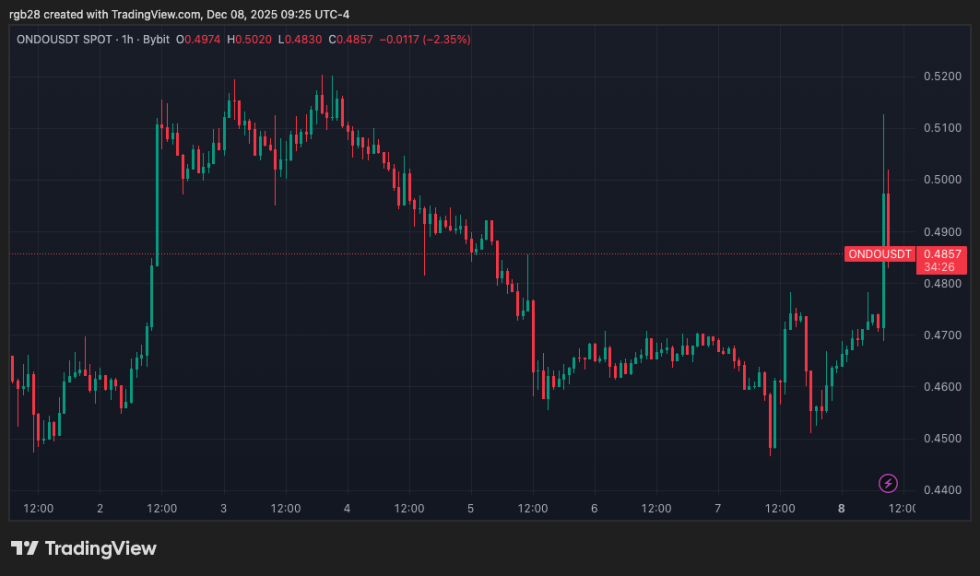
ONDO is trading at $0.48 in the one-week chart. Source: ONDOUSDT on TradingView


Leituras Relacionadas

Fei-Fei Li's Team Clarifies the Concept of 'World Models', Sora Merely a Renderer

"World Models" has become a widely used yet confusing term in AI. To address this, a team led by Fei-Fei Li and World Labs proposed a functional taxonomy based on the Partially Observable Markov Decision Process framework. This taxonomy categorizes systems called "world models" into three distinct projections: Renderers, Simulators, and Planners. Renderers, like OpenAI's Sora and other video generation models, focus on producing photorealistic visual outputs for human perception. They prioritize visual fidelity over physical accuracy. Simulators, such as NVIDIA Omniverse, aim to compute precise future environmental states for computational tasks like engineering analysis or digital twins. Planners, like Vision-Language-Action models, take in observations and goals to output executable actions for robots or agents. The article clarifies that most current "world models," including Sora, are primarily Renderers. They generate convincing visuals but lack the core ability to simulate state transitions based on actions, a key requirement for a true world model in classic reinforcement learning definitions. This conceptual confusion has practical implications, leading to potential misalignment in technology selection, investment, and public understanding of AI capabilities. Clear categorization is crucial. It helps enterprises avoid costly mistakes (e.g., using a renderer for robot training), allows investors to accurately assess markets, and enables researchers to build comparable benchmarks. While future systems may integrate these functions, recognizing current boundaries is essential for honest assessment and progress.

marsbitHá 25m

Fei-Fei Li's Team Clarifies the Concept of 'World Models', Sora Merely a Renderer

marsbitHá 25m

Bloomberg Uncovered: How Do China's Wealthy Circumvent the Annual $50,000 Limit to Transfer Assets?

**Summary: How Wealthy Chinese Circumvent $50,000 Annual Foreign Exchange Limits** Despite China's strict capital controls, including an annual $50,000 per person foreign exchange quota, an estimated $150 billion in funds still leaves the country annually via various gray and underground channels. This report outlines the evolution of China's "capital wall" and the methods used to bypass it. **The Evolving Capital Controls:** * **Foundation (1994):** The system of "current account convertibility with strict capital account controls" was established. * **Quota Set (2007):** The $50,000 individual annual forex purchase limit was formalized. * **Crackdown Begins (2015-2017):** Following market volatility, enforcement tightened. Banks were required to scrutinize transactions, and channels like using UnionPay cards for Hong Kong insurance premiums or buying overseas property were blocked. * **Digital & Legal Upgrades (2024-2026):** Enhanced algorithms now flag suspicious patterns (e.g., "smurfing"). The Common Reporting Standard (CRS) provides Chinese tax authorities with data on citizens' offshore accounts. Unlicensed cross-border brokers have been targeted. **Five Primary Methods for Moving Capital:** 1. **Underground Banking / "Hawala" (Duiqiao):** The largest-scale method. No money crosses borders. Clients pay RMB to a domestic account; an overseas associate deposits equivalent foreign currency into the client's offshore account. Risks include high fees, account freezes, and legal penalties. 2. **"Smurfing" or "Ant Moving":** Using multiple individuals' $50,000 quotas to pool funds for one offshore recipient. Increasingly detected by anti-money laundering algorithms. 3. **Trade Invoice Manipulation:** Businesses over-invoice imports or under-invoice exports via offshore shell companies, creating a pretext to transfer excess funds abroad under the guise of trade. 4. **Channel Migration:** After a crackdown on internet brokers, funds flow toward more compliant but costly channels like major banks' cross-border wealth management services or Qualified Domestic Institutional Investor (QDII) quotas. 5. **Structural Arrangements:** High-net-worth individuals use complex, high-cost legal structures involving offshore trusts, insurance, and investment migration programs to transfer asset ownership. **Regulatory Response: Focusing on People, Not Just Money** The current strategy extends oversight from enterprises to **individual residents**. Tools like CRS allow retroactive visibility into offshore assets. Cryptocurrencies, once seen as a potential loophole, are now actively monitored and prosecuted as an illegal channel. The underlying driver remains: with significant wealth concentrated among millions of affluent households seeking diversification amid domestic economic shifts, the incentive to move assets offshore persists despite regulatory barriers.

marsbitHá 44m

Bloomberg Uncovered: How Do China's Wealthy Circumvent the Annual $50,000 Limit to Transfer Assets?

marsbitHá 44m

Trading

Spot
Futuros

Artigos em Destaque

Como comprar ONDO

Bem-vindo à HTX.com!Tornámos a compra de OndoFinance (ONDO) simples e conveniente.Segue o nosso guia passo a passo para iniciar a tua jornada no mundo das criptos.Passo 1: cria a tua conta HTXUtiliza o teu e-mail ou número de telefone para te inscreveres numa conta gratuita na HTX.Desfruta de um processo de inscrição sem complicações e desbloqueia todas as funcionalidades.Obter a minha contaPasso 2: vai para Comprar Cripto e escolhe o teu método de pagamentoCartão de crédito/débito: usa o teu visa ou mastercard para comprar OndoFinance (ONDO) instantaneamente.Saldo: usa os fundos da tua conta HTX para transacionar sem problemas.Terceiros: adicionamos métodos de pagamento populares, como Google Pay e Apple Pay, para aumentar a conveniência.P2P: transaciona diretamente com outros utilizadores na HTX.Mercado de balcão (OTC): oferecemos serviços personalizados e taxas de câmbio competitivas para os traders.Passo 3: armazena teu OndoFinance (ONDO)Depois de comprar o teu OndoFinance (ONDO), armazena-o na tua conta HTX.Alternativamente, podes enviá-lo para outro lugar através de transferência blockchain ou usá-lo para transacionar outras criptomoedas.Passo 4: transaciona OndoFinance (ONDO)Transaciona facilmente OndoFinance (ONDO) no mercado à vista da HTX.Acede simplesmente à tua conta, seleciona o teu par de trading, executa as tuas transações e monitoriza em tempo real.Oferecemos uma experiência de fácil utilização tanto para principiantes como para traders experientes.

417 Visualizações TotaisPublicado em {updateTime}Atualizado em 2026.06.02

Como comprar ONDO

Discussões

Bem-vindo à Comunidade HTX. Aqui, pode manter-se informado sobre os mais recentes desenvolvimentos da plataforma e obter acesso a análises profissionais de mercado. As opiniões dos utilizadores sobre o preço de ONDO (ONDO) são apresentadas abaixo.

活动图片












