US Nonfarm Payrolls Unexpectedly Strong, Probability of September Rate Hike Rises to About 60%, Market Eyes Next Week's CPI

marsbitPublished on 2026-09-05Last updated on 2026-09-05

Abstract

U.S. August non-farm payrolls came in significantly stronger than expected, adding 162k jobs—nearly triple economists' forecasts. This robust employment data signals ongoing economic resilience and has sharply increased market expectations for a Federal Reserve rate hike at the September meeting, with fed funds futures now pricing in roughly a 60% probability of an increase. The data prompted immediate market adjustments: U.S. equities closed lower on Friday, and Treasury yields climbed, with the policy-sensitive 2-year yield rising to its highest level since January 2025. However, broader market impact remained contained for now, as major stock indexes still posted weekly gains and credit spreads stayed relatively low. Analysts note that despite higher rates, financial conditions remain accommodative, corporate earnings are strong, and the AI investment boom—evident in job gains in sectors like construction and manufacturing—is providing economic support. While the non-farm payrolls report tilts the policy debate toward a more hawkish stance, it does not conclusively determine the Fed's next move. Market focus is now firmly shifting to the upcoming Consumer Price Index (CPI) report. Analysts warn that if inflation data remains elevated and further pushes up rate expectations, it could force investors to more aggressively reduce risk exposure, potentially increasing market volatility. The CPI release, alongside political considerations around the midterm elections, is seen ...

Author: Wall Street News

The US August nonfarm payrolls data significantly exceeded expectations, further widening market divergence over the Fed's September policy path. The strong job growth indicates the US economy remains resilient and has led markets to reassess their expectations for further Fed rate hikes. US stocks fell on Friday, Treasury yields broadly rose, and gold came under pressure.

Data released by the US Labor Department on Friday showed that nonfarm payrolls increased by 162,000 in August, about three times the economists' forecast. The stronger-than-expected employment performance suggests the labor market has not deteriorated as significantly as markets had previously feared, further complicating the Fed's policy balancing act between employment and inflation.

Federal funds futures markets indicate that the probability of a Fed rate hike at the September 16th meeting has risen to about 60%. Previously, Fed Governor Waller signaled a preference to hold rates steady, leading to some retrenchment in market bets for a September hike.

Market reactions subsequently tilted hawkish. The three major US stock indices closed lower across the board on Friday, and US Treasury yields broadly moved higher. However, on a weekly basis, the S&P 500 and Nasdaq 100 indices still posted gains, indicating the market adjustment triggered by this employment data remains relatively limited so far.

US Treasury Yields Rise Across the Curve, Risk Assets Show No Significant Pressure Yet

Following the employment data release, US Treasuries were sold off, with yields rising broadly across maturities.

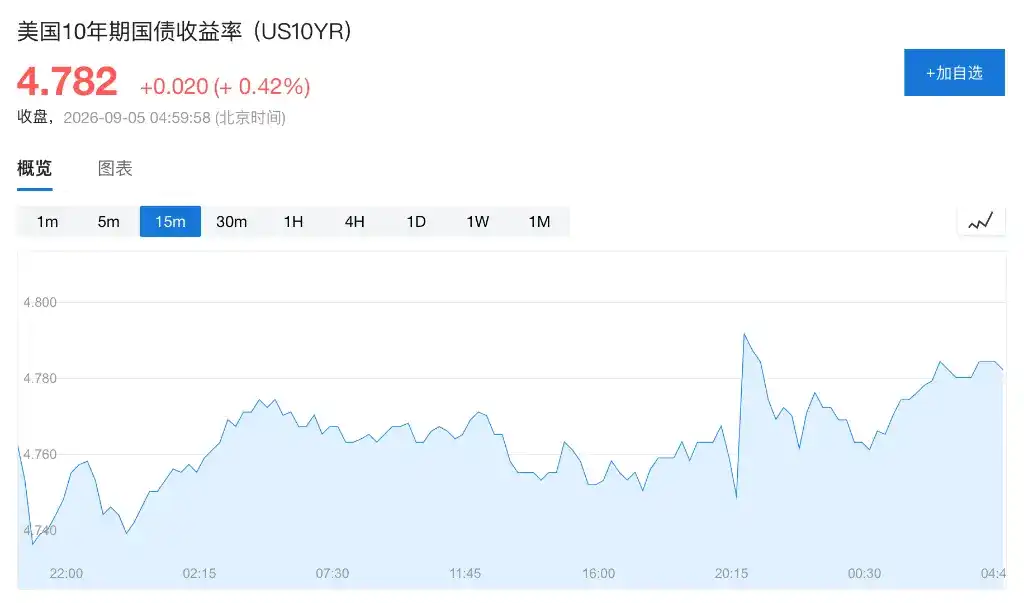
Among them, the most policy-sensitive 2-year Treasury yield rose 3.4 basis points to 4.3703%, hitting an intraday high of 4.416%, the highest since January 2025; the 10-year Treasury yield rose 2.2 basis points to 4.782%; the 30-year Treasury yield edged up 0.3 basis points to 5.246%.

However, the transmission of this bond market volatility to other risk assets remains limited. Credit spreads remain at low levels, and the cost of downside protection for risk assets is also relatively modest. JPMorgan notes that US Treasury market liquidity has deteriorated noticeably, but similar pressures have not yet appeared in stock index futures or corporate bond ETFs.

Collin Martin, Head of Fixed Income Research and Strategy at Charles Schwab, said current financial conditions remain accommodative, and credit spreads are still at exceptionally tight levels. Meanwhile, corporate earnings are growing over 20% year-over-year, and current corporate financing costs do not yet appear to pose a significant strain on businesses.

This means that, despite the employment data pushing up rate expectations, the impact of high interest rates on corporate financing and risk assets has not yet fully materialized.
AI Investment Boom Provides Support, Employment Structure Shows Divergence

The current resilience of the US economy is also linked to the ongoing boom in AI infrastructure investment.

Brad Conger, Chief Investment Officer at Hirtle & Co., stated that the contours of 'AI substitution effects' are already faintly visible in the August employment data: combined, the finance and information sectors lost 34,000 jobs, while employment in construction, manufacturing, and utilities—sectors related to data center construction, equipment supply, and power infrastructure—was notably stronger.

Economists at BNP Paribas noted in a client report that this employment report shows the US economy remains in a cyclical expansion phase, supported significantly by accommodative policies and the AI infrastructure construction boom. With labor supply constrained, the unemployment rate could continue to fall, and wages face upward pressure.

At the same time, high financing costs have not yet significantly suppressed credit expansion. JPMorgan found that, although borrowing costs have risen, US loan volumes and money creation have not contracted in sync; bank lending is still growing, and net issuance of US investment-grade corporate bonds also increased in August.

Therefore, the current US economic situation does not represent a typical 'high-interest-rates-suppress-demand' scenario. While corporate financing costs have increased, credit activity and investment demand continue to show some growth, which is also one reason why risk assets have not seen more severe adjustments in response to the hawkish-leaning employment data.

Rate Hike Expectations Intensify, CPI to Become Next Key Validation

While the nonfarm payrolls data is clearly hawkish-leaning, it is not enough to completely determine the Fed's next policy step. The market will now shift more focus towards inflation data.

Dan Suzuki, Global Investment Strategist at iCapital, warned that if interest rates rise significantly further, it could force investors to more aggressively cut risk exposure and further deteriorate market sentiment.

Sarah Hunt, Chief Market Strategist at Alpine Saxon Woods, said that compared to a weaker employment report, this data provides significantly less policy basis for the dovish camp.

Marvin Loh, Senior Macro Strategist at State Street, pointed out that Friday's employment report again shows the US economy is performing well even without structural conditions to lower unemployment. He believes the market is signaling to the Fed that it 'should hike rates' and still expects the Fed to raise rates within the year.

Greg Boutle, Head of US Equity & Derivatives Strategy at BNP Paribas, stated that with the earnings season largely over, macroeconomic data will be important variables influencing the market in the coming weeks. He believes it's appropriate to adopt a more cautious stance on stocks now, but it's not yet time for a definitive bearish view.

In his view, while Friday's nonfarm payrolls data leaned slightly hawkish, it has not fully clarified the Fed's next policy direction. The most critical variables ahead are the CPI data to be released next week, and whether the Fed will choose to hike rates before the US midterm elections.

Related Questions

QWhat was the key takeaway from the August US non-farm payroll report regarding the Federal Reserve's next move?

AThe much stronger-than-expected August non-farm payroll data significantly increased market expectations for a Federal Reserve rate hike in September, with the probability rising to about 60% according to federal funds futures.

QHow did the financial markets react immediately to the strong non-farm payroll data?

AFinancial markets reacted with a hawkish tilt. US stock indices fell, and US Treasury yields rose across the board, with the policy-sensitive 2-year yield hitting its highest level since January 2025. However, the broader market adjustment was seen as limited.

QAccording to the article, what is one reason the strong employment data hasn't triggered a more severe sell-off in risk assets yet?

AOne key reason is that, despite higher interest rate expectations, the actual impact of high rates has not fully materialized. Financial conditions remain relatively loose, credit spreads are narrow, corporate profits are strong, and AI infrastructure investment is providing economic support.

QWhat structural shift in employment was hinted at in the August jobs report, according to Hirtle & Co.'s CIO?

AThe report hinted at an 'AI substitution effect,' where sectors like financial activities and information lost jobs, while industries related to AI infrastructure—such as construction, manufacturing, and utilities tied to data center building and power supply—saw stronger employment gains.

QWhat is the next critical piece of data that markets will focus on to gauge the Fed's policy path after this jobs report?

AMarkets will now shift their primary focus to the upcoming Consumer Price Index (CPI) inflation data, as it will be a crucial factor in determining whether the Federal Reserve will proceed with a rate hike at its next meeting.

Related Reads

Former Polychain Partner Starts a Company: Enters Tokenized Real Estate, Raises $50 Million Seed Round to Build the "S&P 500" of Real Estate

Index Industries, a startup co-founded by former Polychain Capital president Josh Rosenthal and Longmark founder Brian Hardecker, has raised a $50 million seed round led by Lightspeed Venture Partners with participation from Polychain, Galaxy Ventures, and Wintermute Ventures. The company aims to create something the $55 trillion U.S. housing market has never had: a liquid, investable index product akin to a "S&P 500 for real estate." While FHFA and Case-Shiller indices provide widely followed monthly home price data, there has been no easily tradable financial instrument giving investors direct exposure to the overall U.S. housing market. Index Industries addresses this with its USHP Index, a daily-updated national home price benchmark built on traditional indices (FHFA, Freddie Mac) and enhanced with statistical smoothing, trend, momentum, and mortgage affordability signals. The index data is published on-chain via Chainlink oracles on Ethereum. On top of the index, the company offers USHP, a tokenized index asset backed by housing-related reserve assets that provides price exposure without conveying homeownership, and USHPi, a yield-bearing version distributing reserve income to holders. Minting and redemption are priced at the lower of the index value or reserve net asset value, protecting against over-redemption. Roughly 86% of reserves are housing-related assets, with the remainder in cash, stablecoins, and tokenized Treasuries. The article notes that CME's earlier attempt at Case-Shiller housing futures in 2006 largely failed due to thin liquidity, basis risk, and a lack of natural counterparties. Index Industries hopes to overcome these obstacles through tokenization, dedicated liquidity reserves, institutional backing (up to $100 million in commitments, including from Galaxy and Forward Industries), and professional market makers, integrating USHP into lending markets and on-chain yield protocols. Whether these structures can sustain real trading liquidity remains to be proven.

marsbit34m ago

Former Polychain Partner Starts a Company: Enters Tokenized Real Estate, Raises $50 Million Seed Round to Build the "S&P 500" of Real Estate

marsbit34m ago

Injective Plans Veyra Upgrade on November 24, Introducing Institutional-Grade RWA Trading and Request-for-Quote Mechanism

Injective has initiated on-chain governance voting for its Veyra mainnet upgrade, submitted as proposal IIP-717, marking the final major network upgrade planned for 2026. Voting is open to INJ stakers and closes on November 16, with INJ's market cap at approximately $724 million and network TVL exceeding $20.35 million. The Veyra upgrade focuses on institutional-grade financial infrastructure and cross-chain trading efficiency. It includes deployment of institutional RWA底层 components, expansion of enterprise access gateways, and support for cross-chain interoperability and atomic swaps. The cross-chain channel supports Injective's institutional track for issuing, trading, and settling tokenized assets on-chain. Veyra also introduces an RFQ (request-for-quote) system for large trades, allowing market makers and large traders to settle customized block trades outside the public order book, reducing slippage and execution friction. Additionally, Veyra lays the technical foundation for CypherOS, Injective's native on-chain privacy layer, enabling shielded transactions and private RFQs to protect institutional strategies. The full CypherOS architecture and audit reports have not yet been published. This follows the Meridian upgrade activated on September 24, forming a dense two-month iteration cycle. The upgrade is defined as a state-machine-breaking change, requiring validators to replace binaries during network downtime. The software version is locked to v1.21.0. Current on-chain data shows 62.0% approval with about 13.97 million INJ voted and no opposition, but overall participation is around 24.9%, below the 33.4% quorum threshold. If the proposal passes before the November 16 deadline, the mainnet will halt at block height 193,145,000 on November 24 and switch to v1.21.0.

marsbit35m ago

Injective Plans Veyra Upgrade on November 24, Introducing Institutional-Grade RWA Trading and Request-for-Quote Mechanism

marsbit35m ago

Trading

Spot
活动图片