US Government Shutdown Again? Why the Somali Immigration Fraud Case Ends with the Crypto Market Footing the Bill

marsbitPublicado em 2026-01-26Última atualização em 2026-01-26

Resumo

U.S. Government Shutdown Risk Surges to 79%, Triggering Crypto Market Sell-off According to Polymarket, the probability of a U.S. government shutdown by the end of January has dramatically increased from 9% to 79%. This sudden spike, occurring over a weekend, caused an immediate negative reaction in the cryptocurrency market, leading to a sharp price decline. The potential shutdown stems from a political impasse over funding for the Department of Homeland Security (DHS). The current funding, a temporary "Continuing Resolution" from a compromise bill passed in November, is set to expire on January 30th. The deadlock is directly linked to recent aggressive immigration enforcement actions. Following a massive welfare fraud case involving Somali immigrants in Minnesota (with confirmed losses of $240 million and potential losses up to $9 billion), former President Trump called for a crackdown. This led to the deployment of approximately 2,000 ICE agents to Minneapolis. During these operations, ICE agents shot and killed two U.S. citizens, sparking major public controversy. Senate Democrats are now opposing the House's funding bill for DHS, demanding accountability and reform for ICE's conduct. Republicans, however, are pushing for their border security agenda. This funding stalemate is the direct cause of the heightened shutdown risk. The crypto market absorbed the initial shock of this political news over the weekend, acting as the first "payer" for the crisis. The sell-off r...

Author: Demir, C Labs Crypto Observer

According to data from Polymarket, the probability of a US government shutdown by the end of the month has suddenly surged from 9% to 79%!
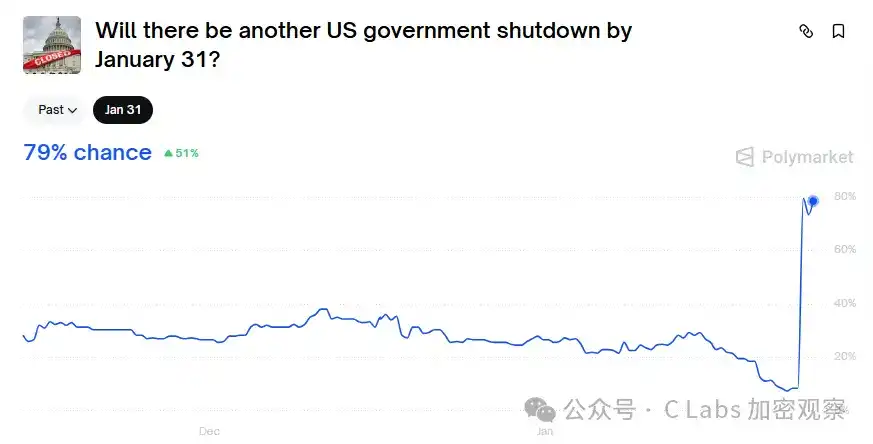
Due to the sudden nature of the event and it being a weekend, the crypto market has already taken a hit:
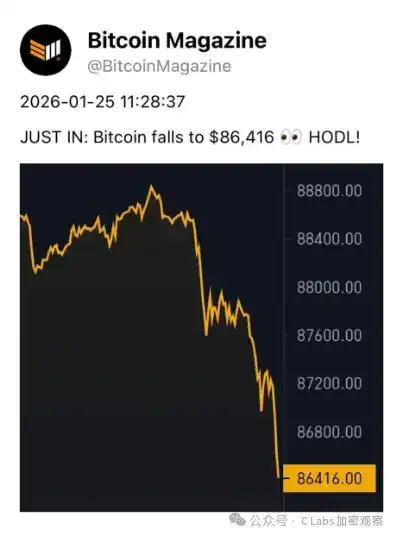
It's important to remember that the US government had already experienced a record 43-day shutdown starting on October 1st of last year, which ultimately ended on November 12, 2025, with the passage of a compromise bill (While the Binance community was celebrating, the US government had already been shut down for two weeks...).

Now, barely over two months have passed since that compromise bill, so why is there another potential shutdown?

01. Why is the government shutting down again?

The reason for this potential US government shutdown is that the bill passed last year was only a "Continuing Resolution" (CR), which temporarily extended funding authorization for most government agencies until January 30, 2026.
Only a few departments (such as the Department of Agriculture, Veterans Affairs, and Congressional operations themselves) received full-year funding.

Congress must pass a new, longer-term bill before January 30th; otherwise, agencies without full-year funding will face another lapse.
The reason for this shutdown threat is that Democrats disagree with the funding allocation plan for the Department of Homeland Security (DHS), citing recent shootings involving Immigration and Customs Enforcement (ICE) agents.

02. Originating from Somali Immigrant Fraud

Trump has recently been heavily focused on the Somali immigrant fraud case in Minnesota, using it as a pretext to intensify crackdowns on illegal immigration in the area.

However, ICE agents conducted two enforcement operations in Minneapolis, resulting in the fatal shootings of two US citizens, which has caused significant controversy in US public opinion.

The relief fund fraud case involving Somalis has confirmed losses of over $240 million, with other reports suggesting total losses could be as high as $9 billion.

Trump consequently made strong public statements, saying Somalis should "get out of the US," and accused officials of "inciting rebellion."

Using this as a pretext, the Department of Homeland Security (DHS) escalated its enforcement actions against illegal immigration, deploying approximately 2,000 additional ICE agents to Minneapolis, the capital of Minnesota. The initial targets of the operation were Somalis with final orders of removal.

But it was these aggressive enforcement actions and the subsequent shootings of US citizens by ICE agents that have now led Senate Democrats to oppose the House appropriations bill containing DHS funding.

Democrats are demanding accountability and reform for ICE's actions, while Republicans want to continue pushing their border security agenda.

This deadlock directly leads to the current risk of a government shutdown.

03. Crypto Market Becomes the "Payer"

The Somali fraud case appears massive, with confirmed losses of $240 million and potential total involvement up to $9 billion.
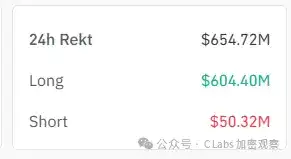
Because Democrats suddenly raised objections over the weekend to the funding for DHS, it is once again the crypto market that is bearing the brunt of this shock.

Today's crash in the crypto market, caused by the risk of a US government shutdown, has already resulted in over $600 million in long positions being liquidated in a single day, and the crypto market capitalization has evaporated by more than $30 billion in one day...

So, the money defrauded from US government welfare by Somalis in Minnesota has finally been paid for by the crypto market today.

As for how the US stock market will react, we'll have to wait until it opens tomorrow to find out~


Perguntas relacionadas

QWhy is the U.S. government facing another potential shutdown at the end of January?

AThe U.S. government is facing a potential shutdown because the previous continuing resolution (CR) that funded most government agencies expires on January 30, 2026. A new, longer-term funding bill must be passed by Congress before this date to avoid a shutdown for agencies that did not receive full-year funding.

QWhat specific event triggered the Democratic Party's opposition to the Department of Homeland Security (DHS) funding bill?

AThe Democratic Party's opposition was triggered by recent U.S. Immigration and Customs Enforcement (ICE) agent shootings that resulted in the deaths of two American citizens during enforcement actions in Minneapolis, leading to demands for ICE accountability and reform.

QWhat was the connection between the Somali immigrant fraud case and the increased ICE enforcement actions?

AFormer President Trump used the massive Somali immigrant relief fund fraud case (involving up to $9 billion) as a reason to intensify crackdowns on illegal immigration, leading to the deployment of approximately 2,000 additional ICE agents to Minneapolis and the subsequent controversial enforcement actions.

QHow did the cryptocurrency market react to the increased probability of a U.S. government shutdown?

AThe cryptocurrency market reacted negatively, experiencing a sharp decline over the weekend. This led to over $6 billion in long positions being liquidated in a single day and a loss of more than $30 billion in market value.

QWhich government agencies were already funded for the full year and thus not affected by the potential shutdown?

AA few departments, including the Department of Agriculture, the Department of Veterans Affairs, and the operations of Congress itself, had already received full-year funding and would not be affected by the potential shutdown.

Leituras Relacionadas

Saylor's Purchase of 1550 Bitcoin Is a Bad Trade

**Title: Saylor's Purchase of 1,550 Bitcoins Was a Bad Trade** The article critically analyzes Strategy's recent move of selling 32 bitcoins followed by a much larger purchase of 1,550 bitcoins. While appearing bullish, the author argues this trade is detrimental to MSTR shareholders. The core argument revolves around the concept of "breakeven modified Net Asset Value (mNAV)," a key metric for Strategy. To increase Bitcoin per share (BPS) for MSTR holders, Strategy must issue new shares at a premium high enough that the funds raised can buy more bitcoin than the bitcoin backing each existing share. Currently, this breakeven mNAV is estimated at 1.30. The recent trade failed on two counts: 1. The shares for the $181 million raise were issued at an mNAV *below* the 1.30 breakeven point. Selling "cheap" shares to buy bitcoin actually *reduces* BPS. 2. Only $101.3 million of the raised funds were used to buy bitcoin; the rest went to boost the company's dollar reserves. The breakeven mNAV calculation assumes *100%* of proceeds are used for bitcoin purchases. Diverting funds, even if mNAV were high, dilutes BPS. The result is an estimated 0.19% decrease in Bitcoin per share for MSTR holders. In exchange, Strategy merely extended its operational runway for its dollar reserves from ~6.3 months to 7 months. The author interprets this as Strategy prioritizing the survival and development of its STRC business over its stated core goal of increasing MSTR's BPS. This constitutes a gamble: if sacrificing MSTR value leads to improved market sentiment and a recovery in STRC's price (and thus mNAV), the whole system could work. If not, Strategy may be forced into a cycle of further diluting MSTR to stay afloat, potentially leading to deferred STRC dividends or corporate decline. The article concludes with a hope for price recovery for Bitcoin, MSTR, and STRC.

Foresight NewsHá 3m

Saylor's Purchase of 1550 Bitcoin Is a Bad Trade

Foresight NewsHá 3m

The AI Bear Market Lasting Two Days Is Over; Why Did Funds Buy Back Storage Stocks First?

After a severe two-day selloff in early June that erased over $1 trillion from U.S. chip stock market value, capital is flowing back first to the memory sector. The correction was not driven by a collapse in AI demand but rather a market reassessment of high expectations. Stocks like Broadcom faced selling pressure despite strong AI revenue guidance, signaling a shift in focus from who has an "AI story" to who can most rapidly translate AI demand into verifiable profits and earnings per share (EPS). Memory companies, such as Micron and SK Hynix, are leading the recovery because their EPS growth is more immediately verifiable. The AI server boom directly increases demand for high-bandwidth memory (HBM) and high-capacity server DRAM, tightening supply and driving up contract prices for conventional DRAM and NAND Flash. This price increase, coupled with a shift to higher-margin products, flows directly into near-term revenue and profitability, as evidenced in recent earnings reports. In contrast, other AI semiconductor segments like GPUs, ASICs, and optical modules, while central to the long-term AI infrastructure story, face longer and less certain paths to EPS validation. Their growth depends more on future product cycles, customer adoption timelines, and capital expenditure plans. The rebound in memory stocks highlights a market preference for assets with shorter, more transparent EPS conversion cycles following the recent de-risking phase. However, this does not negate the potential of other AI hardware segments should they provide clearer near-term order visibility. The episode has raised the validation bar for all AI-related investments.

marsbitHá 3m

The AI Bear Market Lasting Two Days Is Over; Why Did Funds Buy Back Storage Stocks First?

marsbitHá 3m

Monera Digital|Crypto Market May Report: Four Major Reasons Behind the Accelerated Decline

Monera Digital Crypto Market May Report: Four Key Reasons Behind the Accelerated Decline The crypto market experienced a significant downturn in May, driven by an internal liquidity crisis rather than external macro factors. Bitcoin fell from around $82,850 to $73,674, even as traditional markets rallied in the final week, highlighting a clear "liquidity transmission failure" specific to crypto. Four primary internal factors caused the accelerated sell-off: 1. **Major ETF Outflows:** U.S. spot Bitcoin ETFs saw a net outflow of $2.425 billion for the month, the third-largest monthly withdrawal since their launch. Ethereum ETFs also reversed to net outflows. This turned a key pillar of the bull run into a source of selling pressure. 2. **Holder Capitulation:** On-chain data showed textbook "surrender" patterns. The Short-Term Holder MVRV ratio fell below 1.0, indicating this cohort is now in aggregate loss. The Net Unrealized Profit/Loss (NUPL) metric also deteriorated significantly. 3. **Contagious Negative Sentiment:** The Coinbase Premium Index, which shows U.S. institutional buying/selling pressure, turned deeply negative for most of the month. This confirmed the ETF outflows and reflected a strategic shift away from crypto toward assets like U.S. Treasuries. 4. **Leverage Unwinding and Psychological Breaks:** Despite the downturn, futures open interest initially grew, signaling leveraged positioning. This culminated in a sharp deleveraging event with $307 million in long liquidations. Furthermore, the price broke below the critical $75K-$76K support zone, which is both a key gamma option level and the approximate average cost basis for major public companies holding Bitcoin, turning them from potential buyers into potential sellers. The report concludes that the market's pricing power has shifted from macro narratives to internal liquidation. While Bitcoin's 200-week moving average quantile has entered a historical "value zone" at 10.2%, this indicates a deep bear market reset is underway, not an immediate reversal. A sustainable recovery will require both a genuine improvement in the macro liquidity environment and clear signs of renewed on-chain demand, such as ETF inflows resuming and the Coinbase Premium turning positive. Until then, discipline and capital preservation are paramount.

marsbitHá 14m

Monera Digital|Crypto Market May Report: Four Major Reasons Behind the Accelerated Decline

marsbitHá 14m

Trading

Spot
Futuros
活动图片




