US financial markets ‘poised to move on-chain,’ amid DTCC tokenization greenlight

cointelegraphPublicado em 2025-12-12Última atualização em 2025-12-12

Resumo

U.S. financial markets are advancing toward on-chain tokenization following the SEC's approval of a DTCC pilot program for tokenizing assets like the Russell 1000 index, ETFs, and U.S. Treasuries. SEC Chair Paul Atkins emphasized that this shift will enhance market predictability, transparency, and efficiency. The SEC issued a no-action letter allowing the DTCC to proceed without enforcement risk and is considering an "innovation exemption" to ease regulatory burdens for builders. This move accelerates the adoption of blockchain for settlements, enabling 24/7 trading and reducing intermediaries. Analysts note rapid progress in financial tokenization, with continued funding and regulatory support fueling infrastructure development.

Traditional financial markets are moving rapidly onchain as the US Securities and Exchange Commission chair doubles down on the idea of an “innovation exemption” to accelerate tokenization.

“U.S. financial markets are poised to move on-chain,” wrote Paul Atkins, the chair of the SEC, in a Friday X post, adding that the agency is “embracing new technologies to enable this onchain future.”

His comments come shortly after the SEC issued a “no action” letter to a subsidiary of the Depository Trust and Clearing Corporation (DTCC), enabling it to offer a new securities market tokenization service.

The DTCC plans to tokenize assets including the Russell 1000 index, exchange-traded funds tracking major indexes, and US Treasury bills and bonds, which Atkins called an “important step towards onchain capital markets.”

“On-chain markets will bring greater predictability, transparency, and efficiency for investors,” he said.

However, the green light for the DTCC’s pilot is only the beginning, as the SEC will consider an innovation exemption to enable builders to start “transitioning our markets onchain,” without being burdened by “cumbersome regulatory requirements,” added Atkins.
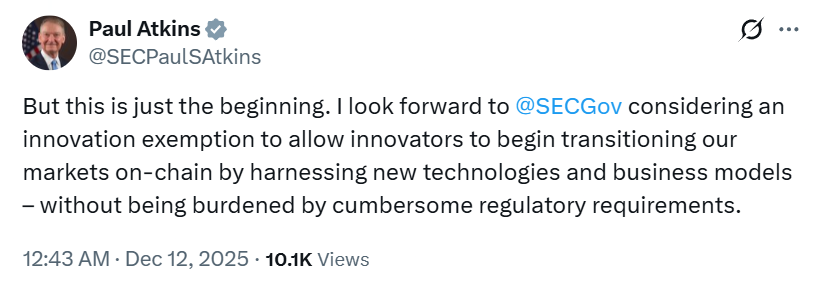
Source: Paul Atkins

Atkins pledged to encourage innovation as the industry moves toward onchain settlement, which would settle transactions on a blockchain ledger, removing intermediaries, enabling 24/7 trading and faster transaction finality.

Related: Crypto nears its ‘Netscape moment’ as industry approaches inflection point

Cointelegraph has contacted the SEC for comment on the details and timeline of an innovation exemption for tokenization.

Atkins first proposed an innovation exemption for tokenization during his remarks at the Crypto Task Force Roundtable on DeFi on June 9.

The SEC’s no-action letter means that the agency won’t take enforcement action if the DTCC’s product operates as described. The DTCC provides clearing, settlements and trading services as one of the most important infrastructure providers for US securities.

Asset tokenization involves minting tangible assets on the blockchain ledger, offering more investor access through fractionalized shares and 24/7 trading opportunities.

Related: Bitcoin treasuries stall in Q4, but largest holders keep stacking sats

DTCC pilot and RWA builders push more TradFi onchain

Crypto analysts have praised the SEC’s move to allow the DTCC’s new market tokenization service, which will award tokenized assets the same entitlements and investor protection mechanisms as traditional assets.

“Not sure people fully appreciate how quickly financial markets are heading towards full tokenization... Moving even faster than I expected,” wrote ETF analyst Nate Geraci, in a Friday X post.

Over the past few months, the SEC issued two no-action letters: one for a Solana-based decentralized physical infrastructure network (DePIN) project, and a second no-action letter in September that allowed investment advisers to use state trust companies as crypto custodians.

Meanwhile, crypto projects continue to raise funds to build the infrastructure necessary for tokenized onchain markets.

On Tuesday, asset tokenization network Real Finance closed a $29 million private funding round to build an infrastructure layer for real-world assets (RWAs) that can boost institutional participation.

Magazine: SEC’s U-turn on crypto leaves key questions unanswered

Criptomoedas em alta

Leituras Relacionadas

From South Korea to the United States: Blue-Collar Jobs Are Becoming Increasingly Popular, Thanks to AI

AI is reshaping the labor market's value proposition. The traditional four-year college degree is losing its appeal as a guaranteed career path, while skilled blue-collar trades like electricians, welders, and plumbers are experiencing historic demand and wage premiums. This shift is driven by dual pressures: AI's displacement of certain white-collar roles and a booming need for physical infrastructure and data center construction. Data confirms the trend. In the U.S., vocational school revenue surged, and a significant portion of recent layoffs are AI-related. Surveys show a majority of Gen Z adults plan to pursue blue-collar work, citing better job security against AI automation. Vocational education interest has exploded recently. Experts cite a psychological shift as younger generations seek tangible, AI-resistant careers and avoid high student debt. In many cases, salaries for skilled trades now match or exceed those requiring a bachelor's degree. In South Korea, semiconductor vocational high schools boast near-total employment, with graduates securing high-paying roles at companies like Samsung. The shortage is structural, exacerbated by a retiring baby boomer workforce and massive infrastructure projects. Companies like JPMorgan Chase, Meta, and Lowe's are investing heavily in training programs. However, overcoming historical stigma and a "perception gap" around trade careers remains a key challenge to closing the talent gap.

marsbitHá 58m

From South Korea to the United States: Blue-Collar Jobs Are Becoming Increasingly Popular, Thanks to AI

marsbitHá 58m

Qualcomm: AI Hype Subsides, When Will Smartphones Emerge from the Gloom?

Qualcomm reported its Q3 FY2026 results (ending June 2026), with revenue of $9.95B, down 4% YoY but above expectations. Gross margin declined to 53.1%, pressured by rising costs across manufacturing and memory. Key business segments showed mixed performance: Handset revenue fell 19.6% YoY to $5.09B, dragged by an 11% decline in non-Apple Android shipments and weaker high-end mix. Conversely, Automotive revenue surged 61% to $1.59B, and IoT grew 9% to $1.83B. Core operating profit dropped 41% YoY due to margin compression and higher expenses. Management's Q4 FY2026 guidance projects revenue of $9.7B-$10.5B, in line with consensus, but Non-GAAP EPS guidance of $2.05-$2.25 fell short of expectations. Amidst persistent weakness in its core handset market, Qualcomm is pursuing growth in AI, focusing on Edge AI (smartphones, PCs, automotive) and Data Center AI. Its data center strategy includes four pillars: AI accelerators (e.g., AI200), commercial CPUs (Dragonfly C1000), custom silicon, and connectivity solutions. While these initiatives initially boosted its stock, concerns over AI capital expenditure sustainability have since erased those gains. The company targets $5B in data center revenue for FY2027 and $15B for FY2029. The report concludes that with the traditional handset business still under pressure, the data center opportunity is currently viewed as a longer-term option, and a more conservative valuation based on core operations may be warranted until AI contributions materialize.

marsbitHá 1h

Qualcomm: AI Hype Subsides, When Will Smartphones Emerge from the Gloom?

marsbitHá 1h

From TPU to Self-Evolving Agents: How Jeff Dean Predicts the Next Step in AI

At the 2026 YC Startup School, Jeff Dean outlined his vision for AI's next phase, shifting focus from simply scaling models to building intelligent, autonomous systems. He believes AI's progress is no longer just about creating smarter models, but about integrating them into systems capable of long-term, iterative work, automated experimentation, and continuous learning. This evolution moves the competition from "who has the bigger model" to "who can best organize intelligence." Dean suggests AI capabilities are now comparable to a junior engineer, enabling the automation of complex workflows. However, the true challenge and opportunity lie in managing these AI "workers" at scale. He emphasizes the importance of **context engineering**—structuring tools, memory, and feedback loops—over raw model power. For startups, this means building deep expertise in niche domains where general models currently fail (near 0-1% success rates), leveraging proprietary data, specialized tools, and domain-specific evaluators. A recurring theme is re-examining fundamental constraints. Dean's past work, like moving Google's search index to memory or creating the TPU, stemmed from questioning outdated assumptions about hardware and cost. He sees similar inflection points today, particularly in **specialized inference hardware** to drastically reduce latency and energy consumption for real-time Agent operation. Notably, he points out that in modern AI systems, the dominant cost is often not computation but **data movement**. Reliable, long-running Agents require robust system design, borrowing concepts from distributed computing like checkpointing, state management, and parallel exploration to handle failures and maintain progress over days or weeks. As AI automates execution, the scarcest human skills will shift to **defining clear specifications**, **judging what problems are worth solving** (taste), and designing effective feedback loops. Ultimately, Dean's framework prioritizes understanding the problem deeply, identifying the true bottlenecks, and systematically building closed-loop systems where AI can not only perform tasks but also improve AI itself.

marsbitHá 1h

From TPU to Self-Evolving Agents: How Jeff Dean Predicts the Next Step in AI

marsbitHá 1h

Trading

Spot

Artigos em Destaque

Como comprar US

Bem-vindo à HTX.com!Tornámos a compra de Talus Network (US) simples e conveniente.Segue o nosso guia passo a passo para iniciar a tua jornada no mundo das criptos.Passo 1: cria a tua conta HTXUtiliza o teu e-mail ou número de telefone para te inscreveres numa conta gratuita na HTX.Desfruta de um processo de inscrição sem complicações e desbloqueia todas as funcionalidades.Obter a minha contaPasso 2: vai para Comprar Cripto e escolhe o teu método de pagamentoCartão de crédito/débito: usa o teu visa ou mastercard para comprar Talus Network (US) instantaneamente.Saldo: usa os fundos da tua conta HTX para transacionar sem problemas.Terceiros: adicionamos métodos de pagamento populares, como Google Pay e Apple Pay, para aumentar a conveniência.P2P: transaciona diretamente com outros utilizadores na HTX.Mercado de balcão (OTC): oferecemos serviços personalizados e taxas de câmbio competitivas para os traders.Passo 3: armazena teu Talus Network (US)Depois de comprar o teu Talus Network (US), armazena-o na tua conta HTX.Alternativamente, podes enviá-lo para outro lugar através de transferência blockchain ou usá-lo para transacionar outras criptomoedas.Passo 4: transaciona Talus Network (US)Transaciona facilmente Talus Network (US) no mercado à vista da HTX.Acede simplesmente à tua conta, seleciona o teu par de trading, executa as tuas transações e monitoriza em tempo real.Oferecemos uma experiência de fácil utilização tanto para principiantes como para traders experientes.

454 Visualizações TotaisPublicado em {updateTime}Atualizado em 2026.06.02

Como comprar US

Discussões

Bem-vindo à Comunidade HTX. Aqui, pode manter-se informado sobre os mais recentes desenvolvimentos da plataforma e obter acesso a análises profissionais de mercado. As opiniões dos utilizadores sobre o preço de US (US) são apresentadas abaixo.

活动图片













