U.S. Debt Spiral to $40 Trillion Threatens Global Markets, CEO Warns

cryptonews.ruPublicado em 2026-08-25Última atualização em 2026-08-25

Resumo

The CEO of Devere Group, Nigel Green, warns that the US's $40 trillion debt spiral threatens global markets. He argues that rising federal interest payments create a feedback loop: borrowing to cover past interest increases future obligations as older, cheaper debt is refinanced at higher rates. With public debt at $40.03 trillion, the Congressional Budget Office has raised its 2026 deficit forecast by $200 billion to $2.1 trillion. The Government Accountability Office projects debt could reach 251% of GDP by 2056. Rising Treasury yields pressure household mortgages and set a baseline for corporate debt, potentially squeezing investor portfolios built for low yields. Foreign investors, holding significant US securities, share this market risk. The Treasury Department's increased debt buyback operations aim to support liquidity but do not reduce overall debt. Amid these fiscal concerns, some investors are looking to scarce assets like Bitcoin as a potential long-term hedge against currency depreciation, despite its high volatility, while traditional havens like gold also see interest. The core warning is that the debt's compounding arithmetic, not politics or Fed policy, poses a systemic risk to financial stability.

Growing federal interest expenses could put pressure on financial markets even without an economic downturn or new emergencies, Devere Group CEO Nigel Green warned on August 24. He argued that borrowing to fund current interest costs creates larger future obligations as older, cheaper debt matures and gets refinanced at higher rates.

Green explained:

"This is arithmetic, not sentiment. Interest is compounding faster than the economy generates income to pay it, so every dollar borrowed to cover last year's interest payments leads to larger interest payments this year, regardless of who is in the White House or what the Federal Reserve decides next."

Treasury Department data shows total outstanding public debt stood at roughly $40.03 trillion as of August 20. About $32.28 trillion was held by the public, including investors and institutions, while approximately $7.75 trillion represented intragovernmental holdings tied to federal accounts and trust funds.

CBO Raises 2026 Deficit Forecast

The federal budget outlook has deteriorated since the Congressional Budget Office (CBO) published its baseline in February. The agency now estimates the fiscal year 2026 deficit at $2.1 trillion, $200 billion above the $1.9 trillion forecast published on February 11, after lowering its revenue estimate due to lower customs duty receipts.

On August 20, the CBO said trade policy changes enacted through July 31 would add $0.9 trillion to the projected cumulative deficit from 2027 through 2036. Under February's baseline forecast, public debt held by the public was projected to rise from 101% of gross domestic product this year to 120% by 2036, with the annual deficit reaching $3.1 trillion; the agency has not yet revised those figures.

A June 11 report from the Government Accountability Office (GAO) projected that under current revenue and spending policies, debt held by the public would reach 123% of GDP in 2036 and 251% by 2056.
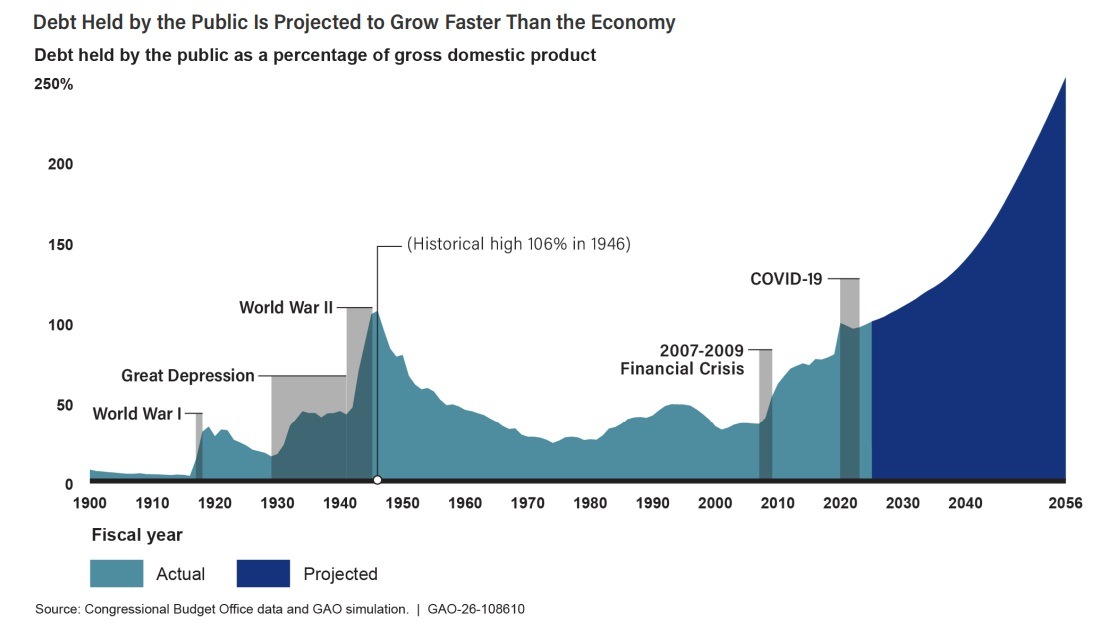
Public debt is projected to grow faster than the U.S. economy. Source: U.S. Government Accountability Office report published June 11, 2026.

Rising benchmark yields also affect households through mortgages and other long-term credit. According to Freddie Mac, the average rate for a 30-year fixed mortgage was 6.65% on August 20, compared to a record low of 2.65% in January 2021. Mortgage rates do not follow Treasury yields exactly, but both respond to inflation expectations, monetary policy, and investor demand for long-term debt.

Foreign Investors Share Treasury Market Risks

International investors remain exposed to U.S. yield fluctuations through their extensive portfolios of Treasuries and other dollar-denominated assets. Treasury International Capital data released on August 17 showed foreign residents were net buyers of $207.1 billion in long-term U.S. securities in June. The Treasury cautions that due to the nature of custody arrangements, the data does not perfectly identify ultimate owners by country.

Recent Treasury intervention signals pressure on longer-dated government securities as borrowing needs grow. The department increased the size of certain buyback operations for debt maturing in 10 to 30 years from $2 billion to at least $4 billion per operation, starting September 9 through November 4. These purchases can support liquidity and reduce short-term yield pressure, but they do not cancel debt and are not Federal Reserve quantitative easing.

Rising Yields Pressure Stocks and Bonds

This debt feedback loop extends beyond government finance, as Treasury yields set a baseline for mortgages, commercial loans, and corporate bonds. Hitting the $40 trillion debt milestone has heightened concerns that higher refinancing costs could lead to rising interest expenses, larger deficits, and the need for further Treasury issuance. New government borrowing must also compete with corporate debt for investor capital.

Higher discount rates may lower the present value investors assign to companies whose expected earnings lie further in the future. Recent volatility in bitcoin, stocks, gold, and bonds has shown how changes in long-term yields can simultaneously impact multiple asset classes. Green warned:

"Portfolios built around low, stable yields now carry risk most investors have not yet priced into their valuations."

Bitcoin Enters the Debt Debate

Some investors are responding to fiscal and monetary policy concerns by considering scarce assets alongside traditional holdings. Bridgewater Associates founder Ray Dalio has warned U.S. debt could reach $55 to $60 trillion within a decade. He favors gold and a small allocation to bitcoin while recommending reduced exposure to debt assets, though his projection is an estimate, not an official government forecast.

Bitcoin's programmed scarcity supports its case as a long-term hedge against currency debasement, but its short-term performance remains highly volatile. The fixed supply of 21 million BTC distinguishes it from state-issued currencies. However, its track record during inflationary shocks has been mixed, making the asset more acceptable as a long-term store of value than a reliable short-term haven.


Perguntas relacionadas

QWhat is the main warning issued by Nigel Green, CEO of Devere Group, regarding the U.S. federal debt?

ANigel Green warns that the growth in federal interest payments could intensify pressure on financial markets even without an economic downturn or new emergencies, as borrowing to finance current interest costs creates larger future obligations due to the refinancing of older, cheaper debt at higher rates.

QAccording to the article, what is the projected U.S. federal deficit for the 2026 fiscal year, and how has this forecast changed?

AThe Congressional Budget Office (CBO) currently projects the deficit for the 2026 fiscal year to be $2.1 trillion. This is $200 billion higher than the $1.9 trillion forecast published on February 11th, due to lowered revenue estimates from reduced customs duty receipts.

QHow are rising Treasury yields affecting households and the broader economy?

ARising Treasury yields affect households through higher mortgage rates and other long-term borrowing costs. For example, the average 30-year fixed mortgage rate was 6.65% on August 20th, compared to a record low of 2.65% in January 2021. These yields also set a baseline for corporate loans and bonds, increasing financing costs across the economy.

QWhat action has the U.S. Treasury Department taken to address pressure on longer-term government securities, and what is its purpose?

AThe U.S. Treasury Department has increased the size of certain buyback operations for debt maturing in 10 to 30 years from $2 billion to at least $4 billion per operation, scheduled from September 9th to November 4th. This action aims to support liquidity and alleviate short-term pressure on yields, though it does not cancel debt or constitute Federal Reserve quantitative easing.

QWhy are some investors considering assets like Bitcoin in response to U.S. debt concerns, and what is a key characteristic of Bitcoin cited in the article?

ASome investors are considering assets like Bitcoin as a hedge against fiscal and monetary policy concerns, viewing it as a scarce asset. The article cites Bitcoin's programmed supply limit of 21 million coins as a key characteristic that supports the argument for its potential as a long-term guard against currency devaluation, though its short-term price movements remain highly volatile.

Leituras Relacionadas

U.S. Aims at Iran's Crypto Sector Due to Oil Payments Exceeding $100 Billion

The U.S. Treasury Department has expanded sanctions on Iran to target its digital asset sector, citing over $100 million in cryptocurrency payments allegedly used to facilitate Iranian oil sales. The Treasury’s Office of Foreign Assets Control (OFAC) announced new sectoral sanctions covering digital assets, technology, gold, aviation, and shipping, alongside sanctions against nearly 60 entities, individuals, and vessels linked to nuclear, missile, cyber, and oil networks. The move allows OFAC to sanction foreign persons and firms operating in or supporting Iran’s crypto sector, which the Treasury stated is increasingly used as a "tool of choice" to circumvent sanctions, including by the Islamic Revolutionary Guard Corps (IRGC). Specific targets include Ukrainian broker Ivan Obukhov and his UAE-registered firm Foscom FZE, accused of processing over $100 million in crypto payments to facilitate oil sales for the IRGC’s Quds Force. This follows recent U.S. actions against Iran-linked crypto exchanges, including sanctions against UK-based Zedcex and Zedxion in January, four Iranian exchanges including Nobitex in June, and exchanges Shelbit and Aban Tether in August. Unlike previous targeted sanctions, the new measures establish a framework to penalize broader involvement in Iran’s crypto sector, significantly expanding OFAC’s authority under Executive Order 13902. Designated persons’ U.S.-linked property will be blocked, and foreign banks facilitating significant transactions for them may face U.S. account restrictions.

cryptonews.ruHá 20m

U.S. Aims at Iran's Crypto Sector Due to Oil Payments Exceeding $100 Billion

cryptonews.ruHá 20m

Conversation with Charles Zhang: Amidst the AI Frenzy, Why Pursue 'Anti-Efficiency' Content?

Dialogue with Charles Zhang: In the Era of AI's Sprint, Why Create "Anti-Efficiency" Content Standing out among China's early internet pioneers, Charles Zhang, founder and CEO of Sohu, maintains a distinct personal identity. He keeps a consistent public presence and embodies traits of high-energy individuals: sleeping only 4-5 hours daily, running 5km or marathons, and hosting frequent offline tech forums and dialogues with Nobel laureates. He has shifted focus from external business expansion to internal self-reconstruction, adhering to his own pace. "People aren't afraid of being busy; the busier you are, the better your health. Having nothing to do can lead to emotional issues and poor health." Marking the 10th anniversary of his live-streamed "Charles Zhang's English Class," he recently took it offline for a real-world classroom session. Following this, he discussed the course's decade-long journey, Sohu Video's content ecosystem, and the value of content in the AI era. **Pen and Mouth Diligence: A Class Against Instant Mastery** His English class began in August 2016 on "Qianfan Live." He spends about 40 minutes daily preparing, reviewing dozens of news headlines, reading five in detail, and selecting three for the lesson. Over ten years, he has completed over 2000 live sessions totaling more than 110,000 minutes, with over 52 million views. Initially, the stream was a way to "talk more" and combat emotional struggles. He started by repeating after TV news anchors, then moved to live-streaming with the launch of Qianfan Live. It was 40% for personal emotional regulation ("like a monk chanting sutras"), 30% to deliver authentic news, and 30% to promote the new platform. This daily "ritual" helped him overcome depression, leading to what he calls his "peak life state." From a product perspective, it was counter-intuitive—launched without prior market research or growth strategies, based on the founder's personal need that resonated with users. Yet, his content creation follows a strict routine. The decade of covering geopolitics, economics, tech, health, and society has built a vast "knowledge compound interest" system. In an age of AI summaries and algorithmic content, Zhang insists on "hard work": meticulous reading, handwritten notes, and manually created teaching materials, refusing AI-generated content. The English class is now a fixed daily rhythm; preparing for his weekly physics class requires a full day of solitary deduction on a blackboard. In his live streams, Zhang positions himself as a "content creator," not a CEO or teacher. He sees physics as extreme brain training and English as a "sensor" to understand the world. This explains why a top entrepreneur persists for a decade in seemingly "unprofessional" pursuits—it's the information input and psychological healing method he found during a low point. It's fundamentally an "anti-efficiency" commitment. He believes the meaning of reading lies in finding community and spiritual support, not just fleeting conversation points. For today's media, he states: "Reading news isn't the goal. As humans with many confusions, we need reference points, to find a group, find kindred spirits, or seek support and spiritual nourishment. Large language models can't satisfy these starting points; they only give you information." This offers solace and a value defense for media professionals impacted by AI summaries. **"Don't Think Earth Stops Turning Because AI Arrived"** A content creator expressed anxiety: after feeding their article to AI, it produced a more comprehensive, profound version, making their work feel valueless. Zhang responded with an analogy: "Carrots from the market, with a bit of soil, not glossy, taste delicious and flavorful. Tomatoes forced by chemical fertilizer have no taste at all." He sees AI giving world content a "plastic feel," but acknowledges its significant role in improving information access efficiency, especially in physics and social science research where he often queries AI for quick professional answers. The key, Zhang stresses, is that the outside world still needs to guide our perspective. LLMs provide "information," while the outside world offers "viewpoints." He cares deeply about *what* that external viewpoint is and *how* someone thinks about an issue. "Don't think the Earth stops turning because AI arrived," he analyzes. AI currently replaces rule-based work, noting significant impact on the software industry with many programmers laid off as even less experienced people can now write decent code. However, AI cannot yet replace arts, social sciences, emotions, and creative content. "Hollywood remains thriving, producing great works. Oscars will continue, Nobel Literature Prizes will still be awarded—all by real people, with works conceived by real people." While wary of AI, Zhang isn't anti-technology and is open to its applications. Sohu itself has launched AI assistants. In Sohu's AI practice, Zhang defines his role as a "large language model corpus provider." He believes LLM training is inseparable from human-original content as its data foundation, so original content retains irreplaceable value. "The era of self-media indeed offers everyone new ways to discover their strengths and achieve growth." He suggests every young person should consider self-media. Most importantly, the bottom line of content creation should be "authenticity." If using AI avatars, they must be clearly labeled; not doing so and misleading viewers wastes their time, especially when people still prefer real human content. Behind AI's sprint lie unavoidable realities. As AI quickly provides seemingly perfect answers, people grow accustomed to accepting "summarized" results, omitting processes of questioning, deduction, and trial-and-error, leading to a decline in deep thinking. Zhang's "anti-efficiency" practice with his two live-streamed classes is his answer to AI's狂奔: In an algorithm-driven era chasing ultimate efficiency, don't expect AI to fill inner voids. Read books, speak in front of a camera, sweat on a running track, and build connections with real people.

marsbitHá 30m

Conversation with Charles Zhang: Amidst the AI Frenzy, Why Pursue 'Anti-Efficiency' Content?

marsbitHá 30m

Zcash's ETF Gilding: How a Privacy Coin Was Packaged by Wall Street into a Compliant Asset

The article traces the decade-long path of Zcash (ZEC), a privacy-focused cryptocurrency, to its potential launch as the first privacy coin spot ETF, with Grayscale's ZCSH filing in August 2026. It argues ZEC's suitability stemmed not from regulatory acceptance of its privacy technology, but from its centralized, institutional structure from inception—a commercial company (ECC) with venture capital backing and a Founder's Reward—making it easier to package than decentralized alternatives. Three key institutions, intertwined in a network, drove the process: Grayscale (owned by DCG, an early ZEC investor), which had held ZEC in a trust since 2017; Coinbase, providing custody, prime brokerage, derivatives, and venture investment; and ZODL, a new for-profit entity formed in 2026 when ECC's core development team split from the non-profit foundation. The major regulatory hurdle was SEC scrutiny (2023-2026) over ZEC's historical structure, which resembled an unregistered investment contract due to automatic block rewards to ECC and the Foundation. This was resolved through governance changes (NU6 upgrade in 2024) that ended direct funding and shifted control to community voting, coinciding with a broader shift in SEC enforcement policy. Notably, the law firm Davis Polk represented both the Zcash Foundation in its SEC defense and Grayscale in the ETF filing. The push is also driven by DCG's dire financial needs amid Genesis bankruptcy lawsuits, seeking high-fee products (the ZEC ETF charges 2.5%). Concurrently, major mining operations by entities like Cypherpunk Technologies (backed by Winklevoss Capital) and DCG's Fortitude Mining expanded, motivated by profitability and aiming to influence the network. The article concludes with irony: to become a compliant ETF asset, ZEC must shed its core privacy feature for the fund's holdings, which will be held in transparent, auditable addresses. Wall Street is not adopting privacy technology but packaging the *concept* of privacy into a tradable, fee-generating financial product. The transformation was not a single master plan but the result of a network of aligned interests capitalizing on regulatory, governance, and market shifts over ten years.

marsbitHá 40m

Zcash's ETF Gilding: How a Privacy Coin Was Packaged by Wall Street into a Compliant Asset

marsbitHá 40m

Trading

Spot
活动图片