US Banks’ Push To Ban Stablecoin Rewards Could Hand Global Advantage To China, Execs Warn

bitcoinistPublicado em 2026-01-01Última atualização em 2026-01-01

Resumo

Crypto industry leaders warn that U.S. banks' efforts to ban interest payments on stablecoins could undermine the competitiveness of the U.S. dollar and hand a strategic advantage to global rivals like China. This follows China's announcement that it will pay interest on its Digital Yuan (e-CNY) starting in 2026, granting it similar status to bank deposits. Coinbase’s Chief Policy Officer, Faryar Shirzad, cautioned that such a prohibition could weaken the impact of the recently passed GENIUS Act, which aims to solidify the dominance of U.S. dollar stablecoins. Other executives, including Coinbase CEO Brian Armstrong and Variant CLO Jake Chervinsky, echoed that this is not just a regulatory issue but a matter of national security, arguing that limiting stablecoin rewards could diminish the global role of the dollar and strengthen China's position in the digital currency landscape.

After China’s latest move with its Digital Yuan, multiple crypto industry executives have cautioned that the US banks’ push to prohibit all interest payments on stablecoins could give a major advantage to their global rivals.

US Risks Giving China A Major Global Advantage

On Tuesday, Coinbase’s Chief Policy Officer (CPO), Faryar Shirzad, warned the US Congress that banning interest payments on the digital assets could risk diminishing the legislative efforts and victories obtained this year with the Guiding and Establishing National Innovation for U.S. Stablecoins (GENIUS) Act.

In an X post, Shirzad affirmed that “tokenization is the future and the GENIUS Act was a visionary move by POTUS and Congress to ensure US dollar stablecoins issued under US rules would be the primary settlement instrument of the future.”

However, Shirzad noted that the “sobering and timely” announcement by the People’s Bank of China of its plan to pay interest on the Digital Yuan could pose a bigger problem to the US than investors think.

As reported by Bitcoinist, China is about to start paying interest on its Digital Yuan (e-CNY). Deputy Governor at the People’s Bank of China, Lu Lei, recently shared a new framework that will redefine the rules of virtual currency, giving it the same legal status as deposits held at banks.

Under the new framework, commercial banks that manage Digital Yuan wallets will be able to pay interest to clients based on the amount of e-CNY they hold, starting from January 1, 2026.

Based on this, Shirzad cautioned that “If this issue is mishandled in Senate negotiations on the market structure bill, it could hand our global rivals a big assist in giving non-US stablecoins and CBDCs a critical competitive advantage at the worst possible time.”

Stablecoin Rewards: A ‘Matter Of National Security’

Coinbase’s CPO added that although “lobbyists for entrenched incumbents will always fight change,” it’s crucial for Congress to “protect the primacy of the US dollar and the US financial system, “not just incumbent interests.”

Similarly, other crypto executives agreed with Shirzad’s statement, including Coinbase’s Chief Executive Officer (CEO) Brian Armstrong and Variant’s Chief Legal Officer (CLO) Jake Chervinsky.

Armstrong emphasized that US “stablecoins must remain competitive on a global stage. Meanwhile, Chervinsky asserted that banks’ push to ban stablecoin rewards “isn’t just a matter of incumbents seeking a regulatory moat. It’s a matter of national security.”

To the lawyer, revisiting the issue of interest payments on USD-pegged tokens would weaken the victory that the GENIUS Act gave to US dollar dominance worldwide and “hand that win to China.”

Notably, the banking sector has criticized the US’s landmark stablecoin legislation over the past few months, arguing that it has loopholes that could pose risks to the financial system.

The crypto framework, which was signed into law by President Trump in July, prohibits interest payments on the holding or use of payment-purpose stablecoins. Nonetheless, the prohibition only addresses issuers, meaning that it could be “easily circumvented” by exchanges or affiliates providing rewards.

Earlier this year, multiple banking associations across the US sent a joint letter to the Senate Banking Committee urging Congress to amend the law. The banking groups claimed that interest payments would distort market dynamics and could affect credit creation. Therefore, they suggested extending the prohibition to include digital asset exchanges, brokers, dealers, and related entities.

Shirzad, alongside multiple crypto industry players, has rejected these concerns over the past several months, stating that the banking sector’s proposals could threaten to create an uncompetitive environment for USD-denominated tokens.

In October, Coinbase’s CPO slammed the financial institution’s narrative that stablecoins would destroy bank lending, concluding that it “ignores reality” and misreads the crucial moment.
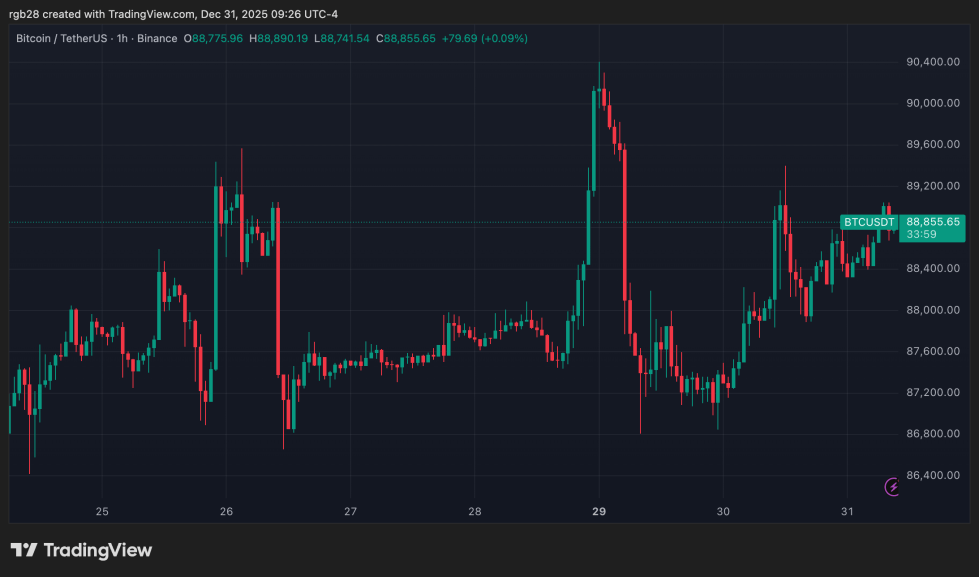
Bitcoin (BTC) trades at $88,855 in the one-week chart. Source: BTCUSDT on TradingView.


Perguntas relacionadas

QWhat is the main concern raised by crypto industry executives regarding the US banks' push to ban stablecoin interest payments?

ACrypto industry executives warn that the US banks' push to ban all interest payments on stablecoins could hand a major global advantage to rivals like China, potentially undermining the US dollar's primacy and the competitiveness of US financial systems.

QWhat specific action did the People's Bank of China announce that is seen as a competitive threat?

AThe People's Bank of China announced a plan to pay interest on the Digital Yuan (e-CNY), giving it the same legal status as bank deposits and allowing commercial banks to pay interest based on the amount held, starting from January 1, 2026.

QWhy do banking associations in the US want to extend the prohibition on interest payments to include exchanges and related entities?

ABanking associations argue that interest payments on stablecoins could distort market dynamics, affect credit creation, and pose risks to the financial system, so they want to extend the ban to digital asset exchanges, brokers, dealers, and related entities to prevent circumvention.

QHow does Coinbase's CPO, Faryar Shirzad, view the GENIUS Act and its relation to US dollar stablecoins?

AFaryar Shirzad views the GENIUS Act as a visionary move to ensure that US dollar stablecoins issued under US rules become the primary settlement instrument of the future, reinforcing the dominance of the US dollar globally.

QWhat is Jake Chervinsky's perspective on the push to ban stablecoin rewards?

AJake Chervinsky, Variant's Chief Legal Officer, asserts that the push to ban stablecoin rewards is not just about incumbents seeking a regulatory advantage but is a matter of national security, as it could weaken US dollar dominance and benefit rivals like China.

Leituras Relacionadas

How Many Tokens Away Is Yang Zhilin from the 'Moon Chasing the Light'?

The article explores the intense competition between two leading Chinese AI companies, DeepSeek and Kimi (Moon Dark Side), and the mounting pressure on Yang Zhilin, the founder of Kimi. While DeepSeek re-emerged after 15 months of silence with its powerful V4 model—boasting 1.6 trillion parameters and low-cost, long-context capabilities—Kimi has been focusing on long-context processing and multi-agent systems with its K2.6 model. Yang faces a threefold challenge: technological rivalry, commercialization pressure, and investor expectations. Despite Kimi’s high valuation (reaching $18 billion), its revenue heavily relies on a single product with low paid conversion rates, while DeepSeek’s strategic silence and open-source influence have strengthened its market position and valuation prospects, now targeting over $20 billion. Both companies reflect broader trends in China’s AI ecosystem: Kimi aims for global influence through open-source contributions and agent-based advancements, while DeepSeek prioritizes foundational innovation and hardware independence, notably shifting to Huawei’s chips. Their competition is seen as vital for China’s AI progress, with the gap between top Chinese and U.S. models narrowing to just 2.7% on the Elo rating scale. Ultimately, the article argues that this rivalry, though anxiety-inducing for leaders like Zhilin, is essential for driving innovation and solidifying China’s role in the global AI landscape.

marsbitHá 18m

How Many Tokens Away Is Yang Zhilin from the 'Moon Chasing the Light'?

marsbitHá 18m

TechFlow Intelligence Bureau: ChatGPT Helps Amateur Mathematician Crack 60-Year-Old Problem, CFTC Sues New York Regulator Over Coinbase and Gemini

An amateur mathematician, with the assistance of ChatGPT, has solved a combinatorial mathematics puzzle originally proposed by Hungarian mathematician Paul Erdős in the 1960s. This marks another milestone in AI-aided mathematical research, demonstrating the evolving capabilities of large language models in formal reasoning. In other AI developments, OpenAI introduced a new privacy filter tool for enterprise API usage, automatically screening sensitive data. Meanwhile, the Qwen3.6-27B model achieved 100 tokens per second on a single RTX 5090 GPU using quantization, significantly lowering the cost barrier for local AI deployment. In crypto and Web3, the U.S. CFTC sued New York’s financial regulator, challenging its oversight of Coinbase and Gemini—a first-of-its-kind federal-state regulatory clash. Following a vulnerability, KelpDAO and major DeFi protocols established a recovery fund. Tether froze $344 million in assets linked to Iran’s central bank upon U.S. Treasury request, highlighting the centralized control risks in stablecoins. Separately, Litecoin underwent a 3-hour chain reorganization to undo a privacy-layer exploit. In the U.S., former President Trump invoked the Defense Production Act to address power grid bottlenecks affecting AI data centers and dismissed the entire National Science Board, raising concerns over research independence. A retail trader gained 250% on a $600k Intel options bet amid AI-related speculation. Xiaomi announced its first performance electric vehicle, targeting rivals like Tesla. Meanwhile, iPhone users reported devices automatically reinstalling a hidden app daily, suspected to be MDM-related. A Chinese securities report noted that A-share institutional crowding has reached its second-longest streak since 2007, signaling high valuations and potential style rotation. The day’s developments reflect a dual narrative: AI is enabling unprecedented individual breakthroughs, while centralized power structures—whether governmental or corporate—are becoming more assertive, underscoring that decentralization is as much a political-economic challenge as a technical one.

marsbitHá 41m

TechFlow Intelligence Bureau: ChatGPT Helps Amateur Mathematician Crack 60-Year-Old Problem, CFTC Sues New York Regulator Over Coinbase and Gemini

marsbitHá 41m

Trading

Spot
Futuros

Artigos em Destaque

Como comprar PUSH

Bem-vindo à HTX.com!Tornámos a compra de Push Protocol (PUSH) simples e conveniente.Segue o nosso guia passo a passo para iniciar a tua jornada no mundo das criptos.Passo 1: cria a tua conta HTXUtiliza o teu e-mail ou número de telefone para te inscreveres numa conta gratuita na HTX.Desfruta de um processo de inscrição sem complicações e desbloqueia todas as funcionalidades.Obter a minha contaPasso 2: vai para Comprar Cripto e escolhe o teu método de pagamentoCartão de crédito/débito: usa o teu visa ou mastercard para comprar Push Protocol (PUSH) instantaneamente.Saldo: usa os fundos da tua conta HTX para transacionar sem problemas.Terceiros: adicionamos métodos de pagamento populares, como Google Pay e Apple Pay, para aumentar a conveniência.P2P: transaciona diretamente com outros utilizadores na HTX.Mercado de balcão (OTC): oferecemos serviços personalizados e taxas de câmbio competitivas para os traders.Passo 3: armazena teu Push Protocol (PUSH)Depois de comprar o teu Push Protocol (PUSH), armazena-o na tua conta HTX.Alternativamente, podes enviá-lo para outro lugar através de transferência blockchain ou usá-lo para transacionar outras criptomoedas.Passo 4: transaciona Push Protocol (PUSH)Transaciona facilmente Push Protocol (PUSH) no mercado à vista da HTX.Acede simplesmente à tua conta, seleciona o teu par de trading, executa as tuas transações e monitoriza em tempo real.Oferecemos uma experiência de fácil utilização tanto para principiantes como para traders experientes.

500 Visualizações TotaisPublicado em {updateTime}Atualizado em 2025.03.21

Como comprar PUSH

Discussões

Bem-vindo à Comunidade HTX. Aqui, pode manter-se informado sobre os mais recentes desenvolvimentos da plataforma e obter acesso a análises profissionais de mercado. As opiniões dos utilizadores sobre o preço de PUSH (PUSH) são apresentadas abaixo.

活动图片