Upbit Shifts Nearly All Assets to Cold Storage as Exchange Responds to Security Concerns

bitcoinistPublicado em 2025-12-11Última atualização em 2025-12-11

Resumo

Following a hack that stole $30 million from a Solana hot wallet, Upbit is shifting nearly all customer assets to cold storage, now holding approximately 99% of funds offline. This move places it among the most conservative exchanges globally in terms of online asset exposure, surpassing cold storage ratios of major competitors like Coinbase and Kraken. The decision follows Upbit's second significant security breach and aligns with stricter regulatory expectations in South Korea. While this enhances security, analysts caution that minimal hot wallet reserves could slow withdrawals during high volatility, potentially exacerbating price discrepancies in Korea’s closed crypto market. Upbit has committed to reimbursing affected users and assures that its rebuilt systems will maintain liquidity under normal conditions.

In the aftermath of a hack that saw attackers steal 44.5 billion won (approximately $30 million) from a Solana hot wallet, Upbit has begun shifting nearly all customer assets into cold storage, a move that now places it among the most conservative platforms globally in terms of online asset exposure.

This transition marks one of the strongest security pivots by a major exchange, signaling a broader industry conversation about balancing rapid withdrawals with the need to reduce attack surfaces.

As digital asset markets continue to expand, Upbit’s response provides a real-time glimpse into how platforms balance operational liquidity against systemic cyber risks.
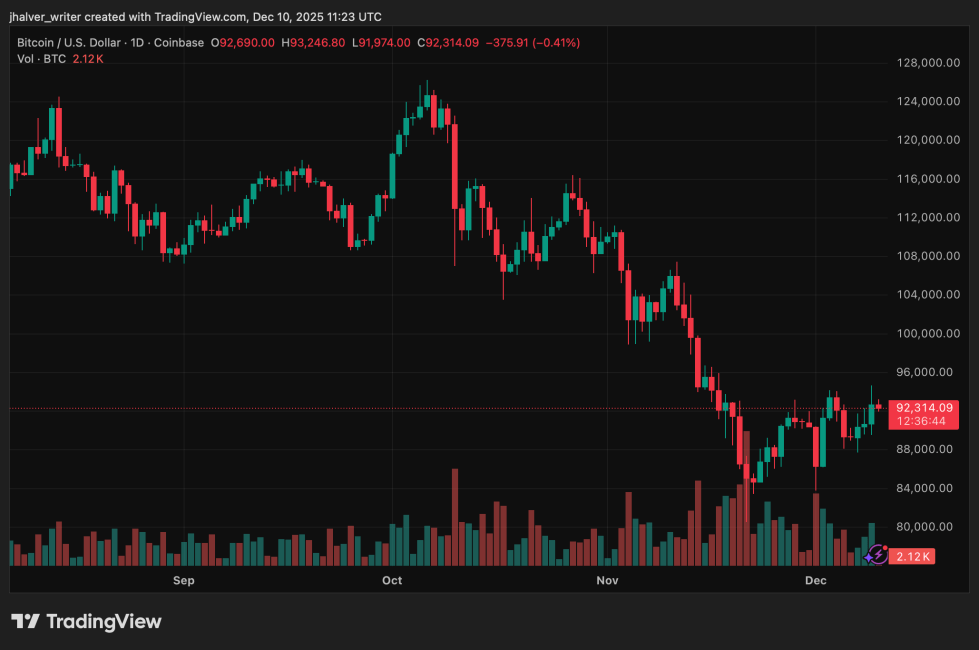
BTC's price records some small gains on the daily chart. Source: BTCUSD on Tradingview

Upbit Pushes Hot Wallet Usage Toward Zero

Following its internal review and system overhaul, Upbit confirmed that it now stores approximately 99% of user assets in cold wallets, with hot wallet exposure reduced to about 1% and expected to decrease further.

As of late October, the exchange held 98.33% of customer funds offline, a rate already well above the 80% minimum required under South Korea’s Virtual Asset User Protection Act.

This shift follows a pattern of rising caution. The recent breach was Upbit’s second significant attack, occurring on November 27, mirroring a 2019 incident that saw more than 342,000 ETH drained from its systems.

This year’s Solana-based attack resulted in withdrawals across 24 tokens within less than an hour, prompting an immediate shutdown of hot wallet operations and emergency transfers to cold storage. Upbit has pledged to fully reimburse affected users from corporate reserves.

Domestic data suggests that the exchange already leads the market in cold storage usage, maintaining the lowest hot wallet ratio among local competitors, whose cold wallet shares range from 82% to 90%.

Security Benchmark Sets Pressure on Global and Local Exchanges

Upbit’s near-99% cold wallet ratio surpasses the standards of major global exchanges. Coinbase stores about 98% of its funds offline, while Kraken’s ratio sits between 95% and 97%.

Several Asian exchanges, including OKX and Gate.io, maintain similar levels. With Upbit’s latest update, the platform now stands at the forefront of global cold storage practices.

Industry observers note that the move aligns with broader regulatory momentum. South Korea’s Financial Services Commission is considering new rules that would require exchanges to compensate users for losses resulting from hacks, regardless of fault, similar to the standards imposed on banks.

Liquidity Questions Linger in a Restricted Market

While security is at the center of Upbit’s restructuring, analysts caution that running with minimal hot wallet reserves may slow withdrawals during periods of heightened market volatility.

South Korea’s crypto market is largely closed to foreign participants, restricting arbitrage and creating conditions where delays can exacerbate price discrepancies, commonly known as the “Kimchi premium.”

During last month’s temporary withdrawal suspension, liquidity was effectively trapped, resulting in sharply widening price gaps between the Korean and global markets. Still, Upbit maintains that its rebuilt systems and predictive models will ensure sufficient liquidity under normal trading conditions.

Cover image from ChatGPT, BTCUSD chart from Tradingview

Leituras Relacionadas

Can Generative Models Finally Be Trained End-to-End? The Core Is a For Loop

This article introduces a novel training paradigm for generative models called Explorative Modeling (XM), which enables true end-to-end training. Traditionally, powerful generative models like autoregressive and diffusion models are not trained end-to-end. They are trained to predict a single small step but require iterative multi-step sampling for inference. This "exposure bias" leads to error accumulation and limits performance. The core challenge XM addresses is "mode blurring." In generative tasks, a single input (e.g., "generate a dog") corresponds to many valid outputs (multiple modes). Standard training objectives like reconstruction loss force the model to average these modes, producing unrealistic, blurry outputs. To avoid this, existing models break generation into many small, almost deterministic steps, sacrificing end-to-end training. XM tackles this by restructuring the training loop itself. Its key insight is to amplify "generative expressivity." For each training input, instead of generating one sample, the model generates K candidate outputs. Only the candidate closest to the real data is used for computing the loss and updating the model via backpropagation. This simple "best-of-K" mechanism is implemented as a short for-loop. By exploring multiple possibilities, the model learns to distribute its guesses across different modes rather than collapsing to their uninformative average. The paper demonstrates that "exploration" acts as a new, powerful scaling axis. Gains from XM increase with model size, data scale, and compute. Experiments show improvements in FID scores for image generation and significant efficiency gains, sometimes outperforming larger models without exploration. When pushed to the limit, XM enables fully single-step, end-to-end generative models. In robotics tasks, an "Explorative Policy" matched the performance of a 100-step Diffusion Policy with a single forward pass, drastically improving inference speed. While the best-of-K concept is not entirely new, the authors' contribution lies in formally understanding it as a direct method to boost generative expressivity without fragmenting the generation process. This work suggests that as models scale, enhancing exploration during training may become crucial for overcoming fundamental performance bottlenecks.

marsbitHá 9m

Can Generative Models Finally Be Trained End-to-End? The Core Is a For Loop

marsbitHá 9m

Annual Salary of Millions Competing for Electricians, Meta Rushes to Open Its Own Technical School

The AI boom is facing an unexpected bottleneck: a severe shortage of skilled construction workers and electricians. As tech giants like Meta, OpenAI, and Alphabet race to build massive data centers—such as OpenAI's $16 billion "Stargate" project—they are hitting a critical labor wall. The U.S. needs an estimated 130,000 more electricians, 240,000 construction workers, and 150,000 supervisors by 2030 for AI infrastructure alone, but tens of thousands of electrician jobs go unfilled each year. While AI companies offer high premiums, with electricians earning up to $280,000 annually, worker scarcity still causes massive losses—delays on a single project can cost $14.2 million per month. The complexity of building AI data centers, which require immense power (equivalent to powering hundreds of thousands of homes), sophisticated electrical systems, and advanced liquid cooling solutions, demands highly skilled technicians who are in short supply. To combat this, companies are investing heavily in training. Meta has committed $115 million to a free training school offering tuition, housing, and stipends, targeting 5,000 new workers. OpenAI is partnering with unions to secure skilled labor. These efforts are paying off, with a significant rise in Gen Z interest in trade schools over college. However, the power demands are staggering. AI data centers are driving a rapid surge in electricity consumption, projected to account for up to 12% of U.S. power use by 2028 and raising costs for consumers. Furthermore, the construction boom is project-based, leading to a potential future glut of trained workers once building peaks, which could depress wages industry-wide. The race for AI supremacy now depends as much on skilled hands as on advanced chips.

marsbitHá 1h

Annual Salary of Millions Competing for Electricians, Meta Rushes to Open Its Own Technical School

marsbitHá 1h

Trading

Spot
活动图片




