By leveraging tokenization, could enabling ordinary users to enter the market for unicorns like SpaceX before their IPO become the new future narrative for RWA?
Written by: Frank
As of 2026, RWA still seems to lack new battlefields.
Looking back over the past 5 years, from stablecoins to U.S. bonds, and then to funds and U.S. stocks, mainstream assets have been gradually introduced into the on-chain ecosystem. Through tokenization, they have become new, tradable financial products, to some extent streamlining the on-chain trading logic for secondary market assets from TradFi.
However, the primary market, that place harboring super unicorns like SpaceX, ByteDance, OpenAI, Anthropic, remains behind closed doors. Users can trade Tesla seamlessly on-chain, yet struggle to buy a "ticket" to SpaceX before the bell rings.
Nevertheless, since last year, boundaries are indeed being explored: Robinhood tested waters in Europe with tokenized equity products for companies like OpenAI; Hyperliquid listed perpetual contracts for SpaceX; and this week, MSX launched on-chain Pre-IPO share offerings for unicorns like SpaceX and ByteDance.
Although the approaches differ, they point in the same direction: Pre-IPO, this previously highly封闭的 primary market, is beginning to embrace the chain.
I. Pre-IPO Is, and Must, Embrace the Chain
To understand the significance of Onchain for Pre-IPO, we must first clarify the unique role "Pre-IPO" plays in the capital market lifecycle.
Long have we heard familiar investment myths: Masayoshi Son finalizing the Alibaba deal in 6 minutes, a16z's early investment in Meta (Facebook), Sequoia's bet on Coinbase, etc. Essentially, they all tell the same story: securing a position in优质 assets before their IPO through institutional身份, capturing the "scissor差" from the valuation leap between private and public markets.
Objectively speaking, they deserve it.
After all, early-stage VC is a "game of probability"; a16z might have invested in hundreds of failed social networks before hitting one Facebook; Masayoshi Son, before and after betting on Alibaba, missed/mis-invested in countless internet companies... Ultimately, bearing extremely high trial-and-error costs, enduring exit cycles as long as a decade, and finally covering overall losses with the超额 returns from a few successful projects—this is the basic business logic of risk investment, and the "risk premium" institutional capital理应 earns.
However, when we discuss Pre-IPO (the eve of listing), the logic undergoes a qualitative change.
Because this is a截然不同的 stage. As the "last mile" before going public, the company has grown into a super unicorn like SpaceX, ByteDance, OpenAI, Anthropic. The business model is extremely mature, revenue paths are clear and visible. Entering at this point carries significantly lower risk compared to early-stage VC, even possessing a certain二级市场-like certainty.
And ironically, in this high-certainty stage, the returns around the IPO can still be astonishing. Take two representative stocks in 2025 as examples: Figma's IPO price was $33, it closed at $115.5 on the first day, a surge of over 250%; Bullish's first-day gain was also接近 290%.
This means that those institutions that secure allocations before the bell, under extremely low risk, still take away the fattest piece of the cake.
Regrettably, even with secondary trading platforms for private company equity like Forge and EquityZen, they普遍 adopt a point-to-point OTC matching model, with entry thresholds in the hundreds of thousands of dollars, and are only open to accredited investors. Ordinary users can only go to the secondary market to pick up the pieces after the IPO bell rings.
From the perspective of capital efficiency, this is inherently an inefficient structure. On one side, unicorn valuations continue to climb; on the other, ordinary investors are blocked outside the high wall. A natural question随之 arises:
Since blockchain can lower the entry barrier for U.S. stocks and achieve asset fragmentation, can it also, through tokenization before unicorn assets go public, allow users to share in the valuation growth红利 during the transition from private to IPO?
II. Diverging Paths: Perps or Tokenized Mirrors?
The on-chain experimentation with Pre-IPO has currently diverged into two logically distinct paths.
One is the perpetual contract model represented by Hyperliquid. For example, based on the HIP-3 framework, developers can自定义 deploy perpetual contract products for Pre-IPO assets like OpenAI and SpaceX. The core logic is combining Pre-IPO with perpetual contracts, not involving actual equity settlement. Essentially, it bypasses the equity itself, only providing price exposure, allowing users to bet on the valuation rise and fall of companies like SpaceX and OpenAI.
The advantages are obvious: extremely low entry threshold, no need for accredited investor certification; trades are instant, without complex equity settlement processes, etc.
At the mechanism level, we can simply understand it as a betting agreement on the valuation of unicorns like SpaceX. Liquidity is activated jointly by market makers and leverage mechanisms. Precisely because of this, it requires constant attention to whether the oracle is stable, whether the risk control mechanism is reliable, and whether清算 is fair under extreme conditions.
Furthermore, from a compliance perspective, whether this model constitutes变相 securities issuance remains in a global regulatory grey area in major jurisdictions.
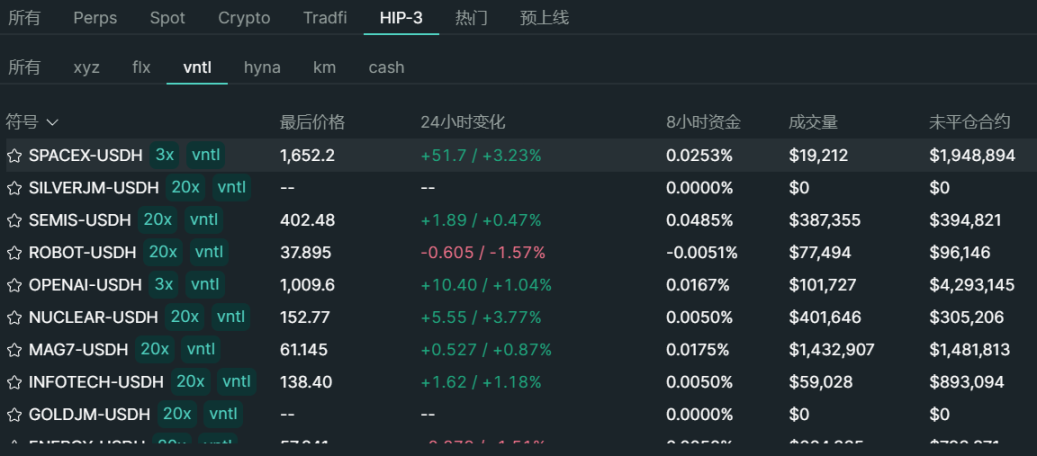
The other path is much more difficult: under compliant premises, allowing users to actually hold tokenized equity, not just trade prices.
Robinhood's European test in June 2025 and MSX's launch of the on-chain Pre-IPO zone in March 2026 both point in this direction—both platforms相继 partnered with Republic, a U.S. compliant asset tokenization platform,致力于将真实的 Pre-IPO equity tokenized through an SPV (Special Purpose Vehicle) structure, allowing investors to hold legally protected equity份额.
The core value of this model lies in the fact that the tokens correspond to real existing equity, held by a regulated third-party custodian,具备 legal and asset backing foundation.
Specifically, Republic adopts an "SPV indirect holding" structure. An offshore SPV is established to hold the underlying company shares, and then the SPV's权益 is tokenized and distributed to investors. Although it is still indirect holding, compared to pure derivatives, this model at least establishes a traceable chain of "Token → SPV → Equity".
Of course, the落地 of this model highly depends on compliant infrastructure. It must operate under the U.S. SEC regulatory framework, cooperate with licensed custodians (like BitGo Trust Company, etc.), ensure asset security and legal validity. This also means it is not just product innovation, but an institutional engineering project.
Overall, these two paths represent two截然不同的 value orientations. The former (perps) is closer to DeFi's efficiency logic, pursuing extreme liquidity and low thresholds, at the cost of lacking real correlation with the underlying asset; the latter (tokenized equity mirrors) is closer to TradFi's institutional logic, with the difficulty lying in building the compliance framework.
But regardless of the path chosen, a consensus is forming: through the tokenization of unlisted equity, a "one-and-a-half market"介于 primary and secondary is taking shape.
III. From Robinhood to MSX: The Global Bridge for the "One-and-a-Half Market"
The爆发 of a market requires not only a grand narrative but, more crucially,入口-level products.
From a technical perspective, tokenization technology,经过 years of engineering verification, smart contracts, oracles, and on-chain compliance frameworks all possess the capability to carry complex financial products. From an application perspective, DeFi and TradFi have初步融合. Global users are increasingly accustomed to sharing this era's scarcest优质 asset growth红利 in a decentralized, permissionless manner.
It can be said that the on-chaining of Pre-IPO assets is at a historical inflection point,临门一脚. But单纯的 DeFi protocols often struggle to independently complete user education, compliance docking, and large-scale capital introduction alone. Therefore, at this time, on-chain infrastructure that can connect with traditional financial genes often becomes the most critical variable between narrative and落地.
Looking back, the attempt by Robinhood in June 2025 was profoundly significant.
As a global标杆 for internet retail brokers, it allowed European users to participate in on-chain份额 trading for star unicorns like OpenAI and SpaceX with extremely low thresholds. This算得上 the first time a mainstream broker has taken such a clear, large-scale stance towards the on-chain Pre-IPO market. This verified that the regulatory framework can be adapted弹性地, and proved that the masses have a real and旺盛 demand for such products.
But Europe is just the beginning. The larger, higher-growth Asian market同样 harbors an incremental space that cannot be ignored. And here, a truly entry-level platform is still lacking.
This is precisely why MSX's newly launched Pre-IPO zone deserves attention.
On March 2nd, MSX partnered with Republic—the same platform that supported Robinhood's European compliant structure—replicating this verified path to the Asian market: the first batch opened subscriptions for tokenized equity of top unicorns like SpaceX, ByteDance, Lambda Labs, Cerebras Systems, with a minimum threshold of only 10 USDT.
To some extent, MSX is playing the role of an "Asian version of Robinhood"—using a compliant tokenization structure to connect the稀缺 equity "pre-bell" with global liquidity "post-bell" in the relatively complex regulatory environment of the Asian market, bridging that hardest-to-cross "last mile".
From a broader perspective, the on-chaining of Pre-IPO is never just a one-sided demand from ordinary users; it is essentially a two-way rush:
-
Ordinary users need a truly equitable entry point to share the growth红利 of global top unicorns before the bell rings, without having to wait outside the secondary market door;
-
Private equity and early shareholders同样 hope to introduce an unprecedented global incremental funding pool, exchanging on-chain liquidity for diversified exit options for their holdings;
Both needs一拍即合.
So from Robinhood to MSX, one in Europe, one in Asia,确实说明 the Pre-IPO market is gradually moving from its原始形态 of "point-to-point matching" into the tokenization era of "low threshold, high efficiency".
IV. Final Words
The maturity and large-scale普及 of underlying technology often don't immediately materialize as product爆发. But when accumulation is sufficient, the delayed wave of innovation反而 comes more fiercely.
In this sense, it is not without basis for on-chain Pre-IPO to become a mainstream asset class in the next 3~5 years: blockchain technology has reached today, tokenization infrastructure already possesses the engineering capability to carry complex financial products, on-chain compliance frameworks are gradually clarifying, and bilateral trust between institutions and users is being slowly but steadily built.
But logical feasibility never equals natural occurrence.
Whether the compliance path is clear enough, whether the risk control mechanism is truly reliable, whether the liquidity between institutions and retail investors can be effectively matched, etc.—each is a necessary condition,缺一不可. More importantly, it's not just Robinhood and MSX; more platforms are needed, willing to bear the cost of "being the first to eat crab", using real products and real users to tread a replicable path.
In 2026, will the tokenization of Pre-IPO be a flash-in-the-pan concept game, or the true starting point for重塑 the rules of capital market access? We will know soon.



















