Uniswap Innocent, Tornado Developer Jailed: Two Verdicts from the Same Judge

比推Publicado em 2026-03-03Última atualização em 2026-03-03

Resumo

In a landmark ruling, a New York federal court dismissed a class-action lawsuit against Uniswap and its founder, Hayden Adams, holding that open-source developers are not liable for fraudulent tokens traded on their decentralized protocols. The judge, Katherine Polk Failla, compared the case to holding a car manufacturer responsible for crimes committed using its vehicles. This decision is seen as a significant victory for DeFi developers. However, the same judge previously presided over the case against Tornado Cash developer Roman Storm, who was convicted for operating an unlicensed money-transmitting business. The contrasting outcomes highlight a key distinction in regulatory attitude: decentralization is tolerated, but privacy tools that enable large-scale money laundering—especially for state actors like North Korean hackers—are not. The article argues that while Uniswap isn’t legally obligated to screen for scam tokens, there is an expectation for major platforms to take proactive measures to protect users. The piece concludes that operating within existing legal frameworks—such as implementing sanctions screening—may be essential for decentralized protocols to survive.

Author: Eric, Foresight News

Original Title: The Same Judge, Different Outcomes for Uniswap and Tornado


At 3 a.m. Beijing time on March 3, the class action lawsuit demanding that Uniswap and its founder Hayden Adams be held responsible for scam tokens on Uniswap was dismissed by the U.S. District Court for the Southern District of New York. Brian Nistler, General Counsel of the Uniswap Foundation, called it a "landmark ruling for DeFi."
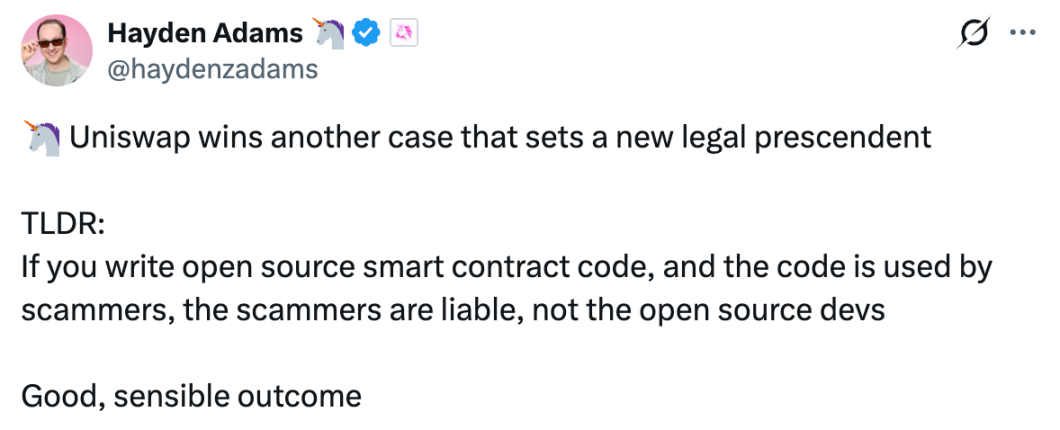
Hayden Adams also tweeted, "If you write open-source smart contract code and that code is used by scammers, the scammers are responsible, not the open-source developers. This is a reasonable and just outcome."

For Web3 developers, this is undoubtedly good news. But little known is that the judge who made this "just ruling" is the same person who, during the tenure of the former SEC chairman, found the developers of the mixer Tornado Cash guilty.

The Final Verdict

Nearly four years have passed since the class action lawsuit against Uniswap was filed and today's final resolution.

In April 2022, Uniswap users, represented by Nessa Risley, filed a class action lawsuit in court, accusing defendants Paradigm, a16z, Uniswap, and its founder Hayden Adams of violating federal securities laws by issuing and selling unregistered securities, including UNI, in the form of tokens on Uniswap. Additionally, the defendants failed to register Uniswap as an exchange or broker-dealer under applicable securities laws and did not provide investors with registration statements for the securities they issued and sold.

This lawsuit was initiated by the law firms Kim&Serritella and Barton, representing users who traded EtherumMax, Bezoge, MatrixSamurai, Alphawolf Finance, RocketBunny, and BoomBaby.io tokens on Uniswap between April 5, 2021, and April 4, 2022.

The phrase "unregistered securities" had extraordinary destructive power in the crypto industry at the time, but this lawsuit unexpectedly and quickly tilted in Uniswap's favor.

Presiding Judge Katherine Polk Failla, while agreeing that the so-called "scam tokens" were indeed securities, ruled that Uniswap did not need to be held responsible. Failla argued that Uniswap's decentralized nature meant the protocol had no control over which tokens were listed on the platform or who could interact with it. "The case is more like holding the developer of an autonomous vehicle responsible for traffic violations or bank robberies committed by third parties using the car."

Based on this, Failla dismissed the federal securities law charges in August 2023. The plaintiffs then appealed, and the Second Circuit Court of Appeals affirmed the dismissal of the federal part in 2025 but remanded the state law part for retrial.

Subsequently, the plaintiffs amended the complaint and sued again. This time, the losing investors accused Uniswap and other defendants of aiding and abetting fraud, making false statements, profiting from transactions involving scam tokens, and violating fraud laws in multiple states.

After another review by the same judge, Failla, the amended claims were dismissed again, with no further amendments allowed, bringing the case to a complete end.

The judge's reasoning this time was largely the same as before: Uniswap was unaware of the scam tokens, and even if it were aware, it did not provide substantial assistance. It also did not meet the definition of fraudulent behavior under any state law. Regarding unjust enrichment, Uniswap did not gain direct benefits, and the speculative indirect benefits from such scam activities expanding the user base were too tenuous.
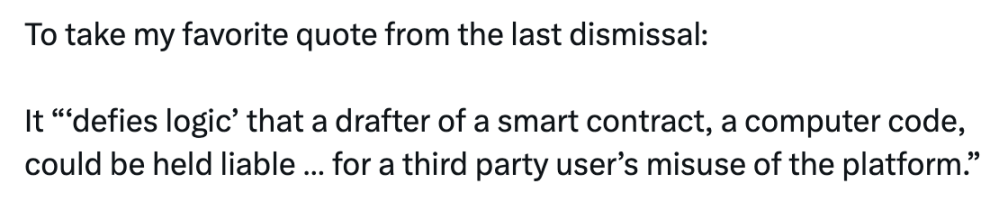
Brian Nistler stated in a tweet, quoting a line from the previous ruling, that it "defies logic" to hold the drafter of a smart contract responsible for the abusive actions of third-party users on the platform.

Tornado Cash's Different Outcome

Facing the same judge, Roman Storm of Tornado Cash met a different fate.

Tornado Cash was first added to the sanctions list by the U.S. Treasury Department's Office of Foreign Assets Control (OFAC) on August 8, 2022, accused of helping criminals, including North Korean hackers, launder over $7 billion. Two days after being added to the sanctions list, Dutch police arrested Alexey Pertsev, one of Tornado Cash's core developers.

On May 14, 2024, a Dutch court found Alexey Pertsev guilty of money laundering and sentenced him to 64 months in prison. The court ruled that Pertsev was aware that the platform he developed and operated was used for crime but did nothing to stop it, subjectively acquiescing to Tornado Cash being used as a money laundering tool. Alexey Pertsev is still appealing, but there have been no recent updates.

Seven months before Alexey Pertsev was found guilty, the U.S. Department of Justice sued two other developers, Roman Storm and Roman Semenov, in the Southern District of New York. Roman Storm was previously arrested in Washington State, while Roman Semenov remains at large.
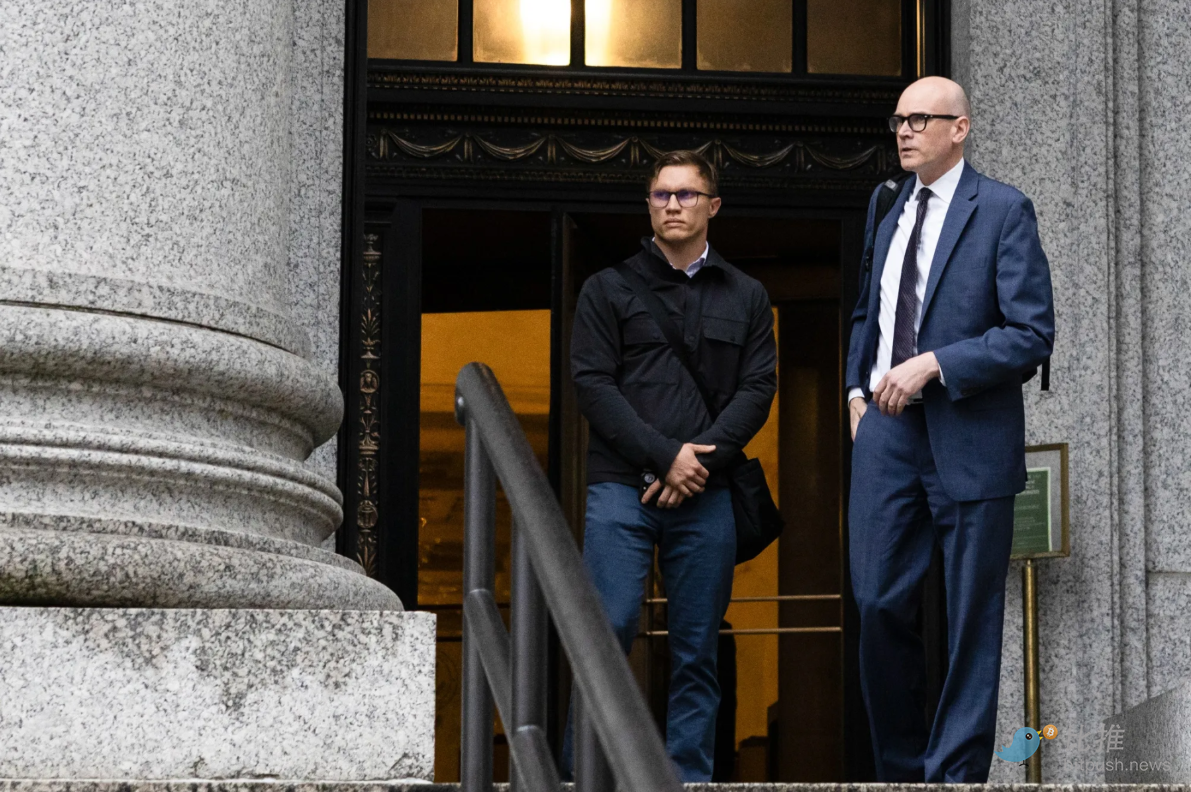
Roman Storm in court

Although an appeal later determined that OFAC's sanctions against Tornado Cash were an overreach and invalid, Roman Storm still found himself in the defendant's seat last July. After a trial presided over by Judge Katherine Polk Failla, the jury found Roman Storm guilty of "conspiracy to operate an unlicensed money transmitting business," though sentencing has not yet been formally announced.
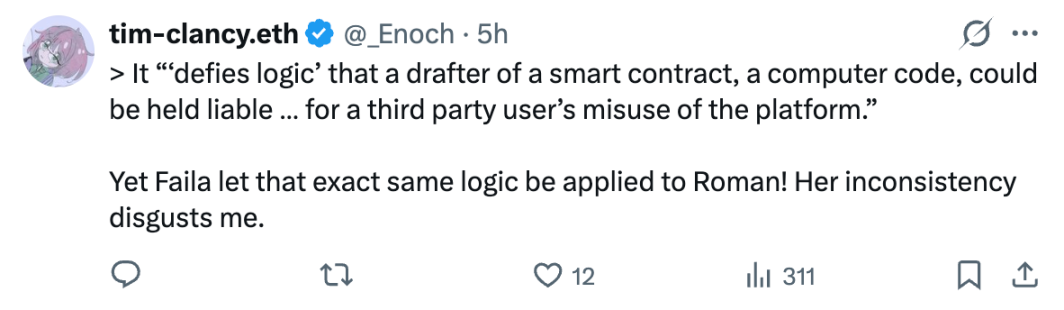
Under Brian Nistler's tweet celebrating Uniswap's victory, a comment by Sigil developer tim-clancy.eth criticizing Failla's contradictory rulings (the verdict against Roman Storm was actually made by a jury) received the most likes among all comments.

Decentralization Is Fine, but Privacy Is Not

I am not a professional lawyer, but setting aside political factors and from a simple emotional perspective, I can roughly understand why Uniswap and Tornado Cash had different outcomes.

The core reason is that Tornado Cash's developers should have been well aware that mixers would inevitably be used for money laundering. This clearly reveals regulators' stance: decentralization is acceptable, but it must be traceable. Tether faced similar challenges, which is why it later began cooperating with money laundering investigations and added freezing capabilities.

Perhaps Roman Storm, behind bars, would feel unjust upon learning of today's ruling. But he should realize that even in a crypto-friendly U.S. under Trump's administration, platforms aiding North Korean state-level hackers in money laundering cannot be tolerated. The power of crypto today is still insufficient to challenge national authority.

Web3 practitioners decry the injustice faced by Tornado Cash's developers while cheering Uniswap's victory. In our eyes, the two protocols are not fundamentally different; in fact, Tornado Cash even excels in privacy protection. Uniswap's addition of front-end blocking for sanctioned addresses in 2022 sparked some debate. Now, it seems that permissionless operation within the existing legal framework may be the only way for decentralized protocols to survive.

But that said, did Uniswap really have no responsibility at all in these scam incidents?

Strictly logically speaking, as the judge's analogy suggests, you cannot hold Mercedes responsible for a bank's losses just because a robber used their car to rob a bank. However, from a business perspective, we tend to believe that giants should provide protection within their capabilities. Current security tools can already identify a large number of potential scam projects in advance. For these established projects that have reaped the benefits of Web3's development, simple screening is not troublesome.

Doing their part to protect investors is not a mandatory obligation, but it is a responsibility that ordinary investors hope Uniswap and others will actively shoulder.


Twitter:https://twitter.com/BitpushNewsCN

Bitpush TG Discussion Group:https://t.me/BitPushCommunity

Bitpush TG Subscription: https://t.me/bitpush

Original link:https://www.bitpush.news/articles/7616264

Perguntas relacionadas

QWhat was the outcome of the class action lawsuit against Uniswap and its founder Hayden Adams?

AThe class action lawsuit against Uniswap and Hayden Adams was dismissed by the court. The judge ruled that Uniswap, as a decentralized protocol, was not responsible for scam tokens on its platform, comparing it to holding the developer of an autonomous car liable for traffic violations or crimes committed by users.

QWho was the judge presiding over both the Uniswap and Tornado Cash cases, and what were the different outcomes?

AJudge Katherine Polk Failla presided over both cases. She dismissed the lawsuit against Uniswap, ruling the protocol was not liable for third-party misuse. However, in the Tornado Cash case, developer Roman Storm was convicted by a jury for conspiracy to operate an unlicensed money transmitting business.

QWhy did the judge rule that Uniswap was not liable for the scam tokens on its platform?

AThe judge ruled that Uniswap's decentralized nature meant it had no control over which tokens were listed or who interacted with the protocol. She stated that holding the smart contract developers responsible for third-party misuse was 'illogical' and compared it to blaming autonomous car developers for crimes committed using their vehicles.

QWhat was the core reason suggested in the article for the different legal outcomes for Uniswap and Tornado Cash?

AThe article suggests the core reason is that Tornado Cash's developers were aware their mixer would be used for money laundering, particularly by entities like North Korean hackers. The author states that while decentralization is acceptable to regulators, privacy tools that enable untraceable transactions, especially for sanctioned entities, are not tolerated.

QWhat does the article suggest is the 'only way to survive' for decentralized protocols under the current legal framework?

AThe article suggests that 'permissionlessness within the existing legal framework' is the only way for decentralized protocols to survive. This is exemplified by Uniswap's 2022 decision to add front-end blocking of sanctioned addresses, a move that balances decentralization with regulatory compliance.

Leituras Relacionadas

Copper, the Gold of 2026

Copper: The New Gold for 2026? Market focus has shifted from AI chips to underlying infrastructure, with copper emerging as a key narrative. Its role is evolving beyond "Dr. Copper"—a traditional indicator of economic cycles—due to structural demand growth from AI data centers (requiring massive electrical infrastructure), grid expansion, EVs, and re-industrialization. Estimates suggest data centers alone could require 300,000 tons of copper by 2050. The core bullish thesis is not just demand but a severe supply constraint. New copper mines take ~17 years to develop, while ore grades are declining and new discoveries are scarce, potentially leading to a 30% supply deficit by 2035. This supply rigidity, coupled with strategic importance, is giving copper a "gold-like" scarcity narrative. Major macro investors, including Stanley Druckenmiller, are allocating to copper as a hedge against dollar weakness and for its exposure to energy transition and geopolitics. Traders like Pierre Andurand have projected prices could reach $40,000/ton. Capital inflows are visible in surging futures trading volumes. Copper mining stocks act as leveraged plays on copper prices. Companies like Freeport-McMoRan (FCX) and Southern Copper (SCCO), as well as Chinese miners like CMOC, have seen significant volatility, offering high upside but also steep drawdowns, reflecting operational and geopolitical risks. While copper remains cyclical and won't fully replicate gold's monetary role, its long-term fundamentals have shifted. Its new scarcity premium, driven by a tightening supply structure and expanding electrical demand, suggests its "goldification" is just beginning.

marsbitHá 5m

Copper, the Gold of 2026

marsbitHá 5m

pump.fun's New Feature Brings 'Black Mirror' Into Reality

The article begins by recounting a dark fictional story from *Black Mirror* (Season 7, Episode 1 "Common People"), where a man is forced to perform humiliating tasks online to pay for his wife's life-sustaining medical subscription. It then draws a parallel to a new real-world feature on the crypto platform pump.fun called "Pump.fun Go," which allows users to post and complete paid bounty tasks. This feature gained mainstream attention, often negatively, through extreme examples. A prominent case involved a bounty of 40 SOL (~$2,600) offered to permanently tattoo "$bountywork" on one's forehead. An Indian man completed the task, stating the money "changed his life," and later earned significantly more from a related meme coin. Another bounty paid 200 SOL (~$14,000) for a "bounty.fun" forehead tattoo, with the participant simply stating, "We need the money." The article highlights how this system can amplify darkness, citing the dev behind $Bountywork who spent thousands on bounties for attention-grabbing stunts like eating bugs or drinking hot sauce for small sums. It compares this to past tragic live-streaming incidents where people harmed themselves for money, noting regulation cannot stop those in desperate need. However, it also points to positive, altruistic bounties that have emerged, such as organizing anti-work rallies in New York, performing random acts of kindness for strangers, organizing community food drives, or even helping an elderly person cross the street. The piece concludes by acknowledging the platform reflects both the dark and light sides of human nature when actions are given a price, hoping for more of the latter.

marsbitHá 11m

pump.fun's New Feature Brings 'Black Mirror' Into Reality

marsbitHá 11m

As the US and Japan Hike Interest Rates, Which Asset Class is Most at Risk?

This week, global markets face two major events: the Bank of Japan's likely interest rate hike and the US Federal Reserve's FOMC meeting. For risk assets, it is a pivotal and volatile week. In the US, expectations for rate cuts have faded dramatically. May's higher-than-expected CPI and resilient jobs data have shifted the Fed's focus from potential cuts to the possibility of future hikes. New Fed Chair Wash is unlikely to raise rates at this meeting, but any hawkish shift in communication, the dot plot, or the policy statement could lead markets to price in tighter policy, pushing up short-term Treasury yields and strengthening the dollar. High-valuation growth stocks, AI-related assets, and small-cap stocks reliant on cheap funding are most vulnerable to rising rates. In Japan, a 25 basis point hike is almost fully priced in (98.3% probability), which would bring the policy rate to 1%, its highest since 1995. The concern is not the hike itself, but its potential to unwind the massive "carry trade," where investors borrowed low-yielding yen to invest globally. Historically, Japan's rate hikes have coincided with global market stress (2000, 2007, 2024). While this well-telegraphed hike may be digested smoothly, two key factors increase uncertainty: 1) Governor Ueda's absence due to illness, putting communication in the hands of less-familiar deputies, and 2) the Fed meeting occurring just days later, creating potential for a compounded market reaction if both central banks sound hawkish. Asset implications: * **Bonds:** US short-term yields sensitive to Fed signals. Japan's rate hike could pressure its massive US Treasury holdings. * **Currencies:** Dollar likely supported by Fed; Yen's reaction hinges on BoJ's forward guidance. * **Equities:** US growth stocks, small-caps most at risk. Japanese stocks face pressure from a stronger yen. * **Crypto:** Assets like Bitcoin face headwinds from higher rates and tighter liquidity; high-beta altcoins are even more vulnerable. The convergence of these two central bank meetings amplifies market volatility risks, with potential spillovers across asset classes globally.

marsbitHá 16m

As the US and Japan Hike Interest Rates, Which Asset Class is Most at Risk?

marsbitHá 16m

Trading

Spot
Futuros
活动图片