Under the Curse of TGE Peaking, Which Tokens Defied the Trend and Rose?

比推Publicado em 2025-12-31Última atualização em 2025-12-31

Resumo

Amid the prevailing trend of tokens peaking at their Token Generation Event (TGE) and declining thereafter in 2025, a few exceptions managed to sustain price increases post-launch. Tokens like ASTER, FOLKS, AVICI, and SENTIS demonstrated resilience, driven by genuine buying support rather than temporary spikes. Key factors contributing to their success include fair token distribution (e.g., AVICI with 0% team allocation, SENTIS with activity-based emissions), reasonable initial valuations that allowed for market re-rating, observable product usage or adoption (such as Aster’s Perp volume and Avici’s real-world spending), transparent and linear unlock schedules, and strategic exchange listings that amplified rather than dictated performance. These tokens highlight a market shift towards valuing structural integrity—healthy circulation, fair launches, and tangible utility—over mere narrative potential, emphasizing survival through sound tokenomics and adoption in an increasingly competitive landscape.

Author: Stacy Muur

Compiled by: CryptoLeo

Original title: What Are the Characteristics and Commonalities of Tokens That Performed Well After TGE in 2025?


Last week, I compiled a research post by Solus Group titled "Over 80% of New Tokens Peak at TGE: The Root Cause and Cure for Web3's False Prosperity," which analyzed the post-TGE performance of 113 tokens in 2025. The vast majority of these tokens peaked at TGE, with their prices starting to decline the day after launch, despite having conditions such as high financing, community support, and exchange listings.

Today's shared article is from crypto researcher Stacy Muur, who compiled several tokens from 2025 that showed significant price increases compared to their TGE prices and analyzed what advantages/conditions these projects possessed. In contrast, the previous article presented a statistical result based on data, while this article focuses more on the projects themselves. In summary: In today's overly homogeneous and expanding crypto market, project tokens need to meet multiple conditions to survive/succeed in the market. Odaily Planet Daily has compiled it as follows:

If you've been keen on trading tokens that TGE'd in 2025, the results so far are clear: tokens are hot in the first week after launch, then gradually cool down, and finally, it's tacitly accepted that "the issuance price is the peak." Most newly launched tokens perform poorly, or even plummet, as the market always treats tokenomics and liquidity as fundamentals.
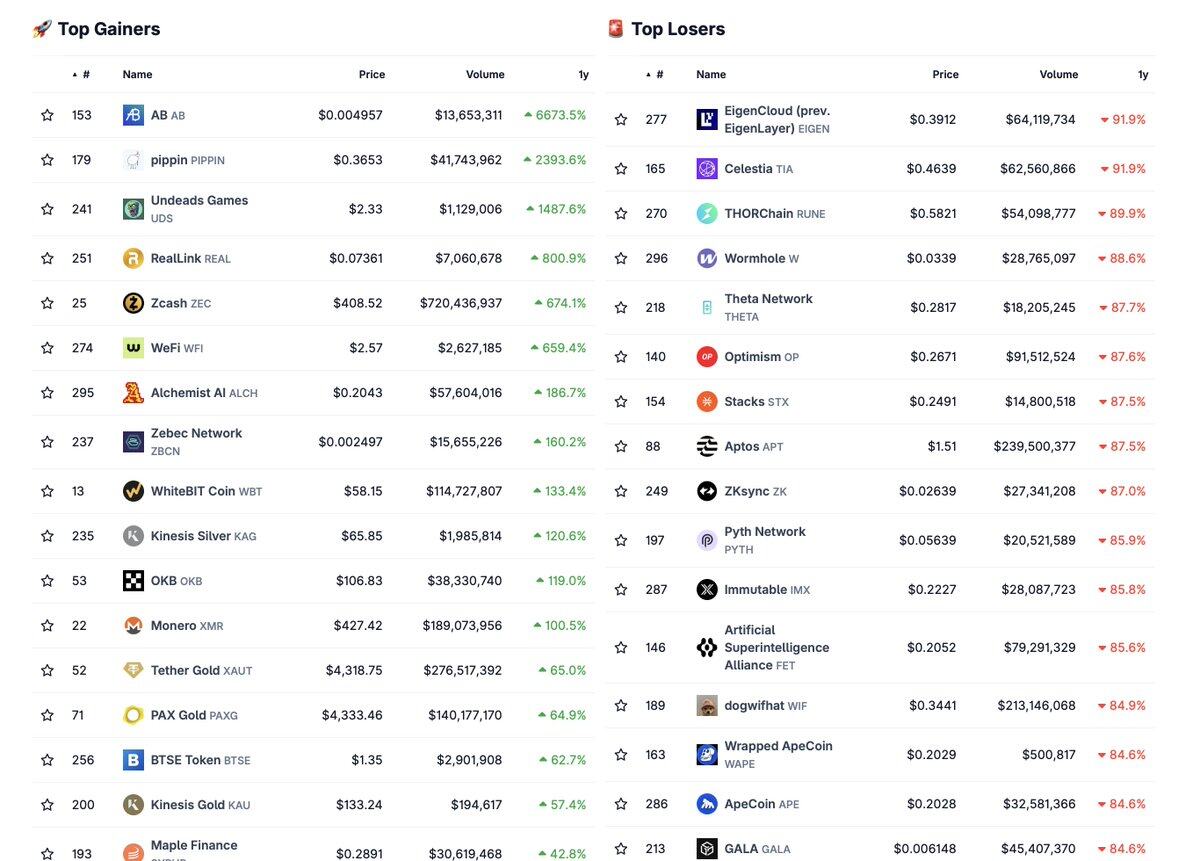
Despite this, a few tokens in 2025 maintained price increases relative to their TGE, not in the sense of "rebounding after a price crash" or "buying at the market bottom," but in a way that indicates genuine buying support.

Here are the truly rising tokens from 2025 TGE that I've compiled: ASTER, FOLKS, AVICI, and SENTIS (there are also some "barely passing" tokens like IRYS/FHE/CORN). They don't look exactly the same, but they all share certain characteristics.

The Best Rising Tokens from 2025 TGE

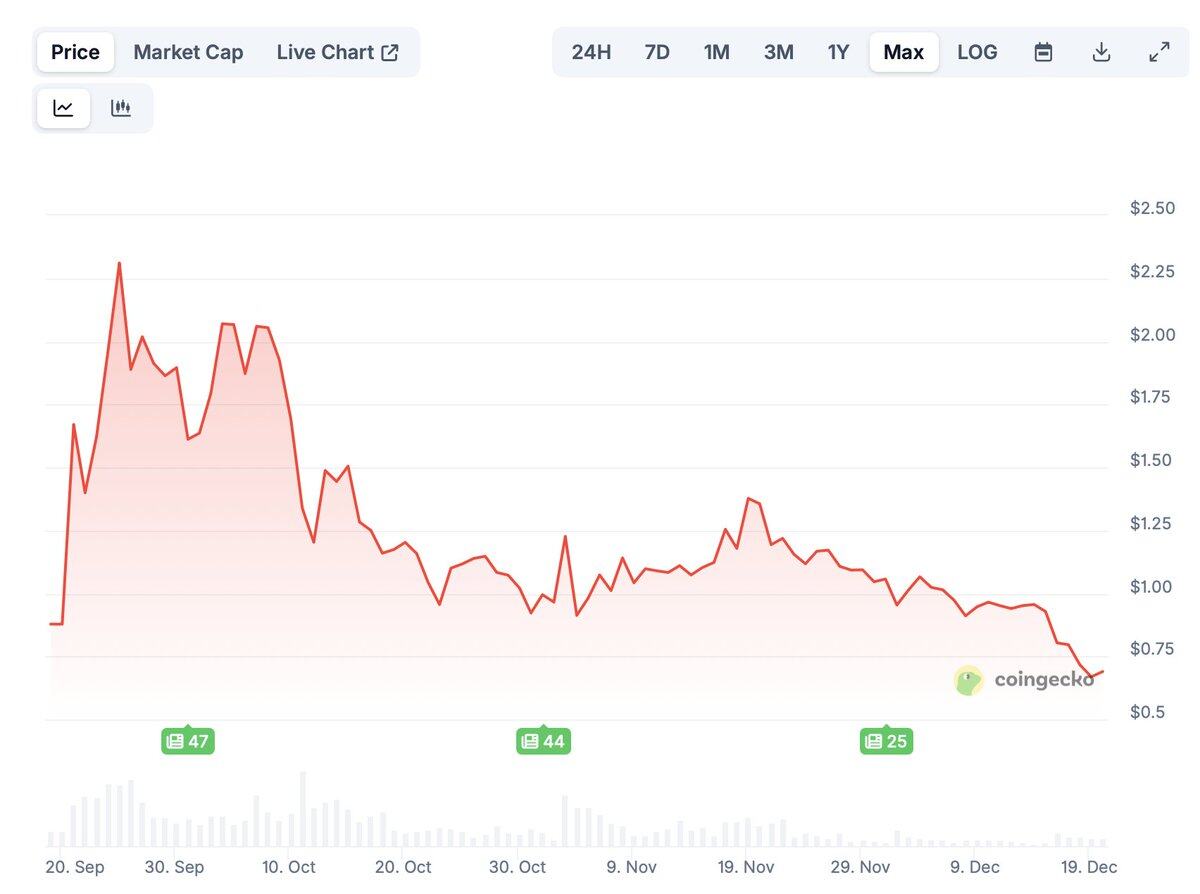
Aster is a typical example. ASTER got everything the project needed on its first day: major exchange listing, deep liquidity, and the widely accepted "Perp DEX" narrative. The story circulating throughout the year was basically: "Binance-backed Perp DEX with privacy features."

ASTER's price action was controversial (you could call it ZK-related, CZ shadow gaming, or simply better execution strategy). But nonetheless, it was one of the few projects that didn't experience an "immediate sell-off" at TGE.
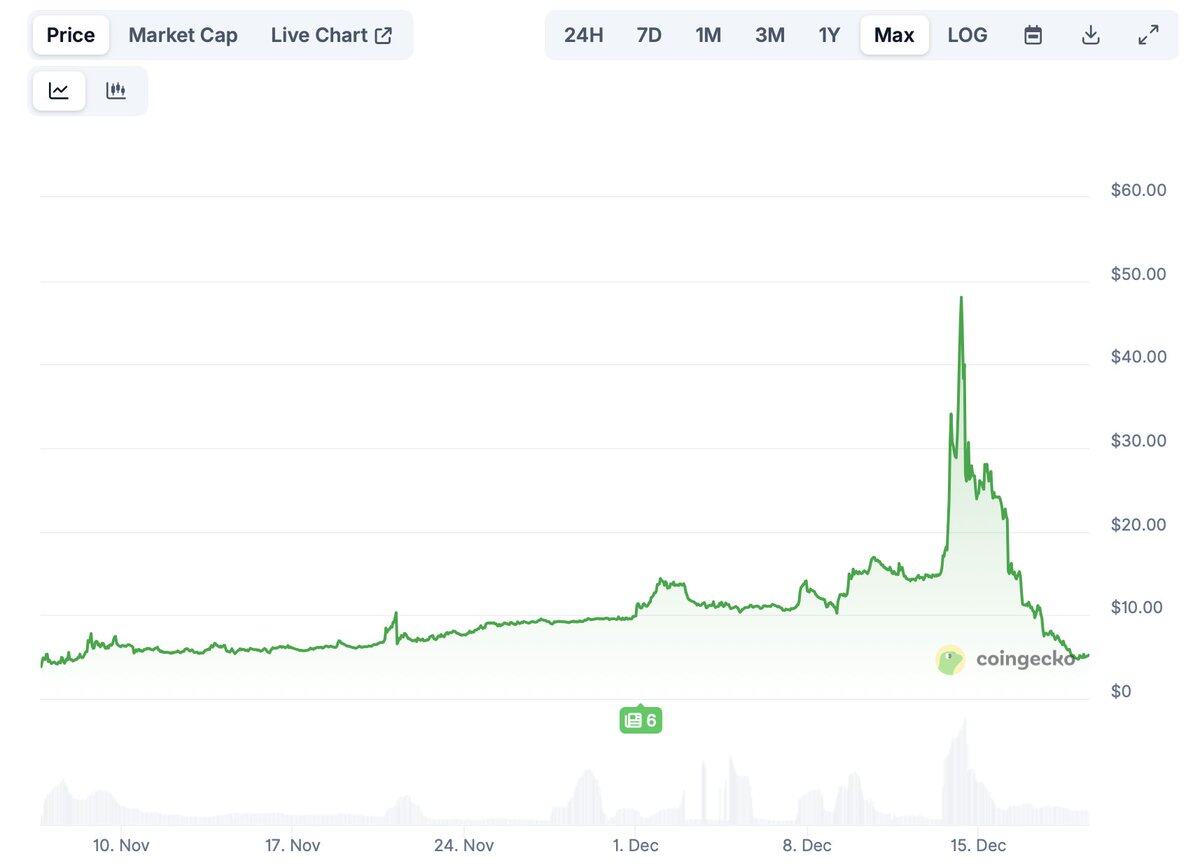
FOLKS is different: it's a lending token, seen as Alpha in "such a garbage year." The formula: "Binance and Kraken showed support from day one, cross-chain pools kept growing, no obvious massive unlock." The last point is very important. It performed well until the token unlock on December 15th.
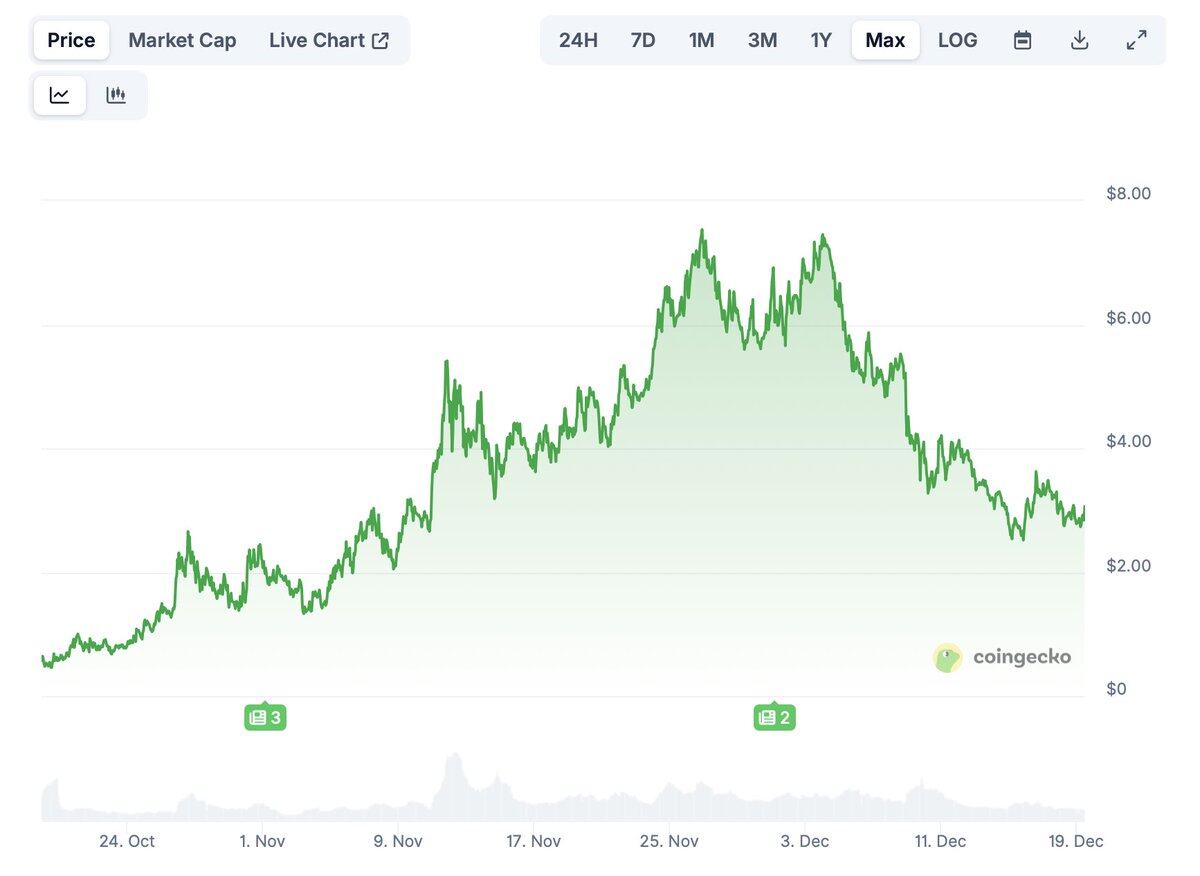
AVICI is different from the first two. AVICI is on this list not because it has the most cutting-edge technology, but because it provided the clearest narrative for CT: "Fair launch, truly usable product." It emphasized not tokenomics but usage: "decent neobank app, Visa card, real spending." In a market flooded with endogenous "utility," AVICI was refreshing, both thinking outside the box and being practical. AVICI might be one of the best TGE tokens of the year.
When Tokens Rise for a Reason, Their Prices Tend to Be More Stable

Looking now, the token with the strongest performance post-TGE is SENTIS. Its support points are simple and clear: AI Agent narrative + continuous incentive distribution + exchange listing. In CT, the dominant framework remains consistent: "AI Agent is the next DeFi automation layer," providing traders with a simple mental model as an anchor.

Mechanically, SENTIS doesn't rely on a one-time listing pump. The token's continuous distribution mechanism (tasks/retrodrop/participation rewards) maintains a steady level of user participation, which often translates into sustained spot demand as participants prepare for future distributions and ecosystem milestones. This dynamic can support the price even before more meaningful on-chain adoption appears.

"Barely Passing" Tokens

IRYS and FHE belong to the "AI infrastructure and private transactions" field: both benefited from the AI boom, stayed above their initial ranges, and both maintained sufficient liquidity to avoid a price crash. If these projects can translate their narratives into on-chain usage, they can survive. Relying solely on narrative support is not enough.

Then there's CORN. CORN isn't very volatile and is relatively stable compared to its peers, but CORN is more of a "structured product." In 2025, that's not a bad thing. When the market "punishes" overdevelopment, survivability becomes important.

What Characteristics Do the Well-Performing Tokens of 2025 Share?

Stripping away the narratives and vibes, some clear structural patterns emerge:

1. Token distribution is more important than hype

The strongest performing projects avoided large internal liquidity at TGE. AVICI (0% team allocation), SENTIS (activity-based emissions).

Lesson: At project launch, who holds the tokens is more important than who invested privately.

2. Reasonable launch valuation beats perfect token launch timing

Many of the best-performing tokens didn't launch at the peak of market hype, but at reasonable valuations, allowing the market to re-rate them upwards.

AVICI launched a working product with an FDV of around $3.5 million, offering asymmetric upside relative to FDV.

Lesson: Tokens that "grow into" their valuation perform better than those that start overvalued.

3. Project usage (or credible near-term usage) is reflected in the price

Aster's Perp trading volume, Folks' lending scale, Avici's credit card spending—these aren't just whitepaper promises but observable signals.

Sentis started early but also linked token emissions to on-chain activity, creating a feedback loop between usage and price.

Lesson: The market is now impatient. Utility > Vision.

4. Unlock structure > Unlock size

Linear and transparent token unlocks matter, as their dilution effect is digested by the market. For example, SENTIS releases tokens gradually through participation mechanisms.

Elsewhere, what destroys user confidence isn't dilution itself, but risky cliff unlocks.

Lesson: Predictable token unlocks are bearable; unexpected ones are not.

5. Exchange listing is necessary, but not sufficient

Almost every token had decent exchange access, but this alone doesn't determine anything. Listings amplify results: they help strong tokens accelerate upward, while weak tokens get sold off faster. AVICI's token performance wasn't that bad even without a Binance listing.

Lesson: Exchange liquidity is an accelerator, not a foundation.

Key Takeaways

Overall, the situation for 2025 TGE tokens marks a shift.

The market no longer rewards "potential" but instead rewards "structure":

- Healthy circulating supply

>- Fair token distribution

>- Reliable adoption

>- Controlled unlock mechanisms

The "rising tokens" of 2025 aren't perfect projects; they were just built to survive their launch. If 2024 was about narrative, then 2025 is about token design under pressure. And this is a lesson most projects haven't yet learned during their TGE.


Twitter:https://twitter.com/BitpushNewsCN

Bitpush TG Discussion Group:https://t.me/BitPushCommunity

Bitpush TG Subscription: https://t.me/bitpush

Original link:https://www.bitpush.news/articles/7599438

Perguntas relacionadas

QAccording to the article, what are the key characteristics of tokens that maintained a price increase after TGE in 2025?

AThe key characteristics are: healthy token distribution, fair token allocation, verifiable adoption or credible near-term usage, controlled and transparent unlock mechanisms, and reasonable initial valuations that allow for market re-rating.

QWhich token was cited as a prime example of a successful TGE due to its 'Perp DEX' narrative and exchange support?

AASTER was cited as the prime example, benefiting from the 'Binance-backed Perp DEX' narrative with privacy features.

QWhat was the unique approach of the AVICI token that contributed to its post-TGE success?

AAVICI's unique approach was a fair launch (0% team allocation), a focus on a real, usable product (a functional neobank app with a Visa card for real spending), and a low initial FDV that created asymmetric upside potential.

QHow did the token distribution model of SENTIS help support its price stability?

ASENTIS used a continuous distribution mechanism tied to on-chain activities (tasks, retrodrops, participation rewards), which created steady user engagement and translated into consistent spot demand in anticipation of future allocations.

QWhat is the main shift in the market's focus for evaluating new tokens in 2025, as described in the article's conclusion?

AThe market shifted from rewarding 'potential' and narrative' to rewarding 'structure,' which includes healthy circulation, fair distribution, reliable adoption, and controlled unlock mechanisms.

Leituras Relacionadas

Must-Watch Events Next Week|CLARITY Act Could Face Senate Vote; SpaceX, Circle to Report Earnings (8.3-8.9)

**Summary: Key Events and Developments to Watch (August 3-9)** The upcoming week is marked by significant financial disclosures, key legislative deadlines, and notable product updates. **Major Financial Events:** Several companies are scheduled to release their Q2 2026 earnings. American Bitcoin (ABTC) will report on August 3, followed by SpaceX and Hut 8 Mining Corp. on August 4, and Circle on August 5. Notably, a significant portion of SpaceX shares (up to 12% of total shares) will be unlocked on August 6 following their earnings release. **Key Legislative Deadline:** The U.S. Senate faces an August 7 deadline to secure 60 votes for the CLARITY Act, a bipartisan bill aiming to establish a federal regulatory framework for cryptocurrencies. The Senate may hold a full vote on the bill during the week. **Economic Data:** The U.S. July Non-Farm Payrolls report will be released on August 7, providing crucial labor market data. **Technology & Product Updates:** * **Shutdowns:** DeFi portfolio tracker Zapper and wallet app Ctrl Wallet will cease operations on August 3. * **Upgrades:** LayerZero will deprecate its v1 relayers on August 3. XRP Ledger's new version 3.3.0, featuring five new functions, is expected next week. * **AI:** Elon Musk announced that the advanced Grok 4.6 AI model is set for release around August 7. * **Bitcoin:** The BIP-110 forced signaling for a potential Bitcoin network change is scheduled to begin around August 8. **Other Notable Events:** Chinese robotics firm Unitree Tech has set its preliminary price inquiry for its IPO for August 5. South Korean exchange Upbit will delist AQT and AERGO tokens on August 3.

marsbitHá 26m

Must-Watch Events Next Week|CLARITY Act Could Face Senate Vote; SpaceX, Circle to Report Earnings (8.3-8.9)

marsbitHá 26m

Stocks Are Plummeting More Sharply Than Cryptocurrencies. Where Has the Money Gone?

Stock Markets Plunge Deeper Than Cryptocurrencies: Where Did the Money Go? In late July, Seoul's Kospi index triggered circuit breakers for two consecutive days, plummeting over 40% from its June high. The collapse was led by heavyweight stocks like SK Hynix, whose record profits still disappointed investors, and devastating leveraged ETFs, with one major product losing over 83% of its value. This signaled a global, forced deleveraging targeting the most crowded trades. Interestingly, while stocks exhibited extreme volatility akin to crypto markets, Bitcoin rose nearly 15% in July after a prior steep drop. Analysis shows the money fleeing equities did not flow into Bitcoin. Instead, Bitcoin had already absorbed its sell-off in May-June, when U.S. spot Bitcoin ETFs saw historic outflows. The true safe-haven beneficiary was gold, whose price rose over 20% year-on-year, highlighting a decoupling between Bitcoin and gold as "digital gold." The sell-off was a targeted unwinding of leveraged positions in tech and semiconductors, accelerated by broker-dealer risk management and shifts in the AI narrative, including new competition from Chinese memory chipmakers. The retreat path was clear: from high-valuation tech stocks to cash and U.S. Treasuries, then to gold. For Bitcoin to attract sustained institutional inflows, conditions like eased global liquidity pressure, a "soft-landing" Fed rate cut, and U.S. regulatory clarity via legislation like the stalled CLARITY Act are needed. Currently, Bitcoin is not a safe haven but an already-cleared asset. Its low correlation with tech stocks, however, makes it a potential diversification play for institutional portfolios once the storm passes. The money isn't here yet, but the positioning is underway.

marsbitHá 26m

Stocks Are Plummeting More Sharply Than Cryptocurrencies. Where Has the Money Gone?

marsbitHá 26m

In Conversation with Ray Dalio: We Are Currently in an AI Bubble, with 1% of My Portfolio in Bitcoin

Ray Dalio, founder of Bridgewater Associates, warns in an interview that the current AI boom shows classic bubble characteristics, which could lead to significant economic downturns as seen in past cycles like 1929 or 2000. He explains that speculative enthusiasm, fueled by debt and overvaluation, often precedes a crash when rising rates or taxation force asset sales, causing widespread losses and recession. Dalio also outlines his "Big Cycle" theory, describing an approximate 80-year pattern where widening wealth gaps, massive government deficits, and shifting geopolitical power (like China's rise) create internal conflict and global instability. He emphasizes that we are in a late-cycle, transitional phase where traditional powers like the US and UK face decline. For personal wealth protection, Dalio advises diversification beyond cash into assets like stocks, bonds, real estate, and particularly gold, which he prefers over Bitcoin. While he holds about 1% of his portfolio in Bitcoin as a non-printable hard asset, he views gold as more secure from technological or governmental threats. Regarding AI's impact, Dalio believes it will disproportionately benefit capital owners, worsening inequality by replacing both physical and cognitive labor. He suggests that human intuition and emotional intelligence, combined with AI, will be key for future workers. On taxation, Dalio argues that wealth taxes are impractical and risk triggering asset sell-offs, reducing productive investment. He points to the UK as a cautionary example of debt, low productivity, and political strife. Geopolitically, Dalio foresees a more regionalized world, with the US showing weakness in prolonged conflicts like with Iran, akin to past imperial declines. The ideal outcome, he suggests, is coexisting powerful blocs (e.g., Americas, China-Asia Pacific) without major war.

marsbitHá 4h

In Conversation with Ray Dalio: We Are Currently in an AI Bubble, with 1% of My Portfolio in Bitcoin

marsbitHá 4h

Daily 7.2 Trillion KRW: Foreign Capital's Record Net Buying on Friday! Wall Street Says Headwinds for Korean Stock Fund Flows Have Subsided

South Korean stock market sees a dramatic shift in fund flows. On July 31, foreign investors made a record net purchase of approximately KRW 7.2 trillion in KOSPI stocks, marking a fundamental reversal from the persistent large-scale net outflows seen in previous months. This contributed to a significant narrowing of foreign net selling in July to KRW 9.8 trillion, down sharply from KRW 48.4 trillion in June and KRW 44.5 trillion in May. Simultaneously, domestic institutional pressure eased. South Korean pension funds and asset managers turned to a net buying position in July, purchasing KRW 1.0 trillion worth of KOSPI shares, contrasting with net sales in May and June. Market volatility is expected to be dampened by new financial regulations. Effective July 31, the Financial Services Commission tightened access for retail investors to single-stock leveraged ETFs by raising the minimum cash deposit requirement. Trading volumes for these products subsequently dropped to about 50% of their monthly average. Citigroup Research maintains its year-end KOSPI target of 10,000 points. The firm cites several supportive factors: the substantial easing of headwinds from capital outflows, a robust fundamental outlook for the semiconductor sector, historically low market valuations, strong economic fundamentals, and the potential for policy support from financial authorities if needed.

marsbitHá 4h

Daily 7.2 Trillion KRW: Foreign Capital's Record Net Buying on Friday! Wall Street Says Headwinds for Korean Stock Fund Flows Have Subsided

marsbitHá 4h

Trading

Spot
活动图片





