UAE telco giant e& taps dirham stablecoin for bill payments pilot

cointelegraphPublicado em 2025-12-11Última atualização em 2025-12-11

Resumo

UAE telecom giant e& has signed a memorandum of understanding with Al Maryah Community Bank to pilot a dirham-pegged stablecoin, AE Coin, for consumer bill payments and digital services. The initiative, part of the UAE’s push toward regulated digital finance, aims to enable instant, transparent, and frictionless transactions. If successful, the pilot could integrate the licensed stablecoin across e&'s payment infrastructure, including mobile and home-service bills, prepaid top-ups, and e-commerce. However, the project remains in an early exploratory stage, with no defined timeline or rollout scope yet.

United Arab Emirates’ telecom giant e& is reportedly preparing to test whether regulated stablecoins can support mainstream consumer payments, having signed a memorandum of understanding (MoU) with Al Maryah Community Bank to explore the use of a dirham-pegged stablecoin across its digital channels.

According to a Gulf News report, executives framed the collaboration as part of the UAE’s push toward regulated digital finance. e& Group CEO Hatem Dowidar said the stablecoin enables “instant settlement, complete transparency, and frictionless access.”

Al Maryah Community Bank CEO Mohammed Wassim Khayata described the initiative as a step toward expanding the “real-world applications” of licensed virtual assets.

While the move signals growing interest in blockchain-based financial rails, the initiative remains an early-stage pilot, which puts it several stages away from real-world adoption at scale.
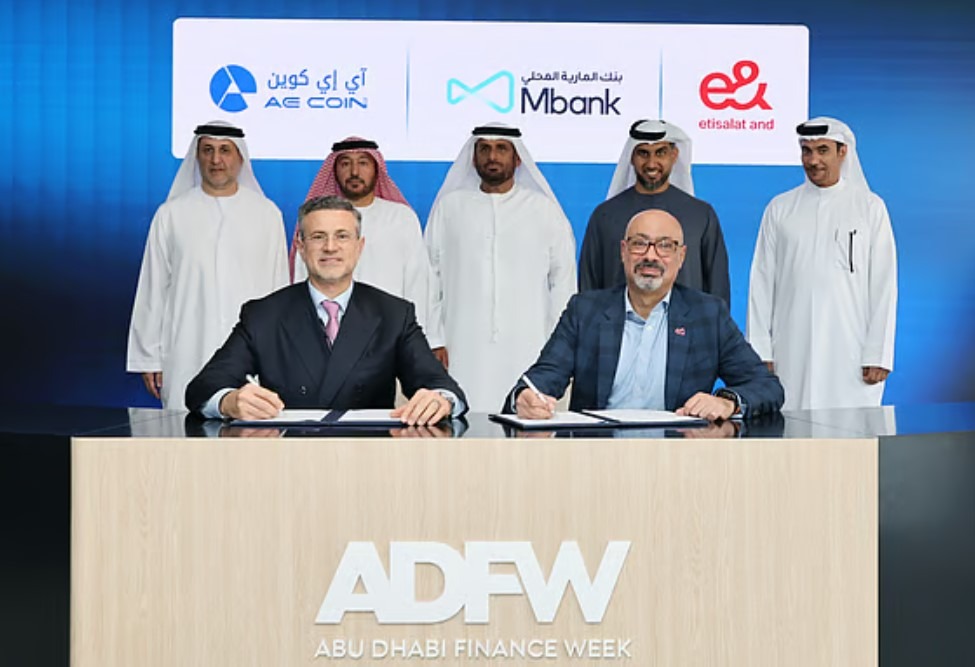
MoU signing at the Abu Dhabi Finance Week. Source: Gulf News

e& to test dirham-backed stablecoin in payments

Under the agreement, e& will assess how AE Coin, a dirham-backed stablecoin licensed by the Central Bank of the UAE (CBUAE), can be embedded in the telecom giant’s payment infrastructure.

The trial would allow customers to use the token to pay mobile and home-service bills, top up prepaid lines, manage postpaid recharges and interact with e&'s digital platforms and smart service systems.

The company also said that it would consider integrating e-commerce touchpoints with the token in the future, positioning the stablecoin as a potential alternative payment method within one of the UAE’s most widely used consumer ecosystems.

Ramez Rafeek, the General Manager of AED Stablecoin, the company behind the dirham-pegged token, stated that the stablecoin was created to facilitate instant, transparent, and regulated digital payments.

He described the agreement as a milestone in the application of licensed stablecoins to essential consumer services.

Related: Australian regulator eases rules for stablecoins and wrapped tokens

As Cointelegraph previously reported, AED Stablecoin was among the first companies to receive in-principle approval from the CBUAE under its Payment Token Service Regulation framework.

The preliminary approval made the company one of the frontrunners in the region’s stablecoin race.

Despite the promising narrative, the initiative remains exploratory in nature. An MoU often signals intent and not execution. This means that timelines, rollout scope and measurable impact remain undefined.

However, if the pilot succeeds, it could validate a model where regulated tokens quietly power routine financial activity behind the scenes.

Magazine: Koreans ‘pump’ alts after Upbit hack, China BTC mining surge: Asia Express

Leituras Relacionadas

$9.4 Billion: The Largest Robotics Funding This Year Has Emerged

Munich-based humanoid robotics company Neura has completed a $1.4 billion (approximately RMB 94.9 billion) Series C funding round, valuing the company at around $7 billion and positioning it among the global leaders in the sector. The investment round is notable not just for its size—reportedly the largest in robotics this year—but also for its strategic backers, which include tech giants like NVIDIA and Amazon, alongside established industrial players such as German engineering firms Bosch and Schaeffler. This mix of investors signals a significant shift in the industry's focus from technological demonstrations and general-purpose narratives toward practical, industrial deployment and commercialization. Neura's approach centers on developing humanoid robots for defined, high-value industrial tasks rather than pursuing a general-purpose model. Its early validation comes from a partnership with BMW, where its robots are being tested on actual production lines. The involvement of Bosch and Schaeffler, companies deeply embedded in global manufacturing, underscores a growing belief that humanoid robots are transitioning from labs to viable factory-floor solutions. The article highlights two converging trends driving investment: advancements in AI and large language models, which enhance robots' perception and decision-making in unstructured environments, and mounting pressure from labor shortages and rising costs in major manufacturing regions. The funding landscape is now bifurcating between companies like Figure AI, focusing on versatile general-purpose robots, and firms like Neura, targeting specific vertical industrial applications with clearer, shorter paths to ROI. While technical hurdles remain, the core challenges for widespread adoption are increasingly seen as engineering and commercial in nature: managing the high integration and customization costs for different factory environments and establishing robust, localized maintenance and service networks. The record investment in Neura, particularly from industrial capital, indicates the industry's growing confidence in moving from proving feasibility to solving the practical problems of scalability, reliability, and building sustainable business models around humanoid robots in real-world settings like automotive manufacturing and hazardous labor environments.

marsbitHá 14h

$9.4 Billion: The Largest Robotics Funding This Year Has Emerged

marsbitHá 14h

Trading

Spot
Futuros
活动图片