Two Acquisitions in One Day: OpenAI Buys 'Narrative', Anthropic Buys 'Barriers'

marsbitPublicado em 2026-04-03Última atualização em 2026-04-03

Resumo

On April 2, OpenAI and Anthropic each announced an acquisition, reflecting their divergent strategies as both target an IPO by late 2026. OpenAI acquired tech talk show TBPN to shape public AI discourse and support its revenue base, which is 60% consumer-driven from ChatGPT subscriptions. In contrast, Anthropic purchased AI biotech startup Coefficient Bio for approximately $400 million in stock, continuing its focused strategy of deepening enterprise capabilities, particularly in high-switching-cost sectors like life sciences. Over the past three years, OpenAI completed 15 acquisitions across diverse fields including hardware, media, and healthcare, spending over $7.7 billion on disclosed deals, such as the $6.5 billion purchase of Jony Ive’s AI hardware firm. Anthropic made only three acquisitions, each precisely strengthening its product stack: Bun for coding infrastructure, Vercept for autonomous agents, and now Coefficient Bio for biotech R&D pipelines. Anthropic’s enterprise-focused revenue (80% of total) drives its strategy to lock in clients with vertical integration, as seen in its sequenced moves into life sciences and healthcare. Meanwhile, with a higher reliance on consumer subscriptions, OpenAI is investing in narrative influence—TBPN aims to boost ad revenue and steer public AI conversation. Both companies are on accelerated IPO paths: Anthropic eyeing a $60+ billion offering led by Goldman Sachs and JPMorgan, and OpenAI targeting a ~$1 trillion valuation. The...

On April 2, OpenAI and Anthropic each announced an acquisition. OpenAI acquired the tech live show TBPN, while Anthropic spent approximately $400 million in stock to acquire AI biotech startup Coefficient Bio. Both companies are sprinting toward an IPO by the end of 2026, but their shopping lists point to entirely different anxieties.

15 vs. 3. This is the number of acquisitions completed by OpenAI and Anthropic, respectively, over the past three years.
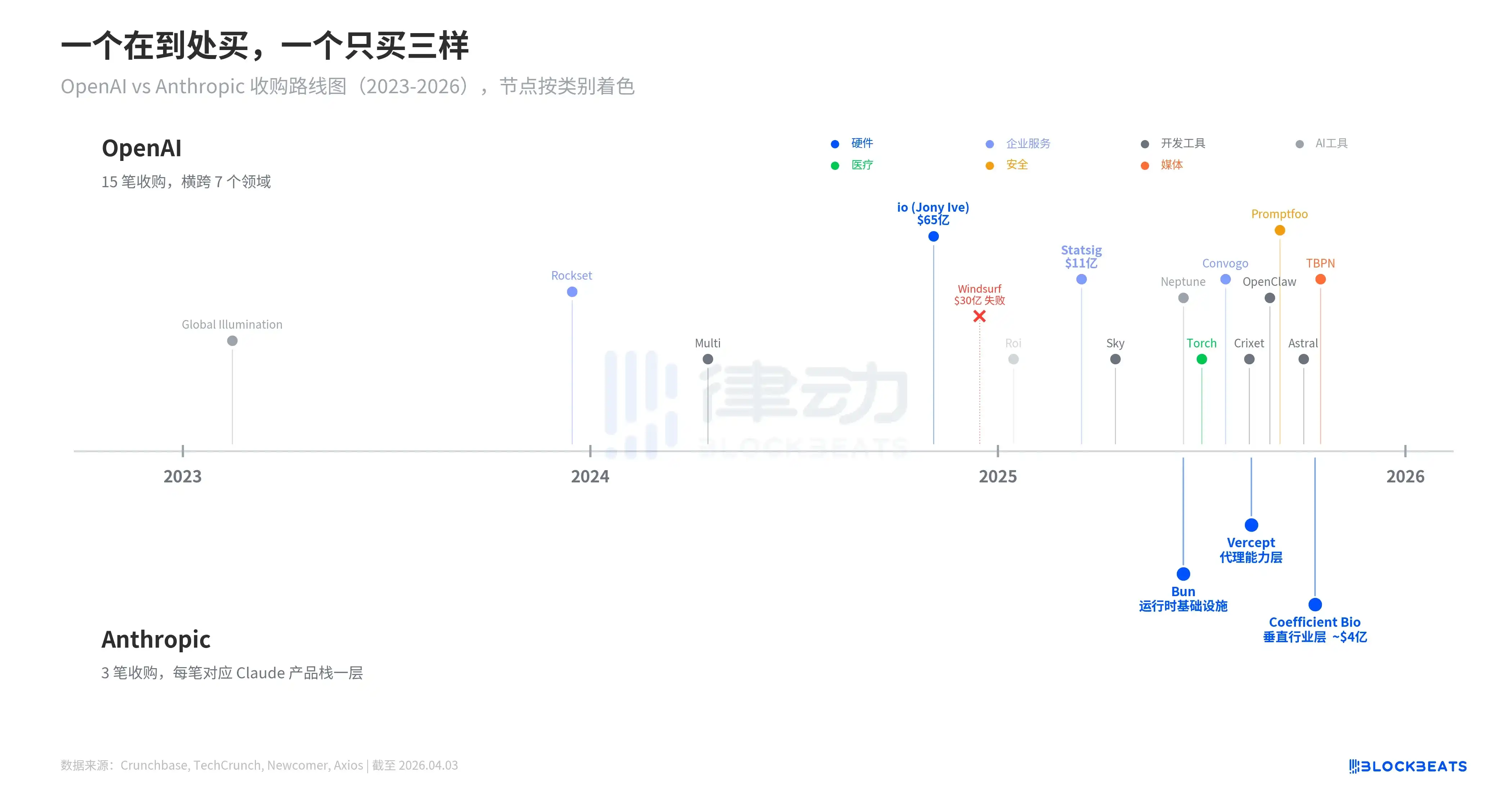
According to Crunchbase statistics, OpenAI has completed 15 acquisitions since 2023, spanning seven areas: hardware, enterprise services, developer tools, healthcare, security, media, and consumer. Six were completed in the first three months of 2026 alone. The total disclosed value of these transactions exceeds $7.7 billion, with the largest being the $6.5 billion acquisition of io, an AI hardware company founded by former Apple designer Jony Ive, in May 2025.

Anthropic has only made 3. In December 2025, it acquired the JavaScript runtime Bun to complete the underlying infrastructure for Claude Code. According to an official Anthropic announcement, the acquisition of Bun coincided with the disclosure that Claude Code had reached $1 billion in annualized revenue. In February 2026, it acquired the computer use agent startup Vercept to strengthen Claude's autonomous operation capabilities. On April 2, it acquired Coefficient Bio to enter the life sciences R&D pipeline. Each acquisition precisely corresponds to a technical layer in the Claude product stack.

It is worth noting that OpenAI also had one failed transaction. In May 2025, OpenAI reached a $3 billion acquisition intent with the code editor Windsurf (formerly Codeium). However, according to IT Pro, due to IP clauses in the Microsoft contract, OpenAI could not protect Windsurf's technology from being accessed by Microsoft, and the deal fell through in July. This failure also reflects a structural constraint of OpenAI's "broad procurement" model.

This difference in density is not accidental. It reflects the two companies' vastly different revenue structures and the resulting different anxieties.

Revenue Structure Determines Acquisition Direction

According to Sacra estimates, OpenAI's annualized revenue as of February 2026 was approximately $25 billion, with about 60% coming from the consumer end (ChatGPT subscriptions) and 40% from the enterprise end. 15.5 million paying users are the foundation of OpenAI's income. For a company about to IPO, a high proportion of consumer revenue means public sentiment directly impacts the valuation narrative.

This explains why OpenAI bought TBPN. According to Axios, TBPN is a daily live tech talk show with $5 million in advertising revenue in 2025 and a target of over $30 million for 2026. Post-acquisition, OpenAI will maintain its editorial independence while hiring former Postmates executive Dylan Abruscato to handle advertising monetization. The logic behind buying a tech podcast lies not in its revenue, but in its ability to continuously influence the public discussion framework around AI topics.
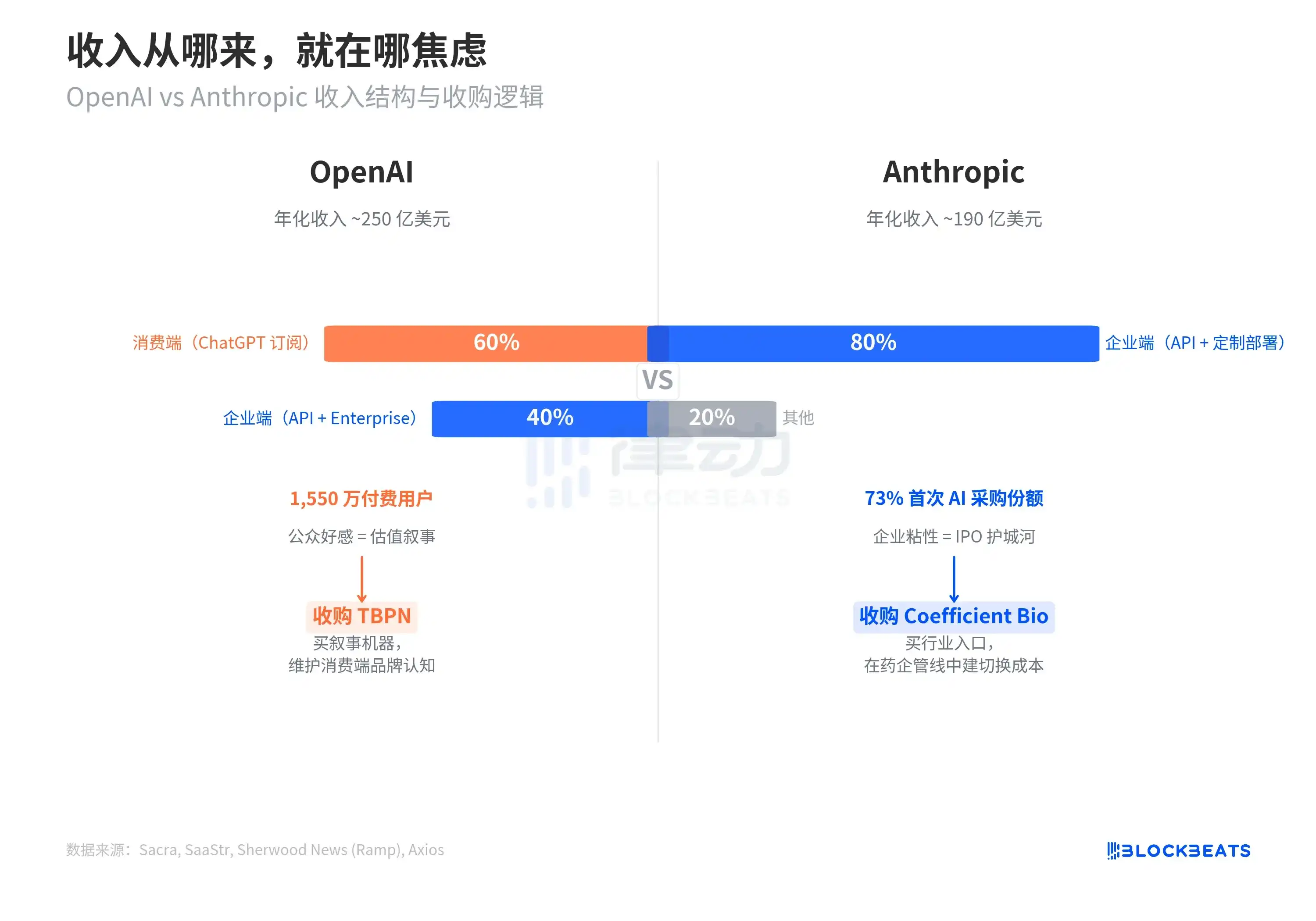
Anthropic's anxiety is entirely different. According to Ramp data cited by Sherwood News, Anthropic currently captures 73% of the market share for first-time AI procurement enterprise clients; ten weeks ago, this number was 50%. According to SaaStr, about 80% of Anthropic's revenue comes from the enterprise end. For enterprise customers, choosing an AI supplier is a decision with high switching costs. Anthropic's IPO narrative needs to prove that these enterprise customers will not leave.

Three Moves in Six Months

Coefficient Bio is not an impulsive acquisition. Viewed within the sequence of Anthropic's actions over the past six months, the logic is clear.

In October 2025, Anthropic launched Claude for Life Sciences, integrating with research databases like PubMed and UniProt, enabling Claude to assist with literature reviews and experimental design. In January 2026, at the JPM26 conference, it launched Claude for Healthcare, obtained HIPAA compliance certification, and formally entered the healthcare system. On April 2, it acquired Coefficient Bio, gaining full-cycle AI capabilities for drug R&D.
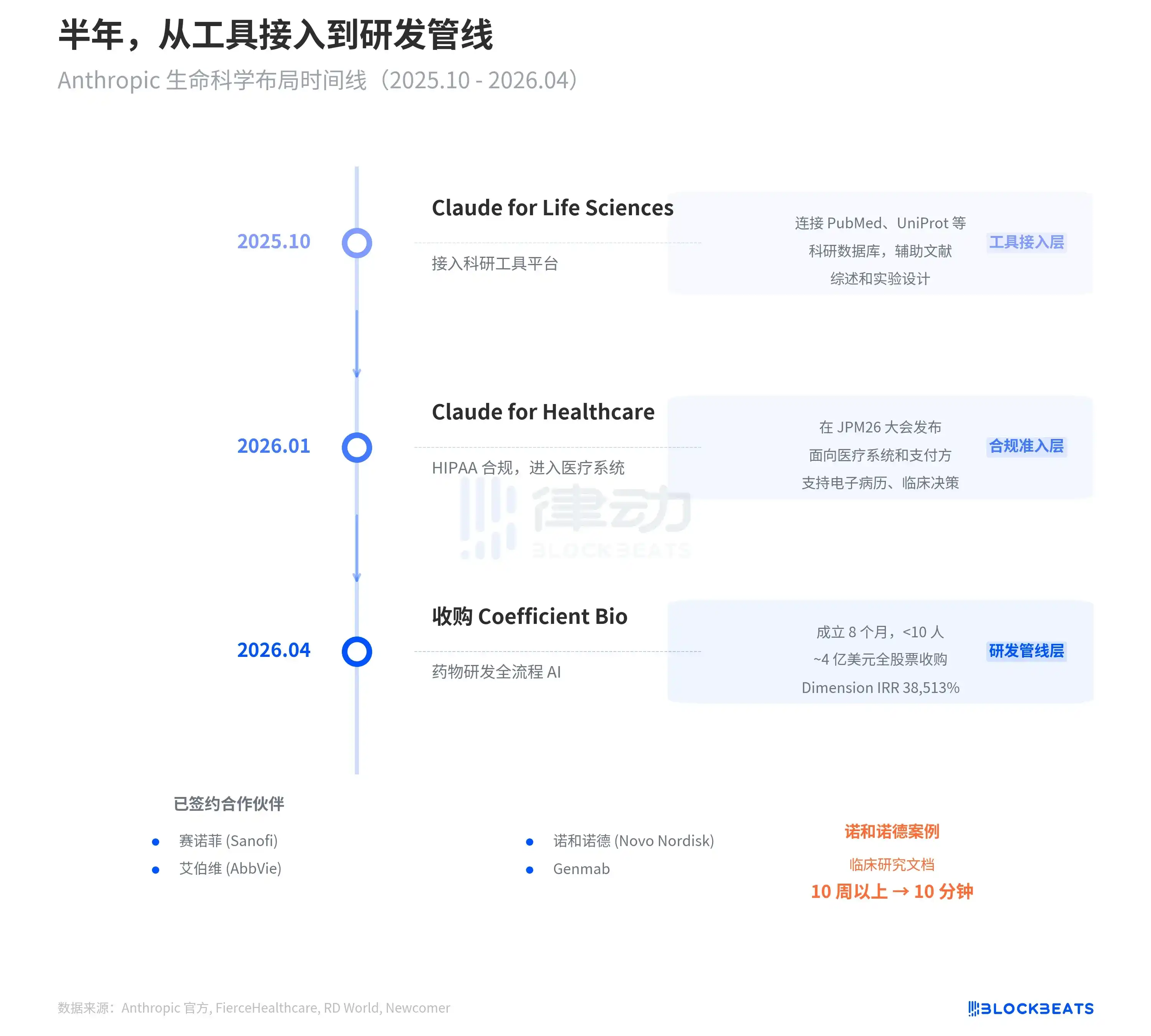
In six months, it progressed from the tool integration layer to the compliance access layer, and then to the R&D pipeline layer. According to Newcomer, Coefficient Bio was founded just 8 months ago, has fewer than 10 employees, and is about 50% owned by venture capital firm Dimension. Anthropic completed the acquisition for approximately $400 million in stock. Dimension stated in a letter to LPs that the IRR on this investment reached 38,513%.

This number itself shows that Anthropic is not buying a company's revenue or product, but rather a team plus an industry entry point. According to reports from Anthropic and RD World, pharmaceutical companies like Sanofi, Novo Nordisk, AbbVie, and Genmab are already using Claude's life science tools. The Novo Nordisk case is particularly typical, reducing clinical study document processing time from over 10 weeks to 10 minutes.

Two Balance Sheets, One Countdown

According to WinBuzzer and The Tech Portal, Anthropic has hired Goldman Sachs and J.P. Morgan to lead underwriting, targeting an IPO as early as October 2026 with a financing scale exceeding $60 billion. OpenAI is targeting Q4 2026 or Q1 2027 with a valuation nearing $1 trillion. According to Tom Tunguz's analysis, if OpenAI, Anthropic, and SpaceX all IPO in the same year, these three alone could absorb over $3 trillion in market liquidity.

Both are making final strategic adjustments before their IPOs. According to CNBC, OpenAI CEO Fidji Simo internally announced the cancellation of Sora, the Atlas browser, hardware projects, and instant checkout features, stating the company is "like entering a red alert" and needs to focus on enterprise and agent products. Anthropic's path is to continue deepening into vertical industries like life sciences, using industry switching costs to lock in enterprise customers.
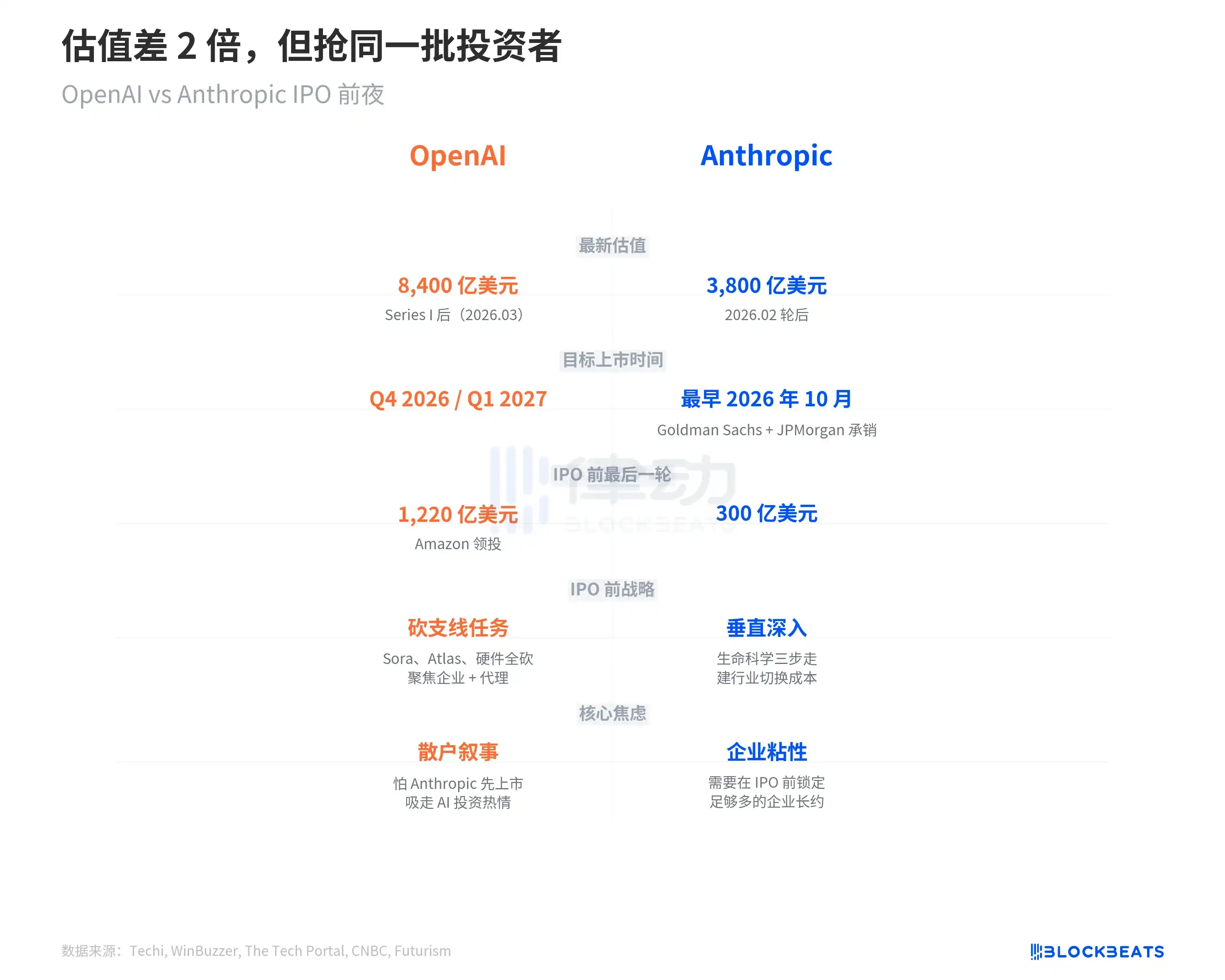
According to FinancialContent, the OpenAI board is concerned that if Anthropic goes public first, it will siphon off the retail investment enthusiasm that has been building up for AI. The valuations of the two companies differ by more than 2 times, but they are competing for the same pool of investors' money. Two acquisitions on the same day: one buying a narrative machine, the other buying an industry entry point.

Criptomoedas em alta

Perguntas relacionadas

QWhat are the key differences in acquisition strategies between OpenAI and Anthropic as described in the article?

AOpenAI has pursued a broad acquisition strategy, completing 15 acquisitions across seven fields including hardware, media, and consumer services, focusing on influencing public narrative and consumer markets. Anthropic has made only 3 highly targeted acquisitions, each precisely strengthening a specific technical layer of its Claude product stack, such as infrastructure, autonomous operation, and industry-specific capabilities like biotech R&D.

QWhy did OpenAI acquire the tech broadcast network TBPN according to the article?

AOpenAI acquired TBPN, a daily tech talk show, not for its revenue but for its ability to continuously influence the public discussion framework around AI topics. This aligns with OpenAI's high reliance on consumer subscriptions and its need to manage public sentiment, which directly impacts its IPO valuation narrative.

QWhat was the strategic rationale behind Anthropic's acquisition of Coefficient Bio?

AAnthropic acquired Coefficient Bio, an AI biotech startup, to gain full-process AI capabilities for drug R&D. This was the final step in a clear six-month strategic sequence to deeply penetrate the life sciences vertical, following the release of specialized tools and achieving healthcare compliance, aiming to lock in enterprise clients with high switching costs.

QHow do the revenue structures of OpenAI and Anthropic influence their respective acquisition anxieties?

AOpenAI's revenue is ~60% consumer-based (ChatGPT subscriptions), making it anxious about public narrative affecting its IPO valuation, hence its 'narrative' acquisitions. Anthropic's revenue is ~80% from enterprise clients, making it anxious about proving client retention, hence its acquisitions focus on building technical 'moats' and deep vertical integration to increase switching costs.

QWhat are the reported IPO timelines and valuation targets for OpenAI and Anthropic?

AAnthropic aims for an IPO as early as October 2026, targeting a fundraising scale of over $60 billion. OpenAI is targeting an IPO in Q4 2026 or Q1 2027, with a valuation nearing $1 trillion. The article notes a concern that if both IPO around the same time as SpaceX, they could collectively absorb over $3 trillion in market liquidity.

Leituras Relacionadas

The Verdict in Choi Tae-won's Divorce Case: Revealing the Inheritance Undercurrent Behind SK Hynix's Trillion-Won Empire

SK Group Chairman Chey Tae-won's high-profile divorce case, involving a record 1.38 trillion won settlement, has drawn attention to the succession plans for Korea's second-largest conglomerate, especially its crown jewel, SK hynix. Unlike traditional chaebol scripts centered on the eldest son, Chey's three children from his marriage to former President Roh Tae-woo's daughter, Roh Soh-yeong, are carving distinct, non-traditional paths. Eldest daughter Chey Yun-jung (b. 1989) is seen as the most evident successor. With a scientific and consulting background, she holds executive roles at SK bioscience and SK Inc.'s growth support department, focusing on future strategy and biopharma. Her marriage is to an AI infrastructure entrepreneur, not a traditional business alliance. Second daughter Chey Min-jung (b. 1991) took a unique route, voluntarily serving as a South Korean naval officer, including an anti-piracy deployment. She later worked on policy and strategy for SK hynix in Washington D.C. before co-founding an AI-driven healthcare startup. She married a former U.S. Marine Corps officer, connecting her to U.S. defense and policy circles—networks crucial for a global semiconductor giant. The only son, Chey In-geun (b. 1995), who studied physics like his father, worked briefly at SK E&S before joining McKinsey. Despite fitting the traditional "heir" profile as the eldest son, he remains silent and holds no public position or shares in SK, suggesting the old succession playbook is obsolete. As SK hynix's valuation soars, becoming a geopolitical asset in the AI era, the heirs' legitimacy is no longer automatic. They must prove themselves in fields like AI biotech, global policy, and strategic consulting. Their marriages also reflect new elite networks in tech and defense, not old political alliances. Their inheritance is the complex challenge of navigating a globalized, tech-driven world, not just a corporate throne.

marsbitHá 3h

The Verdict in Choi Tae-won's Divorce Case: Revealing the Inheritance Undercurrent Behind SK Hynix's Trillion-Won Empire

marsbitHá 3h

From OpenSea to OpenRouter: Is Alex Atallah Repeating His 'Exit at the Peak' Playbook?

From OpenSea to OpenRouter: Is Alex Atallah Repeating His "Exit at the Peak" Playbook? According to the Wall Street Journal, payments giant Stripe is in talks to acquire the AI model aggregation platform OpenRouter in a potential deal valuing the company near $100 billion. This would mark founder Alex Atallah's second creation of a company reaching a $100 billion valuation, following his co-founding of NFT marketplace OpenSea. OpenRouter, founded just over three years ago, has grown rapidly by acting as a unified gateway for developers to access over 400 AI models. It currently has about 10 million users and processes over 200 trillion tokens monthly. While the platform's annualized revenue is around $50 million, its valuation has skyrocketed from $1.3 billion in March 2026. The potential acquisition by Stripe, a company OpenRouter's founder once likened it to, represents a major expansion into AI infrastructure for the payments leader. This move echoes Atallah's previous timing with OpenSea, where he departed before the NFT market's significant downturn. For OpenRouter, selling now may be strategic. Despite its scale, its business model—charging a 5-5.5% fee on AI inference calls—faces pressure from competition, open-source models, and potential price wars among model providers, limiting its profitability narrative for an IPO. A key asset for potential acquirers like Stripe is OpenRouter's vast repository of real-world AI usage data, which offers unique insights into model performance and developer preferences that are difficult to replicate. Whether this potential deal signifies a new valuation benchmark for AI infrastructure or another market peak signal remains to be seen.

链捕手Há 3h

From OpenSea to OpenRouter: Is Alex Atallah Repeating His 'Exit at the Peak' Playbook?

链捕手Há 3h

Trading

Spot

Artigos em Destaque

Como comprar ONE

Bem-vindo à HTX.com!Tornámos a compra de Harmony (ONE) simples e conveniente.Segue o nosso guia passo a passo para iniciar a tua jornada no mundo das criptos.Passo 1: cria a tua conta HTXUtiliza o teu e-mail ou número de telefone para te inscreveres numa conta gratuita na HTX.Desfruta de um processo de inscrição sem complicações e desbloqueia todas as funcionalidades.Obter a minha contaPasso 2: vai para Comprar Cripto e escolhe o teu método de pagamentoCartão de crédito/débito: usa o teu visa ou mastercard para comprar Harmony (ONE) instantaneamente.Saldo: usa os fundos da tua conta HTX para transacionar sem problemas.Terceiros: adicionamos métodos de pagamento populares, como Google Pay e Apple Pay, para aumentar a conveniência.P2P: transaciona diretamente com outros utilizadores na HTX.Mercado de balcão (OTC): oferecemos serviços personalizados e taxas de câmbio competitivas para os traders.Passo 3: armazena teu Harmony (ONE)Depois de comprar o teu Harmony (ONE), armazena-o na tua conta HTX.Alternativamente, podes enviá-lo para outro lugar através de transferência blockchain ou usá-lo para transacionar outras criptomoedas.Passo 4: transaciona Harmony (ONE)Transaciona facilmente Harmony (ONE) no mercado à vista da HTX.Acede simplesmente à tua conta, seleciona o teu par de trading, executa as tuas transações e monitoriza em tempo real.Oferecemos uma experiência de fácil utilização tanto para principiantes como para traders experientes.

349 Visualizações TotaisPublicado em {updateTime}Atualizado em 2026.06.02

Como comprar ONE

Discussões

Bem-vindo à Comunidade HTX. Aqui, pode manter-se informado sobre os mais recentes desenvolvimentos da plataforma e obter acesso a análises profissionais de mercado. As opiniões dos utilizadores sobre o preço de ONE (ONE) são apresentadas abaixo.

活动图片