Trust Wallet Hacked: What Crypto Users Should Do Now

bitcoinistPublicado em 2025-12-26Última atualização em 2025-12-26

Resumo

Trust Wallet has confirmed a security incident specifically affecting its Chrome browser extension version 2.68, advising users to immediately disable and upgrade to version 2.69. Mobile-only users and those on other extension versions are not impacted. The breach was first flagged by on-chain investigator ZachXBT, who reported multiple users had funds drained. Cybersecurity firm PeckShield estimates losses exceeded $6 million, with a portion sent to centralized exchanges. Trust Wallet is directing affected users to contact support, and Binance founder Changpeng Zhao has stated that Trust Wallet will cover the estimated $7 million in losses. Users are urged to update their extensions and avoid using version 2.68 until upgraded.

Trust Wallet says a “security incident” hit only one slice of its product stack: the Chrome browser extension on version 2.68. If you are a mobile-only user, the company says you’re not affected. If you are on any other extension version, the company says you’re not affected either. The problem, per Trust Wallet’s own wording, is tightly scoped, even if the fallout doesn’t feel that way when you’re staring at an emptied address.

The first public flare went up on Dec. 25 via on-chain investigator ZachXBT, who posted a Telegram warning that “a number of Trust Wallet users have reported that funds were drained from wallet addresses within the past couple of hours.”

He stressed that “the exact root cause has not been determined,” then pointed out an uncomfortable coincidence: “the Trust Wallet Chrome extension pushed a new update yesterday.” In the same message, he asked victims to DM him on X so he could “update the list of theft addresses below as I verify more,” and he began publishing alleged theft destinations across multiple chains. His list included multiple EVM addresses and a Solana address.

Trust Wallet Confirms The Hack

The wallet firm later confirmed the incident on X. “We’ve identified a security incident affecting Trust Wallet Browser Extension version 2.68 only. Users with Browser Extension 2.68 should disable and upgrade to 2.69,” the company wrote, linking users to the official Chrome Web Store listing.

It added: “Please note: Mobile-only users and all other browser extension versions are not impacted.” The post closed with the kind of line every security team ends up typing sooner or later: “We understand how concerning this is and our team is actively working on the issue. We’ll keep sharing updates as soon as possible.”

Then the guidance got more urgent, and more specific. Trust Wallet warned users who hadn’t updated to 2.69: “please do not open the Browser Extension until you have updated. This may help to ensure the security of your wallet and prevent further issues.”

In a follow-up, it spelled out a step-by-step that boils down to: don’t open the extension, go to Chrome’s extensions page for Trust Wallet, toggle it off if it’s still on, enable Developer mode, hit “Update,” and confirm you’re on version 2.69 before doing anything else. It’s not glamorous, but it’s actionable, which is what matters when you’re in incident mode.

As the claims and counterclaims swirled, cybersecurity firm PeckShield put an early dollar figure on the damage. “The Trust Wallet exploit has drained >$6M worth of cryptos from victims,” PeckShield wrote, adding that while about “~$2.8M of the stolen funds remain in the hacker’s wallets (Bitcoin/EVM/Solana), the bulk – >$4M in cryptos – has been sent to CEXs,” with a breakdown of “~$3.3M to ChangeNOW, ~$340K to Fixed Float, & ~$447K to Kucoin.”

One more pressure point surfaced quickly: compensation. ZachXBT said, “I currently have many concerned victims contacting me via DM so can your team please clarify if you will be offering any compensation for Trust Wallet Browser Extension users.” Trust Wallet did not answer that directly in public. Instead, it replied that its customer support team was already in touch with impacted users regarding next steps and directed people to reach out via its support channel.

So what should users do now, in plain terms? If you are on extension version 2.68, Trust Wallet’s instruction is to stop using it as-is: disable it and upgrade to 2.69 before you open it again. If you think you were affected, the company is routing users to support, while independent investigator ZachXBT is asking for reports to help map theft flows.

UPDATE: Binance founder Changpeng Zhao confirmed via X that user will be compensated for the hack. “So far, $7m affected by this hack. Trust Wallet will cover. User funds are SAFU. Appreciate your understanding for any inconveniences caused. The team is still investigating how hackers were able to submit a new version,” Zhao wrote today.

At press time, the total crypto market cap stood at $2.95 trillion.
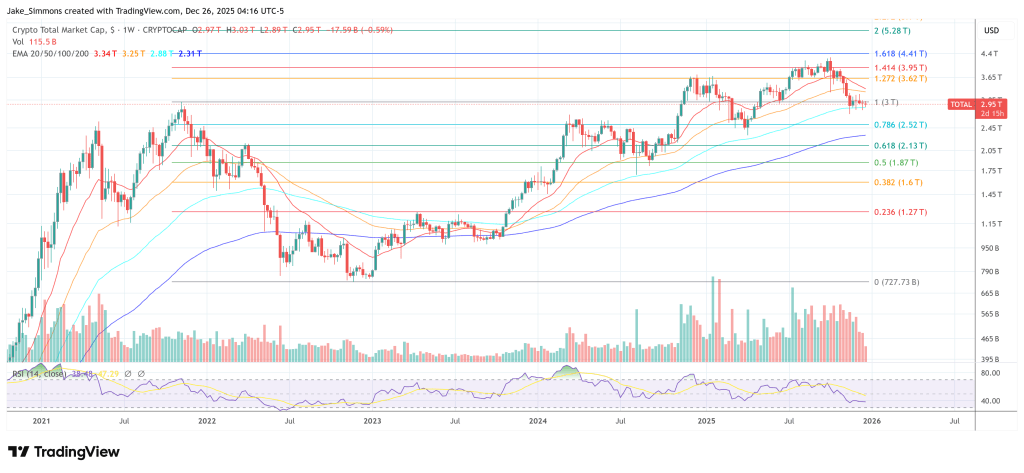
Total crypto market cap sits below the 2021 high, 1-week chart | Source: TOTAL on TradingView.com

Perguntas relacionadas

QWhich specific version of the Trust Wallet extension was affected by the security incident?

AThe security incident affected Trust Wallet Browser Extension version 2.68 only.

QWhat is the primary action users of the affected extension version should take immediately?

AUsers on version 2.68 should disable the extension and upgrade to version 2.69 before opening it again.

QAccording to cybersecurity firm PeckShield, what was the estimated value of crypto drained in the exploit?

APeckShield reported that the exploit drained over $6 million worth of cryptocurrencies from victims.

QWho first publicly reported the potential issue with Trust Wallet on December 25th?

AOn-chain investigator ZachXBT first reported the issue via a Telegram warning.

QDid Trust Wallet or its parent company commit to compensating affected victims?

AYes, Binance founder Changpeng Zhao confirmed via X that Trust Wallet would cover the losses, stating that user funds are SAFU.

Leituras Relacionadas

In Jinjiang, Fujian, a Storage Super Unicorn Lies Quiet

In Fujian's Jinjiang, a city known for sportswear, lies a quiet semiconductor giant: Fujian Jinhua Integrated Circuit Co. (JHICC). Once a promising domestic DRAM manufacturer alongside Yangtze Memory and ChangXin Memory Technologies (CXMT), its journey was derailed in 2018 when the U.S. placed it on an Entity List and filed criminal charges for alleged trade secret theft. This halted production for years. A turning point came in February 2024 when a U.S. federal court found JHICC not guilty. However, it had lost crucial time. While CXMT soared to become a top-valued A-share company in 2024, JHICC, with an estimated valuation of 80 billion RMB, was just restarting. Its current output is primarily customized DDR4 chips, not the advanced DDR5/HBM demanded for AI, but it still benefits from the broader memory chip upcycle. JHICC's story is tied to Chen Zhengkun, a veteran engineer who left Micron to lead the venture. Founded in 2016 with state-backed funding, JHICC partnered with Taiwan's UMC to develop DRAM technology. Rapid progress was cut short by the U.S. actions, which Micron initiated, partly due to its heavy reliance on the Chinese market. Post-sanctions, Chen's team worked to rebuild the production line with reduced reliance on U.S. technology. According to its records, JHICC achieved small-scale production and revenue growth under immense pressure. It now focuses on the stable "niche" DRAM market (e.g., TVs, routers) with a monthly capacity of ~40,000 wafers, aiming for 60,000 by 2026. It holds over 1,000 patents but remains on the Entity List. For Jinjiang, investing in JHICC was a bold industrial leap. The local government provided unwavering financial and logistical support during the crisis, helping the company survive. JHICC has become the anchor for a growing local semiconductor cluster. Though its scale lags behind domestic peers, JHICC's persistence symbolizes a hard-won foothold in a global market long dominated by Samsung, SK Hynix, and Micron. Having missed one boom, it seeks a place in the new AI-driven memory supercycle.

marsbitHá 13m

In Jinjiang, Fujian, a Storage Super Unicorn Lies Quiet

marsbitHá 13m

Must-Watch Events Next Week|CLARITY Act Could Face Senate Vote; SpaceX, Circle to Report Earnings (8.3-8.9)

**Summary: Key Events and Developments to Watch (August 3-9)** The upcoming week is marked by significant financial disclosures, key legislative deadlines, and notable product updates. **Major Financial Events:** Several companies are scheduled to release their Q2 2026 earnings. American Bitcoin (ABTC) will report on August 3, followed by SpaceX and Hut 8 Mining Corp. on August 4, and Circle on August 5. Notably, a significant portion of SpaceX shares (up to 12% of total shares) will be unlocked on August 6 following their earnings release. **Key Legislative Deadline:** The U.S. Senate faces an August 7 deadline to secure 60 votes for the CLARITY Act, a bipartisan bill aiming to establish a federal regulatory framework for cryptocurrencies. The Senate may hold a full vote on the bill during the week. **Economic Data:** The U.S. July Non-Farm Payrolls report will be released on August 7, providing crucial labor market data. **Technology & Product Updates:** * **Shutdowns:** DeFi portfolio tracker Zapper and wallet app Ctrl Wallet will cease operations on August 3. * **Upgrades:** LayerZero will deprecate its v1 relayers on August 3. XRP Ledger's new version 3.3.0, featuring five new functions, is expected next week. * **AI:** Elon Musk announced that the advanced Grok 4.6 AI model is set for release around August 7. * **Bitcoin:** The BIP-110 forced signaling for a potential Bitcoin network change is scheduled to begin around August 8. **Other Notable Events:** Chinese robotics firm Unitree Tech has set its preliminary price inquiry for its IPO for August 5. South Korean exchange Upbit will delist AQT and AERGO tokens on August 3.

marsbitHá 2h

Must-Watch Events Next Week|CLARITY Act Could Face Senate Vote; SpaceX, Circle to Report Earnings (8.3-8.9)

marsbitHá 2h

Trading

Spot
活动图片





