Trump, the "Stock Market Manipulator" in U.S. Stocks, Lifts Up the Entire Quantum Computing Sector

marsbitPublicado em 2026-05-27Última atualização em 2026-05-27

Resumo

"Trump, the 'U.S. Stock Market Mastermind,' Boosts the Entire Quantum Computing Sector" This article details how former U.S. President Donald Trump's policies and public statements have significantly influenced the stock market, particularly in the quantum computing sector. A key example is the U.S. government's direct investment in Intel stock in August 2025, which yielded over $45 billion in gains within seven months. Trump publicly credited himself for this profit. Recently, the Trump administration announced a new $2 billion initiative. Through the Department of Commerce, funding from the CHIPS and Science Act will be provided to nine quantum computing companies in exchange for minority, non-controlling equity stakes. The recipients include IBM ($1B for its subsidiary Anderon), GlobalFoundries ($375M), and listed companies like D-Wave, Infleqtion, and Rigetti ($100M each). Private firms such as Atom Computing and PsiQuantum also received $100M. This "investment-for-equity" strategy marks a shift from pure subsidies to an "active investor" model under the CHIPS Act. The announcement immediately boosted quantum computing stocks. The article frames this as part of Trump's "America First" industrial policy, aimed at securing U.S. technological leadership, similar to past investments in semiconductors, rare earths, and lithium. The author suggests this pattern of government-backed market intervention, alongside Trump's personal stock endorsements, is a hallmark of his appro...

Original | Odaily Planet Daily (@OdailyChina)

Author | Wenser (@wenser 2010)
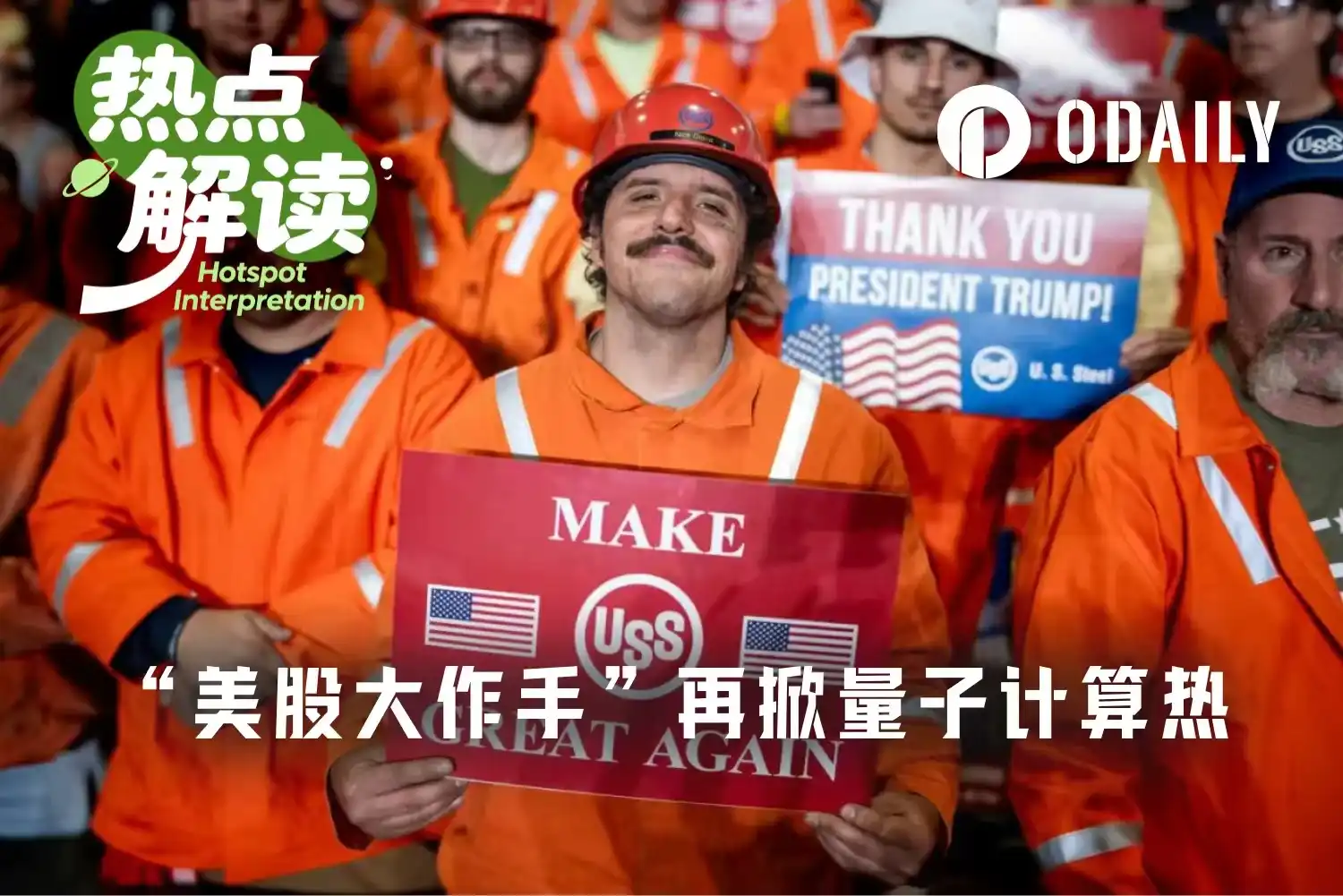
Last August, driven by Trump, the U.S. government completed the conversion of funds through the CHIPS Act, directly purchasing nearly 10% of Intel's newly issued original shares (approximately 433.3 million shares) at $20.47 per share. At that time, the value was less than $9 billion; by early May less than a year later, as Intel's stock price hit a record high, the total value of those shares had reached $54.1 billion, increasing by over $45 billion in just seven months.

Mentioning this, Trump could not hide his pride and posted: "I made the United States $45 billion in the past 8 months."

As a capital maestro who "manipulates the U.S. stock market by posting at a whim," Trump exerts an extraordinary influence on the rise and fall of U.S. stocks. Recently, he has started his performance again—providing a total of $2 billion in funding to 9 quantum computing companies through the U.S. Department of Commerce in exchange for equity. Odaily Planet Daily will provide a brief analysis in this article.

U.S. Government Acts Again, Investing $2 Billion in Quantum Computing Sector

On May 21, the Trump administration announced it would provide a total of $2 billion in funding to 9 quantum computing companies through the U.S. Department of Commerce, in exchange for partial equity. The specific allocation of funds is as follows:

  • $1 billion will be awarded to IBM (IBM) for the operation and development of its independent subsidiary, Anderon;
  • $375 million is allocated to chip manufacturer GlobalFoundries (GFS);
  • Listed companies such as D-Wave (QBTS), Infleqtion (INFQ), and Rigetti (RGTI) each receive $100 million;
  • Private companies such as Atom Computing, PsiQuantum, and Quantinuum (Honeywell-HON's independent subsidiary) each receive $100 million;
  • Startup Diraq is expected to receive $38 million.

According to official documents, this is part of the Trump administration's "active investor" industrial policy, with funding sourced from R&D appropriations under the 2022 CHIPS and Science Act. The Department of Commerce emphasized that this is a "portfolio" strategy, covering two quantum wafer foundries and 7 quantum computing companies, targeting various quantum modalities such as neutral atoms, silicon spin, superconductors, photons, and trapped ions, addressing critical engineering bottlenecks like device reproducibility, error rates, optical complexity, and cryogenic system integration.

On the day the news was released, the U.S. stock quantum computing sector surged at the market open. Among them, D-Wave Quantum rose 16%, Rigetti Computing rose 14%, Infleqtion stock rose 25%, Quantum Computing rose 9%, and IonQ rose 3.1%.

It is worth mentioning that among these companies receiving funds, only GlobalFoundries Inc. (GFS) revealed the equity exchange ratio is approximately 1%. For other companies, whether public or private, the equity is a minority, non-controlling stake, with specific ratios not yet disclosed. Final ratios will be disclosed after formal agreements are signed and filed with the SEC.

Capital Operations Under the "America First" Strategy

Examining this "investment-for-equity" operation, it remains an action under the Trump administration's "America First" strategy.

Previously, U.S. government investments in Intel (INTC), MP Materials (MP) (the only fully integrated U.S. rare earth producer), Trilogy Metals (TMQ), Lithium Americas (LAC), U.S. Steel, and others were also strategic moves to maintain the dominant position of the domestic semiconductor industry chain.

Especially the nearly $9 billion investment in Intel, the Trump administration explicitly stated that this move was to support domestic advanced semiconductor manufacturing in the U.S. and reduce dependence on TSMC (TSM). Therefore, the U.S. government's related holdings are passive, with no board seats, and it does not participate in the company's daily operations and management, largely following board votes on most matters.

However, the U.S. government's "equity investments" include not only financial support but also credit endorsement and multi-layered policy support (such as export licenses, tariff protection). Previously, after receiving U.S. government funding, Intel received strong support from U.S. Secretary of Commerce Lootnick, who met with Apple CEO Cook, Tesla CEO Musk, and NVIDIA CEO Jensen Huang multiple times over the past year, persuading them to cooperate with Intel successively. With Apple joining, Intel has now established relevant collaborations with all three companies mentioned.

Operational Shift Under the CHIPS and Science Act: From Grants to Equity Exchange

The $2 billion behind the investment in quantum computing companies stems from the CHIPS and Science Act, a landmark bipartisan bill introduced by the U.S. government in 2022, officially titled the "CHIPS and Science Act of 2022." The bill authorizes approximately $280 billion over 10 years to support semiconductor industry development and basic science and technology R&D. Its primary purpose is to revitalize U.S. semiconductor manufacturing, strengthen scientific research and innovation capabilities, and address competition from other nations in high-tech fields through massive investment.

However, unlike the fund grants or pure subsidy model during the Biden administration, the Trump administration's operational model is the aforementioned "active investor" model—switching to providing funding in exchange for minority, non-controlling equity. As of this May, the Act has attracted over $645 billion in private investment in semiconductor manufacturing, with over 140 projects, creating 525,000 new jobs.

It must be said that aside from personally manipulating and hyping stocks like Dell (DELL), Micron (MU), and Palantir (PLTR), Trump is also promoting U.S. stock market prosperity in the name of the U.S. government and its departments. No wonder he has repeatedly boasted, "The new highs in the stock market are mainly because of me."

Additionally, it is noteworthy that a previous investment announcement from the U.S. Department of Commerce stated, "The CHIPS Research and Development Office continues to solicit proposals from eligible applicants for research, prototyping, and commercial solutions in microelectronics technologies in the United States. Eligible applicants should submit applications via Announcement 2025-NIST-CHIPS-CRDO-01 on the www.grants.gov website." In other words, the U.S. government's "investment door" remains open. More information and funding announcements can be found in official sources.

Of course, the U.S. government invests in a wide range of company sectors, also involving critical minerals/rare earths, lithium batteries and other new energy sources, medical supplies, communication infrastructure, etc., such as Westinghouse Electric, Lithium Americas, Trilogy Metals, USA Rare Earth, Vulcan Elements, XLight, L3Harris Technologies, and others.

Furthermore, U.S. Secretary of Commerce Lootnick once revealed to the media that the current U.S. administration might take stakes in major defense contractors like Lockheed Martin (LMT).

In summary, the aforementioned numerous listed companies, key minerals/rare earths/battery material supply chains, nuclear energy/small modular reactors (SMRs) and advanced nuclear fuel, and other quantum computing targets may become directions for the Trump administration's continued investment in the second half of the year.


Perguntas relacionadas

QAccording to the article, what significant action did the Trump administration recently take regarding quantum computing companies?

AThe Trump administration announced it would provide a total of $2 billion in funding to nine quantum computing companies through the U.S. Department of Commerce in exchange for equity stakes.

QWhich specific company received the largest share of the $2 billion quantum computing funding mentioned in the article?

AIBM received the largest share, with $1 billion allocated to its independent subsidiary, Anderon.

QWhat is the source of the $2 billion funding for the quantum computing initiative as stated in the article?

AThe funding comes from the research and development appropriations of the 2022 CHIPS and Science Act.

QHow did the stock prices of quantum computing companies react to the news of the government funding?

AOn the day of the announcement, the quantum computing sector's stock prices rose sharply at market open. Specifically, D-Wave Quantum rose 16%, Rigetti Computing rose 14%, Infleqtion stock rose 25%, Quantum Computing rose 9%, and IonQ rose 3.1%.

QHow does the Trump administration's approach to implementing the CHIPS and Science Act differ from the previous administration's, as described in the article?

AUnlike the Biden administration's model of providing grants or pure subsidies, the Trump administration's approach is an 'active investor' model, where funding is provided in exchange for minority, non-controlling equity stakes.

Leituras Relacionadas

The Value Distribution of Stablecoins

**Summary: The Value Distribution of Stablecoins** The article argues that stablecoins are evolving from mere trading tools into broader channels for dollar access. It divides the stablecoin ecosystem into four layers to analyze how value is distributed: 1. **Issuance Layer:** Mints stablecoins, holds reserve assets, and captures the spread between reserve yield and user costs (e.g., Tether, Circle). This layer currently earns the largest profit margin. 2. **Infrastructure Layer:** Connects stablecoins to the traditional financial system, handling fiat on/off-ramps, banking integration, compliance (KYC/AML), and asset management (e.g., Bridge, BVNK). This is the "unglamorous" but critical work, building the essential bridges between crypto and real-world finance. 3. **Acquiring/Distribution Layer:** Integrates stablecoins into merchant systems, manages payment flows, and provides enterprise financial software (e.g., Stripe, Coinbase). They act as the access point for businesses. 4. **Application Layer:** The end-users and businesses that ultimately use stablecoins for payments, settlements, or as a store of value. They benefit from convenience but have little pricing power. The core thesis is that while the issuance layer currently dominates profits, the often-overlooked **infrastructure layer holds significant long-term potential**. The real challenge and barrier to mass adoption is not the on-chain transfer of stablecoins (which is simple), but the complex "last mile" integration into existing business workflows, banking systems, and regulatory frameworks across different countries. Companies in this layer are currently in a "land grab" phase, investing heavily to build networks, secure bank partnerships, and establish compliance pathways. While their position is currently pressured by the profitable issuers above and distribution platforms below, the article suggests that if stablecoins become a default financial rail for businesses, the infrastructure providers who have done the hard work of integration will ultimately gain strong pricing power and become entrenched, essential players.

marsbitHá 4h

The Value Distribution of Stablecoins

marsbitHá 4h

The Value Distribution of Stablecoins

The Value Distribution of Stablecoins The article argues that stablecoins are evolving from a mere trading tool into a broad "dollar channel." It analyzes the industry's value chain through four layers: 1. **Issuance Layer (e.g., Tether, Circle):** The top layer that mints stablecoins, holds reserve assets, and captures the thickest interest rate spread. 2. **Infrastructure Layer (e.g., Bridge, BVNK):** Connects stablecoins to the traditional financial system, handling critical but complex "dirty work" like fiat on/off-ramps, banking integration, compliance (KYC/AML), and cross-border settlement. 3. **Acquiring/Distribution Layer (e.g., Stripe, Coinbase):** Embeds stablecoins into merchant systems, manages payment flows, and integrates with enterprise software. 4. **Application Layer:** End-users and businesses that ultimately use stablecoins for payments, settlement, or storing value. The author posits that while the issuance layer currently captures the most profit, the most overlooked and potentially critical layer is infrastructure. The core challenge for stablecoin adoption isn't the on-chain transfer (which is simple), but bridging the gap between blockchain and the real-world financial system. This involves solving practical problems for businesses: fiat conversion, reconciliation, tax handling, and user onboarding. Infrastructure companies are currently in a difficult "land-grab" phase—building networks, securing banking relationships, and achieving compliance country-by-country. They face pressure from both the profitable issuance layer above and distribution platforms below. However, the author suggests this layer is building a crucial moat. Once stablecoins become a default business rail, the infrastructure players who have done the hard work of integration may gain significant, durable value and pricing power.

链捕手Há 4h

The Value Distribution of Stablecoins

链捕手Há 4h

How to Do Research Well: Deliberately Practice the Real Skills That Matter

No one truly teaches you how to do research. You're often given a desk, a pre-selected problem, and vague instructions to "create something new." Consequently, many people reverse-engineer the job based on visible outputs—papers, posts, announcements—learning only how to *appear* like a researcher rather than how to *become* one. True research capability is built from stacking small, trainable skills, nearly all of which can be developed through deliberate practice. **Pick Your Own Problem:** Most researchers absorb problems from advisors or trends, lacking the underlying reasoning. Choosing a problem you genuinely care about, as John Schulman advises, leads to original work. Develop "taste" like a muscle: predict experiment outcomes, guess paper results from methods, and track which findings remain important over time. **Upgrade Your Inputs:** Relying on shared reading lists (arXiv hot lists, filtered group chats) leads to unoriginal conclusions. Undervalued old literature often holds crucial insights (e.g., MoE, LSTM, backpropagation). Richard Sutton's "The Bitter Lesson" or Claude Shannon's 1952 talk on creative thinking are more predictive than lengthy modern surveys. Breadth matters as much as depth: draw from neuroscience, mechanism design, hardware knowledge, and honest statistics. Read papers directly, especially appendices and limitations sections. **Write Everything Down:** As Paul Graham noted, writing exposes flaws in seemingly mature ideas. Writing is the cheapest defense against self-deception. Following Feynman's principle, Darwin programmatically wrote down facts contradicting his theory to combat memory bias. Maintain a detailed log of hypotheses, setups, predictions, results, and updated understandings. Reviewing past logs fosters essential humility.

marsbitHá 6h

How to Do Research Well: Deliberately Practice the Real Skills That Matter

marsbitHá 6h

Trading

Spot
Futuros
活动图片