Trump Steps Into Web3 Gaming – But Will It Endure? New Mine-to-Earn Project Says It Holds the Genuine Long-Term Model

bitcoinistPublicado em 2025-12-12Última atualização em 2025-12-12

Resumo

A recently launched crypto game using Donald Trump's name has drawn attention but appears to be a traditional Web2-style game with optional Web3 elements, raising questions about its legitimacy as a true blockchain-based GameFi project. In contrast, PepeNode (PEPENODE) is introduced as a fully Web3-native "mine-to-earn" game designed for long-term sustainability. It turns crypto mining into a virtual simulation where players build and optimize server setups using PEPENODE tokens for upgrades—70% of which are permanently burned to reduce supply and increase scarcity. The project aims to avoid the pitfalls of earlier Play-to-Earn models by creating a deflationary economy tied to real gameplay consequences. The PepeNode presale is currently active for 27 days, offering tokens at $0.0011873 each, with purchases available via crypto or credit cards. The smart contract has been audited by Coinsult for security assurance.

Thursday 11 December 2025 – A recently launched crypto game using the name of U.S. President Donald Trump has drawn attention across the Web3 space, but a closer look shows an approach that feels atypical for a blockchain-based release. Players are reportedly able to bypass the crypto elements altogether, giving the impression of a traditional Web2 game wrapped in Web3 branding rather than a product built fully around blockchain technology.

PepeNode (PEPENODE) positions itself at the other end of that spectrum. The project is designed as a fully Web3-native game, with blockchain mechanics forming the core of its system rather than an optional add-on. Instead of repeating Play-to-Earn models that struggled or collapsed, such as Axie Infinity, StepN and last year’s wave of Telegram-based games, PepeNode is rolling out what it describes as crypto’s first mine-to-earn meme coin structure aimed at long-term viability.

While many GameFi projects are still testing the waters, PepeNode is taking a more committed stance, arguing that meaningful progress in GameFi requires a complete rethink rather than incremental experiments.

For investors interested in a model that claims to support a sustainable crypto gaming economy, the PepeNode presale is currently live, with PEPENODE priced at $0.0011873 per token. The opportunity is time-limited, however, as the team has announced that the presale will conclude in 27 days. After that point, PEPENODE is expected to be available only through exchanges, where prices may not revisit presale levels.

When Blockchain Is Optional, Does It Still Qualify as GameFi?

A recent post from the TrumpMeme account on X announced the opening of pre-registration for a licensed game built around the Trump brand. The project, titled Trump Billionaires Club, presents Trump in an Apprentice-style role, with gameplay centred on dice rolls, buying up properties, limited stock market activity notably without any direct crypto element and progressing through a glossy “high-roller” ranking ladder.

Players are being lured with the promise to “Live the High-Roller Lifestyle as you race to become the Ultimate TRUMP Billionaire,” with the main draw being a share of $1 million worth of Official Trump (TRUMP) tokens. Beyond that incentive, the game leans on familiar mechanics, integrating Open Loot to distribute digital collectibles an approach many long-time crypto users would recognise as Web2.5 dressed up in Web3 language.

A closer look at the website highlights a key detail: the game runs smoothly even without any blockchain involvement. Web3 features are clearly optional, and players can make purchases using traditional, non-crypto currencies. That raises an obvious question when the project promotes the idea of “Your empire, on-chain” if everything functions off-chain, where does that empire actually exist?

This suggests that while the game may appeal to casual players, it isn’t trying to address the deeper, long-standing problems GameFi has faced. Those same issues once brought millions of newcomers into crypto through gaming, only to see them leave just as quickly when fragile token economies collapsed.

For blockchain gaming to genuinely move forward, those challenges need proper solutions. And at the moment, the project positioning itself as an attempt to tackle them isn’t a familiar board-game-style remake, but the mine-to-earn ecosystem that PepeNode is building.

The First GameFi Economy Built to Grow Stronger Over Time

PepeNode keeps the concept simple on the surface: it turns crypto mining into a virtual game. But once you look a little deeper, it becomes clear the goal is to quietly strip away what never worked in earlier GameFi models. Rather than leaning on hype or shallow mechanics, the project is structured around systems that are meant to hold up over time.

Instead of pushing players into repetitive tapping, endless clicking, or mindless loops, PepeNode drops them into an empty, lifeless server room with a clear message build something that actually functions. Progress isn’t cosmetic. Every action, from buying nodes to upgrading facilities, is paid for using PEPENODE, and every decision carries real consequences.

Put the wrong components together and the system slows down, becoming inefficient and unstable. Combine the right ones and performance improves, with token output increasing like a properly tuned mining operation. The experience feels closer to solving an engineering problem than “playing” a traditional game, and that distinction is very much intentional.
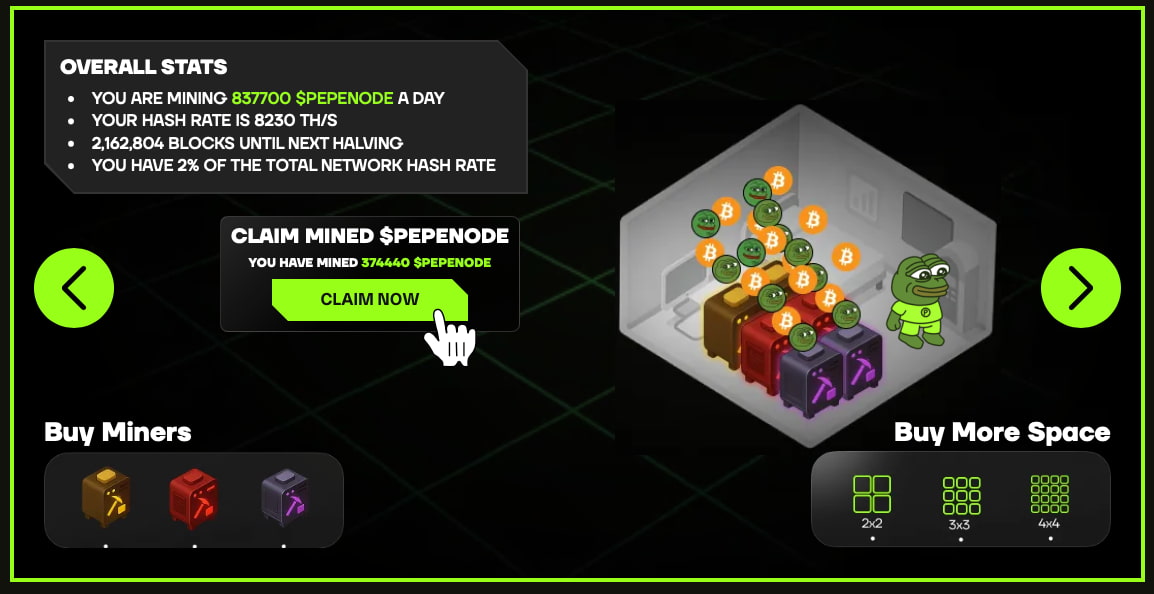
And unlike games that rely on a thin “Web3” label and a familiar brand costume, PepeNode treats simulation as more than a buzzword. When the project talks about simulation, it means it in a literal sense. The team has already hinted at systems that reflect the real-world problems miners deal with every day, from heat surges and power consumption to overall system stability the full set of operational headaches, minus the real electricity bill.

Players do earn PEPENODE from their setups, but the token isn’t just a reward. Its role runs much deeper. The more PEPENODE is spent in-game to fine-tune and optimise a rig, the greater the chance of unlocking higher-tier payouts, including major meme coin rewards such as Pepe (PEPE) and Fartcoin (FARTCOIN).

What really sets the model apart is how upgrades are handled. Every improvement consumes PEPENODE, and 70% of the tokens used are permanently removed from circulation. Progression, therefore, doesn’t expand supply it reduces it. As activity in the game increases, PEPENODE becomes increasingly scarce.

That combination of strategic building, deliberate token spending and access to desirable crypto rewards is why PepeNode is being highlighted as a serious candidate for one of the first GameFi economies designed to hold up over the long term.

Presale Nears Its End as PepeNode Enters Final 27-Day Window

With the presale window still open, early supporters have a chance to secure PEPENODE while directly backing the game’s ongoing development. Tokens are available through the official PepeNode presale site and can be purchased using ETH, BNB, USDT on both ERC-20 and BEP-20 networks, as well as standard credit or debit cards.

Buyers can connect using most major wallets, including Best Wallet, which is often cited as one of the leading crypto and Bitcoin wallets in use today. PepeNode is already listed in Best Wallet’s Upcoming Tokens discovery section, making it possible to buy, monitor, and later claim tokens directly inside the app.

To add another layer of reassurance, the project’s smart contract has undergone a full audit by Coinsult, providing early participants with added confidence in the security and structure of the code.

Those looking to stay informed can follow PepeNode on X and Telegram, or visit the PepeNode website to take part in the presale while it remains open.

Visit PepeNode to join the presale.

Leituras Relacionadas

Ethereum Q1 2026 Report: Fees Decline, Users and Transaction Volume Hit New Highs

Ethereum Q1 2026 Report: Fees Down, Users & Transactions Hit New Highs Token Terminal's Q1 2026 report on Ethereum presents a pivotal development: the network achieved record highs in monthly active users (13.2M, +85.9% YoY), total transactions (200.4M, +81.5% YoY), and throughput (25.78 TPS), while transaction fees on the mainnet plummeted by 47.9% quarter-over-quarter. This shift is attributed to the network's strategic move into a "low fees for scale" phase, exemplified by the Fusaka upgrade which increased data capacity and lowered block space costs, releasing pent-up demand (a manifestation of Jevons's Paradox). The report highlights a core narrative shift for Ethereum: from a DeFi-centric blockchain to a global financial settlement layer. It maintains a dominant position in tokenized assets, holding majority market shares among top chains in stablecoins (61.8%), tokenized funds (73.0%), and tokenized commodities (84.0%). Growth in tokenized funds (+73.1% YoY) and commodities (+325.9% YoY) was particularly strong, driven by institutions like BlackRock and JPMorgan entering the space. Contrasting these usage gains, several USD-denominated value metrics declined in Q1: fully diluted market cap fell 30.3% QoQ, total value locked (TVL) dropped 11.0%, and ecosystem transaction volume decreased 24.0%. The report interprets this as Ethereum prioritizing long-term network expansion and cementing its role as the default settlement layer for finance over short-term fee capture. The commentary from Etherealize argues that, much like the early internet, Ethereum's open, permissionless model is poised to win over closed alternatives as institutional tokenization accelerates.

marsbitHá 17m

Ethereum Q1 2026 Report: Fees Decline, Users and Transaction Volume Hit New Highs

marsbitHá 17m

He Just Raised 2.7 Billion, and Li Fei-Fei Also Invested

Pete Florence, a former senior research scientist at Google DeepMind and a key contributor to the Vision-Language-Action (VLA) model architecture, is deliberately distancing his startup, Generalist AI, from the trendy "world model" label. He argues that the industry should prioritize concrete goals over buzzwords. His goal is to create robots that can perform a vast range of unseen tasks with high speed and success rates, without needing task-specific training data. Recently, his company raised $400 million (¥2.7 billion) at a $2 billion valuation. Notable investors include NVIDIA's NVentures, Bezos Expeditions, NFDG, as well as Xiaomi co-founder Lin Bin, Zoom founder Eric Yuan, and renowned AI scientist Fei-Fei Li. Florence's approach stems from his academic background at MIT under Professor Russ Tedrake, focusing on understanding the physical world. After joining DeepMind, he developed models like Transporter Network and co-created the VLA framework. He left in 2025 to found Generalist AI. The company has launched two models: GEN-0, which demonstrated that scaling laws apply to physical motion, and GEN-1. GEN-1 was trained on over 500,000 hours of physical interaction data collected via a specialized wearable device. It achieves a 99% success rate on precise mechanical tasks like folding boxes and maintains performance three times faster than its predecessor. Florence believes GEN-1 is reaching a commercial utility threshold similar to the GPT-3 inflection point. The substantial funding round, following GEN-1's release, signifies strong investor confidence in Generalist AI's practical, goal-driven path to creating versatile, useful robots, regardless of the "world model" terminology.

marsbitHá 24m

He Just Raised 2.7 Billion, and Li Fei-Fei Also Invested

marsbitHá 24m

Two Legends Lost in Three Days: Is Google's AI Talent Dam Cracking?

In three days, Google lost two AI legends. On June 18, Noam Shazeer, co-author of the seminal "Attention is All You Need" paper and Gemini co-lead, left for OpenAI. Just 48 hours later, John Jumper, 2024 Nobel laureate and AlphaFold lead, departed DeepMind for Anthropic. This follows Andrej Karpathy joining Anthropic in May. These moves highlight a structural trend: top AI talent is concentrating at mission-driven, pre-IPO firms like OpenAI and Anthropic, while Google becomes a primary source. The exodus stems from a core mission mismatch. Google's ad-centric model often subordinates AI research to product and revenue goals, creating friction for pioneers like Shazeer, who returned in 2024 only to leave again. In contrast, OpenAI and Anthropic offer singular focus on pushing AI boundaries, whether towards AGI or safety-aligned models, which deeply appeals to top researchers like Jumper. Financial incentives amplify the pull. With both OpenAI and Anthropic nearing IPO, employees stand to gain immensely from equity, an upside Google's mature stock cannot match. Furthermore, the 2023 merger of Google Brain and DeepMind, intended to consolidate strength, has instead created cultural tension and slowed the path from research to product, as evidenced by Gemini's pace. This talent redistribution is reshaping the AI landscape. While Google retains vast data and compute resources, its true crisis is the quiet, continuous loss of the people who define the field's future. The real moat in AI is not infrastructure, but the concentration of brilliant minds—a battle Google is currently losing.

marsbitHá 2h

Two Legends Lost in Three Days: Is Google's AI Talent Dam Cracking?

marsbitHá 2h

Behind the AI Report Card, Lies a Chinese 'Exam Setter'

Beyond the familiar performance charts like MMLU-Pro and MMMU, which major AI models strive to ace, stands a key "examiner": Chinese-Canadian researcher Wenhu Chen. An assistant professor at the University of Waterloo and founder of TIGERLab, Chen addresses the crucial need for more rigorous AI evaluation. As models like GPT-4 began scoring near-perfect results on older benchmarks like MMLU, it became difficult to distinguish their true capabilities. In response, Chen introduced MMLU-Pro in 2024, featuring harder, more reasoning-focused questions with more answer choices, successfully reintroducing meaningful performance gaps. His work extends to multi-modal evaluation with MMMU and its enhanced version, MMMU-Pro. These benchmarks test a model's ability to understand and reason with complex information from images, charts, and text across diverse academic subjects, exposing the significant challenges even top models face in genuine comprehension. Chen's background in complex QA, table reasoning, and his experience at Google DeepMind on projects like Gemini inform his approach. He understands that effective benchmarks must anticipate how models might "cheat" by memorizing data or avoiding visual analysis. His lab also actively researches video understanding and generation models (e.g., UniVideo, Vamba), ensuring his evaluation work is grounded in practical model-building challenges. Now at Meta's Super Intelligence Lab, Chen continues his focus on multi-modal data and evaluation, representing the deep yet often unseen contributions of Chinese talent in shaping the fundamental tools of the AI industry.

marsbitHá 2h

Behind the AI Report Card, Lies a Chinese 'Exam Setter'

marsbitHá 2h

Trading

Spot
Futuros
活动图片