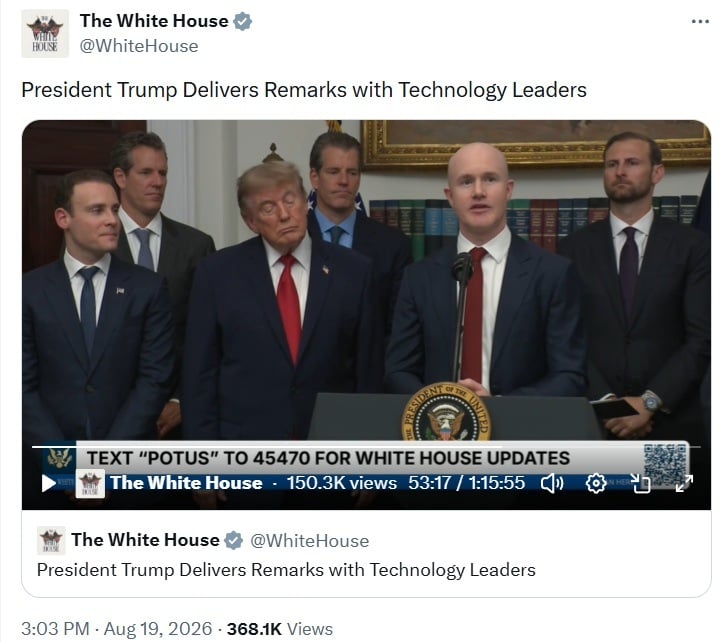
On August 19, President Donald Trump convened leaders from cryptocurrency platforms and traditional financial institutions, bringing digital asset regulation onto his administration's economic agenda. The full video recording of the White House meeting on cryptocurrencies shows Trump receiving policy recommendations from industry leaders and federal regulators.
Describing the participants as leading figures in finance, cryptocurrency, and technology, the President noted they help foster commercial markets in the United States. The scheduled cryptocurrency meeting at the White House included executives from companies such as Coinbase, Ripple, Robinhood, Kraken, Nasdaq, Intercontinental Exchange, and Chainlink.
Criticizing the Biden administration's approach, the President accused it of pursuing cryptocurrency companies through regulations, restrictions, and enforcement measures that have driven innovation overseas. Citing subsequent policy shifts by his own administration, Trump stated:
"We have ended the war on crypto, once and for all."
The President referenced an executive order prohibiting federal agencies from creating or promoting a central bank digital currency in the U.S. He also emphasized the importance of a strategic Bitcoin reserve, U.S. digital asset stockpiles, and an SEC initiative called 'Project Crypto.'
Trump Says US Crypto Purchase Issue Still Under Discussion
When asked whether the government could acquire "significant amounts" of Bitcoin or other cryptocurrencies, the President said the proposal was still under consideration. Trump stated:
"Well, there's been talk about that. I think, on that one, I'd probably rely on Paul and the whole group. He'll make a decision. You guys will make a decision and let me know."
Without specifying a purchasing plan or timeline, the President added that he would consider recommendations from Securities and Exchange Commission (SEC) Chairman Paul Atkins and other officials. Discussing cryptocurrencies, Trump remarked: "It's, uh, reduced pressure on the dollar significantly. It's been very, very good for the dollar." He did not explain the economic mechanism behind this assessment.
Regulators and Market Leaders Outline Their Priorities
Commodity Futures Trading Commission (CFTC) Chairman Mike Selig characterized the administration's approach as a departure from regulation through enforcement, stating that clearer rules could attract investment, create jobs, and keep technological development in the United States.
"Innovation depends on regulatory clarity. Clear rules build trust," said Selig, adding: "Trust attracts investment, and investment creates jobs, strengthens our markets, and keeps the world's best talent continuing to work here in America."
Securities and Exchange Commission (SEC) Chairman Paul Atkins discussed individual exemptions from capital raising rules for qualifying cryptoactive transactions. A proposal from August 18 would allow qualifying placements of up to $5 million over four years or up to $75 million during any 12-month period. Atkins stated:
"Our proposal, the 'Crypto Asset Rule,' would provide crypto entrepreneurs like those in this room, as well as job creators, with the certainty to raise capital in the United States using digital assets."
Intercontinental Exchange (NYSE: ICE) CEO Jeffrey Sprecher supported the idea of revising outdated regulations, while Robinhood Markets Inc. (Nasdaq: HOOD) CEO Vlad Tenev advocated for tokenization alongside investor protection. Kraken co-CEO Arjun Sethi discussed access to financial services and recalled Trump asking why Kraken operates at "warp speed" and not "Trump speed."
Armstrong Presses Congress Amid Ongoing Ethics Dispute
Coinbase (Nasdaq: COIN) CEO Brian Armstrong praised the administration's regulatory appointments and urged senators to advance the 2025 "Digital Asset Market Transparency Act." On July 17, 2025, the House of Representatives passed bill H.R. 3633 by a vote of 294 to 134, though the Senate has not yet completed its floor consideration.
Armstrong stated:
"I believe the most important thing now is the vote on the CLARITY Act bill, scheduled for September 15."
During the August 19 meeting, Armstrong named September 15 as the next key test for the bill, with Trump describing it as bipartisan. This deadline was set after Senate Majority Leader John Thune filed a cloture motion on August 8. This procedural motion, requiring 60 votes to open debate, needs 60 votes to pass; it is not a vote on final passage of the bill.
Presidential ethics issues remain contentious despite a White House agreement reached on July 21 limiting certain activities of senior federal officials regarding digital assets. Later, Democratic Senate staff identified five alleged loopholes in the ethics rules, while Republicans said the proposal sets strict federal limits. Negotiators then proposed a counteroffer for law enforcement, allowing state attorneys general to prosecute violators—a matter that remained unresolved as Senate debate began.
end-content