Trump Executed 3,600 Stock Trades in Q1, Bought Nvidia, Dell, Then Made a 'Stock Tip,' Sparking Conflict-of-Interest Controversy

marsbitPublicado em 2026-05-15Última atualização em 2026-05-15

Resumo

Former President Donald Trump executed 3,642 individual stock trades in Q1 2026, averaging about 60 trades per day, according to a recent OGE 278-T disclosure. This breaks from the modern presidential tradition of using blind trusts. The filings reveal Trump sold large positions in Amazon, Meta, and Microsoft while making significant new purchases in AI and semiconductor firms like NVIDIA, Broadcom, and Intel. Notably, he bought $1-5 million worth of Dell stock on February 10. Three months later, on May 8, he publicly urged Americans to "buy Dell" at a White House event; the stock has since risen 96%. His Intel purchases began in early March, after which the stock surged 150%. The U.S. government had taken a 9.9% stake in Intel in August 2025. These transactions, occurring close to related policy actions or public endorsements, have ignited significant controversy over potential conflicts of interest. While the White House maintains full compliance with the STOCK Act, critics highlight the unprecedented scale of trading and the timing coinciding with his official duties and donors' interests.

Author: Claude, Deep Chao TechFlow

Deep Chao Introduction: Trump's newly disclosed OGE 278-T form shows he executed 3,642 stock trades in Q1 2026, averaging about 60 trades per day, breaking the precedent of using a "blind trust" set by presidents since Lyndon Johnson.

The disclosure reveals that after buying $1 million to $5 million worth of Dell stock on February 10th, Trump publicly urged people on May 8th at the White House to "go buy Dell," following which the stock surged 96%. Multiple trades, including those in Nvidia and Intel, occurred ahead of related policy moves, rapidly fueling a conflict-of-interest controversy.

Trump's personal stock trading record is becoming one of the most contentious documents in Washington.

According to Benzinga, documents released this week by the Office of Government Ethics (OGE) show Trump executed 3,642 securities transactions in Q1 2026, averaging about 58 per day. The 113-page OGE 278-T form was signed by Trump on May 8th, delivered to the OGE on May 12th, and had "Filer paid late fee" handwritten on the cover page, indicating it exceeded the 30- to 45-day filing window stipulated by federal regulations.

This trading frequency breaks the nearly continuous blind trust arrangement precedent since Lyndon Johnson. Most former U.S. presidents placed personal assets in qualified blind trusts to limit conflicts of interest; Carter even liquidated his peanut farm, Obama held Treasury bonds and index funds, and Biden also employed a blind trust arrangement during his term.

Massively Sold Tech Giants, Heavily Bet on AI Chip Supply Chain

Disclosure documents show Trump significantly reduced holdings in Amazon, Meta, and Microsoft in Q1, all falling within the highest valuation bracket of $5 million to $25 million. However, while selling heavily, Trump maintained exposure to these three companies through smaller purchases.

More notably are the new positions. Trump established new positions in the $1 million to $5 million range in Nvidia (NVDA), Broadcom (AVGO), Synopsys (SNPS), Cadence Design Systems (CDNS), and Texas Instruments (TXN), covering almost every core segment of the U.S. AI chip supply chain. Large buys also appeared in Apple, Oracle, ServiceNow, Adobe, and Workday within the same range.
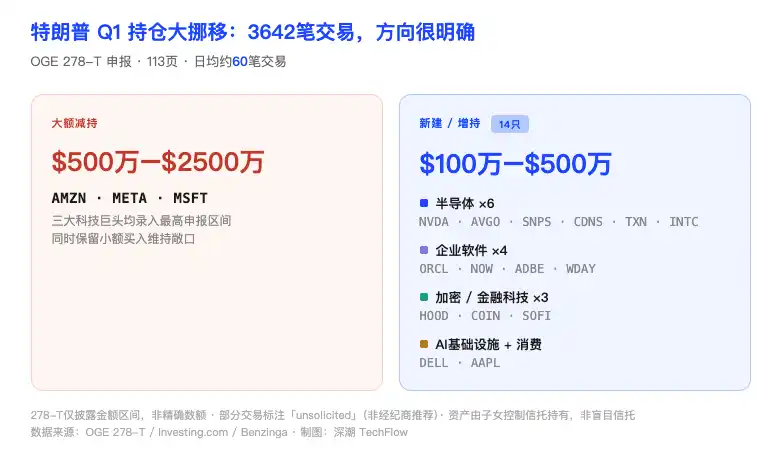
The semiconductor holdings closely align with the White House's policy direction of boosting domestic chip production capacity. According to Quiver Quantitative analysis, the purchase of Nvidia occurred before CEO Jensen Huang accompanied Trump on a visit to China, a trip expected to involve discussions on AI chip exports and semiconductor policy.

White House "Stock Tip" Three Months After Buying Dell, Stock Up 96%

The focus of the conflict-of-interest controversy centers on Dell.

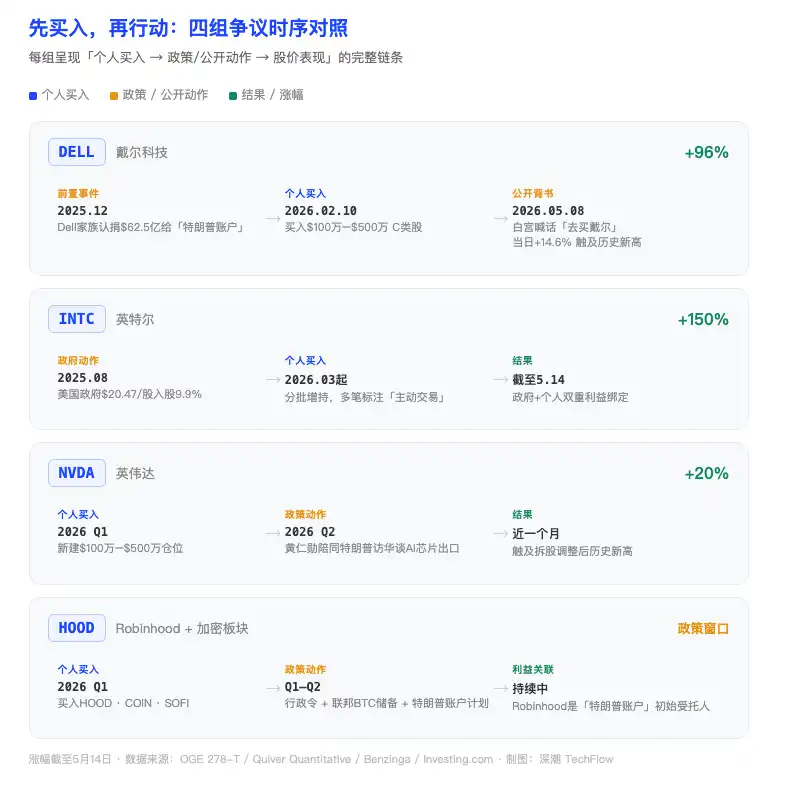
Documents show Trump bought $1 million to $5 million worth of Dell Technologies Class C stock on February 10, 2026. Three months later, at a Mother's Day event on May 8th, Trump thanked Michael Dell and Susan Dell by name at the White House and made the remark that sparked an uproar to those present—telling Americans to "go buy Dell."

That day, Dell's stock price surged as much as 14.6%, hitting a record high of $263.99. From Trump's purchase to the present, Dell's stock price has risen 96% cumulatively.

Another detail in the timeline intensified the controversy. On December 2, 2025, Michael Dell and Susan Dell pledged $6.25 billion to the "Trump Accounts," one of the largest private donations in recent years to a signature project of a sitting president. The White House has not responded to whether there was coordination between the President's public endorsement and the Dell family's donation.

Intel Shares Soar 150% After Purchase, Government Holds 9.9% Stake

Intel's trades are also worth examining.

Trump began buying Intel in batches starting in early March 2026, with several trades marked as "unsolicited," meaning not broker-recommended. Since the initial purchase on March 2nd, Intel's stock price has risen 150%.

Prior to this, the U.S. government purchased 433.3 million shares of Intel in August 2025 at $20.47 per share, giving it a 9.9% stake. In other words, Trump was buying Intel stock in the open market in his personal capacity while, in his presidential role, promoting government investment in Intel.

Additionally, purchases of Coinbase, Robinhood, and SoFi occurred during a period of active government promotion of crypto-friendly policies, including executive orders, a federal bitcoin reserve, and the "Trump Accounts" retirement plan. Robinhood is the initial trustee for that plan.
Non-Blind Trust Sparks Constitutional Debate, White House Claims Compliance

Critics view the alignment of these trading timelines as posing a conflict-of-interest risk. The White House argues that the filings fully comply with the STOCK Act's requirements.

Trump's assets are held in trusts controlled by his children, but the latest documents show numerous trades were executed by brokers acting as agents. The documents do not specify exactly which accounts hold the trading positions nor who gave the trading instructions.

An OGE spokesperson declined to comment on whether the trades reflect Trump's direct trading activity or operations through managed accounts, stating only that "the OGE is committed to transparency and citizen oversight of government."

According to Quiver Quantitative analysis, to their knowledge, this is the first time Trump has actively traded individual stocks while in office. The conservative, bond-heavy portfolio seen in previous 278-T filings has been completely overturned.


Perguntas relacionadas

QWhat is the primary controversy surrounding Donald Trump's stock trades in Q1 2026 as detailed in the article?

AThe primary controversy is the potential conflict of interest, as Trump conducted numerous personal stock trades (3642 in total) while in office, a break from the tradition of modern presidents using blind trusts. Specific concerns include his purchase of Dell stock followed by a public endorsement to "buy Dell" from the White House, and trades in companies like Nvidia and Intel that coincided with or preceded related government policy actions.

QHow did Donald Trump's investment activity in Dell become a focal point of the conflict-of-interest allegations?

ATrump purchased between $1 million and $5 million worth of Dell stock on February 10, 2026. Three months later, on May 8, he publicly told attendees at a White House event to "go buy Dell." Following this endorsement, Dell's stock price surged, having already risen 96% from his purchase date. This sequence created the appearance of using his presidential platform to influence a stock in which he held a significant personal financial stake.

QWhat significant change does the article note in Trump's investment strategy during his presidency compared to his previous disclosures?

AThe article notes a dramatic shift from a conservative, bond-heavy portfolio in his previous financial disclosures to an active trading strategy focused on individual stocks, particularly within the AI chip and technology sectors. This represents his first known period of active individual stock trading while in office.

QAccording to the article, what action did the US government take regarding Intel before Trump's personal stock purchases?

AIn August 2025, the US government purchased 433.3 million shares of Intel at $20.47 per share, acquiring a 9.9% stake in the company. Trump subsequently began personally buying Intel stock in March 2026.

QHow has the White House responded to criticism about the timing of Trump's stock trades?

AThe White House has defended the transactions, stating that the financial disclosures are fully compliant with the requirements of the STOCK Act. However, it has not commented on whether there was any coordination between the president's public endorsements and related stock trades or political donations.

Leituras Relacionadas

GitHub, Transfixed by AI

On the night of February 9th, GitHub suffered a major outage caused by a simple configuration change—reducing a cache refresh interval from 12 to 2 hours—that triggered a cascade of failures. This was not an isolated event, but part of a broader pattern. In early 2026, GitHub experienced at least 8 major incidents, failing to meet its promised 99.9% availability. These outages stemmed from structural issues: explosive growth in load, tight service coupling, and insufficient protection against abnormal traffic. This unprecedented load is driven by AI Agents. In 2025, GitHub handled ~1 billion commits. By 2026, weekly commits reached 275 million, projecting to ~14 billion for the year—a 14x increase. AI tools like Claude Code now contribute 4.5% of all public repository commits, with weekly submissions surging 25x in just three months. AI-generated pull requests jumped from 4 million to 17 million per month in half a year. Unlike human developers, AI Agents work continuously, generating commits at a scale that overwhelms infrastructure designed for human rhythms. The surge also shattered GitHub's business model. Copilot's flat-rate pricing, based on assisting human developers, became unsustainable as Agentic AI sessions consumed resources worth hundreds of dollars for a few dollars in fees. In response, GitHub imposed usage limits and, by June 1st, shifted to a pay-per-use "AI Credits" system. Facing this new reality, GitHub realized a 10x scaling plan was insufficient. It announced a need to *redesign* its architecture for 30x current scale—decoupling services, adding fault isolation, and improving change management to prevent cascading failures. Other platforms like Stripe and AWS are facing similar challenges with AI Agents. Fundamentally, GitHub is transitioning from a human collaboration platform to an "exhaust pipe" for automated AI workflows. Its detailed post-mortem reports aim to maintain trust during this turbulent rebuild. The February outage was not just a technical glitch, but a signal of the software industry's entry into a new, AI-driven era.

marsbitHá 9m

GitHub, Transfixed by AI

marsbitHá 9m

Both Suffer Massive Losses Exceeding $90 Billion, Which Is in Greater Peril: Strategy or Bitmine?

Facing massive paper losses exceeding $90 billion each amidst a sharp market downturn, "Digital Asset Treasury" (DAT) giants Strategy and Bitmine find themselves in a precarious position, but with different underlying risks. Strategy, heavily invested in Bitcoin (BTC), faces significant financial strain. Its strategy relies heavily on debt, including convertible notes and preferred stock (STRC) requiring substantial dividend payments. With its cash reserves dwindling and BTC offering no staking yield for cash flow, Strategy's high leverage makes it vulnerable. A continued price decline could force asset sales to meet obligations, potentially creating a negative feedback loop. Its market value has already fallen sharply. In contrast, Bitmine, an Ethereum (ETH) holder, appears on firmer financial ground. It primarily funds its purchases through equity offerings (like ATM programs), avoiding debt pressure. It also generates income by staking a large portion of its ETH holdings. While not immune to market drops and shareholder dilution concerns, Bitmine maintains more flexibility, recently announcing a new preferred share offering to raise further capital. The core divergence lies in their financing: Bitmine uses equity (investor money), while Strategy uses debt (borrowed money). Consequently, Bitmine currently faces less immediate liquidity pressure than Strategy, which must navigate the dual challenge of servicing debt/dividends and a declining core asset (BTC) price.

marsbitHá 16m

Both Suffer Massive Losses Exceeding $90 Billion, Which Is in Greater Peril: Strategy or Bitmine?

marsbitHá 16m

Where the AI Bubble Really Is: Which Layer of Players Are Naked

AI Bubble: Where It Really Is and Who's Swimming Naked This analysis dissects the AI industry not as a single entity but as a five-layer pyramid, arguing that bubbles are concentrated in specific tiers, not uniformly distributed. **Key Distinction from the 2000 Dot-com Bubble:** Unlike 2000, where companies had stock prices before revenue, today's leading AI players have massive, contract-backed revenue driving their valuations. Core infrastructure demand is real, with every GPU running at full capacity for paying customers. **The Five-Layer Pyramid & Bubble Assessment:** * **L0 (Fab/Manufacturing) & Top L4 (Leading AI Apps): NO BUBBLE.** Companies like TSMC, NVIDIA, major cloud providers (Microsoft, Google, Meta, Amazon), and top AI labs have real revenues and orders. Supply is tightly constrained by TSMC's disciplined capacity control and physical limits like power/land for data centers, preventing a supply glut. * **L1 (Memory): BATTLEGROUND.** Sky-high HBM margins could signal a new structural cycle or a classic "boom before bust." The oligopoly of three major players may enforce supply discipline, making this a high-stakes bet. * **L2 (Interconnect/Optical Modules): BUBBLE TERRITORY.** Companies like Lumentum and AAOI have seen stock surges (4-10x) far outpacing revenue growth. This hardware segment has lower physical barriers to expansion than fabs, allowing speculation. It mirrors the 2000 bubble's epicenter—optics. * **L3 (Infrastructure/"GPU Landlords"): VULNERABLE.** GPU leasing companies profit from the current compute shortage but own no long-term moat. Their business model relies on a temporary bottleneck that will ease as big tech expands and new tech (e.g., potential space-based data centers) emerges. * **L4 Long Tail (VC-backed Startups): STRONG BUBBLE SIGNALS.** VC funding concentration in AI is twice that of the 1999 peak. Many startups with little revenue use the valuation logic of successful giants to justify their own, creating high risk of a "valuation crunch" when funding dries up. **Critical Risks to Monitor:** 1. **GPU Depreciation & Accounting:** Companies extending the assumed useful life of GPUs artificially boost profits. The true economic life depends on future generational leaps from NVIDIA. 2. **"GPU Credit" & Off-Balance-Sheet Leverage:** Emerging structures where shell companies borrow to buy GPUs and lease them out (with chipmakers sometimes investing) move debt off major balance sheets. This echoes the "vendor financing" of 2000 and the securitization risks of 2008, though currently small-scale. 3. **TSMC Abandoning Caution:** If the primary supply bottleneck (TSMC's conservative capacity planning) breaks, runaway supply could trigger a bust. 4. **Algorithmic Efficiency Breakthrough:** A major leap in software efficiency could drastically reduce the need for raw compute hardware, undermining the investment thesis. **Conclusion:** The AI boom is expensive and has frothy areas, but its core is underpinned by real demand and physical supply constraints. The bubble risk is layered: most present in optical components, GPU leasing, and the long-tail startup ecosystem, while the foundational chip manufacturing and leading application layers remain relatively solid—for now.

marsbitHá 28m

Where the AI Bubble Really Is: Which Layer of Players Are Naked

marsbitHá 28m

Trading

Spot
Futuros
活动图片