TRON activity surges with 2.6mln users – But can TRX sustain upside?

ambcryptoPublicado em 2026-03-31Última atualização em 2026-03-31

Resumo

TRON (TRX) has demonstrated significant growth, with an 11.32% increase in Total Value Locked (TVL) and 2.62 million active addresses, indicating strong capital retention and user engagement. The price has been recovering, forming a higher low near $0.27 and advancing toward the $0.322 resistance level. The MACD indicator shows strengthening momentum with sustained buying strength. However, exchange inflows have turned positive, suggesting potential profit-taking near resistance, which could slow upward momentum. Liquidation data indicates a reset in leveraged long positions, creating a more stable market environment. For a sustained breakout, buyers must absorb selling pressure and push above $0.322; otherwise, consolidation may continue.

TRON [TRX] recorded an 11.32% rise in Total Value Locked [TVL] over the past month, signaling steady capital retention.

Network usage also intensified, with 2.62 million Active Addresses and $1.06 million in daily fees. This placed TRX ahead of competing chains in activity.

That combination reflected sustained demand building across the TRX network.

Such growth in liquidity and participation pointed to a structurally active ecosystem.

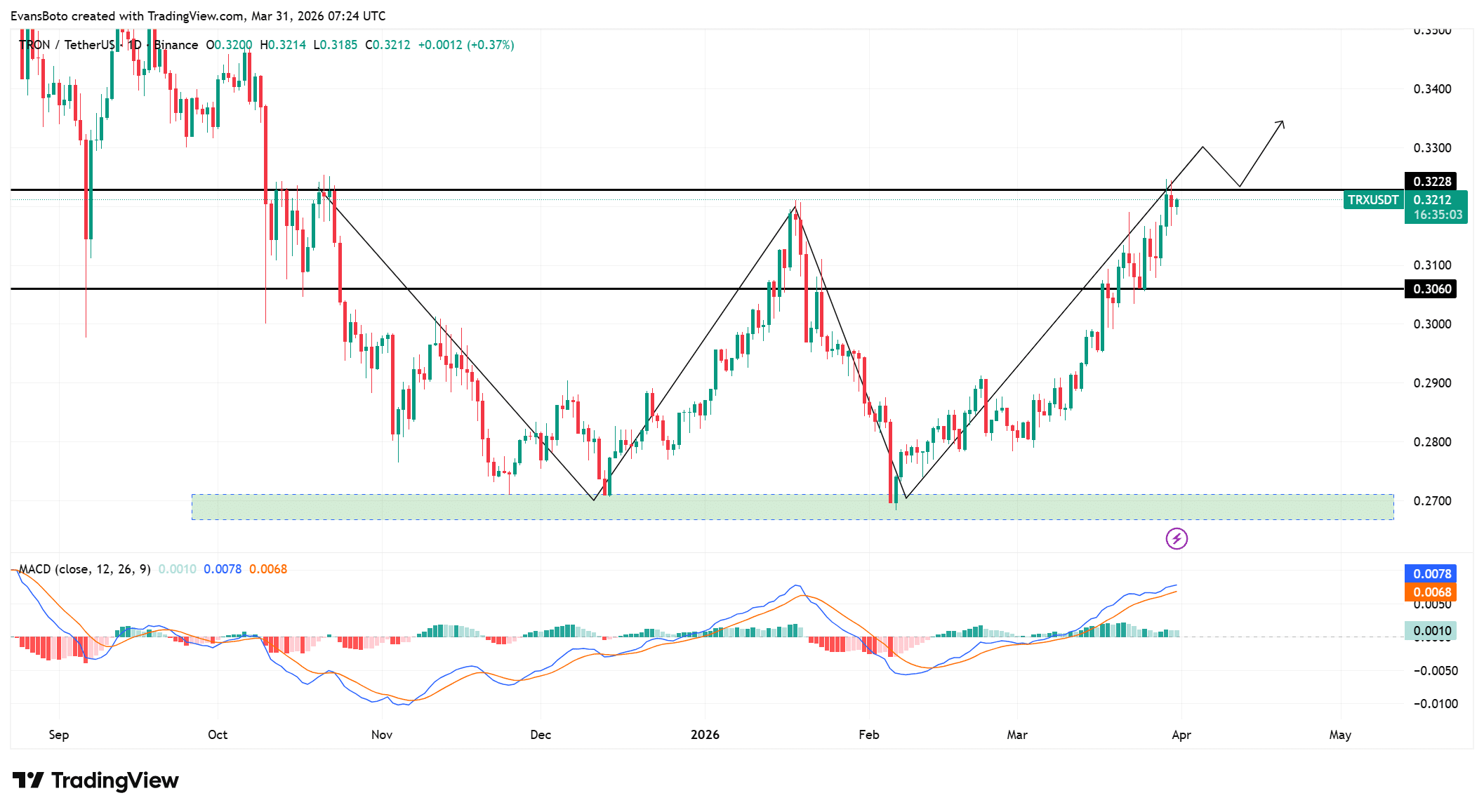
TRX presses resistance after strong recovery structure

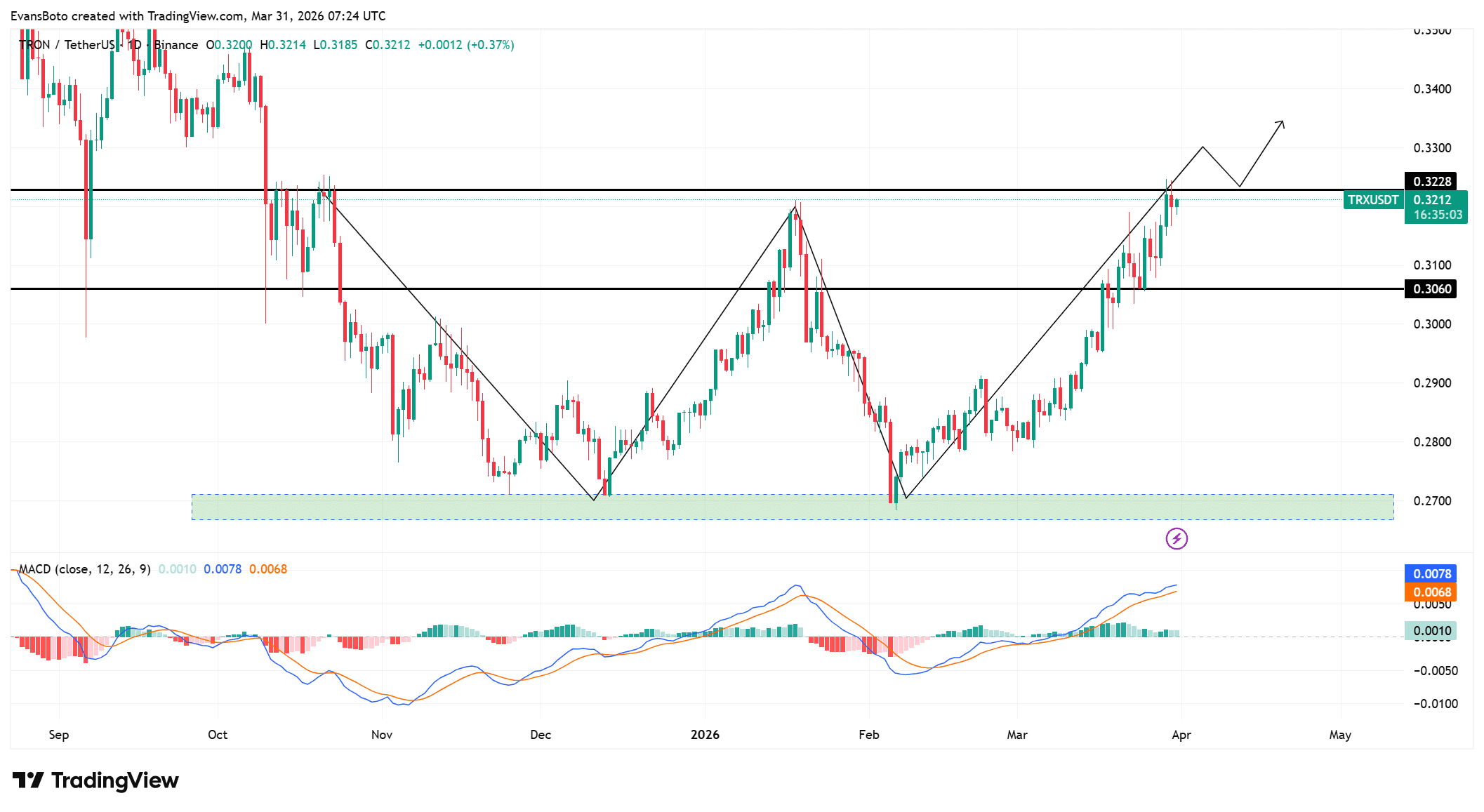
TRX formed a higher low near the $0.27 demand zone, supporting the ongoing recovery.

Price advanced toward the $0.322 resistance, forming a rising structure that showed stronger buyer control.

Each pullback held above prior lows, reinforcing the uptrend.

However, this level remained a key decision point, as prior rejections appeared near this zone. If buyers held above the $0.306 support, the structure could stay intact.

A move above $0.322 would confirm strength, while hesitation could trigger short consolidation.

The MACD crossed above the signal line and widened, indicating strengthening bullish momentum. Histogram bars stayed positive, showing sustained buying strength after the crossover.

This suggested demand remained consistent rather than driven by a single impulse.
Source: TradingView

Exchange inflows rise as selling risk builds

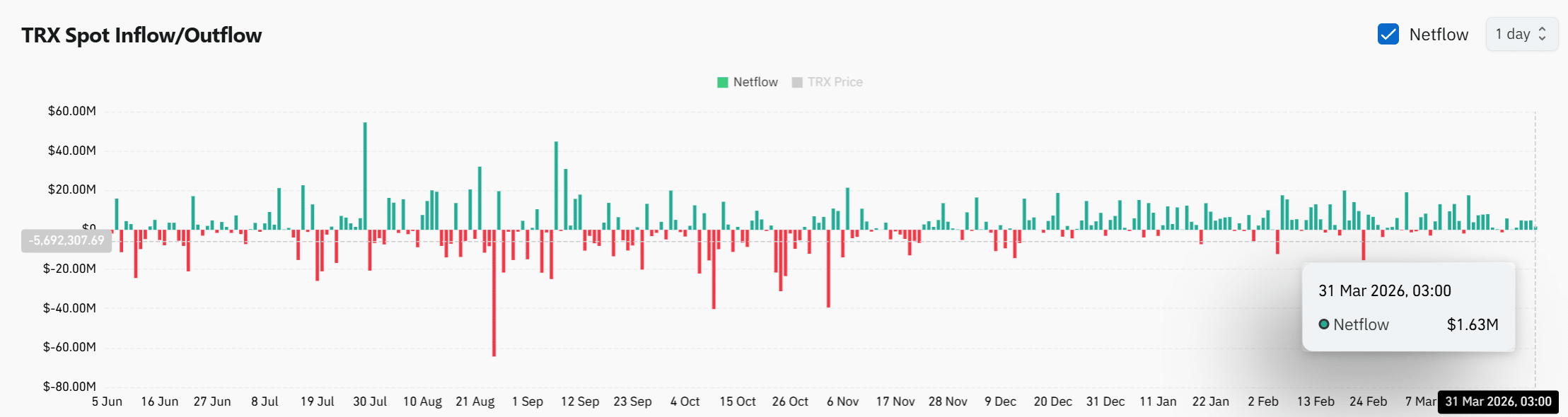
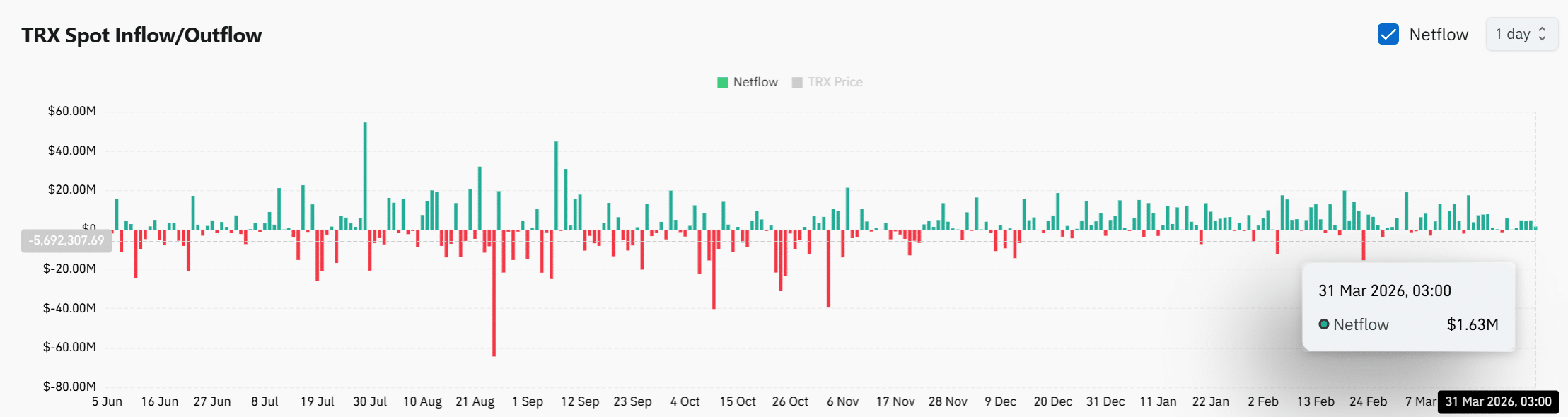
Spot Netflows flipped positive, with $1.63M in inflows, signaling increased exchange deposits. That shift indicated a behavioral change, as earlier outflows reduced sell-side pressure.

Now, rising deposits suggested some traders were prepared to take profits near resistance.

However, inflows alone did not confirm selling and could reflect repositioning.

If price held steady, demand could absorb the incoming supply. By contrast, rising balances near $0.322 could increase rejection risk.
Source: CoinGlass

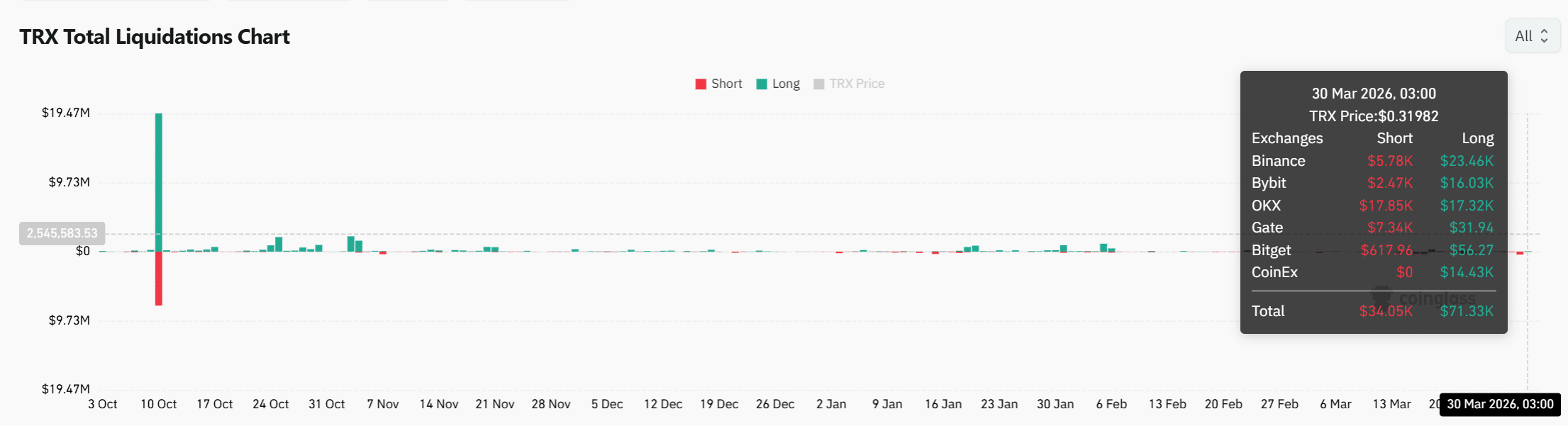
TRX liquidations show leverage reset during volatility

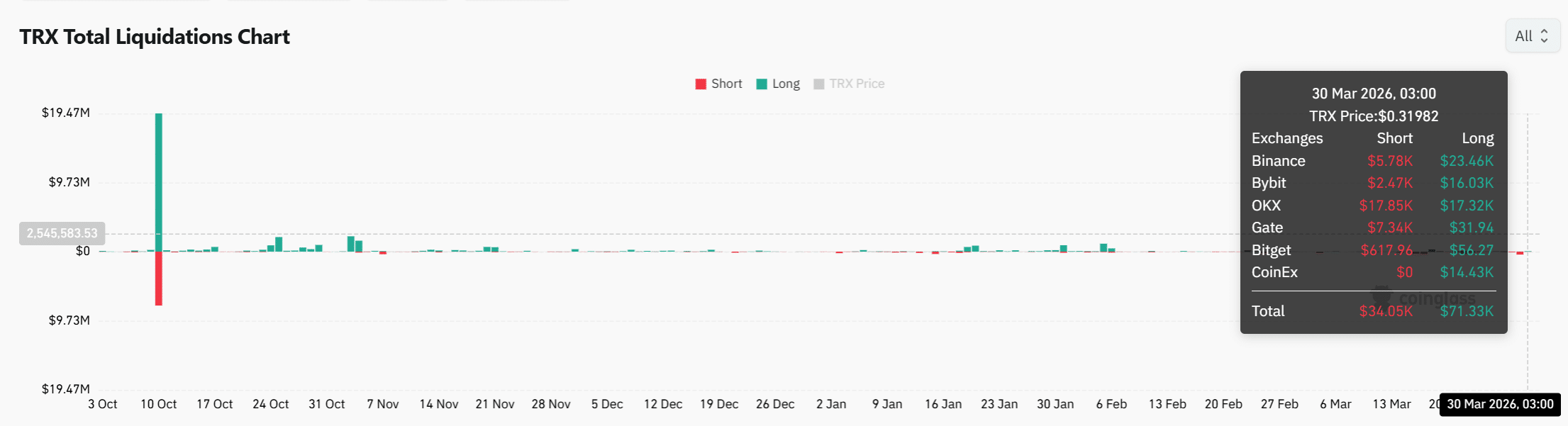
Liquidation data showed long positions absorbed the most recent wipes. About $71.33K in longs cleared, compared to $34.05K in shorts.

This imbalance indicated volatility flushed overleveraged long positions.

That reset reduced excessive leverage across the market. As a result, the structure appeared cleaner, with fewer crowded positions.

This often creates a more stable environment for continuation. Even so, aggressive leverage buildup could bring volatility back.

For now, the liquidation profile suggested a stabilized market.
Source: CoinGlass

TRX has shown strong alignment between rising network activity and improving price structure, which suggests underlying strength continues building.

However, resistance at $0.322 remains the defining barrier.

If buyers sustain pressure and absorb exchange inflows, a breakout would likely follow. Otherwise, price may continue consolidating as fundamentals gradually catch up.


Final Summary

  • Strong network growth continues supporting TRX, yet price still faces pressure near a key resistance zone.
  • Price structure remains bullish, but rising exchange inflows could slow momentum before any sustained breakout attempt.


Perguntas relacionadas

QWhat was the percentage increase in TRON's Total Value Locked (TVL) over the past month, and what does it signal?

ATRON recorded an 11.32% rise in Total Value Locked (TVL) over the past month, signaling steady capital retention.

QHow many active addresses and daily fees did the TRON network have, and what did this activity level indicate?

AThe TRON network had 2.62 million active addresses and $1.06 million in daily fees, which placed it ahead of competing chains and reflected sustained demand building across the ecosystem.

QWhat is the key resistance level for TRX's price mentioned in the article, and what is required for a confirmed breakout?

AThe key resistance level for TRX is $0.322. A move above this level would confirm strength and a likely breakout.

QWhat did the shift to positive Spot Netflows indicate about trader behavior?

AThe shift to positive Spot Netflows, with $1.63 million in inflows, indicated increased exchange deposits and suggested that some traders were preparing to take profits near the resistance level.

QAccording to the liquidation data, which type of positions were cleared more, and what was the implication for the market?

ALong positions were cleared more, with $71.33K in longs compared to $34.05K in shorts. This indicated that volatility flushed overleveraged long positions, which reduced excessive leverage and created a more stable market environment.

Leituras Relacionadas

Apple Also Has to Pay Rent Now

Apple Pays Rent Too: The Two-Way Flow of "Traffic Tax" and "AI Capability Rent" Between Tech Giants For over two decades, Google has paid Apple an estimated $20 billion annually to remain the default search engine on Safari, a "traffic tax" for a critical user entry point. However, in 2026, the direction of this cash flow partially reversed. Apple agreed to pay Google roughly $1 billion per year to license its Gemini AI models, as Apple's own models reportedly struggled with complex tasks. This creates a unique dynamic: Apple acts as the "landlord" in the established search ecosystem, collecting rent from Google for access. Simultaneously, in the emerging AI arena, Apple becomes the "tenant," paying Google for access to cutting-edge AI capabilities it cannot currently match internally. While Apple claims its new models are "distilled" from Gemini outputs and contain "not a drop" of Google's original code, core dependencies remain. Its knowledge base is refined using Gemini's outputs, and its most powerful cloud model runs on Google's infrastructure. Apple has structured the deal as non-exclusive, allowing it to theoretically switch AI suppliers—a hedge against over-reliance. The future hinges on whether advanced AI models become a commodity (cheap and abundant) or remain a concentrated, scarce resource (expensive and controlled by few). Apple is betting on the former, leveraging its massive device ecosystem to be a powerful, choosy customer. If the latter proves true, its bargaining power could erode. This power dynamic is extending to developers. Apple, Google, and WeChat are all pushing for apps to expose their core functions as standardized "actions" or "intents" that their respective AI assistants (Siri, Gemini, WeChat AI) can directly call. The new scarce resource is no longer just app store visibility, but "being selected by the AI." The currency of "rent" has changed from a 30% revenue share to ceding control over how users interact with an app's functions.

marsbitHá 1h

Apple Also Has to Pay Rent Now

marsbitHá 1h

Missed the SpaceX IPO? WEEX's "First Trade Protection" Lets You Experience US Stock Trading Risk-Free.

With the excitement around SpaceX's recent public listing reigniting interest in the US stock market, Chinese investors face significant challenges accessing compliant and convenient trading channels following regulatory actions against major online brokers. This article explores the available options, highlighting their risks and limitations. Traditional paths for US stock investments remain problematic. Qualified Domestic Institutional Investor (QDII) and Listed Open-Ended Fund (LOF) products, while compliant, suffer from high fees, significant purchase premiums, and a very limited selection of assets. Small, unregulated offshore brokers pose substantial risks, including potential insolvency. While secure, VIP accounts at banks in Hong Kong or Singapore require high minimum deposits (often 1-2 million RMB) and in-person visits, placing them out of reach for most retail investors. The article positions cryptocurrency exchanges, specifically their TradFi (traditional finance on-chain) offerings, as a compelling alternative. Platforms like WEEX are noted for providing access to a wide range of US stocks and ETFs, including SpaceX (SPCXON), through tokenized assets. This method offers advantages such as a single account for both crypto and traditional assets, USDT-based settlement avoiding fiat complexities, flexible leverage, and robust risk management. To attract users, WEEX is promoting a "First Trade Guarantee" campaign. Running from June 15 to July 8 (UTC+8), it features a $30,000 prize pool. Users who trade $500 worth of US stock contracts can qualify for a guarantee on their first eligible trade: 100% loss coverage up to $30 or a 20% bonus on profits up to $30. The campaign is presented as a low-risk opportunity for both crypto natives and traditional investors to experience US stock trading.

marsbitHá 1h

Missed the SpaceX IPO? WEEX's "First Trade Protection" Lets You Experience US Stock Trading Risk-Free.

marsbitHá 1h

How Difficult is Chip Making? A Division Error Costs 475 Million Dollars

How Hard Is It to Make a Chip? A Division Error Cost $475 Million Chip expert Shi Kan, a researcher at the Chinese Academy of Sciences and a popular tech creator, explains the immense challenges of chip development. Chips are foundational to modern technology, but their creation is extraordinarily difficult. The journey from sand to a functional chip involves complex design and manufacturing, but a critical bottleneck is verification—ensuring the design works flawlessly before costly production. A single, undetected bug can have catastrophic consequences, as illustrated by the infamous 1994 Intel Pentium FDIV bug. A flaw in the floating-point division unit forced a recall costing $475 million. Unlike software, chips cannot be easily patched after manufacture, making "first-time success" paramount. However, industry surveys show only 24% of chip projects achieve this; over three-quarters require at least one costly re-spin due to design flaws. Verification has thus become the dominant phase, consuming up to 70% of the design cycle. The core challenge is a "verification impossible triangle" between high performance, good debuggability, and low cost. Exhaustively verifying a modern CPU core could take 15,000 years with software simulation, or 30 years with advanced hardware emulation—timeframes utterly impractical for development. Despite being essential, verification is often seen as unglamorous "dirty work," receiving less academic attention than fields like AI. Shi and his team are tackling this by developing an agile verification research framework called ENCORE, based on FPGA technology, to improve verification efficiency and debug capability. Beyond research, Shi engages in public science communication through long-form video content, aiming to demystify chip technology, AI, and computer science. He argues for the value of pursuing "hard and long-term" endeavors, whether in the meticulous world of chip verification or in creating substantive educational content, believing such sustained effort is likely the right path forward.

marsbitHá 1h

How Difficult is Chip Making? A Division Error Costs 475 Million Dollars

marsbitHá 1h

Trading

Spot
Futuros

Artigos em Destaque

Como comprar TRX

Bem-vindo à HTX.com!Tornámos a compra de TRON (TRX) simples e conveniente.Segue o nosso guia passo a passo para iniciar a tua jornada no mundo das criptos.Passo 1: cria a tua conta HTXUtiliza o teu e-mail ou número de telefone para te inscreveres numa conta gratuita na HTX.Desfruta de um processo de inscrição sem complicações e desbloqueia todas as funcionalidades.Obter a minha contaPasso 2: vai para Comprar Cripto e escolhe o teu método de pagamentoCartão de crédito/débito: usa o teu visa ou mastercard para comprar TRON (TRX) instantaneamente.Saldo: usa os fundos da tua conta HTX para transacionar sem problemas.Terceiros: adicionamos métodos de pagamento populares, como Google Pay e Apple Pay, para aumentar a conveniência.P2P: transaciona diretamente com outros utilizadores na HTX.Mercado de balcão (OTC): oferecemos serviços personalizados e taxas de câmbio competitivas para os traders.Passo 3: armazena teu TRON (TRX)Depois de comprar o teu TRON (TRX), armazena-o na tua conta HTX.Alternativamente, podes enviá-lo para outro lugar através de transferência blockchain ou usá-lo para transacionar outras criptomoedas.Passo 4: transaciona TRON (TRX)Transaciona facilmente TRON (TRX) no mercado à vista da HTX.Acede simplesmente à tua conta, seleciona o teu par de trading, executa as tuas transações e monitoriza em tempo real.Oferecemos uma experiência de fácil utilização tanto para principiantes como para traders experientes.

1.8k Visualizações TotaisPublicado em {updateTime}Atualizado em 2026.06.02

Como comprar TRX

Discussões

Bem-vindo à Comunidade HTX. Aqui, pode manter-se informado sobre os mais recentes desenvolvimentos da plataforma e obter acesso a análises profissionais de mercado. As opiniões dos utilizadores sobre o preço de TRX (TRX) são apresentadas abaixo.

活动图片