
Trading Moment: Gold, Silver, and A-Shares Dance Together, BTC Attacks 98,000 with 94,500 as Base

marsbitPublicado em 2026-01-14Última atualização em 2026-01-14

Resumo

Financial markets are experiencing significant movements. Despite US core inflation cooling to a four-year low of 2.6%, expectations for a June Fed rate cut remain unchanged. This uncertainty has strengthened the role of precious metals as hedges, with gold hitting a record high above $4,639 and silver surpassing $91 for the first time, its market cap exceeding $5 trillion. Bitcoin broke through key resistance levels, reaching around $96,500 after the CPI data. Analysts are bullish, with targets up to $112,000, though some caution remains near the $98,000 level. Ethereum is attempting to hold above $3,300, with a breakout potentially leading to $4,000. Altcoins like Solana, meme coins (PEPE, WIF, BONK), and privacy coins (XMR, DASH) saw strong gains. However, newly listed tokens on Binance Alpha showed mixed performance. ETF flows were positive, with Bitcoin ETFs seeing $754 million and Ethereum ETFs $130 million in net inflows. Key events to watch include the Fed's "Beige Book" release and various crypto network upgrades.

Daily key market data review and trend analysis, produced by PANews.

1. Market Observation

Although the latest US core inflation data showed signs of cooling, falling to a four-year low of 2.6%, this did not change the market's general expectation for the Federal Reserve to start cutting interest rates in June this year. Fed officials seem to need more evidence of a weakening job market or sustained easing of price pressures before considering adjusting interest rate policy, causing the initial optimism from the inflation data to quickly fade, putting pressure on US stocks and strengthening the US dollar.

Against this backdrop of uncertainty, the role of precious metals as a "hedge against systemic risks" has become increasingly prominent. Spot gold once hit a new historical high intraday, reaching $4639, while silver was even stronger, touching the $91 mark for the first time, with its total market capitalization breaking through $5 trillion, surpassing Nvidia to become the world's second-largest asset. Market analysis believes this round of gains is more of a repricing of the ambiguous monetary policy outlook, deepening fiscal dominance, and geopolitical risks. Many institutions reacted positively, with ANZ predicting gold prices will break through $5000 in the second half of 2026, and Citigroup even raised its three-month target price to $5000 for gold and $100 for silver. Analysts at VanEck even modeled that, under the assumption of a global return to the gold standard, the "true" price of gold would far exceed current levels.

The A-share market experienced its first decline after 17 consecutive days of gains since January 13th, and January 14th was a dramatic day. The morning session continued the upward trend, with the three major indices collectively opening higher, the ChiNext Index once rising over 2%, and the STAR 50 Index surging over 4%. The market showed a broad rally, with over 4700 stocks rising and over a hundred stocks hitting the daily limit up, particularly in sectors like AI applications, semiconductors, and commercial aerospace. However, the situation changed abruptly in the afternoon. A notice from the Shanghai, Shenzhen, and Beijing Stock Exchanges about raising the minimum margin requirement for margin trading from 80% to 100% caused a brief market plunge. The three major indices once collectively turned negative, and the number of rising stocks plummeted. This move aims to reduce market leverage through counter-cyclical adjustments, protecting investors and promoting long-term stability.

Bitcoin broke through multiple key resistance levels such as $92,000 and $94,000 after the CPI data was released, once touching near $96,500. Michaël van de Poppe and Ali Charts both believe the bull market has started; the former pointed out that BTC has effectively stabilized above the 21-day moving average and is expected to attack $100,000 next week, while the latter stated that breaking through the $94,555 resistance level would point directly to a prediction of $105,921. Additionally, Ardi, Sykodelic, and Astronomer unanimously view $94,500 as the lifeline for the bulls. Ardi emphasized that as long as this support holds, it will sweep through the chip distribution area of $96,500-$97,200 and target $100,000. Astronomer further pointed out that the spot discount in the $80,000-$85,000 range has turned into a premium, which is a strong bullish signal, with subsequent targets as high as $112,000 and a new historical high.

Cautious voices are also not to be ignored. Murphy, through on-chain data analysis, pointed out that the market is in a weak balance of "sentiment repair + low selling pressure" but "insufficient demand." $98,000, as the cost line for short-term holders, is the real "bull-bear dividing line," and a strong intervention of US funds is necessary to break through it. Tradermayne believes there is a 70% probability of forming a secondary high; unless it stabilizes above $105,000, there is still a risk of a bear market. CrypNuevo and CJ worry that this is merely a liquidity grab targeting the 1W 50EMA or the inefficient zone around $97,000, and caution is needed against a bull trap and subsequent decline.

Ethereum, after receiving a response in a key support area, is attempting to break through and stabilize above $3300, but multiple attempts over the past two months have been unsuccessful. Analyst Man of Bitcoin pointed out that a successful break above $3300 would confirm the validity of its bullish roadmap. Investors like Jelle and Max noted that with the Russell 2000 index hitting a new high, the market environment is favorable for ETH to play catch-up. If it can stabilize above key support, $4000 will be the next core target. Looking at derivatives data, Ethereum's open interest is recovering while leverage is decreasing. This divergence usually means a healthier market持仓 structure, and spot buying is leading the recovery. Although plagued in the short term by L2分流 (L2分流 likely means分流to L2s or competition from L2s) and decreased DApp activity, Ethereum is expected to see a catch-up rally after Bitcoin stabilizes.

As the broader market warms up, Solana has attracted much attention due to the "cup and handle pattern" formed on its daily chart. Analysts believe its price structure suggests a potential breakthrough towards the target range of $180 to $190. Additionally, the spot SOL ETF continued to record net inflows in 2026, enhancing market bullish confidence. Inscription tokens like ORDI and SATS also gained over 20%. The Meme coin sector made a comeback, with tokens like PEPE, WIF, and BONK seeing significant gains. In the privacy coin sector, Monero (XMR) hit a new historical high breaking $700, leading other similar tokens like DASH to follow with gains of over 30%. Furthermore, the performance of Meme coins listed on Binance Alpha diverged. The "Dark Horse" (literal translation for 黑马) saw its market cap surge to $15 million before falling back to $11.6 million, with gains narrowing to 500%, while "Laozi" (老子) fell instead, with its market cap shrinking to $8 million, down 35% in 24 hours. In contrast, "Binance Life" (币安人生) became the biggest winner, its market cap once rising to $289 million, breaking its historical high. The top on-chain holder has floating profits exceeding $2.63 million, with a return rate of over 15,434.1%. Some analysts believe "Binance Life" could become a sentiment indicator for altcoins on the Binance platform. (*Note: The content is for reference only, not investment advice. Please do your own research.)

2. Key Data (As of January 14, 13:00 HKT)

(Data Source: CoinAnk, Upbit, SoSoValue, CoinMarketCap)

  • Bitcoin: $94,942 (Year-to-date +8.8%), daily spot trading volume $68.7 billion

  • Ethereum: $3,334 (Year-to-date +12.1%), daily spot trading volume $361.1 billion

  • Fear & Greed Index: 48 (Neutral)

  • Average GAS: BTC: 1.75 sat/vB, ETH: 0.02 Gwei

  • Market Dominance: BTC 58.7%, ETH 12.1%

  • Upbit 24-hour trading volume ranking: XRP, BTC, IP, ETH, SOL

  • 24-hour BTC Long/Short Ratio: 51.20% / 48.80%

  • Sector Gains/Losses: Crypto market broadly higher, NFT and GameFi sectors lead gains over 8%

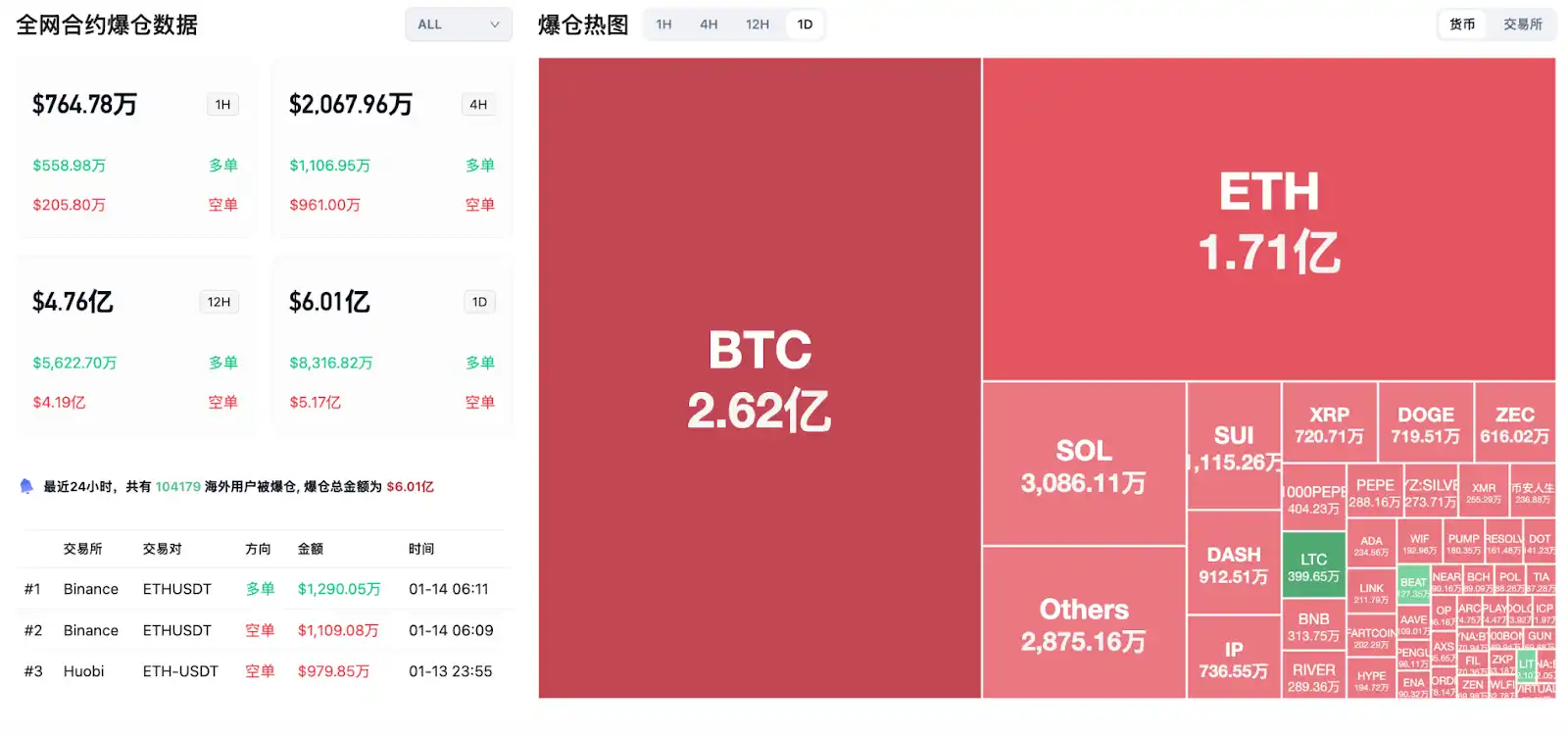
24-hour liquidation data: 104,179 people globally were liquidated, total liquidation amount was $601 million,其中BTC liquidations $262 million, ETH liquidations $171 million, SOL liquidations $30.86 million
3. ETF Flows (As of January 13)

  • Bitcoin ETF: +$754 million, none of the twelve ETFs had net outflows

  • Ethereum ETF: +$130 million, none of the nine ETFs had net outflows

  • XRP ETF: +$12.98 million

  • SOL ETF: +$5.91 million

4. Today's Outlook

  • Tom Lee urges BitMine shareholders to approve the proposal to increase authorized shares from 500 million to 50 billion by January 14th

  • BSC mainnet Fermi hard fork upgrade scheduled for January 14, 2026

  • Binance will list FOGO spot trading on January 15th and mark it with a seed tag

  • MANTRA: All ERC20 versions of OM will be deprecated on January 15th, please migrate as soon as possible

  • Aster: Phase 3 airdrop is open for claiming, will end on January 15, 2026

  • US Supreme Court postpones ruling on Trump tariff case, next ruling on January 14th

  • Federal Reserve releases the Beige Book" on economic conditions (January 15, 03:00)

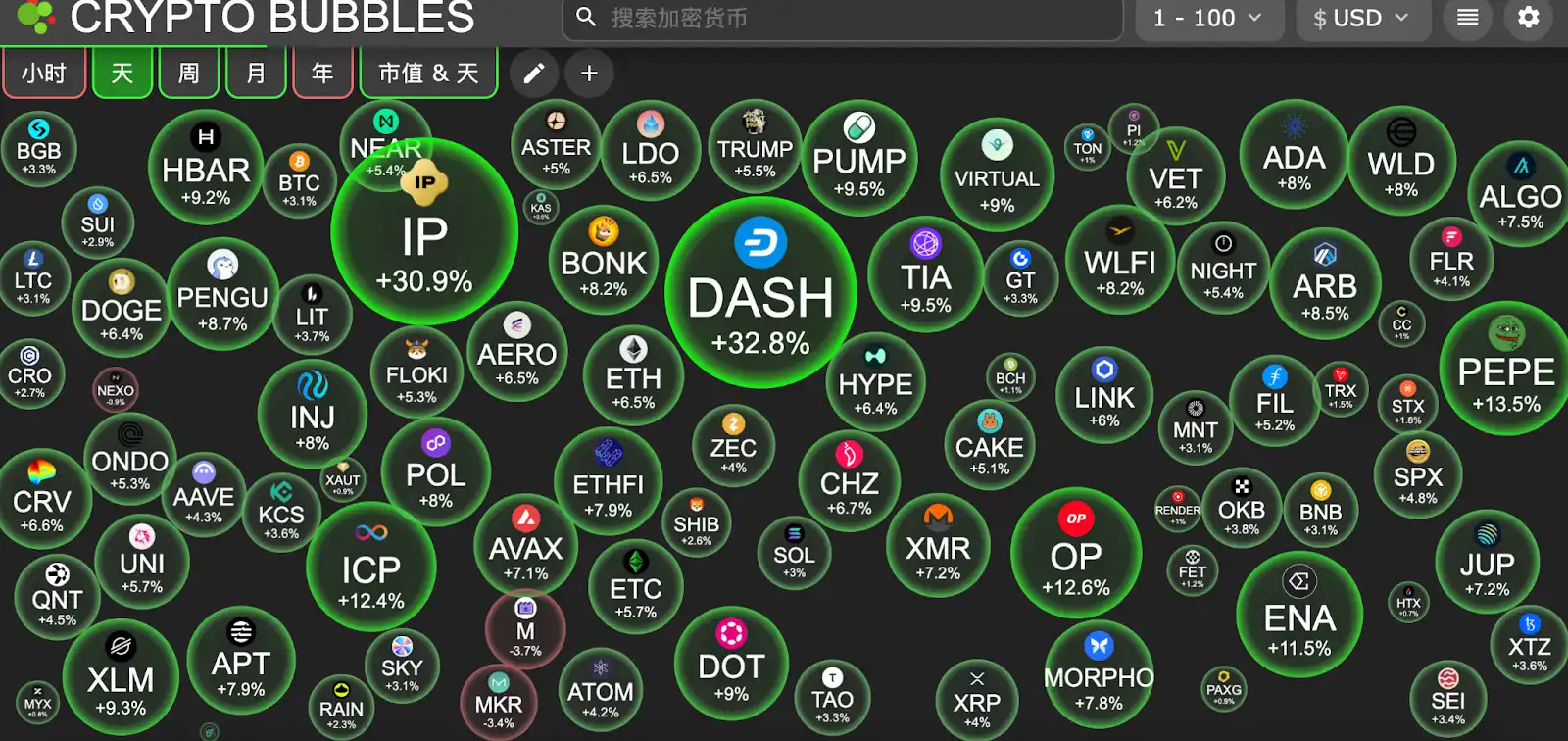
Today's top 100 coins by market cap, maximum gains: Dash up 32.7%, Story up 30.7%, Pepe up 13.5%, Optimism up 12.7%, Internet Computer up 12.3%.
5. Hot News

  • Corporate crypto holdings net increased by approximately 260,000 BTC in the past 6 months, three times the Bitcoin mining output during the same period

  • OpenSea Foundation is preparing for TGE, will consider historical trading volume and Treasures data

  • The top address for "Binance Life" has floating profits exceeding $2.63 million, with a return rate over 154,341.1%

  • DN token fell over 80% in 24 hours, DeepNode responded saying "working with market makers to resolve liquidity issues"

  • Spot silver approaches the $90 mark, hitting a new high again

  • Bitmine stakes another 94,400 ETH, worth $314 million

  • Zama will initiate token sales through CoinList and its own auction APP, FDV floor price is $55 million

  • SharpLink's staking收益 (staking收益 means staking rewards/yield) last week reached 500 ETH, cumulative收益 (收益 means rewards/yield)突破 (突破 means broke through) 11,000 ETH

  • Spot gold stands above $4620/oz, spot silver up over 3.00% intraday

  • US December unadjusted CPI year-on-year 2.7%, core CPI year-on-year 2.6%

  • "On-chain part-time stock investor" turns short on-chain gold, holdings reach $13 million

Perguntas relacionadas

QWhat is the key support level for Bitcoin's upward movement according to multiple analysts mentioned in the article?

AThe key support level for Bitcoin's upward movement is $94,500, which is considered the lifeline for the bulls.

QWhat was the main reason for the temporary plunge in the A-share market on the afternoon of January 14th?

AThe temporary plunge was triggered by a notice from the Shanghai, Shenzhen, and Beijing Stock Exchanges announcing an increase in the minimum margin financing ratio from 80% to 100%.

QWhich precious metal reached a historic high with its total market capitalization surpassing $5 trillion, according to the article?

ASilver reached a historic high, surpassing the $90 mark, with its total market capitalization exceeding $5 trillion.

QWhat is the next core target price for Ethereum if it successfully breaks through and stabilizes above $3,300?

AThe next core target price for Ethereum is $4,000 if it successfully breaks through and stabilizes above $3,300.

QWhat was the overall net flow for Bitcoin ETFs as of January 13th?

AThe overall flow for Bitcoin ETFs was a net inflow of $754 million as of January 13th, with none of the twelve ETFs experiencing a net outflow.

Leituras Relacionadas

SemiAnalysis Report Claims Delay in Two Key Technologies, Triggers Sharp Decline in 'Optoelectronics', Sparking Online Debate Over CPO

A report from analysis firm SemiAnalysis, claiming significant delays in two key AI data center technologies, triggered a sharp sell-off in the photonics sector and sparked intense online debate. The report, dated June 10, states that NVIDIA's 800VDC power architecture rollout is pushed to 2028 and CPO (Co-Packaged Optics) mass production is likely delayed until 2028 or even 2029. Following the news, U.S. optical communication stocks fell sharply, with AAOI dropping 17% and Lumentum down about 8%. The delays were attributed to engineering challenges like photonic engine yield and cost-effectiveness, not a disappearance of demand. Simultaneously, an interview with NVIDIA's networking SVP Gilad Shainer presented an opposing, optimistic view, stating CPO is "the most exciting thing" and shipments would begin scaling in the second half of the year. This contradiction fueled debate on social media. Bears pointed to unresolved reliability and maintenance hurdles for CPO. Bulls argued the delay simply redirects capital to interim solutions like traditional pluggable optical modules and NPO (Near-Packaged Optics), extending their revenue runway. Some users questioned the report's internal logic and timing, noting similar views had circulated earlier. Analysts highlighted potential beneficiaries, including companies in the 1.6T pluggable modules, NPO, and 400VDC power transition supply chains. The consensus suggests the market reaction reflects a recalibration of the technology adoption timeline rather than a fundamental weakening of AI infrastructure demand, with key bottlenecks like power, storage, and GPUs remaining unchanged.

marsbitHá 4m

SemiAnalysis Report Claims Delay in Two Key Technologies, Triggers Sharp Decline in 'Optoelectronics', Sparking Online Debate Over CPO

marsbitHá 4m

U.S. Stock Market Trend: Nasdaq Plunges 3.5% Intraday Before a Remarkable Recovery, All Eyes on CPI Tomorrow

"US Stock Market Trends: Nasdaq Plunges 3.5% Before Dramatic Recovery, Eyes on Tomorrow's CPI" On Tuesday, US markets experienced a wild swing. The Nasdaq initially surged nearly 0.7% before plummeting to a 3.5% intraday loss following a post by Donald Trump on Truth Social. He stated that Iran had shot down a US Apache helicopter in the Strait of Hormuz and that the US "must...respond." The index, however, staged a remarkable recovery in the final two hours, closing down only 0.97%, as subsequent remarks from Trump and Vice President Vance suggested a potential Iran deal within days. The S&P 500 fell 0.26%, while the Dow Jones gained 0.17%, supported by its non-tech components. This incident marked the first loss of a US military asset since tensions with Iran escalated in late February. Despite the event, crude oil prices fell sharply (WTI -3.93%) due to expectations of a near-term deal, OPEC+ plans to increase output, and fears that strong jobs data could lead to Fed rate hikes. Market attention is now laser-focused on the May CPI data release Wednesday morning. This report is seen as critical evidence for whether hot job growth is fueling inflation and will heavily influence expectations for the Federal Reserve's upcoming meeting. A hotter-than-expected reading could trigger further sell-offs, particularly in tech, while a cooler print could spark a significant rebound. The article notes a clear sector rotation, with money flowing out of tech (Nasdaq down over 5% in a week) into defensive sectors like healthcare and consumer staples. Other assets like gold and Bitcoin also remain under pressure. The overarching sentiment is one of "war fatigue," with markets desperately awaiting concrete results from the prolonged Iran negotiations rather than reacting to each new headline.

marsbitHá 36m

U.S. Stock Market Trend: Nasdaq Plunges 3.5% Intraday Before a Remarkable Recovery, All Eyes on CPI Tomorrow

marsbitHá 36m

Second Only to GPUs and Memory: MLCCs Are Becoming the Next Billion-Dollar Windfall for AI Computing Power

After GPU and memory, MLCC (Multi-Layer Ceramic Capacitors) is emerging as the next critical component in AI compute, potentially a multi-billion-dollar market. The article highlights a significant, industry-wide price increase for MLCCs, driven not by inventory cycles but by a fundamental, structural demand surge from AI and automotive sectors. AI servers require exponentially more MLCCs than traditional servers—from 2,000 to over 350,000 units per high-end AI rack—primarily to stabilize power for increasingly powerful, low-voltage GPUs. A key AI server's MLCC cost can reach thousands of dollars, making it the third-largest cost component after GPUs and memory. This demand is compounded by the automotive shift to EVs and advanced ADAS. Supply, however, struggles to keep up. Manufacturing high-end MLCCs involves extreme precision and faces six major barriers: proprietary technology, long customer certification cycles (12-18 months for AI), high capital intensity, patent thickets, specialized talent, and massive scale. Industry capacity grows at only ~10% annually, creating a persistent supply-demand gap projected to last until 2030. Three companies dominate this high-end market. **Murata** (40% global share) is the stable leader. **Samsung Electro-Mechanics** offers the highest growth elasticity with aggressive expansion. **Taiyo Yuden** is the purest MLCC play. While their current P/E ratios appear high, they are expected to compress rapidly as earnings surge, powered by significant pricing power and operational leverage. Key risks include a potential slowdown in AI capex, high valuations, competition from Chinese manufacturers in lower tiers, yen appreciation, and consumer electronics weakness. The article concludes that MLCCs are transforming from a commoditized component into a strategic, capacity-constrained asset essential for the AI-powered future.

marsbitHá 1h

Second Only to GPUs and Memory: MLCCs Are Becoming the Next Billion-Dollar Windfall for AI Computing Power

marsbitHá 1h

Trading

Spot
Futuros

Artigos em Destaque

O que é BITCOIN

Compreender o HarryPotterObamaSonic10Inu (ERC-20) e a Sua Posição no Espaço Cripto Nos últimos anos, o mercado de criptomoedas assistiu a um aumento na popularidade das moedas meme, cativando não apenas os traders, mas também aqueles que procuram envolvimento comunitário e valor de entretenimento. Entre estes tokens únicos está o HarryPotterObamaSonic10Inu (ERC-20), um projeto intrigante que mistura referências culturais no tecido das criptomoedas. Este artigo explora os principais aspetos do HarryPotterObamaSonic10Inu, examinando os seus mecanismos, a sua ética orientada pela comunidade e o seu envolvimento com o vasto panorama cripto. O que é o HarryPotterObamaSonic10Inu (ERC-20)? Como o nome sugere, o HarryPotterObamaSonic10Inu é uma moeda meme construída na blockchain Ethereum, classificada sob o padrão ERC-20. Ao contrário das criptomoedas tradicionais, que podem enfatizar a utilidade prática ou o potencial de investimento, este token prospera no valor de entretenimento e na força da sua comunidade. O projeto visa promover um ambiente onde utilizadores envolvidos possam reunir-se, partilhar ideias e participar em atividades inspiradas por diversos fenómenos culturais. Uma característica notável do HarryPotterObamaSonic10Inu é a zero taxa sobre transações. Este elemento atraente visa encorajar a negociação e o envolvimento da comunidade, isento de encargos adicionais que podem desencorajar os traders de pequena escala. A oferta total da moeda está fixada em mil milhões de tokens, uma cifra que marca a sua intenção de manter uma circulação substancial dentro da comunidade. Criador do HarryPotterObamaSonic10Inu (ERC-20) As origens do HarryPotterObamaSonic10Inu estão um pouco envoltas em mistério; os detalhes sobre o criador permanecem desconhecidos. O desenvolvimento deste token carece de uma equipa identificável ou de um plano explícito, o que não é raro no setor das moedas meme. Em vez disso, o projeto surgiu de forma orgânica, com o seu progresso a depender fortemente do entusiasmo e da participação da sua comunidade. Investidores do HarryPotterObamaSonic10Inu (ERC-20) No que diz respeito a investimentos externos e apoios, o HarryPotterObamaSonic10Inu também permanece ambíguo. O token não lista quaisquer fundações de investimento conhecidas ou apoio organizacional significativo. Em vez disso, o “sangue vital” do projeto é a sua comunidade de base, que informa o seu crescimento e sustentabilidade através da ação coletiva e do envolvimento no espaço cripto. Como Funciona o HarryPotterObamaSonic10Inu (ERC-20)? Como uma moeda meme, o HarryPotterObamaSonic10Inu opera principalmente fora dos quadros tradicionais que muitas vezes governam o valor dos ativos. Existem vários aspetos distintivos que definem como o projeto funciona: Transações Sem Taxas: Sem taxas sobre transações, os utilizadores podem comprar e vender o token livremente, sem a preocupação de custos ocultos. Envolvimento da Comunidade: O projeto prospera na interação da comunidade, aproveitando plataformas de redes sociais para criar entusiasmo e facilitar a participação. Discussões, partilha de conteúdo e envolvimento são elementos cruciais que ajudam a expandir o seu alcance e a fomentar a lealdade entre os apoiantes. Sem Utilidade Prática: Deve ser notado que o HarryPotterObamaSonic10Inu não oferece utilidade concreta dentro do ecossistema financeiro. Em vez disso, é classificado como um token principalmente para entretenimento e atividades comunitárias. Referência Cultural: O token incorpora de forma inteligente elementos da cultura popular para atrair interesse, conectando-se tanto com entusiastas de memes como com seguidores de criptomoedas. HarryPotterObamaSonic10Inu exemplifica como as moedas meme operam de forma diferente de projetos de criptomoedas mais tradicionais, entrando no mercado como construções sociais inovadoras em vez de ativos utilitários. Linha do Tempo do HarryPotterObamaSonic10Inu (ERC-20) A história do HarryPotterObamaSonic10Inu é marcada por vários marcos notáveis: Criação: O token surgiu de um meme viral, capturando a imaginação de muitos entusiastas de criptomoedas. Datas específicas de criação não estão disponíveis, sublinhando a sua ascensão orgânica. Listagem em Exchanges: O HarryPotterObamaSonic10Inu conseguiu entrar em várias exchanges, permitindo um acesso e negociação mais fáceis pela comunidade. Iniciativas de Envolvimento da Comunidade: Atividades contínuas direcionadas a melhorar a interação comunitária, incluindo concursos, campanhas em redes sociais e geração de conteúdo por fãs e defensores. Planos de Expansão Futura: O roteiro do projeto inclui o lançamento de uma coleção de NFTs, mercadorias e um site de eCommerce relacionado aos seus temas culturais, envolvendo ainda mais a comunidade e tentando adicionar mais dimensões ao seu ecossistema. Pontos-Chave sobre o HarryPotterObamaSonic10Inu (ERC-20) Natureza Orientada pela Comunidade: O projeto prioriza a contribuição coletiva e a criatividade, assegurando que o envolvimento dos utilizadores está na vanguarda do seu desenvolvimento. Classificação como Moeda Meme: Representa o epítome da criptomoeda baseada em entretenimento, destacando-se dos veículos de investimento tradicionais. Sem Afiliação Direta com o Bitcoin: Apesar da semelhança no nome do ticker, o HarryPotterObamaSonic10Inu é distinto e não tem qualquer relação com o Bitcoin ou outras criptomoedas estabelecidas. Foco na Colaboração: O HarryPotterObamaSonic10Inu é projetado para criar um espaço de colaboração e partilha de histórias entre os seus detentores, proporcionando uma via para a criatividade e o fortalecimento da comunidade. Perspectivas Futuras: A ambição de expandir além da sua premissa inicial para NFTs e mercadorias delineia um caminho para o projeto potencialmente entrar em avenidas mais mainstream dentro da cultura digital. À medida que as moedas meme continuam a capturar a imaginação da comunidade cripto, HarryPotterObamaSonic10Inu (ERC-20) destaca-se devido aos seus laços culturais e abordagem centrada na comunidade. Embora possa não se encaixar no molde típico de um token orientado para utilidade, a sua essência reside na alegria e camaradagem fomentadas entre os seus apoiantes, destacando a natureza em evolução das criptomoedas em uma era cada vez mais digital. À medida que o projeto continua a desenvolver-se, será importante observar como as dinâmicas comunitárias influenciam a sua trajetória no panorama em constante mudança da tecnologia blockchain.

1.7k Visualizações TotaisPublicado em {updateTime}Atualizado em 2024.12.03

O que é BITCOIN

Como comprar BTC

Bem-vindo à HTX.com!Tornámos a compra de Bitcoin (BTC) simples e conveniente.Segue o nosso guia passo a passo para iniciar a tua jornada no mundo das criptos.Passo 1: cria a tua conta HTXUtiliza o teu e-mail ou número de telefone para te inscreveres numa conta gratuita na HTX.Desfruta de um processo de inscrição sem complicações e desbloqueia todas as funcionalidades.Obter a minha contaPasso 2: vai para Comprar Cripto e escolhe o teu método de pagamentoCartão de crédito/débito: usa o teu visa ou mastercard para comprar Bitcoin (BTC) instantaneamente.Saldo: usa os fundos da tua conta HTX para transacionar sem problemas.Terceiros: adicionamos métodos de pagamento populares, como Google Pay e Apple Pay, para aumentar a conveniência.P2P: transaciona diretamente com outros utilizadores na HTX.Mercado de balcão (OTC): oferecemos serviços personalizados e taxas de câmbio competitivas para os traders.Passo 3: armazena teu Bitcoin (BTC)Depois de comprar o teu Bitcoin (BTC), armazena-o na tua conta HTX.Alternativamente, podes enviá-lo para outro lugar através de transferência blockchain ou usá-lo para transacionar outras criptomoedas.Passo 4: transaciona Bitcoin (BTC)Transaciona facilmente Bitcoin (BTC) no mercado à vista da HTX.Acede simplesmente à tua conta, seleciona o teu par de trading, executa as tuas transações e monitoriza em tempo real.Oferecemos uma experiência de fácil utilização tanto para principiantes como para traders experientes.

4.1k Visualizações TotaisPublicado em {updateTime}Atualizado em 2026.06.02

Como comprar BTC

O que é $BITCOIN

OURO DIGITAL ($BITCOIN): Uma Análise Abrangente Introdução ao OURO DIGITAL ($BITCOIN) OURO DIGITAL ($BITCOIN) é um projeto baseado em blockchain que opera na rede Solana, com o objetivo de combinar as características dos metais preciosos tradicionais com a inovação das tecnologias descentralizadas. Embora partilhe um nome com o Bitcoin, frequentemente referido como “ouro digital” devido à sua percepção como uma reserva de valor, o OURO DIGITAL é um token separado projetado para criar um ecossistema único dentro da paisagem Web3. O seu objetivo é posicionar-se como um ativo digital alternativo viável, embora os detalhes sobre as suas aplicações e funcionalidades ainda estejam em desenvolvimento. O que é o OURO DIGITAL ($BITCOIN)? OURO DIGITAL ($BITCOIN) é um token de criptomoeda explicitamente projetado para uso na blockchain Solana. Em contraste com o Bitcoin, que fornece um papel amplamente reconhecido como armazenamento de valor, este token parece focar em aplicações e características mais amplas. Aspectos notáveis incluem: Infraestrutura Blockchain: O token é construído na blockchain Solana, conhecida pela sua capacidade de lidar com transações de alta velocidade e baixo custo. Dinâmicas de Oferta: O OURO DIGITAL tem um fornecimento máximo limitado a 100 quatrilhões de tokens (100P $BITCOIN), embora os detalhes sobre o seu fornecimento circulante ainda não tenham sido divulgados. Utilidade: Embora as funcionalidades precisas não estejam explicitamente delineadas, existem indicações de que o token poderia ser utilizado para várias aplicações, potencialmente envolvendo aplicações descentralizadas (dApps) ou estratégias de tokenização de ativos. Quem é o Criador do OURO DIGITAL ($BITCOIN)? Neste momento, a identidade dos criadores e da equipa de desenvolvimento por trás do OURO DIGITAL ($BITCOIN) permanece desconhecida. Esta situação é típica entre muitos projetos inovadores no espaço da blockchain, particularmente aqueles alinhados com finanças descentralizadas e fenómenos de moedas meme. Embora tal anonimato possa fomentar uma cultura orientada pela comunidade, intensifica as preocupações sobre governança e responsabilidade. Quem são os Investidores do OURO DIGITAL ($BITCOIN)? As informações disponíveis indicam que o OURO DIGITAL ($BITCOIN) não tem apoiantes institucionais conhecidos ou investimentos proeminentes de capital de risco. O projeto parece operar num modelo peer-to-peer focado no apoio e adoção da comunidade, em vez de rotas de financiamento tradicionais. A sua atividade e liquidez estão principalmente situadas em exchanges descentralizadas (DEXs), como a PumpSwap, em vez de plataformas de negociação centralizadas estabelecidas, destacando ainda mais a sua abordagem de base. Como Funciona o OURO DIGITAL ($BITCOIN) A mecânica operacional do OURO DIGITAL ($BITCOIN) pode ser elaborada com base no seu design de blockchain e nas características da rede: Mecanismo de Consenso: Ao aproveitar o exclusivo proof-of-history (PoH) da Solana combinado com um modelo de proof-of-stake (PoS), o projeto assegura uma validação eficiente das transações, contribuindo para o alto desempenho da rede. Tokenomics: Embora mecanismos deflacionários específicos não tenham sido extensivamente detalhados, o vasto fornecimento máximo de tokens implica que pode atender a microtransações ou casos de uso de nicho que ainda estão por definir. Interoperabilidade: Existe o potencial para integração com o ecossistema mais amplo da Solana, incluindo várias plataformas de finanças descentralizadas (DeFi). No entanto, os detalhes sobre integrações específicas permanecem não especificados. Cronologia de Eventos Chave Aqui está uma cronologia que destaca marcos significativos relacionados ao OURO DIGITAL ($BITCOIN): 2023: O lançamento inicial do token ocorre na blockchain Solana, marcado pelo seu endereço de contrato. 2024: O OURO DIGITAL ganha visibilidade ao tornar-se disponível para negociação em exchanges descentralizadas como a PumpSwap, permitindo que os utilizadores o negociem contra SOL. 2025: O projeto testemunha atividade de negociação esporádica e potencial interesse em envolvimentos liderados pela comunidade, embora não tenham sido documentadas parcerias ou avanços técnicos notáveis até ao momento. Análise Crítica Forças Escalabilidade: A infraestrutura subjacente da Solana suporta altos volumes de transações, o que pode aumentar a utilidade do $BITCOIN em vários cenários de transação. Acessibilidade: O potencial preço de negociação baixo por token pode atrair investidores de retalho, facilitando uma participação mais ampla devido a oportunidades de propriedade fracionada. Riscos Falta de Transparência: A ausência de apoiantes, desenvolvedores ou um processo de auditoria publicamente conhecidos pode gerar ceticismo em relação à sustentabilidade e confiabilidade do projeto. Volatilidade do Mercado: A atividade de negociação depende fortemente do comportamento especulativo, o que pode resultar em volatilidade significativa dos preços e incerteza para os investidores. Conclusão O OURO DIGITAL ($BITCOIN) surge como um projeto intrigante, mas ambíguo, dentro do ecossistema em rápida evolução da Solana. Embora tente aproveitar a narrativa do “ouro digital”, a sua divergência do papel estabelecido do Bitcoin como reserva de valor sublinha a necessidade de uma diferenciação mais clara da sua utilidade pretendida e estrutura de governança. A aceitação e adoção futuras dependerão provavelmente da abordagem da atual opacidade e da definição mais explícita das suas estratégias operacionais e económicas. Nota: Este relatório abrange informações sintetizadas disponíveis até outubro de 2023, e desenvolvimentos podem ter ocorrido além do período de pesquisa.

92 Visualizações TotaisPublicado em {updateTime}Atualizado em 2025.05.13

O que é $BITCOIN

Discussões

Bem-vindo à Comunidade HTX. Aqui, pode manter-se informado sobre os mais recentes desenvolvimentos da plataforma e obter acesso a análises profissionais de mercado. As opiniões dos utilizadores sobre o preço de BTC (BTC) são apresentadas abaixo.

活动图片














