
Daily key market data review and trend analysis, produced by PANews.
1. Market Observation
Amid escalating geopolitical conflicts in Venezuela, Greenland, and Iran, global assets are undergoing a new round of revaluation. Spot gold has broken through the $4,600 mark, accumulating a gain of $280 in the first month of the new year, while spot silver surged to a historic high above $84/oz, with intraday gains approaching 5%. Despite potential short-term selling pressure of approximately $5 billion from the annual rebalancing of indices like the Bloomberg Commodity Index (BCOM), analysts generally believe that the long-term fundamentals for gold—as the ultimate geopolitical safe haven—and silver—with its tightening supply due to industrial and investment demand—remain solid. Market expectations even include gold hitting $5,000 and silver breaking $100.
Against this turbulent backdrop, the Federal Reserve's moves are in focus. The Fed's balance sheet recently expanded by $105 billion, the largest increase since 2022, and Chairman Powell is facing a criminal investigation by the U.S. Attorney's Office regarding renovation funds. Despite the complex macro environment, Goldman Sachs chief U.S. economist David Mericle remains optimistic in the 2026 outlook report, forecasting U.S. GDP growth of 2.8% (above the consensus of 2%) and expecting inflation to moderate to 2.1%, with the Fed likely to cut rates by 25 basis points each in June and September. He believes growth will be driven more by productivity gains from advancements like AI. Simultaneously, the Trump administration's geopolitical moves, including a hardline stance on Iran and judicial rulings on tariff policies, are adding further uncertainty to the market.
Bitcoin is currently oscillating near $92,000, still unable to break the $95,000 resistance level. On the bullish side, BitBull notes the weekly RSI broke the downtrend line, predicting prices could reach $103,000 to $105,000 in the next 3-4 weeks; traders James Easton and Skew also observe bullish divergence and buyer strength, considering the $90,000 support solid; MartyParty analysis suggests Bitfinex whales are closing long positions, often a sign of a Wyckoff "spring" bottom, potentially indicating a major rally similar to the 50% surge in early 2025, targeting $135,000; CryptoQuant data also shows retail accumulation suggests market cycle maturity.
However, bearish risks persist. Doctor Profit points out the market has simultaneously formed three major bearish structures, believing $70,000 is an inevitable target and noting insiders have been selling since August; Fidelity's Jurrien Timmer, through power law analysis, indicates that if 2026 sees consolidation, $65,000 would be the "make-or-break" line, potentially even testing the $45,000 trendline; Murphy, via options Gamma data analysis, notes strong support zones at $90,000 and $88,000, but significant Short Gamma exists at $92,000, making a failed breakout prone to being pulled back below.
Ethereum's market sentiment and technicals are showing characteristics similar to those before the last major rally. Santiment analyst Brian Quinlivan points out that although ETH is down about 36% from its all-time high, trading near $3,089, the subdued social media sentiment resembles the pre-surge period last year, and its "second-largest market cap" status has been reconfirmed by the market; analyst Michaël van de Poppe believes the ETH/BTC ratio bottomed in April last year, with momentum supported by a doubling in stablecoin market cap and developer activity, mirroring the 2019 cycle. Technically, Dami-Defi notes a symmetrical triangle is forming on the daily chart, with a breakout imminent; Ted is optimistic about holding the $3,000 support and moving towards $3,500-$3,600; but Lennaert Snyder remains cautious, believing failure to break the $3,308 high could lead to a retest of the monthly open at $2,970. The overall market remains in the "fear" zone, and ETH's subsequent trend will highly depend on whether it can effectively break through the current technical resistance.
In altcoins and market dynamics, the Solana ecosystem is seen by the community as receiving significant positive news. After prominent trader Eugene called for SOL to rise to $160, X platform product lead and Solana advisor Nikita Bier revealed that X will launch the "Smart Cashtags" feature next month, allowing users to specify particular assets or smart contracts when posting ticker symbols. Solana official also stated "X's new feature will allow users to directly view Solana token charts and news", although SOL price touched $144, its weekly active wallets have dropped from 30.2 million to 7.3 million.
Additionally, policy easing news came from the South Korean market, where the Financial Services Commission ended a nine-year ban, allowing listed companies to invest in cryptocurrencies. Both pieces of news are considered major supportive catalysts for crypto assets.
The Meme coin sector experienced rapid rotation from English to Japanese, to Chinese, and even to Sichuan dialect. Over the weekend, the BNB Chain Foundation spent $200,000 purchasing Chinese Meme coins like "Binance Life", "Hakimi", "I'm F*cking Coming", and "Laozi". Although "Binance Life"'s market cap once surged to $188 million, perhaps after Justin Sun indicated that Huobi would follow the Chinese Meme trend, market speculation suggests this might signal a阶段性见顶 (phase peak) for the sector. "I'm F*cking Coming", "Laozi", and other Chinese Meme coins fell over 20% in the past 24 hours. For now, the Chinese Meme trend still primarily revolves around He Yi, CZ, and BNB Chain. (*Note: Content is for reference only, not investment advice, please do your own research)
2. Key Data (As of January 12, 13:00 HKT)
(Data source: CoinAnk, Upbit, SoSoValue, CoinMarketCap)
-
Bitcoin: $92,022 (Year-to-date +4.8%), daily spot trading volume $29.78 billion
-
Ethereum: $3,158 (Year-to-date +6.1%), daily spot trading volume $15.02 billion
-
Fear & Greed Index: 27 (Fear)
-
Average GAS: BTC: 1.75 sat/vB, ETH: 0.02 Gwei
-
Market Dominance: BTC 58.7%, ETH 12.1%
-
Upbit 24h Trading Volume Ranking: XRP, BTC, IP, ETH, SOL
-
24h BTC Long/Short Ratio: 9.25% / 50.75%
-
Sector Performance: Partial gains in crypto market sectors, AI sector up 2.12%
-
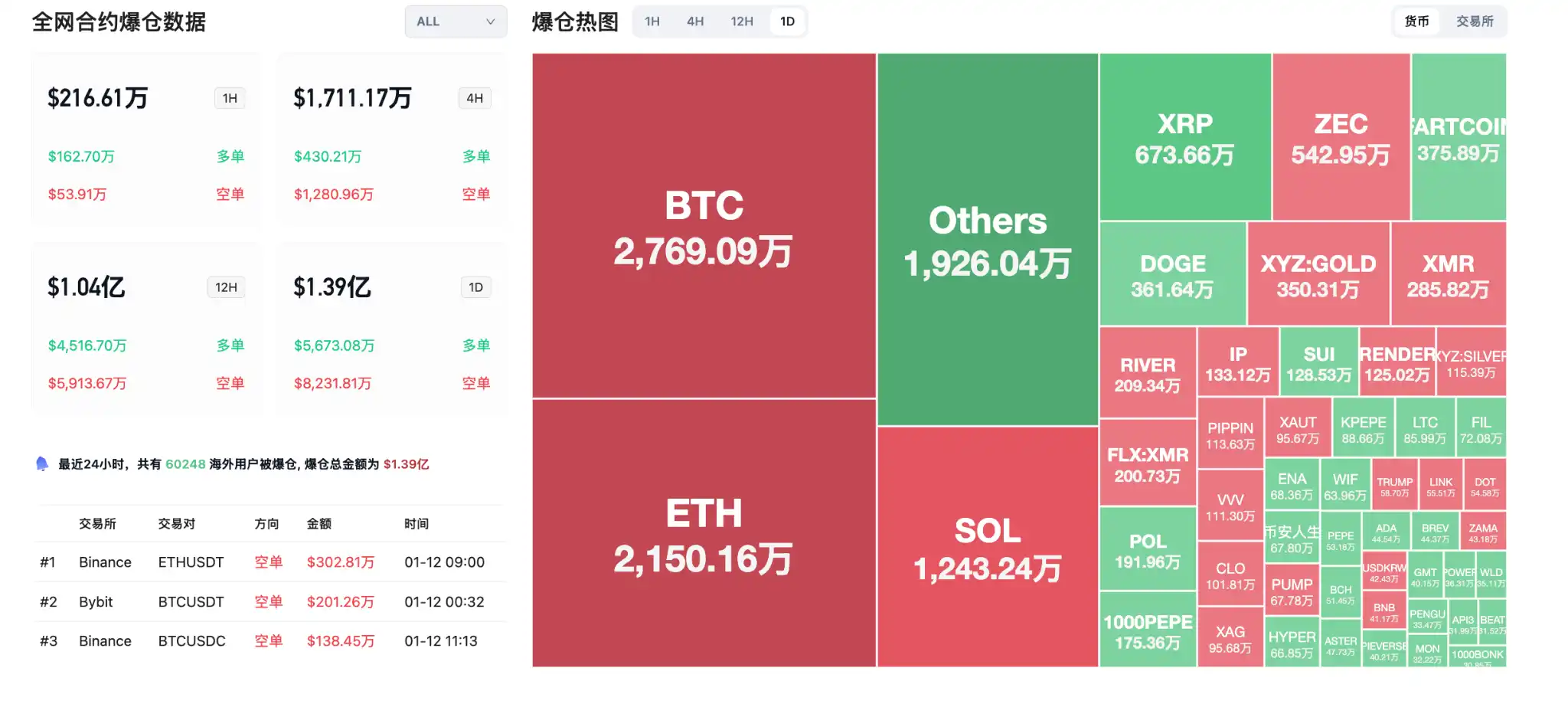
24h Liquidation Data: 60,248 people liquidated globally, total liquidation amount $139 million, including BTC $27.69 million, ETH $21.50 million, SOL $12.34 million
3. ETF Flows (As of January 9)
-
Bitcoin ETF: Net outflow of $681 million last week
-
Ethereum ETF: Net outflow of $68.57 million last week
-
XRP ETF: Net inflow of $38.07 million last week
-
SOL ETF: Net inflow of $41.08 million last week
4. Today's Outlook
-
Binance Alpha will list CharacterX (CAI) on January 12
-
Zama: Public auction for 10% of ZAMA tokens starts January 12, 2026
-
Semler Scientific Founder: Special shareholder meeting to approve proposed merger with Strive will be held on January 13
-
Binance supports FXS mainnet switch and rebranding to FRAX, related adjustments to trading will begin gradually from January 13
-
Binance Wallet launches exclusive Unitas (UP) Booster event and Token Generation Event (TGE)
-
Fogo announces 38.98% of tokens will unlock at network launch on January 13
-
Cheelee (CHEEL) will unlock approximately 20.81 million tokens on January 13 at 08:00 UTC, representing 2.78% of circulating supply, valued at ~$11.6 million;
-
JPMorgan Chase kicks off U.S. major bank quarterly earnings season (January 13)
-
Multiple Fed officials, including Williams, to speak intensively before the month-end FOMC meeting (January 13, 07:00 UTC)
-
US December CPI YoY: Expected 2.7%, Previous 2.7% (January 13, 21:30 UTC)
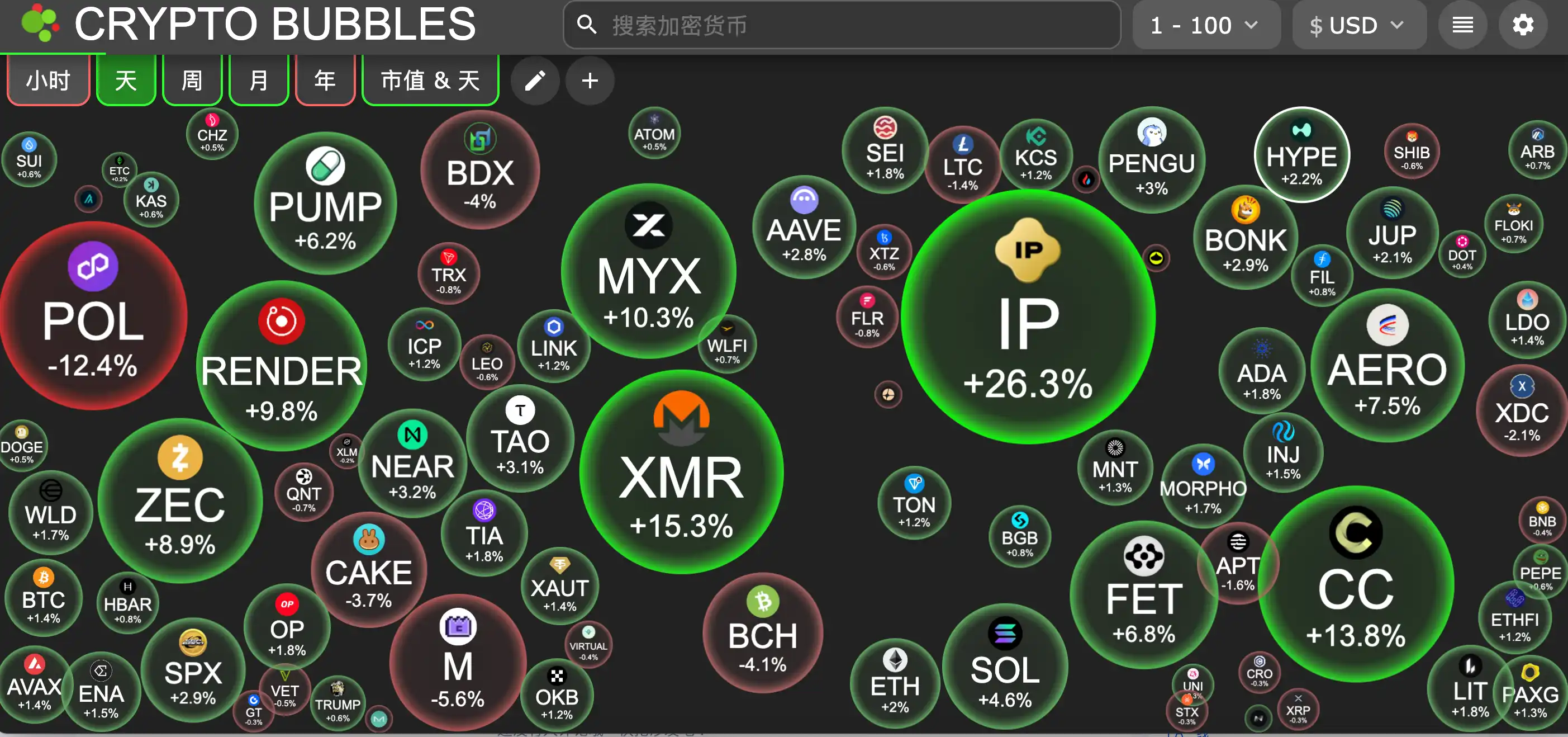
Today's top gainers among top 100 coins by market cap: Story +26.3%, Monero +15.3%, Canton Network +13.8%, MYX Finance +10.3%, Render +9.8%.
5. Hot News
-
Data: TRUMP, CONX, ARB, and other tokens face large unlocks, with TRUMP unlock valued at ~$271 million
-
Week Ahead | US Senate Banking Committee to review crypto market structure bill; TRUMP to unlock tokens worth over $270 million
-
"Strategy Counterparty" opens new long positions on FARTCOI and XPL, and fully closes kPEPE long positions
-
LISA flash crashed 76% in 24 hours, driven by selling from three Alpha users causing a rapid price drop
-
YouTube viewership for cryptocurrency-related content drops to lowest since January 2021
-
Jeff Huang's (MachiBigBrother) HYPE long positions fully closed, overall position profited ~$686,000 in nearly 1 day
-
South Korea lifts nine-year corporate crypto ban, allows listed companies to invest in cryptocurrencies
-
RTFKT's Clone X NFT series floor price surges ~340% in 7 days, market speculates LVMH and Pudgy Penguins as potential acquirers
-
Pump.fun launches creator fee sharing feature
-
Spot gold breaks above $4,600 for the first time
-
Michael Saylor: The best-performing assets over the past decade are NVDA, MSTR, and BTC
-
BNB Chain Foundation bought $币安人生 (Binance Life), $哈基米 (Hakimi), $我踏马来了 (I'm F*cking Coming), and $老子 (Laozi) within two days
-
Bitmine stakes another 86,400 ETH, cumulative staking reaches 1.052 million ETH







