
Trading Moment: Gold and Silver Hit New Highs Again, Bitcoin's Next Support Range is $84,000 to $86,000

marsbitPublicado em 2026-01-26Última atualização em 2026-01-26

Resumo

Global markets are gripped by heightened risk-off sentiment and speculative fervor, driven by geopolitical tensions, fiscal risks, and sectoral cycles. Spot gold surged past $5,000, hitting a record $5,106, with Bank of America forecasting a rise to $6,000 by spring 2026. Silver also reached an all-time high above $109, supported by AI and solar industry demand. In forex, the yen strengthened on potential "Plaza Accord 2.0" intervention fears, while Bitcoin faced a weekly decline of over 7%, testing support near $86,000. Technical analysts warn of further downside risks, with key support levels between $84,000 and $86,000. Ethereum fell more than 14%, breaching $2,800 and eroding market confidence. Meme coins on Solana, like PENGUIN, saw volatile pumps. ETF flows showed net outflows for Bitcoin and Ethereum, while SOL ETF saw modest inflows. Key events include the launch of VanEck’s Avalanche ETF and a joint SEC-CFTC crypto regulatory event.

Daily key market data review and trend analysis, produced by PANews.

1. Market Overview

The global macro market is in the midst of a severe storm triggered by geopolitical games, fiscal crises, and the resonance of industry cycles, with both safe-haven sentiment and speculative fervor coexisting. Following the U.S. ICE shooting incident that led to the breakdown of Congressional budget negotiations, Polymarket data shows the probability of a U.S. government shutdown before January 31 has surged to 79%. Coupled with the Trump administration's tariff threats and purchase intentions towards Canada and Greenland, and the deployment of the U.S. aircraft carrier "Lincoln" to the Middle East in response to the Iran situation, global "credit devaluation" trading has reached a climax. Spot gold historically broke through the $5,000 mark, rising over 2.3% intraday to a high of $5,106, with Bank of America aggressively predicting it will reach $6,000 by Spring 2026; Spot silver, driven by rigid demand from the AI and solar industries, also broke through $109 to hit a record high, with institutions bullish up to $120.

In the forex market, expectations for a "Plaza Accord 2.0" with U.S.-Japan joint FX intervention have heated up sharply. A rare "inquiry" action by the New York Fed triggered short covering in the yen, with USD/JPY falling over 1% to a low of 153. Meanwhile, the Korean market moved independently, with the KOSDAQ index surging 6%, mainly due to explosive growth in the semiconductor industry. Driven by AI demand, global memory chip supply is extremely tight. Samsung Electronics raised Q1 NAND flash prices by over 100% and plans further increases in Q2. The spot premium rate for DDR4 is as high as 172%. Consequently, Goldman Sachs maintains a "buy" rating on Samsung Electronics and SK Hynix, noting that server ODM revenue has seen 13 consecutive months of high growth, indicating the establishment of a super cycle in the memory industry. In U.S. stocks, earnings reports from tech giants like Microsoft and Apple are due this week, but market sentiment is divided. Bloomberg strategist Mike McGlone and trader Peter Brandt both recommend shorting U.S. stocks and the dollar, believing U.S. assets have peaked. While Goldman Sachs strategists are optimistic about Asia, they also warn that global stocks have gone too long without a correction, and geopolitical risks could be a trigger for a pullback.

Bitcoin ended last week with a bearish candle, down over 7% weekly, finding support near $86,000. Matrixport pointed out that BTC has lost the key bull-bear dividing line of the 21-week moving average, with no reversal signal appearing in the market; Technical views are generally pessimistic. Peter Brandt confirmed the formation of a bearish channel and issued a sell signal. EliZ believes that if it breaks below $86,000/$85,800, the price will seek liquidity near $84,500 to $85,000. Daan Crypto Trades pointed out that $84,000 to $85,000 will be an important upcoming support level; Tai Bai analyzed that the weekly chart shows a bearish engulfing pattern, and if the trendline is broken, it could fall to $70,000 or even the $60,000s. Roman continues to be bearish towards $76,000. Rekt Capital warned that breaking below the macro triangle bottom at $82,000 would accelerate the decline. Murphy also emphasized that losing the $87,000-$88,000 range would damage long-term holder confidence, with key support below at $82,000. Despite this, bulls are not without hope. A Coinbase survey showed 71% of institutional investors believe BTC is undervalued between $85,000-$95,000. Astronomer insists on a weekly bullish view and has already entered a long position at $86,000. Sykodelic pointed out a CME gap at $89,500 and that liquidity in the $86,000 region has been absorbed. Castillo Trading believes the return of spot buying on Binance is the only signal for a market rebound. Placeholder partner Chris Burniske has formulated a ladder buying plan, focusing on buying opportunities at $80,000, $74,000, and $58,000, stating that he will continue to add positions if there is a major drop.

Ethereum's weekly loss was double that of Bitcoin, falling over 14%, once breaking below $2,800, a retreat of over 40% from its all-time high, severely testing market confidence. Man of Bitcoin issued a warning, noting that ETH has broken below the key level of $2,867, and a further break below $2,773 would宣告 the complete failure of the bullish pattern; BigBullMike believes it can only stabilize by climbing back above $2,900. On-chain data加剧了 the panic. Whale Alert monitored a dormant whale address from 9 years ago suddenly awakening and transferring 50,000 ETH (approx. $145 million) to Gemini exchange. This address still holds 85,000 ETH, and the potential selling pressure weighs on the market. However, Ted pointed out that ETH and the Russell 2000 index have shown a huge divergence not seen in years,暗示 a potential catch-up rally in 2026,保留 a glimmer of hope for long-term investors.

In the altcoin market, Meme coins on Solana finally saw some improvement. Over the weekend, the White House released an AI-generated image of Trump walking towards Greenland with a penguin, captioned "Embrace the penguin." This led to Binance Alpha, after a long absence, listing the Solana Meme coin PENGUIN. The token's market cap surged over 30 times at one point, skyrocketing to a high of $173 million, and has since回落 to around $85 million. Additionally, the automated tool Clawdbot gained attention for its utility. Despite token issuance controversies, its token $clawd recorded a maximum gain of 720x, with its market cap reaching a high of $17 million (currently回落 to around $9 million), and caused a shortage of Mac Minis.

2. Key Data (As of January 26, 13:00 HKT)

(Data sources: CoinAnk, Upbit, SoSoValue, CoinMarketCap, GMGN)

  • Bitcoin: $87,596 (Year-to-date +0.2%), Daily spot trading volume $50.36 billion

  • Ethereum: $2,895 (Year-to-date -2.26%), Daily spot trading volume $30.47 billion

  • Fear & Greed Index: 20 (Extreme Fear)

  • Average GAS: BTC: 1.75 sat/vB, ETH: 0.02 Gwei

  • Market Dominance: BTC 59.2%, ETH 11.8%

  • Upbit 24-hour trading volume leaders: ENSO, NOM, AUCTION, XRP, ZKC

  • 24-hour BTC Long/Short Ratio: 47.72% / 52.28%

  • Sector Performance: Crypto market generally down, GameFi sector led declines, down nearly 5%

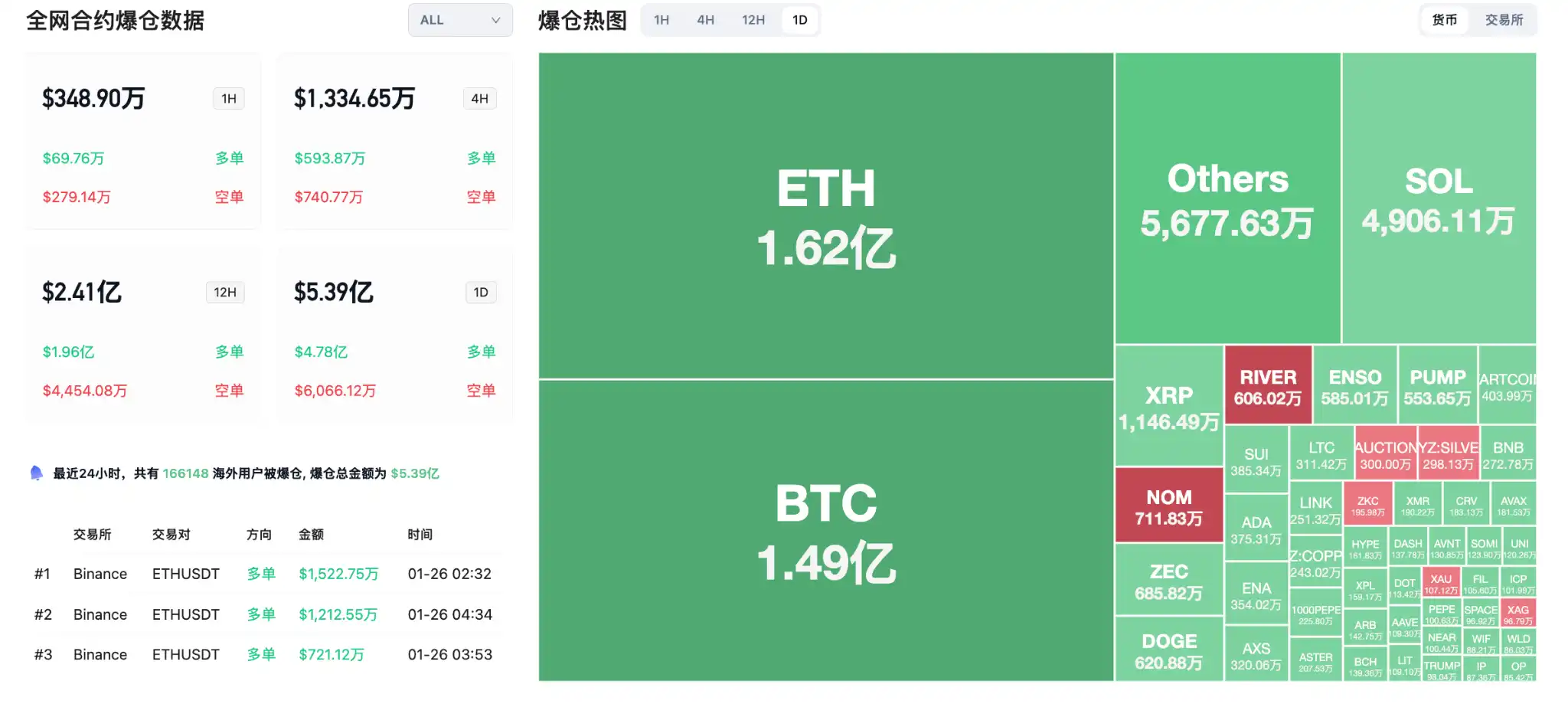
24-hour liquidation data: 166,148 people liquidated globally, total liquidation amount $539 million, including BTC liquidations $162 million, ETH liquidations $149 million, XRP liquidations $11.46 million
3. ETF Flows (As of January 23)

  • Bitcoin ETF: Net outflow this week $1.328 billion

  • Ethereum ETF: Net outflow this week $611 million

  • XRP ETF: Net outflow this week $40.64 million

  • SOL ETF: Net inflow this week $9.5736 million

4. Today's Preview

  • VanEck Avalanche spot ETF will begin trading on Nasdaq on January 26

  • Base network Perp DEX protocol RollX: First batch claim deadline until January 26

  • Fabric plans to launch ROBO token, public sale on Kaito starts January 26

  • Huma Season 2 Airdrop Part 2 opens, claim deadline until January 26

  • SEC and CFTC will host a "Regulatory Coordination" joint crypto-themed event on January 27 at 23:00

  • OKX OKX will delist ULTI, GEAR, VRA and other spot trading pairs

  • Impossible discloses Flying Tulip presale details, public round starts January 27

  • U.S. Treasury Secretary Besant: New Fed Chair appointment to be announced as early as the week of January 26 (Weekly event)

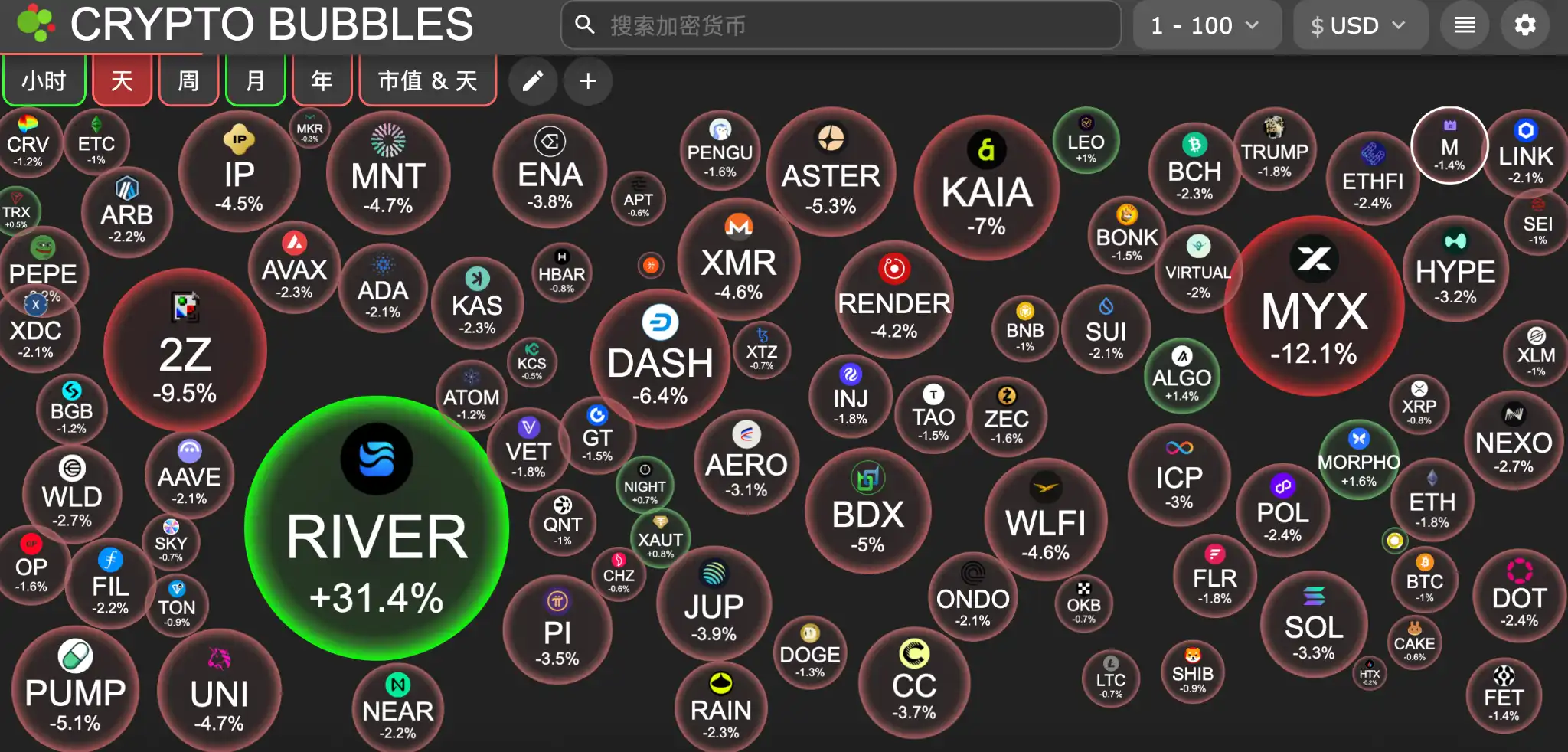
Today's top 100 coins by market cap, biggest gainers: River up 31.4%, Morpho up 1.6%, Algorand up 1.4%, LEO Token up 1%, Tether Gold up 0.8%.
5. Hot News

  • Data: SIGN, JUP and other tokens are about to see large unlocks, with SIGN unlock value approx. $12.2 million

  • Week Preview | SEC and CFTC host "Regulatory Coordination" crypto-themed joint event; Moonbirds to launch BIRB token on Solana blockchain

  • A wallet received 465,000 HYPE from Galaxy Digital OTC, worth $10.32 million

  • Optimism releases Superchain anti-quantum roadmap: ECDSA EOAs to be phased out within 10 years

  • A dormant 9-year ETH whale transferred 50,000 ETH to Gemini, worth approx. $145 million

  • Spot silver breaks through $107 for the first time, up over $35 month-to-date

  • WLFI transferred rewards from the USD1 holding activity treasury to Binance, totaling WLFI tokens worth $40 million

  • Japan may lift ban on crypto ETFs in 2028, SBI and Nomura are advancing related product development

  • Spot gold historically breaks through the $5,000 mark

  • Space public sale refund details: Total $12.3 million, top 5% participants only refunded 11% to 21%

  • Tether Gold market cap breaks $2.5 billion, hitting a new all-time high

  • World Gold Council survey: 95% of central banks will continue buying gold in the future, USD's share of global forex reserves falls below 60%


Perguntas relacionadas

QAccording to the article, what is the next key support range for Bitcoin?

AThe next key support range for Bitcoin is between $84,000 and $86,000.

QWhat major milestone did spot gold achieve, and what is the bullish price target from one institution?

ASpot gold historically broke through the $5,000 mark, and the Bank of America has a bullish price target of $6,000 for it by the spring of 2026.

QWhat was the primary reason cited for the surge in the price of silver?

AThe surge in silver's price was primarily driven by rigid demand from the AI and solar energy industries.

QWhat significant on-chain event for Ethereum is mentioned that is causing market pressure?

AA whale address that had been dormant for 9 years woke up and transferred 50,000 ETH (worth approximately $145 million) to the Gemini exchange, creating potential selling pressure.

QWhich meme coin on Solana saw a significant price increase after being mentioned in a White House post, and on which exchange was it listed?

AThe meme coin PENGUIN on Solana saw a significant price increase after the White House post, and it was listed on Binance Alpha.

Leituras Relacionadas

After Three Consecutive Quarters of Decline, Can the Crypto Market Find a Window for Stabilization in Q3?

The cryptocurrency market has just concluded its worst-performing quarter since 2022, with total capitalization dropping 12.6% to $2.1 trillion. All core metrics indicate capital is leaving the sector, not just rotating within it. Bitcoin fell 14.2% and Ethereum dropped 25.4% in Q2, breaking their previous correlation with US tech stocks. A key driver is the reversal in US spot Bitcoin ETF flows, which saw a net outflow of approximately $4.67 billion in Q2, including a record monthly outflow near $4.5 billion in June. While recent data suggests long-term holders are accumulating again, sustained ETF outflows mean continued selling pressure. Market focus is now singularly on the Federal Reserve. The upcoming July FOMC meeting is seen as the most critical event for Q3. A dovish signal could support Bitcoin reclaiming a $68,000-$84,000 range, while a hawkish stance might establish a new trading band around $50,000-$56,000. Additionally, regulatory uncertainty persists, with the progress of the crucial *CLARITY Act* stalling in the Senate, reducing its perceived 2026 passage probability to 40-45%. Despite the broad downturn, a few sectors showed growth. Prediction markets saw nominal volume surge 48.7% year-over-year to $113.8 billion, and tokenized collectibles transaction volume rose 143% quarterly to $1.4 billion. The Real-World Asset (RWA) tokenization sector also continued steady growth, now representing ~$28.1 billion in on-chain value. The market's foundation for an extreme crash appears limited, with Bitcoin price hovering near its 200-week moving average. However, the trading paradigm has shifted from narrative-driven speculation to decisions based on price action, policy developments, and interest rate expectations, making a broad sentiment-driven rally unlikely in the near term.

marsbitHá 10h

After Three Consecutive Quarters of Decline, Can the Crypto Market Find a Window for Stabilization in Q3?

marsbitHá 10h

BIT Trading Moment: BTC Still Suppressed by Weekly 200 EMA, Rejection May Restart Decline; Storage and Semiconductors that Surged Last Night Begin Falling in Evening Trading

**Crypto & Stock Market Wrap: Bitcoin Tests Resistance, Stocks Retreat After AI Surge** Bitcoin consolidates around $66,000, facing key resistance near $68,000—an area seen as a major psychological and technical hurdle where previous rallies have failed. Analysts note the cryptocurrency is caught between its 200-week moving average (~$63,333) and 200-week EMA (~$68,328). A clear break above $68k is needed to signal a stronger bullish trend, while a rejection could lead to a retest of $63k support. Market sentiment remains cautious, with low futures open interest pointing to a low-liquidity rebound rather than a full bull market. Bitcoin spot ETFs saw another $203 million inflow. US stock futures pointed lower after a strong Tuesday session led by a massive rebound in semiconductors and memory stocks. The rally was fueled by renewed optimism about AI-driven hardware demand, with Micron, SanDisk, and SK Hynix surging. However, those gains reversed in pre-market trading. Super Micro Computer (SMCI) soared over 20% after hours on strong guidance and a record backlog. Other standouts included Rocket Lab and nuclear energy plays Oklo and X-Energy. Rising oil prices (Brent above $91) and climbing Treasury yields (10-year near 4.64%), however, are reigniting inflation concerns and acting as a headwind for equities. In Asia, markets were mixed. South Korea's KOSPI pared early gains to close slightly higher as semiconductor stocks like SK Hynix gave back initial surges. Japan's Nikkei edged lower as the yen hit a fresh 38-year low against the dollar, raising fears of potential market intervention. Key events to watch include the Samsung Galaxy launch, AMD's AI event, and a slew of major tech earnings from Alphabet, Tesla, and IBM after the close on Wednesday, followed by the ECB meeting and Intel's earnings on Thursday.

marsbitHá 10h

BIT Trading Moment: BTC Still Suppressed by Weekly 200 EMA, Rejection May Restart Decline; Storage and Semiconductors that Surged Last Night Begin Falling in Evening Trading

marsbitHá 10h

Former CFTC Chairman, Circle President Tarbert: Preaching Long-Termism While Cashing Out $30 Million Himself

Former CFTC Chairman and Circle President Heath Tarbert has consistently advocated for a long-term vision in public, urging patience from investors as Circle’s stock price has fallen significantly from its peak. However, it has been revealed that since Circle’s IPO, Tarbert has continuously sold his CRCL shares through pre-arranged trading plans, cashing out approximately $30 million, without making any public market purchases. This contrast between his public messaging and personal actions has drawn criticism. Tarbert joined Circle in July 2023 as Chief Legal Officer, leveraging his regulatory experience to help guide the company through its IPO and expansion. Despite promoting stablecoins as long-term infrastructure, he established a 10b5-1 trading plan just before Circle went public, leading to substantial stock sales over the following year. In March 2026, he initiated another plan to sell more shares. His career trajectory highlights a pattern of moving between high-level regulatory roles and influential positions in the financial sector. After resigning as CFTC Chairman in early 2021, he joined Citadel Securities as Chief Legal Officer just 27 days later, during a period of intense regulatory scrutiny for the firm. He later joined Circle, aiding its efforts to navigate regulatory challenges for its public listing. While Tarbert's expertise in policy and compliance is valuable to companies like Circle, his actions—advocating long-term confidence while personally divesting—raise questions about the alignment between his public statements and his private financial decisions, leaving investors who followed his advice to bear the market risks.

marsbitHá 10h

Former CFTC Chairman, Circle President Tarbert: Preaching Long-Termism While Cashing Out $30 Million Himself

marsbitHá 10h

Gate Research Institute: The 'Wall Street-ization' Wave of Crypto Financial Products – Competition or Integration?

The article titled "Gate Research Institute: Are Crypto Financial Products Sparking a 'Wall Street' Wave—Competition or Convergence?" explores the evolving relationship between the crypto ecosystem and traditional finance (TradFi). The piece begins by reflecting on Bitcoin's original 2009 vision of decentralization, disintermediation, and moving away from banks. It then contrasts this with the 2024 landscape, where key crypto assets like Bitcoin are increasingly held through Wall Street products like ETFs issued by giants like BlackRock. The article questions whether this signifies that TradFi is systematically taking over the rights to issue, price, custody, and distribute crypto financial assets. The core argument is that this is not a zero-sum takeover but rather a bidirectional convergence where each side addresses the other's weaknesses. Crypto offers 24/7 global markets, programmable settlement, and open access but lacks compliant channels, institutional-grade custody, deep fiat liquidity, and mainstream distribution. TradFi possesses these but is constrained by legacy systems, limited operating hours, and slow settlement. Two primary convergence paths are highlighted: * **Path A (CEX to TradFi):** Exemplified by Gate, which has progressed from offering tokenized stocks and CFDs to providing direct, real stock trading (US, Hong Kong, South Korea) within its platform, using USDT. * **Path B (TradFi to Crypto):** Exemplified by Robinhood, which has integrated crypto trading, acquired exchanges like Bitstamp, and is moving traditional assets like stocks onto the blockchain via tokenization and its own Layer 2. Both paths are ultimately competing to become the next-generation, unified financial account—a "super account" where users can seamlessly trade cryptocurrencies, stocks, ETFs, RWA (Real World Assets), and tokenized treasury products in one interface. The growth of RWA and tokenized treasuries (e.g., BlackRock's BUIDL) is presented as the asset-layer fusion, providing stable, yield-bearing assets on-chain and acting as a bridge between the two worlds. In conclusion, the "Wall Street-ization" of crypto is framed as a mutual transformation. Decentralized ideals persist in the protocol layer, while at the application layer, a more efficient, global, and accessible unified capital market is emerging from this convergence. The future competition lies not between crypto exchanges and stockbrokers, but between platforms vying to offer the most comprehensive asset coverage, liquidity, and user experience within a single account.

marsbitHá 10h

Gate Research Institute: The 'Wall Street-ization' Wave of Crypto Financial Products – Competition or Integration?

marsbitHá 10h

Trading

Spot
活动图片




