Trade War 2.0: Trump Demands Fed Lower Rate, Threatens Embargo

cryptonews.ruPublished on 2026-09-06Last updated on 2026-09-06

Abstract

Trump Demands Fed Lower Interest Rate, Threatens Trade Embargo On September 4, 2026, former President Trump demanded the Federal Reserve lower interest rates, threatening to halt trade with countries where the U.S. has a trade deficit. He argued this approach is "better than tariffs," citing a February 2026 Supreme Court ruling he claims supports his authority under the International Emergency Economic Powers Act (IEEPA). A national emergency concerning trade deficits, declared in April 2025, provides the legal basis. Speaking from the Oval Office, Trump singled out Canada, Mexico, and the EU, stating he could impose an embargo "with one stroke of a pen." This demand comes as the U.S. trade deficit hit an 16-month high of $88.6 billion in July 2026, with major contributors being Mexico ($27.5B), Vietnam ($23.3B), Taiwan (~$18-20.7B), China ($15.2B), Germany (~$5.6-6.3B), and Ireland (~$3.9B). The article's AI analysis draws a historical parallel to President Nixon pressuring Fed Chair Arthur Burns in 1971, which preceded high inflation and a severe recession, questioning if current pressure on the Fed risks repeating that cycle.

Trump demanded that the Federal Reserve lower the interest rate, threatening to halt trade with countries with which Washington has a trade deficit. He published a corresponding post on his Truth Social network on September 4, 2026.

In the message, Trump stated he was prepared to stop trade with debtor nations if the rate was not lowered, calling such a move "better than tariffs." He also referenced a U.S. Supreme Court decision on a tariff case, which, according to him, affirmed the President's authority for such measures. Separately, Trump indicated that the U.S. should have the world's lowest interest rate, citing strong employment data as an argument — the economy added 162,000 jobs in August.

The same day, speaking in the Oval Office of the White House, the President reiterated his position: the U.S. is not obligated to trade with countries where deficits have accumulated for years, and halting such trade, in his opinion, would automatically eliminate the imbalance. Trump mentioned Canada, Mexico, and the European Union, noting he could impose an embargo "with the stroke of a pen."

Trade Deficit Hits 16-Month High

According to data from the U.S. Bureau of Economic Analysis and the Census Bureau, the overall U.S. trade deficit in goods and services reached $88.6 billion in July 2026 — the highest level in 16 months. Several countries were the main contributors to the imbalance.

  • Mexico — $27.5 billion
  • Vietnam — $23.3 billion
  • Taiwan — approximately $18–20.7 billion
  • China — $15.2 billion
  • Germany — approximately $5.6–6.3 billion
  • Ireland — approximately $3.9 billion

The full statistics by trading partner are published separately by the agencies.

What Authorities Trump Cites

The President's statements rely on a U.S. Supreme Court decision dated February 20, 2026, regarding the case Learning Resources, Inc. v. Trump and related lawsuits. The Court ruled 6-3 that the International Emergency Economic Powers Act (IEEPA) does not grant the President the authority to impose tariffs. However, the text of IEEPA (50 U.S.C. § 1702) directly empowers the head of state to prevent or prohibit imports and exports, as well as regulate related transactions under declared national emergencies — it is this provision, not tariff authority, that Trump now relies on.

A national emergency concerning trade deficits was declared in April 2025 and extended in March 2026. Presidents have previously used IEEPA to impose embargoes — for example, against Iran, North Korea, and specific goods from Russia. In addition to IEEPA, the head of state has other instruments for restricting trade — sections 232, 301, and 122 of the relevant legislation. Formally, the Constitution grants Congress the authority to regulate foreign trade, but it has delegated broad powers to the President in case of emergency circumstances.

AI Opinion

From the perspective of machine data analysis, the demand to lower the interest rate under threat of trade restrictions finds a direct historical parallel. The end of 1971 provides a similar example: President Richard Nixon systematically pressured Fed Chairman Arthur Burns to achieve a policy easing before the 1972 election. The outcome of that episode was inflation, which, according to a study in the Journal of Economic Perspectives, reached 9.6% in 1973 and required the painful recession of 1980–82 to tame. The macroeconomic link here is obvious: the attempt to secure cheap money for short-term economic growth often translates into a long-term inflationary bill. The question arises whether the current confrontation with the Fed will repeat the same scenario a decade later.

Related Questions

QWhat is Trump's main demand from the Federal Reserve in the article, and what is his threat?

ATrump's main demand is for the Federal Reserve to lower the interest rate. His threat is to stop trading with countries with which the U.S. has a trade deficit.

QWhat key legislation and Supreme Court decision does Trump reference to justify his potential actions on trade?

ATrump references the International Emergency Economic Powers Act (IEEPA). He relies on a Supreme Court decision from February 20, 2026 (Learning Resources, Inc. v. Trump), which, while ruling that IEEPA does not grant tariff authority, affirmed the president's power under IEEPA to prevent or prohibit imports and exports during a declared national emergency.

QAccording to the article's data, which country contributed the largest amount to the US trade deficit in July 2026?

AAccording to the article, Mexico contributed the largest amount to the US trade deficit in July 2026, at $27.5 billion.

QWhat historical parallel does the 'AI Opinion' section draw regarding Trump's pressure on the Fed?

AThe 'AI Opinion' section draws a parallel to late 1971, when President Richard Nixon systematically pressured Federal Reserve Chairman Arthur Burns to ease monetary policy ahead of the 1972 election. This led to high inflation (9.6% in 1973) and later required a painful recession in 1980-82 to control it.

QWhat specific countries did Trump mention as potential targets for a trade embargo during his Oval Office remarks?

ADuring his Oval Office remarks, Trump mentioned Canada, Mexico, and the European Union as potential targets for a trade embargo, stating he could impose it 'with the stroke of a pen'.

Related Reads

Price Hasn't Moved Yet, But Market Makers Are Already Frantically Pulling Orders: How a New Metric Can Warn of Imminent Violent Market Swings

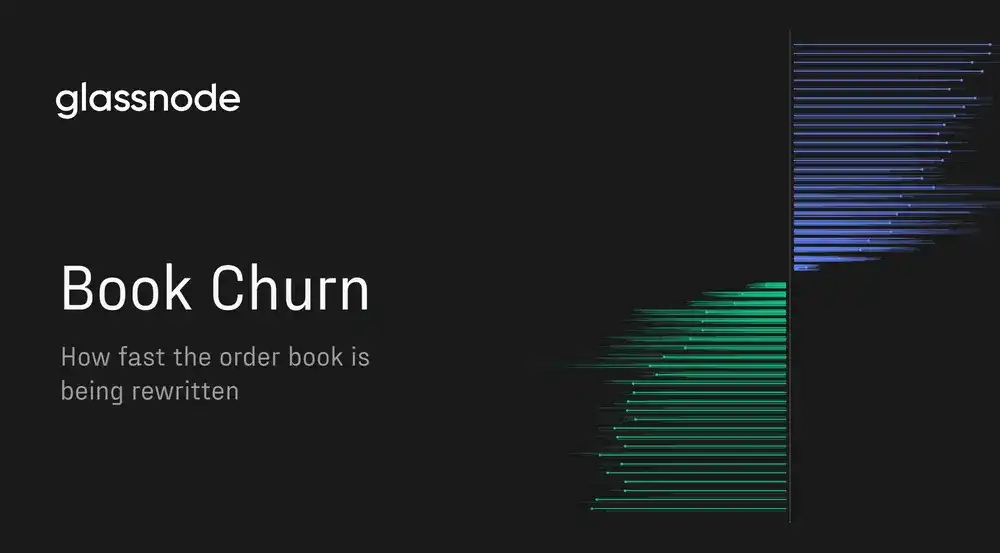
In traditional crypto derivatives and spot analysis, traders often rely on static order book depth and bid-ask spreads to gauge liquidity. However, high-frequency quote cancellations and re-quoting by market makers mean static snapshots frequently mask genuine liquidity crises and sharp price swings. To address this blind spot, Glassnode has introduced a new high-frequency metric called "Book Churn," which quantifies how often order book price levels are updated and rewritten within a given time window. Two order books with identical static depth and spreads can differ several-fold—or even tenfold—in rewrite frequency, and snapshots cannot distinguish between them. The metric captures microsecond-level market maker behavior: when market makers feel confident, quotes tend to rest quietly; when they sense risk, they cancel and re-quote at extraordinary speed. Raw counts are massive—a typical 10-minute BTC perpetual window contains roughly 607,000 level changes, surging into the millions during extreme volatility. To ensure comparability across market cycles, raw counts are log-transformed and standardized into a Z-Score using each asset's trailing 60-day mean and standard deviation. A Z-Score above 2 means the current rewrite frequency exceeds over 95% of recent history; above 3 signals extreme liquidity restructuring. Backtesting since 2020 on BTCUSDT and ETHUSDT perpetuals shows a pronounced right-tail distribution rather than a symmetric normal one. High-churn episodes typically consist of 2–5 consecutive elevated slices, with BTC and ETH peaks highly synchronized during macro shocks, reflecting coordinated risk contraction across market makers' cross-asset arbitrage systems. Most importantly, when Book Churn scores reach 2 or above, the predictive win rate for realized volatility exceeding the historical baseline in the next hour holds steady at 65%–72%—significantly beating the 50% random baseline at a 95% confidence interval. This confirms that market makers' high-frequency rewriting behavior is not merely a backward-looking record but a valuable forward-looking warning signal within market microstructure.

marsbit5m ago

Price Hasn't Moved Yet, But Market Makers Are Already Frantically Pulling Orders: How a New Metric Can Warn of Imminent Violent Market Swings

marsbit5m ago

Aave No Longer Waits for Users to Come to It: V4 Deposits Surge 5.8x, Can the White-Label Model Support Token Buybacks?

Alea Research examines how Aave is expanding through a white-label strategy rather than waiting for users to come to its own frontend. Under Aave V4, partners like EtherFi run dedicated instances on Aave's underlying contracts—EtherFi pays 20% of net interest revenue to the Aave DAO—embedding Aave's lending depth into ecosystems such as Kraken's Ink and EtherFi's Cash card. In Q3, V4 total deposits surged 5.8x to $1.34 billion, while borrows jumped from $76 million to $403 million; even excluding EtherFi, base deposits grew 4.5x. Aave's share among the top four lending networks rose to 64.9%. Notably, Aave Core's USDC pool attracted $326 million in net deposits in Q3 with no token subsidies, plus another $145 million within two weeks after the Fed rate cut. Aave's native stablecoin GHO generates roughly 5x the spread revenue per dollar for the DAO compared with USDC lending, since all GHO interest accrues to the treasury. Since August, the DAO's monthly revenue has consistently exceeded operating costs; Q3 revenue of $17.8 million topped $15.4 million in costs, covering 77% of staking rewards. Of $100.5 million in Q3 fees, depositors and liquidators took $86.4 million while the DAO retained $14.1 million. AAVE rose 87.4% in Q3, beating ETH's 71%. Restarting buybacks requires clearing roughly 8,000 ETH (~$17 million) in legacy debt, well covered by over $100 million in treasury assets. AAVE's valuation multiple remains modest versus peers, with upside if V4 white-label instances keep driving lending demand.

marsbit25m ago

Aave No Longer Waits for Users to Come to It: V4 Deposits Surge 5.8x, Can the White-Label Model Support Token Buybacks?

marsbit25m ago

Trump administration unveils new center to choke off scam payments

The Trump administration has unveiled a new Threat Disruption Center aimed at stopping money flows to foreign criminal networks behind scams, cybercrime, and sextortion schemes. Announced Wednesday by the Homeland Security Task Force's National Coordination Center, co-led by the departments of Homeland Security and Justice, the unit seeks to help more than 30 federal agencies and over 440 state and local partners track scams and work with banks and crypto platforms to halt payments to scam networks. The center was created under a March 2026 executive order directing federal agencies to work with private companies to combat online fraud and other cybercrime targeting Americans. Heith Janke, operations director of the FBI's Criminal Branch, noted that every hour between a victim's report and a response gives criminals more time to launder stolen funds and identify their next target. Blockchain intelligence firm TRM Labs was selected as the center's main private-sector partner and will provide and maintain Ardence, the investigative platform used to map scam networks and identify victims, along with engineering and investigative support. TRM Labs co-founder and CEO Esteban Castano said scammers rarely stop after one payment, draining victims' savings or retirement over months and years, and that stepping in sooner changes everything—a warning before the next payment, a scam website removed before it victimizes another family, or stolen funds frozen while they can still be recovered. The FBI received about 453,000 reports of online fraud in 2025, with reported losses exceeding $17.7 billion. In September, the Justice Department estimated that overseas scam centers cost Americans about $10 billion a year through schemes including crypto and online investment fraud.

cointelegraph1h ago

Trump administration unveils new center to choke off scam payments

cointelegraph1h ago

Fed Minutes Sound Hawkish Alarm: Nearly All See More Rate Hikes Needed, More Backed Action as Soon as October

The minutes of the Fed's October 27-28 meeting showed a markedly hawkish tone: almost all participants judged that further rate hikes would likely be appropriate to bring inflation back to the 2% target in a timely manner, consistent with the September SEP. Although the committee held rates steady by a 10-2 vote, a few officials who supported holding described it as a "close call," and some participants favored a 25bp hike at that meeting, warning that delay could entrench high inflation or force larger, more disruptive tightening later. A couple of participants said a hike exceeding 25bp might be warranted if inflation data disappoints, and a few saw a need for a more restrictive stance if inflation proves stubborn. Separately, the minutes highlighted AI as a growing inflation risk: many participants noted AI-buildout demand straining supply and pushing up tech goods prices, with pricing pressures spreading beyond data-center-related industries. On financial stability, almost all participants discussed risks from disappointing AI investment returns; many explored consequences of an AI-related asset repricing; most noted rapid growth in AI-related debt, much of it through complex, opaque financing structures; and a few flagged increasing concentration of AI exposure among a small number of firms. The staff also warned that off-balance-sheet lease commitments and circular financing arrangements among AI-related firms could amplify losses if returns fall short.

marsbit1h ago

Fed Minutes Sound Hawkish Alarm: Nearly All See More Rate Hikes Needed, More Backed Action as Soon as October

marsbit1h ago

Trading

Spot
活动图片