Top House Democrat Questions Kansas City Fed’s Approval Of Kraken Master Account

bitcoinistPublicado em 2026-03-28Última atualização em 2026-03-28

Resumo

Representative Maxine Waters, the top Democrat on the House Financial Services Committee, has questioned the Federal Reserve Bank of Kansas City's approval of a "limited purpose account" for crypto exchange Kraken. This approval grants Kraken's banking arm direct access to the Fed's payment system, a first for a cryptocurrency firm. Waters expressed concerns about the lack of transparency, potential risks to financial stability, and the adequacy of consumer protections, especially as this access was granted while Congress is still debating the terms for such expansions. She has requested detailed information on the services accessible to Kraken, the conditions applied, and the risk assessments conducted. The move has also drawn opposition from traditional banking groups, who warn it could threaten the U.S. payment system.

House of Representatives Ranking Member Maxine Waters has pressed the Federal Reserve Bank of Kansas City over its approval of a “limited purpose account” for Kraken, expressing concerns about the implications of granting a crypto firm access to the Federal Reserve’s (Fed) payment system.

Rep. Waters Seeks Clarity On Kraken’s Master Account Approval

On Thursday, Representative Maxine Waters, the top Democrat on the House Financial Services Committee, sent a letter to Jeff Schmid, President and CEO of the Federal Reserve Bank of Kansas City, questioning the Kansas City Fed’s recent decision to approve a “limited purpose account” to the US’s second-largest crypto exchange, Kraken.

In the letter, Waters seeks clarification from the Kansas City Fed regarding the practical implications of this approval “at a time when Congress has debated whether or not to expand access to the Fed’s payment rails and on what terms.”
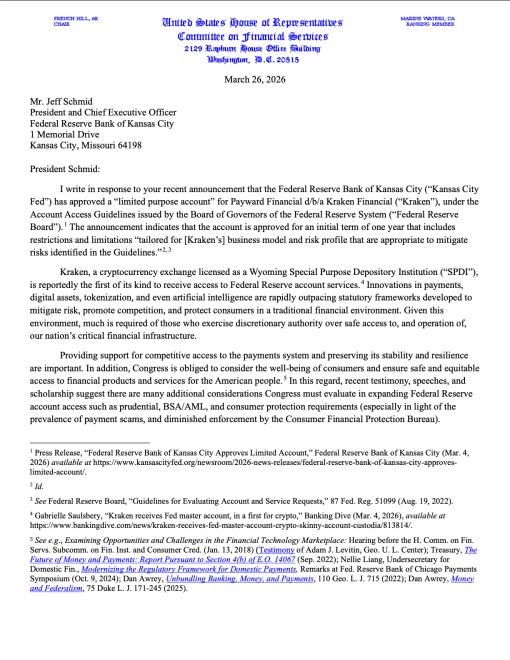
Rep. Waters' letter to Kansas City Fed's President Jeff Schmid. Source: House Financial Services Committee

Notably, Kraken Financial, Kraken’s banking arm, made history as the first crypto company to gain direct access to the Federal Reserve’s core payment system. This achievement was accomplished after Kraken secured approval from the Kansas City Fed for a Fed master account earlier this month.

As reported by Bitcoinist, the master account’s approval will enable Kraken Financial to expedite and streamline transactions for its large clients and professional traders. Additionally, it will grant Kraken’s banking unit direct access to Fedwire, a prominent interbank payment system that processes over $4 trillion in transfers daily.

The milestone represents a significant triumph for the crypto industry, which had been repeatedly denied access to the Federal Reserve system for years. Previously, the company had relied on intermediary banks to facilitate transfers to other firms.

The lawmaker highlighted that granting a cryptocurrency firm access to the Federal Reserve’s payment system for the first time raises policy, regulatory, and consumer protection concerns, arguing that it is particularly concerning given the rapid pace at which financial innovation is outpacing the rules and safeguards designed to ensure the safety of the financial system.

The Kansas City Fed’s announcement does not disclose specific information about Kraken’s access to the range of Federal Reserve financial services “due to the confidentiality of business information provided by applicants.” However, the announcement raises questions about the approval because neither statute nor the Federal Reserve Board’s Account Access Guidelines refer to a ‘limited purpose account’ type.

Crypto Access To Fed’s Payment Rails Faces Opposition

Representative Waters emphasized that access to the nation’s core payments infrastructure carries significant public responsibility and should not be extended without full transparency, clear legal grounding, and confidence that risks will be properly managed.

Therefore, she requested information no later than April 10, 2026, on the Federal Reserve services that Kraken can now access, the conditions or restrictions that apply, and the prudential, anti-money laundering (AML), and consumer protection considerations that were weighed before proceeding with the approval.

The lawmaker’s letter arrives as banking groups express significant concerns about granting crypto and fintech companies direct access to the Federal Reserve’s payment systems. Traditional banks have cautioned that even limited access could pose a substantial threat to the US payment system and overall financial stability.

For context, Kraken’s limited access to the master account is similar to the “skinny” master account concept initially proposed by the Federal Reserve Board of Governors in October 2025.

This type of restricted account would enable payment fintechs and crypto companies to access the Federal Reserve’s payment systems. However, it would exclude other advantages more closely associated with banks, such as the discount window lending facility.

In addition, the Office of the Comptroller of the Currency (OCC) approved conditional bank charters for Ripple, Circle, BitGo, Paxos, and Fidelity in December, raising concerns that it could blur the lines between banking activities and lead to regulatory arbitrage.

Last month, the American Bankers Association (ABA) urged the main banking regulator to postpone its approval of applications for crypto bank charters, suggesting that the agency should wait until the regulatory uncertainties are resolved.
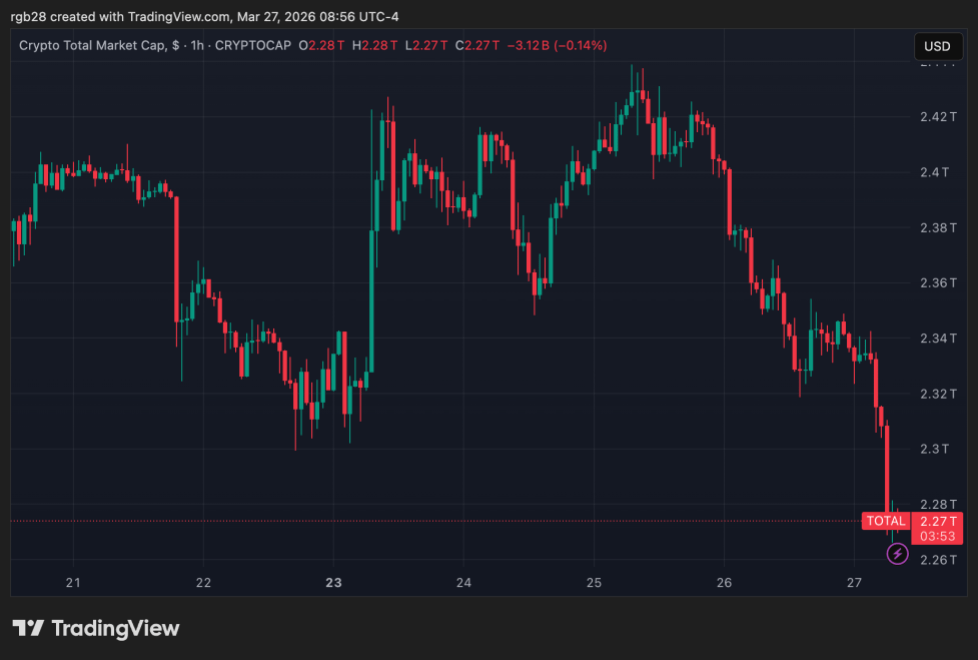
Total crypto market capitalization is at $2.27 trillion in the one-week chart. Source: TOTAL on TradingView


Criptomoedas em alta

Perguntas relacionadas

QWhat is the main concern raised by Representative Maxine Waters regarding the Kansas City Fed's approval of a master account for Kraken?

ARepresentative Maxine Waters expressed concerns about the policy, regulatory, and consumer protection implications of granting a cryptocurrency firm direct access to the Federal Reserve's payment system for the first time, arguing that financial innovation is outpacing existing rules.

QWhat specific type of account did the Federal Reserve Bank of Kansas City approve for Kraken, and why is it notable?

AThe Kansas City Fed approved a 'limited purpose account' for Kraken. It is notable because it marks the first time a crypto company has gained direct access to the Federal Reserve's core payment system, a significant milestone for the industry.

QWhat practical benefits does the master account provide to Kraken Financial?

AThe master account enables Kraken Financial to expedite and streamline transactions for its large clients and professional traders and grants it direct access to Fedwire, a major interbank payment system that processes over $4 trillion daily.

QWhat information did Representative Waters request from the Kansas City Fed, and by when?

ARepresentative Waters requested information on the Federal Reserve services Kraken can access, the conditions or restrictions that apply, and the prudential, AML, and consumer protection considerations weighed before approval. This information was requested by April 10, 2026.

QWhy are traditional banking groups opposed to granting crypto companies access to the Fed's payment systems?

ATraditional banking groups, like the American Bankers Association, are concerned that even limited access for crypto and fintech companies could pose a substantial threat to the U.S. payment system and overall financial stability, potentially leading to regulatory arbitrage.

Leituras Relacionadas

Beyond the Stadium: The Profitable Games Surrounding the World Cup

"Beyond the Pitch: The Profit Game Around the World Cup" The FIFA World Cup transcends being a sporting spectacle, evolving into a massive global arena for speculation and profit-seeking. The 2026 tournament has amplified this dynamic, creating a multi-layered ecosystem of financial opportunism alongside the football. **Prediction markets** have surged into the mainstream. Platforms like Polymarket and Kalshi saw trading volumes for World Cup contracts soar, attracting new users with their financial trading model and high-profile, chain-based wealth stories that overshadow traditional sports betting in terms of growth and narrative. However, **traditional sportsbooks** remain the dominant force, leveraging established user habits, legal markets, and comprehensive product offerings to handle the vast majority of speculative wagers, with projections suggesting record-breaking betting volumes. Capital markets also react. **"Concept stocks"** in countries like South Korea and Japan experience volatile price swings based on team performance and anticipated fan spending on items like chicken, beer, and viewing parties, effectively becoming a stock market reflecting fan sentiment. The **ticket resale market** has become a sophisticated arena for arbitrage. Prices fluctuate wildly based on team draws and star power, with sellers sometimes listing tickets they don't yet own in a practice akin to short-selling, while FIFA's own "Right to Buy" tokens add another layer of speculative trading. **Collectibles and merchandise** offer another avenue. Panini sticker albums, with their inherent scarcity and nostalgic value, can become high-value collectibles. Limited-edition or locally themed jerseys command significant premiums on secondary markets, and even counterfeit vendors profit from fans' desire for affordable match-day identity. The **cryptocurrency** space has seen a frenzy of speculative, unauthorized World Cup-themed meme coins on chains like Solana. These tokens, often exploiting team names and player imagery, experience extreme pump-and-dump cycles, creating stories of massive gains for a few early entrants and steep losses for many others. Finally, an entire industry thrives on **providing information and tools** to other speculators. Developers create platforms like SeatSidekick to track ticket inventory and prices, while paid Telegram groups and subscriptions sell betting tips and predictions, monetizing the widespread desire for an informational edge. In essence, the World Cup has become a compressed, global laboratory for speculation. While the games determine champions on the field, a parallel, complex network of financial transactions—spanning prediction contracts, bets, stocks, tickets, collectibles, crypto, and information services—settles its own scores in the global market.

marsbitHá 37m

Beyond the Stadium: The Profitable Games Surrounding the World Cup

marsbitHá 37m

How Does Codex Use a Computer? Three Entry Points and Permission Boundaries

This article explains the three primary methods for Codex to interact with a computer, each with distinct use cases, permission boundaries, and trust levels. **1. Computer Use:** This offers the broadest access, allowing Codex to visually control and interact with the graphical user interface of authorized macOS/Windows apps, system settings, and even iOS simulators. It's ideal for tasks lacking APIs or structured tools, such as operating legacy software or multi-app workflows. However, it's the slowest method and has the widest permission scope, requiring careful supervision for sensitive actions. **2. Chrome Extension:** This grants Codex access to the user's logged-in Chrome browser state, including cookies, profiles, and open tabs. It's best for tasks requiring user identity across websites like Gmail, LinkedIn, Salesforce, or internal dashboards. Its key advantage is multi-tab control for complex workflows. While more powerful for browser-based tasks than Computer Use, it carries higher sensitivity as actions are performed under the user's identity. **3. In-App Browser:** This is a browser isolated within the Codex thread, separate from the user's personal browsing data. It excels in web development and debugging scenarios—previewing local servers, testing responsive layouts, or annotating designs directly on the page. Its isolation is a strength for development but a limitation for tasks requiring login sessions. The core principle is to choose the narrowest, safest, and most structured interface for the task. Use plugins or MCPs first, resort to visual control (Computer Use) only for GUI-dependent tasks, employ the Chrome extension for identity-reliant browser work, and prefer the In-App Browser for isolated development. **Appshots** are clarified as a fourth, complementary tool for *inputting* context—capturing a screenshot of a window to point Codex to something—rather than a method for Codex to *act*. Together, this layered approach highlights a key to AI agent productization: not granting unlimited permissions, but constraining them within clear boundaries for specific tasks while preserving user oversight.

marsbitHá 2h

How Does Codex Use a Computer? Three Entry Points and Permission Boundaries

marsbitHá 2h

The "Iron Rule" of Chip Equipment Is Being Broken

For years, the semiconductor equipment industry followed an unwritten "iron rule": suppliers offered steep discounts for new tool introductions (Design-in) and faced consistent price pressure during repeat orders, especially during market downturns. This long-standing buyer's market dynamic is now being upended. Recently, SK Hynix's primary equipment suppliers have reportedly requested a 3-4% price *increase*, a nearly unprecedented move. This shift is driven by a severe supply-demand imbalance fueled by the AI compute boom. Securing equipment has become an urgent arms race as chipmakers' expansion speed dictates their ability to fulfill massive AI chip orders. Key areas feeling the strain include: **TCB (Thermal Compression Bonding) Equipment:** Demand is exploding, driven by the simultaneous needs of HBM4 memory stacking, AI chip Chip-on-Substrate (C2S), and logic Chiplet Chip-on-Wafer (C2W) packaging. Players like Hanmi Semiconductor, Hanwha Semitech, and ASMPT are receiving major orders. While hybrid bonding is seen as the future, TCB remains the pragmatic choice for HBM4 mass production, with its lifecycle extended by relaxed specifications and ongoing technological upgrades. **Test Equipment Bottlenecks:** Ironically, AI-driven shortages are now crippling test equipment manufacturing. Critical components like FPGAs, Driver ICs, and CPUs face severe shortages and extended lead times (up to 52 weeks for FPGAs), as AI data center and server vendors prioritize supply. This creates a paradoxical cycle: AI chip shortages drive fab expansion, which requires more test equipment, whose production is delayed because its key parts are diverted to make AI chips. The industry is entering a broad, AI-powered upcycle. SEMI forecasts global semiconductor equipment sales to hit a record $156 billion by 2027, fueled by investment in advanced logic/foundry, HBM-driven DRAM, and advanced packaging (like CoWoS). Major players like TSMC, SK Hynix, and Micron are aggressively ramping capital expenditure. In conclusion, leading equipment vendors are no longer just selling tools; they are selling the critical capability to deliver AI-era capacity. Pricing power is shifting decisively to those with indispensable technology in key process nodes like advanced logic, HBM, and advanced packaging, rewriting the industry's traditional power structure.

marsbitHá 2h

The "Iron Rule" of Chip Equipment Is Being Broken

marsbitHá 2h

Trading

Spot
Futuros

Artigos em Destaque

Como comprar HOUSE

Bem-vindo à HTX.com!Tornámos a compra de Housecoin (HOUSE) simples e conveniente.Segue o nosso guia passo a passo para iniciar a tua jornada no mundo das criptos.Passo 1: cria a tua conta HTXUtiliza o teu e-mail ou número de telefone para te inscreveres numa conta gratuita na HTX.Desfruta de um processo de inscrição sem complicações e desbloqueia todas as funcionalidades.Obter a minha contaPasso 2: vai para Comprar Cripto e escolhe o teu método de pagamentoCartão de crédito/débito: usa o teu visa ou mastercard para comprar Housecoin (HOUSE) instantaneamente.Saldo: usa os fundos da tua conta HTX para transacionar sem problemas.Terceiros: adicionamos métodos de pagamento populares, como Google Pay e Apple Pay, para aumentar a conveniência.P2P: transaciona diretamente com outros utilizadores na HTX.Mercado de balcão (OTC): oferecemos serviços personalizados e taxas de câmbio competitivas para os traders.Passo 3: armazena teu Housecoin (HOUSE)Depois de comprar o teu Housecoin (HOUSE), armazena-o na tua conta HTX.Alternativamente, podes enviá-lo para outro lugar através de transferência blockchain ou usá-lo para transacionar outras criptomoedas.Passo 4: transaciona Housecoin (HOUSE)Transaciona facilmente Housecoin (HOUSE) no mercado à vista da HTX.Acede simplesmente à tua conta, seleciona o teu par de trading, executa as tuas transações e monitoriza em tempo real.Oferecemos uma experiência de fácil utilização tanto para principiantes como para traders experientes.

289 Visualizações TotaisPublicado em {updateTime}Atualizado em 2026.06.02

Como comprar HOUSE

Discussões

Bem-vindo à Comunidade HTX. Aqui, pode manter-se informado sobre os mais recentes desenvolvimentos da plataforma e obter acesso a análises profissionais de mercado. As opiniões dos utilizadores sobre o preço de HOUSE (HOUSE) são apresentadas abaixo.

活动图片