Tom Lee Signals Market Bottom: Why Smart Money Is Rotating Towards Quantum Security and BMIC

bitcoinistPublicado em 2026-02-09Última atualização em 2026-02-09

Resumo

Tom Lee, Head of Research at Fundstrat, suggests the crypto market has likely bottomed out, signaling a shift from survival to expansion. He points to cooling inflation and Bitcoin's resilience as key indicators. The next market cycle is expected to prioritize new infrastructure that addresses existential threats, particularly the looming risk of quantum computing to current encryption standards. This creates a significant opportunity for quantum-resistant security solutions. BMIC ($BMIC) is positioned as a key player, offering a fully quantum-proof financial stack. It uses post-quantum cryptography to protect assets from future attacks and integrates ERC-4337 smart accounts for enhanced security without complex seed phrases. The project's presale has raised over $444,000, indicating strong investor confidence. The $BMIC token powers its "Quantum Meta-Cloud," a decentralized network for quantum computing resources, and features a "Burn-to-Compute" mechanism. Analysts believe that as the market matures, the premium for quantum security will grow significantly, making BMIC a potential long-term investment as it aims to become the standard for secure, institutional-grade digital asset storage.

Fundstrat's Head of Research, Tom Lee, is known for predicting market reversals just when everyone else is still in the midst of panic-selling. His recent analysis suggests that the crypto market bottom has already been reached, or is at least dangerously close. Lee points to a "perfect storm" of indicators: cooling inflation, a market that has finally absorbed the excess supply from major failures, and Bitcoin's surprising resilience during geopolitical tensions. The "purge" phase of the cycle, it seems, is over.

But just watching price action means missing the main point. The importance of a market bottom lies not only in prices stopping their decline; it lies in the narrative shifting from survival to expansion. When liquidity returns (driven by the Fed's inevitable policy reversal and ETF inflows), it doesn't simply flow into the same old coins.

It seeks new infrastructure that solves existential threats. In previous cycles, we saw this capital flood scalability solutions and DeFi protocols. This time? The next big rotation might prioritize security layers capable of handling institutional-grade value.

This is important because the "next bull run" must face a technological chasm that previous rallies did not know: the looming threat of quantum computing. As the value of assets swells, the incentive to break current encryption standards grows exponentially.

This creates a huge blind spot where traditional wallets are essentially underestimated risks, while quantum-resistant infrastructure represents the "alpha" not yet detected. Investors following Tom Lee's "risk-on" signals are now hunting for projects that secure the digital future against next-generation threats.

And this is where BMIC ($BMIC) comes in, a project positioning itself as the fortified layer for this new liquidity cycle.

Institutional Inflows Require Post-Quantum Armor

The "harvest now, decrypt later" attack vector is perhaps the elephant in the room for the entire industry. State actors and sophisticated hacker groups are currently scraping encrypted data from blockchains, archiving it, and simply waiting for quantum computing power to break current standards like RSA and Elliptic Curve Cryptography (ECC).

If Tom Lee's prediction of six-figure Bitcoin comes true, the "honey pot" for these attackers would become a treasure trove worth trillions of dollars.

BMIC ($BMIC) addresses this problem by offering what it claims is the only platform with a fully quantum-proof financial stack. Unlike legacy crypto wallets that rely on 1990s encryption methods, BMIC uses post-quantum cryptography to ensure assets stored today remain secure against future brute-force computational attacks. (And no, it's not just paranoia; it's a mathematical necessity for any company planning to hold digital assets for more than five years).
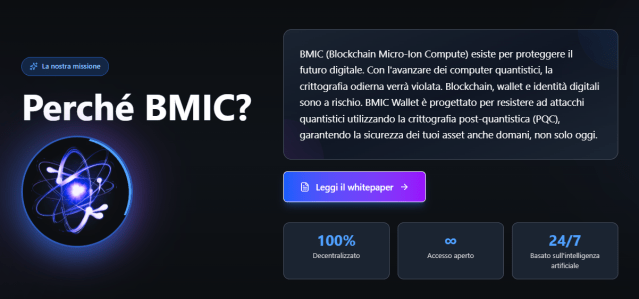
Beyond the encryption layer, the project integrates ERC-4337 smart accounts. This standard enables "account abstraction," meaning users get the robust security of quantum resistance without the headache of managing complex seed phrases, which often represent the biggest hurdle for institutional clients.

By combining AI-powered threat detection with no public key exposure, the protocol effectively creates a "moat" around user assets that not even a quantum computer can cross.

BMIC Presale Data Signals Early Investor Confidence

While the "mass" waits for confirmation of the reversal predicted by Tom Lee, smart money often moves into presales to maximize return asymmetry. Current BMIC fundraising data indicates a disconnect between general market apathy and the high conviction of security-focused investors. $BMIC has raised over $444,000, with tokens currently priced at $0.049474.

This capital raise is notable not only for the total but for the utility of the funding. The $BMIC token is not a simple governance tool; it acts as fuel for the "Quantum Meta-Cloud" ecosystem and powers the exclusive "Burn-to-Compute" mechanism.

How Does the Quantum Meta-Cloud Work?

The system aims to connect various quantum hardware providers under a single decentralized access layer. The goal is to make computing power available transparently without relying on a single centralized provider.

As the network grows, the demand for quantum-secure computing power drives the token's velocity. Thanks to this offering, we believe $BMIC is one of the best long-term crypto investments.

Why Do Investors Believe?

Those analyzing the risk-reward ratio are betting on a simple premise: as the crypto market matures, security-related premiums are destined to skyrocket.

  • Current Valuation: The market prices the gap between a standard wallet and a quantum-secure one at almost zero.

  • Potential: If BMIC manages to become the standard for post-quantum storage, that gap will close rapidly.

With the crypto presale still active, the entry point remains tied to the early stages of development rather than the immense speculative value the security narrative could generate in the future.


Perguntas relacionadas

QWhat does Tom Lee's recent analysis suggest about the crypto market?

ATom Lee's recent analysis suggests that the crypto market bottom has already been reached or is dangerously close, pointing to a 'perfect storm' of indicators including cooling inflation, the market absorbing excess supply from major failures, and Bitcoin's resilience during geopolitical tensions.

QWhat is the 'harvest now, decrypt later' attack vector mentioned in the article?

AThe 'harvest now, decrypt later' attack is a threat where state-sponsored actors and sophisticated hacker groups are currently harvesting encrypted data from blockchains, storing it, and waiting for quantum computing power to break current encryption standards like RSA and Elliptic Curve Cryptography (ECC).

QHow does the BMIC ($BMIC) project aim to address the quantum threat?

AThe BMIC project aims to address the quantum threat by offering what it claims is the only platform with a fully quantum-proof financial stack. It uses post-quantum cryptography to secure assets and integrates ERC-4337 smart accounts for robust security without the complexity of managing seed phrases.

QWhat is the function of the $BMIC token within its ecosystem?

AThe $BMIC token acts as fuel for the 'Quantum Meta-Cloud' ecosystem and powers the exclusive 'Burn-to-Compute' mechanism. It is not just a governance token but is used to access decentralized quantum computing power.

QWhat does the current fundraising data for BMIC indicate, according to the article?

AThe current fundraising data for BMIC indicates a disconnect between general market apathy and high conviction from security-focused investors. It has raised over $444,000, with tokens priced at $0.049474, signaling strong belief in its long-term value proposition.

Leituras Relacionadas

How Many Tokens Away Is Yang Zhilin from the 'Moon Chasing the Light'?

The article explores the intense competition between two leading Chinese AI companies, DeepSeek and Kimi (Moon Dark Side), and the mounting pressure on Yang Zhilin, the founder of Kimi. While DeepSeek re-emerged after 15 months of silence with its powerful V4 model—boasting 1.6 trillion parameters and low-cost, long-context capabilities—Kimi has been focusing on long-context processing and multi-agent systems with its K2.6 model. Yang faces a threefold challenge: technological rivalry, commercialization pressure, and investor expectations. Despite Kimi’s high valuation (reaching $18 billion), its revenue heavily relies on a single product with low paid conversion rates, while DeepSeek’s strategic silence and open-source influence have strengthened its market position and valuation prospects, now targeting over $20 billion. Both companies reflect broader trends in China’s AI ecosystem: Kimi aims for global influence through open-source contributions and agent-based advancements, while DeepSeek prioritizes foundational innovation and hardware independence, notably shifting to Huawei’s chips. Their competition is seen as vital for China’s AI progress, with the gap between top Chinese and U.S. models narrowing to just 2.7% on the Elo rating scale. Ultimately, the article argues that this rivalry, though anxiety-inducing for leaders like Zhilin, is essential for driving innovation and solidifying China’s role in the global AI landscape.

marsbitHá 6h

How Many Tokens Away Is Yang Zhilin from the 'Moon Chasing the Light'?

marsbitHá 6h

TechFlow Intelligence Bureau: ChatGPT Helps Amateur Mathematician Crack 60-Year-Old Problem, CFTC Sues New York Regulator Over Coinbase and Gemini

An amateur mathematician, with the assistance of ChatGPT, has solved a combinatorial mathematics puzzle originally proposed by Hungarian mathematician Paul Erdős in the 1960s. This marks another milestone in AI-aided mathematical research, demonstrating the evolving capabilities of large language models in formal reasoning. In other AI developments, OpenAI introduced a new privacy filter tool for enterprise API usage, automatically screening sensitive data. Meanwhile, the Qwen3.6-27B model achieved 100 tokens per second on a single RTX 5090 GPU using quantization, significantly lowering the cost barrier for local AI deployment. In crypto and Web3, the U.S. CFTC sued New York’s financial regulator, challenging its oversight of Coinbase and Gemini—a first-of-its-kind federal-state regulatory clash. Following a vulnerability, KelpDAO and major DeFi protocols established a recovery fund. Tether froze $344 million in assets linked to Iran’s central bank upon U.S. Treasury request, highlighting the centralized control risks in stablecoins. Separately, Litecoin underwent a 3-hour chain reorganization to undo a privacy-layer exploit. In the U.S., former President Trump invoked the Defense Production Act to address power grid bottlenecks affecting AI data centers and dismissed the entire National Science Board, raising concerns over research independence. A retail trader gained 250% on a $600k Intel options bet amid AI-related speculation. Xiaomi announced its first performance electric vehicle, targeting rivals like Tesla. Meanwhile, iPhone users reported devices automatically reinstalling a hidden app daily, suspected to be MDM-related. A Chinese securities report noted that A-share institutional crowding has reached its second-longest streak since 2007, signaling high valuations and potential style rotation. The day’s developments reflect a dual narrative: AI is enabling unprecedented individual breakthroughs, while centralized power structures—whether governmental or corporate—are becoming more assertive, underscoring that decentralization is as much a political-economic challenge as a technical one.

marsbitHá 6h

TechFlow Intelligence Bureau: ChatGPT Helps Amateur Mathematician Crack 60-Year-Old Problem, CFTC Sues New York Regulator Over Coinbase and Gemini

marsbitHá 6h

Trading

Spot
Futuros
活动图片




