Tom Lee Signals Market Bottom: Why Smart Money Is Rotating Towards Quantum Security and BMIC

bitcoinistPublicado em 2026-02-09Última atualização em 2026-02-09

Resumo

Tom Lee, Head of Research at Fundstrat, suggests the crypto market has likely bottomed out, signaling a shift from survival to expansion. He points to cooling inflation and Bitcoin's resilience as key indicators. The next market cycle is expected to prioritize new infrastructure that addresses existential threats, particularly the looming risk of quantum computing to current encryption standards. This creates a significant opportunity for quantum-resistant security solutions. BMIC ($BMIC) is positioned as a key player, offering a fully quantum-proof financial stack. It uses post-quantum cryptography to protect assets from future attacks and integrates ERC-4337 smart accounts for enhanced security without complex seed phrases. The project's presale has raised over $444,000, indicating strong investor confidence. The $BMIC token powers its "Quantum Meta-Cloud," a decentralized network for quantum computing resources, and features a "Burn-to-Compute" mechanism. Analysts believe that as the market matures, the premium for quantum security will grow significantly, making BMIC a potential long-term investment as it aims to become the standard for secure, institutional-grade digital asset storage.

Fundstrat's Head of Research, Tom Lee, is known for predicting market reversals just when everyone else is still in the midst of panic-selling. His recent analysis suggests that the crypto market bottom has already been reached, or is at least dangerously close. Lee points to a "perfect storm" of indicators: cooling inflation, a market that has finally absorbed the excess supply from major failures, and Bitcoin's surprising resilience during geopolitical tensions. The "purge" phase of the cycle, it seems, is over.

But just watching price action means missing the main point. The importance of a market bottom lies not only in prices stopping their decline; it lies in the narrative shifting from survival to expansion. When liquidity returns (driven by the Fed's inevitable policy reversal and ETF inflows), it doesn't simply flow into the same old coins.

It seeks new infrastructure that solves existential threats. In previous cycles, we saw this capital flood scalability solutions and DeFi protocols. This time? The next big rotation might prioritize security layers capable of handling institutional-grade value.

This is important because the "next bull run" must face a technological chasm that previous rallies did not know: the looming threat of quantum computing. As the value of assets swells, the incentive to break current encryption standards grows exponentially.

This creates a huge blind spot where traditional wallets are essentially underestimated risks, while quantum-resistant infrastructure represents the "alpha" not yet detected. Investors following Tom Lee's "risk-on" signals are now hunting for projects that secure the digital future against next-generation threats.

And this is where BMIC ($BMIC) comes in, a project positioning itself as the fortified layer for this new liquidity cycle.

Institutional Inflows Require Post-Quantum Armor

The "harvest now, decrypt later" attack vector is perhaps the elephant in the room for the entire industry. State actors and sophisticated hacker groups are currently scraping encrypted data from blockchains, archiving it, and simply waiting for quantum computing power to break current standards like RSA and Elliptic Curve Cryptography (ECC).

If Tom Lee's prediction of six-figure Bitcoin comes true, the "honey pot" for these attackers would become a treasure trove worth trillions of dollars.

BMIC ($BMIC) addresses this problem by offering what it claims is the only platform with a fully quantum-proof financial stack. Unlike legacy crypto wallets that rely on 1990s encryption methods, BMIC uses post-quantum cryptography to ensure assets stored today remain secure against future brute-force computational attacks. (And no, it's not just paranoia; it's a mathematical necessity for any company planning to hold digital assets for more than five years).
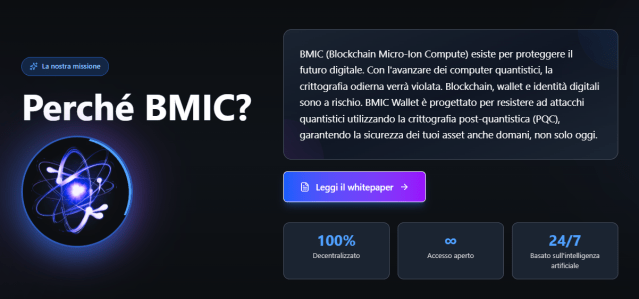
Beyond the encryption layer, the project integrates ERC-4337 smart accounts. This standard enables "account abstraction," meaning users get the robust security of quantum resistance without the headache of managing complex seed phrases, which often represent the biggest hurdle for institutional clients.

By combining AI-powered threat detection with no public key exposure, the protocol effectively creates a "moat" around user assets that not even a quantum computer can cross.

BMIC Presale Data Signals Early Investor Confidence

While the "mass" waits for confirmation of the reversal predicted by Tom Lee, smart money often moves into presales to maximize return asymmetry. Current BMIC fundraising data indicates a disconnect between general market apathy and the high conviction of security-focused investors. $BMIC has raised over $444,000, with tokens currently priced at $0.049474.

This capital raise is notable not only for the total but for the utility of the funding. The $BMIC token is not a simple governance tool; it acts as fuel for the "Quantum Meta-Cloud" ecosystem and powers the exclusive "Burn-to-Compute" mechanism.

How Does the Quantum Meta-Cloud Work?

The system aims to connect various quantum hardware providers under a single decentralized access layer. The goal is to make computing power available transparently without relying on a single centralized provider.

As the network grows, the demand for quantum-secure computing power drives the token's velocity. Thanks to this offering, we believe $BMIC is one of the best long-term crypto investments.

Why Do Investors Believe?

Those analyzing the risk-reward ratio are betting on a simple premise: as the crypto market matures, security-related premiums are destined to skyrocket.

  • Current Valuation: The market prices the gap between a standard wallet and a quantum-secure one at almost zero.

  • Potential: If BMIC manages to become the standard for post-quantum storage, that gap will close rapidly.

With the crypto presale still active, the entry point remains tied to the early stages of development rather than the immense speculative value the security narrative could generate in the future.


Perguntas relacionadas

QWhat does Tom Lee's recent analysis suggest about the crypto market?

ATom Lee's recent analysis suggests that the crypto market bottom has already been reached or is dangerously close, pointing to a 'perfect storm' of indicators including cooling inflation, the market absorbing excess supply from major failures, and Bitcoin's resilience during geopolitical tensions.

QWhat is the 'harvest now, decrypt later' attack vector mentioned in the article?

AThe 'harvest now, decrypt later' attack is a threat where state-sponsored actors and sophisticated hacker groups are currently harvesting encrypted data from blockchains, storing it, and waiting for quantum computing power to break current encryption standards like RSA and Elliptic Curve Cryptography (ECC).

QHow does the BMIC ($BMIC) project aim to address the quantum threat?

AThe BMIC project aims to address the quantum threat by offering what it claims is the only platform with a fully quantum-proof financial stack. It uses post-quantum cryptography to secure assets and integrates ERC-4337 smart accounts for robust security without the complexity of managing seed phrases.

QWhat is the function of the $BMIC token within its ecosystem?

AThe $BMIC token acts as fuel for the 'Quantum Meta-Cloud' ecosystem and powers the exclusive 'Burn-to-Compute' mechanism. It is not just a governance token but is used to access decentralized quantum computing power.

QWhat does the current fundraising data for BMIC indicate, according to the article?

AThe current fundraising data for BMIC indicates a disconnect between general market apathy and high conviction from security-focused investors. It has raised over $444,000, with tokens priced at $0.049474, signaling strong belief in its long-term value proposition.

Leituras Relacionadas

Must-Watch Events Next Week|CLARITY Act Could Face Senate Vote; SpaceX, Circle to Report Earnings (8.3-8.9)

**Summary: Key Events and Developments to Watch (August 3-9)** The upcoming week is marked by significant financial disclosures, key legislative deadlines, and notable product updates. **Major Financial Events:** Several companies are scheduled to release their Q2 2026 earnings. American Bitcoin (ABTC) will report on August 3, followed by SpaceX and Hut 8 Mining Corp. on August 4, and Circle on August 5. Notably, a significant portion of SpaceX shares (up to 12% of total shares) will be unlocked on August 6 following their earnings release. **Key Legislative Deadline:** The U.S. Senate faces an August 7 deadline to secure 60 votes for the CLARITY Act, a bipartisan bill aiming to establish a federal regulatory framework for cryptocurrencies. The Senate may hold a full vote on the bill during the week. **Economic Data:** The U.S. July Non-Farm Payrolls report will be released on August 7, providing crucial labor market data. **Technology & Product Updates:** * **Shutdowns:** DeFi portfolio tracker Zapper and wallet app Ctrl Wallet will cease operations on August 3. * **Upgrades:** LayerZero will deprecate its v1 relayers on August 3. XRP Ledger's new version 3.3.0, featuring five new functions, is expected next week. * **AI:** Elon Musk announced that the advanced Grok 4.6 AI model is set for release around August 7. * **Bitcoin:** The BIP-110 forced signaling for a potential Bitcoin network change is scheduled to begin around August 8. **Other Notable Events:** Chinese robotics firm Unitree Tech has set its preliminary price inquiry for its IPO for August 5. South Korean exchange Upbit will delist AQT and AERGO tokens on August 3.

marsbitHá 1h

Must-Watch Events Next Week|CLARITY Act Could Face Senate Vote; SpaceX, Circle to Report Earnings (8.3-8.9)

marsbitHá 1h

Stocks Are Plummeting More Sharply Than Cryptocurrencies. Where Has the Money Gone?

Stock Markets Plunge Deeper Than Cryptocurrencies: Where Did the Money Go? In late July, Seoul's Kospi index triggered circuit breakers for two consecutive days, plummeting over 40% from its June high. The collapse was led by heavyweight stocks like SK Hynix, whose record profits still disappointed investors, and devastating leveraged ETFs, with one major product losing over 83% of its value. This signaled a global, forced deleveraging targeting the most crowded trades. Interestingly, while stocks exhibited extreme volatility akin to crypto markets, Bitcoin rose nearly 15% in July after a prior steep drop. Analysis shows the money fleeing equities did not flow into Bitcoin. Instead, Bitcoin had already absorbed its sell-off in May-June, when U.S. spot Bitcoin ETFs saw historic outflows. The true safe-haven beneficiary was gold, whose price rose over 20% year-on-year, highlighting a decoupling between Bitcoin and gold as "digital gold." The sell-off was a targeted unwinding of leveraged positions in tech and semiconductors, accelerated by broker-dealer risk management and shifts in the AI narrative, including new competition from Chinese memory chipmakers. The retreat path was clear: from high-valuation tech stocks to cash and U.S. Treasuries, then to gold. For Bitcoin to attract sustained institutional inflows, conditions like eased global liquidity pressure, a "soft-landing" Fed rate cut, and U.S. regulatory clarity via legislation like the stalled CLARITY Act are needed. Currently, Bitcoin is not a safe haven but an already-cleared asset. Its low correlation with tech stocks, however, makes it a potential diversification play for institutional portfolios once the storm passes. The money isn't here yet, but the positioning is underway.

marsbitHá 1h

Stocks Are Plummeting More Sharply Than Cryptocurrencies. Where Has the Money Gone?

marsbitHá 1h

In Conversation with Ray Dalio: We Are Currently in an AI Bubble, with 1% of My Portfolio in Bitcoin

Ray Dalio, founder of Bridgewater Associates, warns in an interview that the current AI boom shows classic bubble characteristics, which could lead to significant economic downturns as seen in past cycles like 1929 or 2000. He explains that speculative enthusiasm, fueled by debt and overvaluation, often precedes a crash when rising rates or taxation force asset sales, causing widespread losses and recession. Dalio also outlines his "Big Cycle" theory, describing an approximate 80-year pattern where widening wealth gaps, massive government deficits, and shifting geopolitical power (like China's rise) create internal conflict and global instability. He emphasizes that we are in a late-cycle, transitional phase where traditional powers like the US and UK face decline. For personal wealth protection, Dalio advises diversification beyond cash into assets like stocks, bonds, real estate, and particularly gold, which he prefers over Bitcoin. While he holds about 1% of his portfolio in Bitcoin as a non-printable hard asset, he views gold as more secure from technological or governmental threats. Regarding AI's impact, Dalio believes it will disproportionately benefit capital owners, worsening inequality by replacing both physical and cognitive labor. He suggests that human intuition and emotional intelligence, combined with AI, will be key for future workers. On taxation, Dalio argues that wealth taxes are impractical and risk triggering asset sell-offs, reducing productive investment. He points to the UK as a cautionary example of debt, low productivity, and political strife. Geopolitically, Dalio foresees a more regionalized world, with the US showing weakness in prolonged conflicts like with Iran, akin to past imperial declines. The ideal outcome, he suggests, is coexisting powerful blocs (e.g., Americas, China-Asia Pacific) without major war.

marsbitHá 5h

In Conversation with Ray Dalio: We Are Currently in an AI Bubble, with 1% of My Portfolio in Bitcoin

marsbitHá 5h

Trading

Spot
活动图片




