Tom Lee Signals Market Bottom: Why Smart Money Is Rotating Towards Quantum Security and BMIC

bitcoinistPublicado em 2026-02-09Última atualização em 2026-02-09

Resumo

Tom Lee, Head of Research at Fundstrat, suggests the crypto market has likely bottomed out, signaling a shift from survival to expansion. He points to cooling inflation and Bitcoin's resilience as key indicators. The next market cycle is expected to prioritize new infrastructure that addresses existential threats, particularly the looming risk of quantum computing to current encryption standards. This creates a significant opportunity for quantum-resistant security solutions. BMIC ($BMIC) is positioned as a key player, offering a fully quantum-proof financial stack. It uses post-quantum cryptography to protect assets from future attacks and integrates ERC-4337 smart accounts for enhanced security without complex seed phrases. The project's presale has raised over $444,000, indicating strong investor confidence. The $BMIC token powers its "Quantum Meta-Cloud," a decentralized network for quantum computing resources, and features a "Burn-to-Compute" mechanism. Analysts believe that as the market matures, the premium for quantum security will grow significantly, making BMIC a potential long-term investment as it aims to become the standard for secure, institutional-grade digital asset storage.

Fundstrat's Head of Research, Tom Lee, is known for predicting market reversals just when everyone else is still in the midst of panic-selling. His recent analysis suggests that the crypto market bottom has already been reached, or is at least dangerously close. Lee points to a "perfect storm" of indicators: cooling inflation, a market that has finally absorbed the excess supply from major failures, and Bitcoin's surprising resilience during geopolitical tensions. The "purge" phase of the cycle, it seems, is over.

But just watching price action means missing the main point. The importance of a market bottom lies not only in prices stopping their decline; it lies in the narrative shifting from survival to expansion. When liquidity returns (driven by the Fed's inevitable policy reversal and ETF inflows), it doesn't simply flow into the same old coins.

It seeks new infrastructure that solves existential threats. In previous cycles, we saw this capital flood scalability solutions and DeFi protocols. This time? The next big rotation might prioritize security layers capable of handling institutional-grade value.

This is important because the "next bull run" must face a technological chasm that previous rallies did not know: the looming threat of quantum computing. As the value of assets swells, the incentive to break current encryption standards grows exponentially.

This creates a huge blind spot where traditional wallets are essentially underestimated risks, while quantum-resistant infrastructure represents the "alpha" not yet detected. Investors following Tom Lee's "risk-on" signals are now hunting for projects that secure the digital future against next-generation threats.

And this is where BMIC ($BMIC) comes in, a project positioning itself as the fortified layer for this new liquidity cycle.

Institutional Inflows Require Post-Quantum Armor

The "harvest now, decrypt later" attack vector is perhaps the elephant in the room for the entire industry. State actors and sophisticated hacker groups are currently scraping encrypted data from blockchains, archiving it, and simply waiting for quantum computing power to break current standards like RSA and Elliptic Curve Cryptography (ECC).

If Tom Lee's prediction of six-figure Bitcoin comes true, the "honey pot" for these attackers would become a treasure trove worth trillions of dollars.

BMIC ($BMIC) addresses this problem by offering what it claims is the only platform with a fully quantum-proof financial stack. Unlike legacy crypto wallets that rely on 1990s encryption methods, BMIC uses post-quantum cryptography to ensure assets stored today remain secure against future brute-force computational attacks. (And no, it's not just paranoia; it's a mathematical necessity for any company planning to hold digital assets for more than five years).
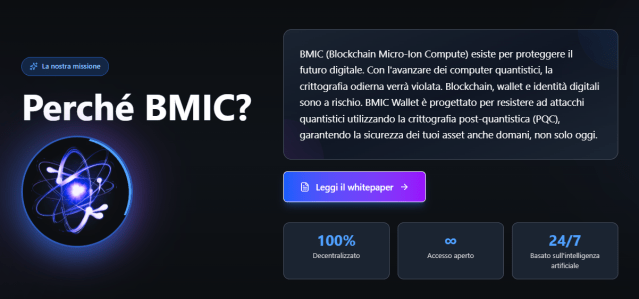
Beyond the encryption layer, the project integrates ERC-4337 smart accounts. This standard enables "account abstraction," meaning users get the robust security of quantum resistance without the headache of managing complex seed phrases, which often represent the biggest hurdle for institutional clients.

By combining AI-powered threat detection with no public key exposure, the protocol effectively creates a "moat" around user assets that not even a quantum computer can cross.

BMIC Presale Data Signals Early Investor Confidence

While the "mass" waits for confirmation of the reversal predicted by Tom Lee, smart money often moves into presales to maximize return asymmetry. Current BMIC fundraising data indicates a disconnect between general market apathy and the high conviction of security-focused investors. $BMIC has raised over $444,000, with tokens currently priced at $0.049474.

This capital raise is notable not only for the total but for the utility of the funding. The $BMIC token is not a simple governance tool; it acts as fuel for the "Quantum Meta-Cloud" ecosystem and powers the exclusive "Burn-to-Compute" mechanism.

How Does the Quantum Meta-Cloud Work?

The system aims to connect various quantum hardware providers under a single decentralized access layer. The goal is to make computing power available transparently without relying on a single centralized provider.

As the network grows, the demand for quantum-secure computing power drives the token's velocity. Thanks to this offering, we believe $BMIC is one of the best long-term crypto investments.

Why Do Investors Believe?

Those analyzing the risk-reward ratio are betting on a simple premise: as the crypto market matures, security-related premiums are destined to skyrocket.

  • Current Valuation: The market prices the gap between a standard wallet and a quantum-secure one at almost zero.

  • Potential: If BMIC manages to become the standard for post-quantum storage, that gap will close rapidly.

With the crypto presale still active, the entry point remains tied to the early stages of development rather than the immense speculative value the security narrative could generate in the future.


Perguntas relacionadas

QWhat does Tom Lee's recent analysis suggest about the crypto market?

ATom Lee's recent analysis suggests that the crypto market bottom has already been reached or is dangerously close, pointing to a 'perfect storm' of indicators including cooling inflation, the market absorbing excess supply from major failures, and Bitcoin's resilience during geopolitical tensions.

QWhat is the 'harvest now, decrypt later' attack vector mentioned in the article?

AThe 'harvest now, decrypt later' attack is a threat where state-sponsored actors and sophisticated hacker groups are currently harvesting encrypted data from blockchains, storing it, and waiting for quantum computing power to break current encryption standards like RSA and Elliptic Curve Cryptography (ECC).

QHow does the BMIC ($BMIC) project aim to address the quantum threat?

AThe BMIC project aims to address the quantum threat by offering what it claims is the only platform with a fully quantum-proof financial stack. It uses post-quantum cryptography to secure assets and integrates ERC-4337 smart accounts for robust security without the complexity of managing seed phrases.

QWhat is the function of the $BMIC token within its ecosystem?

AThe $BMIC token acts as fuel for the 'Quantum Meta-Cloud' ecosystem and powers the exclusive 'Burn-to-Compute' mechanism. It is not just a governance token but is used to access decentralized quantum computing power.

QWhat does the current fundraising data for BMIC indicate, according to the article?

AThe current fundraising data for BMIC indicates a disconnect between general market apathy and high conviction from security-focused investors. It has raised over $444,000, with tokens priced at $0.049474, signaling strong belief in its long-term value proposition.

Leituras Relacionadas

Goldman Sachs: July Smashes Through Crowded Trades, U.S. Stock Bull Market Not Broken but Harder to Navigate

Goldman Sachs: July Sees Crowded Trades Unwound, U.S. Bull Market Intact but Getting Tougher. The U.S. stock market in July did not see an index-level crash, but rather a significant unwinding of speculative positions. While the S&P 500 remained stable—trading within a narrow 3.5% range and staying within 2% of its high—underlying market dynamics were volatile. Heavily crowded trades, particularly in high-momentum tech, AI-linked stocks, and Asian strategies, faced severe pressure and forced deleveraging. Data indicates this was a meaningful cleanse, not a minor adjustment. Global tech exposure saw its largest sell-off in over five years, leverage in Korean equity ETFs plummeted, and Goldman's prime brokerage recorded the largest gross exposure reduction since late 2022. Leverage on momentum factors among fundamental long/short clients fell to the 28th percentile of its one-year range. The AI trade narrative shifted from pure potential to a focus on tangible returns. While Meta failed to show clear AI monetization, Microsoft and Amazon provided evidence that massive capital expenditure is translating into scalable revenue and product growth, preventing a blanket sell-off of the AI sector. The Federal Reserve's more opaque communication style and volatility in long-end Treasury yields have introduced new friction, particularly for rate-sensitive growth and tech stocks. The broader outlook for U.S. equities remains favorable, supported by a strong economy, robust earnings, and substantial AI capital expenditure. However, risk/reward is no longer cheap, and the market's upward elasticity has weakened. The Nasdaq 100's trajectory—up 12% year-to-date despite significant pullbacks—illustrates that the bull trend persists but the path is becoming more difficult. The key lesson from July is that the market no longer rewards crowded, highly leveraged trades, requiring more disciplined and liquid portfolio approaches.

marsbitHá 18m

Goldman Sachs: July Smashes Through Crowded Trades, U.S. Stock Bull Market Not Broken but Harder to Navigate

marsbitHá 18m

Interview with Robinhood Executive: Meme + Tokenized US Stocks as "Barbell" Customer Acquisition Strategy, All Business Lines Achieve Hundreds of Millions in Revenue

Interview with Robinhood executive Johann Kerbrat reveals the company's "barbell" customer acquisition strategy for its new Robinhood Chain, combining meme tokens with tokenized stocks. Three weeks after mainnet launch, the chain has seen over $3B in weekly DEX volume and 105M transactions. Kerbrat explains the logic behind the permissionless chain: meme tokens attract DeFi users, while tokenized real-world assets (RWA), currently over 90 US stocks and ETFs accessible in 120+ countries, serve global users. The goal is to bring Robinhood's 27 million funded accounts on-chain by simplifying DeFi with a user-friendly interface, exemplified by features like Robinhood Earn which offers yield without requiring wallet management. Built on Arbitrum's technology stack for its speed, low cost, and Ethereum's security, the chain focuses on financial products like Earn, spot trading, and perpetuals. Kerbrat downplays direct competition with platforms like Base, emphasizing the goal of expanding the overall market for on-chain assets. He details selective partnerships (e.g., Morpho, Lighter) based on compliance, unique UX, and differentiation. While regulatory clarity is pending for US perpetuals, the expansion continues via Bitstamp in Europe. Finally, Kerbrat positions Robinhood as a "super app" integrating stocks, options, crypto, banking, and AI trading, with all major business lines generating hundreds of millions in revenue. For the chain, current priority is driving adoption over maximizing gas fee revenue.

marsbitHá 2h

Interview with Robinhood Executive: Meme + Tokenized US Stocks as "Barbell" Customer Acquisition Strategy, All Business Lines Achieve Hundreds of Millions in Revenue

marsbitHá 2h

Fidelity Q3 Report: BTC, ETH, and SOL Continue to Build Bottoms; How Much Further Will This Crypto Bear Market Go?

Fidelity's Q3 Crypto Signal Report analyzes the current bear market, noting Bitcoin (BTC), Ethereum (ETH), and Solana (SOL) are in a prolonged bottoming phase. Key indicators like the weighted Net Unrealized Profit/Loss (NUPL) have turned negative (-0.01), signaling the market is slightly below its aggregate cost basis, with BTC acting as the primary stabilizing asset. BTC's dominance has risen to 68%, indicating a lack of capital rotation to other digital assets. Performance has been weak across the board, with BTC, ETH, and SOL down significantly year-to-date. Market sentiment is depressed, exacerbated by substantial outflows from spot ETPs and a challenging macro environment. The report compares the current ~203-day downtrend to historical ~300-day bottoming cycles, suggesting the process may be two-thirds complete, with late 2026 as a potential timeframe to monitor. For Bitcoin, NUPL at 0.09 indicates cautious sentiment, while momentum signals remain negative. The Yardstick metric points to potential undervaluation relative to network security (hashrate). Ethereum's NUPL is deep in the "capitulation" zone at -0.43, a historically positive signal for future returns, though its momentum and network fee revenue are negative. Solana shows the deepest NUPL at -0.72 but demonstrates relative resilience in on-chain activity and stablecoin transfer volume. The report concludes that while several metrics are near historical capitulation levels, a definitive market bottom has not yet been established. The path forward likely involves continued consolidation, with BTC's relative strength and fundamental on-chain usage for ETH and SOL providing key areas for investor observation.

marsbitHá 2h

Fidelity Q3 Report: BTC, ETH, and SOL Continue to Build Bottoms; How Much Further Will This Crypto Bear Market Go?

marsbitHá 2h

Trading

Spot
活动图片




