Tokenized Stocks Surpass $85 Million in Risk-Weighted Asset Volume on Robinhood Chain for the First Time

cryptonews.ruPublicado em 2026-08-26Última atualização em 2026-08-26

Resumo

On August 25th, the daily trading volume of real-world assets (RWAs) on the Robinhood Chain blockchain hit a new record of $85.1 million. The bulk of this volume, 78%, came from direct stock token trading, a significant shift from late July when 73% of volume was from memecoin-to-stock pairs. This suggests a shift in user behavior towards treating tokens as financial instruments rather than speculative vehicles. Two key factors drove this growth. First, Robinhood Crypto added 100 new stock tokens earlier in August, expanding its offering to over 190. Second, nearly 99% of stock token liquidity is on Uniswap, primarily in its v4 version using correlated pools that pair individual stocks with the SPY ETF. This design minimizes impermanent loss, leading to tighter spreads and enabling larger, more efficient trades. The timing coincided with Nvidia's earnings report, as its token is among the most traded on the chain, providing a 24/7 trading venue while traditional markets are closed. Regulatory discussions and Coinbase's launch of tokenized stocks on Base also contributed to a favorable environment. The key question is sustainability. The chain's baseline volume in August was around $25 million. If the floor settles around $40 million post-earnings, it would signal genuine user base expansion. A drop back to July levels would indicate the record was a temporary spike.

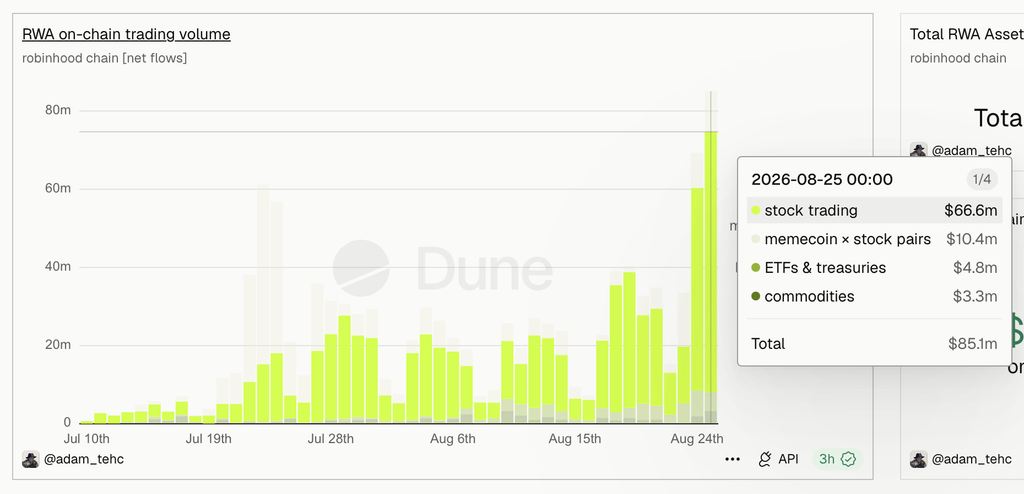
Yesterday, August 25th, the daily trading volume of real-world assets (RWAs) on the Robinhood Chain blockchain reached a new record of $85.1 million. The majority of this volume came from tokenized stocks: according to a Dune Analytics dashboard compiled by analyst adam_tehc, $66.6 million was from stock trading, $10.4 million from memecoin-paired stock trading, $4.8 million from ETFs and Treasury bonds, and the remaining $3.3 million from commodities. However, this daily figure is only half the story. The other half is who is generating this volume.
Memecoin Trading Stopped Supporting the Blockchain

In late July, less than a month after its mainnet launch, the daily trading composition on Robinhood looked completely different from today. The majority came from memecoin-paired stock trades, meaning swapping memecoins for the stock on the other side of the transaction. At its peak on July 26th, memecoin x stock pairs accounted for 73% of the volume. Yesterday, that figure completely flipped: it accounted for 12%, while direct stock trading accounted for 78%.

This indicates the emergence of a completely different user base over the past few weeks. Memecoin-paired trading relies on volatility, often represents short-term plays, and disappears when attention shifts to other narratives. The growth in stock trading volume not tied to any memecoin suggests people are viewing the tokens more as instruments rather than trading gimmicks.

Supply Increased, Then Liquidity Arrived

Two factors truly fueled the growth in stock trading volume on the chain. First, Robinhood Crypto added 100 new stock tokens to the chain earlier this month, bringing the total to over 190. More tickers means more reasons to engage.

The Robinhood Chain platform has added 100 more Robinhood Stock Tokens, bringing the total to over 190.

Supported both on Robinhood Chain and in any compatible self-custody wallets. pic.twitter.com/88hzZdU0N5

— Robinhood Crypto (@RobinhoodCrypto) August 13, 2026

Liquidity did the rest. Uniswap now commands nearly 99% of the stock token liquidity on the chain, with its v4 version accounting for about 73% of that. A key design detail is Uniswap's correlated pools, which pair individual stock tokens with SPY. Because the price of a single stock and the index mostly move together, these liquidity pools suffer far less impermanent loss than a standard pair. Ten such pools processed $33 million in trades from over 11,000 traders in 12 days.

Lower liquidity provider risk means tighter spreads. Tighter spreads mean large orders can actually be executed without slippage. This is how the supply chain goes from $20 million a day to $85 million a day.

Nvidia Reports Tonight, and the Platform Stays Open

The timing is no accident. Nvidia reports earnings after U.S. markets close today, and NVDA is among the most traded tokens on the chain. When Wall Street shuts, the 24/7 on-chain venue becomes one of the few places to position for the market's reaction. Traders front-run the event in this period, and their positions land in the previous day's volume data.

Regulatory chatter provides a conducive backdrop. On August 18th, Vlad Tenev called on U.S. regulators for a clear system for tokenized stocks, and Coinbase launched tokenized shares of Apple, Nvidia, Meta, and Alphabet on its Base platform the same week.

Watch the Floor, Not the Spike

Earnings-driven spikes revert to the mean. That's what they do. Therefore, it's important to track whether $85.1 million gets pulled again this week.

Pay attention to quieter days. The baseline for Robinhood Chain for most of August hovered around $25 million. If that floor settles back to $40 million after Nvidia's stock price settles and the news flow quiets, then the chain has truly expanded its user base. If it drops back to July levels, then August 25th becomes a growth catalyst disguised as a milestone.

end-content

Perguntas relacionadas

QWhat new record was set on the Robinhood Chain on August 25th, and what type of tokenized asset contributed most to this volume?

AOn August 25th, the daily trading volume of real-world assets (RWAs) on the Robinhood Chain reached a new record of $85.1 million. Tokenized stocks contributed the most to this volume, accounting for $66.6 million of the total.

QHow has the composition of daily trading on the Robinhood Chain changed between late July and late August in terms of memecoin-stock pairs versus direct stock trading?

AThe trading composition changed dramatically. In late July, memecoin-stock pairs accounted for 73% of the volume, while direct stock trading was a smaller portion. By late August, this reversed: memecoin-stock pairs only accounted for 12%, while direct stock trading comprised 78% of the volume.

QAccording to the article, what two main factors contributed to the growth in tokenized stock trading volume on the Robinhood Chain?

ATwo main factors contributed to the growth: 1) Robinhood Crypto adding 100 new stock tokens earlier in the month, bringing the total to over 190, which increased the available tickers. 2) Enhanced liquidity, primarily provided by Uniswap, with Uniswap v4 holding about 73% of the stock token liquidity. The use of correlated pools (matching individual stock tokens with SPY) reduced impermanent loss, leading to tighter spreads and enabling larger trades.

QWhy was the timing of Nvidia's earnings report mentioned as significant for the Robinhood Chain platform?

AThe timing was significant because Nvidia's earnings report was scheduled for release after U.S. markets closed. With NVDA being one of the most traded tokens on the chain, the 24/7 blockchain platform became one of the few venues for traders to position themselves in anticipation of the market's reaction to the earnings news, contributing to the elevated trading volume recorded that day.

QWhat does the article suggest is more important to watch than the single-day record volume of $85.1 million, and what would indicate a genuine expansion of the Robinhood Chain's user base?

AThe article suggests it is more important to watch the baseline or 'floor' volume rather than the single-day peak. It states that if, after the Nvidia news cycle passes, the chain's baseline daily volume settles back to around $40 million instead of the July levels of approximately $25 million, it would indicate a genuine expansion of the user base. If it falls back to July levels, the record day would be seen as a temporary spike, not a sustainable milestone.

Leituras Relacionadas

Circle CEO: Stablecoins Are at the Internet's 2002 Stage, Will Reach Trillions of Dollars in the Future

Circle CEO Jeremy Allaire, in a Q2 2026 earnings AMA, discussed the current state and future of stablecoins and Circle's strategy. He compared stablecoins today to the internet in 2002, predicting they will grow from hundreds of billions to trillions of dollars. Key points include: * **Current Use Cases**: Stablecoins have achieved product-market fit in digital asset markets (for trading/settlement), as a digital dollar store of value in emerging markets, and for cross-border payments and settlement. * **Future Growth Areas**: Allaire highlighted opportunities in the AI agent economy, merchant payments (especially via QR codes and stablecoin cards), and the convergence of traditional and on-chain finance. * **Circle's Strategy**: Circle aims to grow USDC through global partnerships. Its economic engines will include reserve income, transaction fees from its on-chain payment network (CPN), and its upcoming "economic operating system," Arc. * **Arc's Vision**: Arc, launching its mainnet on September 16, is a stablecoin-native blockchain designed for seamless user and developer experience. It aims to power the future "on-chain" economy where businesses and AI agents operate. * **Global Adoption**: Allaire emphasized that stablecoin adoption is a global phenomenon, driven by regulatory clarity in regions like Europe (MiCA) and the US (GENIUS Act), and will continue regardless of specific US legislation like the CLARITY Act. * **EURC Growth**: Circle's euro stablecoin, EURC, has surpassed €400 million in circulation, benefiting from early preparation for European regulations and existing distribution networks. Allaire expressed confidence in Circle's execution, citing strong team cohesion and the adoption of AI tools, while identifying cybersecurity and global local operations as key areas for continued strengthening.

marsbitHá 45m

Circle CEO: Stablecoins Are at the Internet's 2002 Stage, Will Reach Trillions of Dollars in the Future

marsbitHá 45m

With Revenue 3.8 Billion Lower Than CXMT, Net Profit Is 8.6 Billion Higher: What Secrets Are Hidden in YMTC's IPO?

Chinese NAND flash giant Changcun Holdings has submitted its IPO prospectus to the Shanghai Stock Exchange. In Q1 2026, the company reported revenue of 47.042 billion yuan and a net profit attributable to parent company shareholders of 33.379 billion yuan. This presents a striking contrast with its competitor Changxin Technology, which had higher revenue (50.8 billion yuan) but a significantly lower net profit of 24.762 billion yuan. The key to this discrepancy lies in their ownership structures of core assets. Changcun Holdings fully owns its main operating entity, Yangtze Memory Technologies Co., Ltd., allowing nearly all group profits to flow to the parent company. In contrast, Changxin Technology controls but does not fully own its key production subsidiaries, meaning a substantial portion of its consolidated profits (approximately 8.25 billion yuan in Q1 2026) belongs to minority shareholders, reducing its reported net profit. Despite Changcun's higher net profit, its pre-IPO valuation is estimated lower than Changxin's. Analysts attribute this to differing market expectations: Changxin, focused on DRAM and the high-growth HBM market for AI servers, is seen as having greater long-term growth potential. Changcun, while dominant in NAND flash, operates in a market with inherent size constraints, making its future valuation more dependent on successfully upgrading its product mix toward higher-value segments like enterprise SSDs.

marsbitHá 57m

With Revenue 3.8 Billion Lower Than CXMT, Net Profit Is 8.6 Billion Higher: What Secrets Are Hidden in YMTC's IPO?

marsbitHá 57m

Perpetual Contract Liquidation Wave Resurges, Bitcoin $62k - $67k May Become the 'Disaster Zone'

A wave of liquidations has hit the crypto perpetual futures market, with analysts warning of continued volatility. Following Bitcoin's drop below $76,000 and subsequent rebound, over $84 million in long positions were liquidated in one hour, demonstrating the amplified impact of leverage. The U.S. CFTC's recent approval of a spot Bitcoin perpetual contract on the Kalshi exchange has opened this "previously closed" asset class to American institutions, with the platform reporting $5.5 billion in volume in its first two weeks. However, critics like Better Markets warn that perpetuals are "among the most dangerous crypto products" for retail investors due to a lack of enhanced protections. Recent price action saw a massive $529 million in hourly liquidations, predominantly longs. Analysts note that while a $3.3 billion short squeeze cleared liquidity above $80,000, a significant pool of long liquidations now sits between $62,000 and $67,000, posing a downside risk if key resistance holds. Experts caution new traders against using leverage or options, which can expire worthless, without proper experience and risk management. Despite the dangers, the demand for leveraged products persists, with some institutional players preferring on-chain platforms for their transparency and self-custody. As Kalshi expands its perpetual offerings beyond crypto, the core warning remains: leverage can lead to sudden, severe losses for unprepared investors.

marsbitHá 57m

Perpetual Contract Liquidation Wave Resurges, Bitcoin $62k - $67k May Become the 'Disaster Zone'

marsbitHá 57m

Trading

Spot
活动图片