Tokenized stocks may be onchain, but the SEC still wants the keys

cointelegraphPublicado em 2025-12-18Última atualização em 2025-12-18

Resumo

The US Securities and Exchange Commission (SEC) has issued guidance allowing broker-dealers to custody tokenized stocks and bonds under existing customer protection rules, specifically Rule 15c3-3. This means tokenized securities will be treated under traditional frameworks rather than as a new asset class. Broker-dealers must maintain exclusive control over private keys, ensuring that only authorized parties can move the assets. They are also required to prepare for risks like 51% attacks, hard forks, and legal restrictions. The guidance emphasizes that tokenized securities must behave like traditional securities, regardless of blockchain technology. Meanwhile, platforms like Nasdaq and Securitize are advancing plans for compliant onchain trading of tokenized equities.

The US Securities and Exchange Commission’s Trading and Markets Division on Wednesday laid out how broker-dealers can custody tokenized stocks and bonds under existing customer protection rules, signaling that blockchain-based crypto asset securities will be slotted into traditional securities safeguards rather than treated as a new category.

The division said it would not object to broker-dealers deeming themselves in possession of crypto asset securities under existing customer protection rules, as long as they meet a set of operational, security and governance conditions. This applies only to crypto securities, including tokenized stocks or bonds.

While the statement is not a rule, it provides clarity on how US regulators expect tokenized securities to fit within traditional market safeguards.

The guidance suggests that tokenized securities are not treated as a new asset class with unique rules. Instead, they are being placed into existing broker-dealer frameworks, even if they settle within blockchain networks.
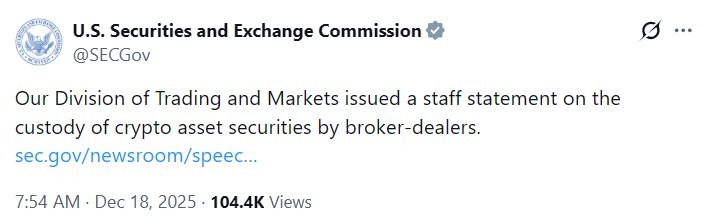
Source: US SEC

TradFi on a blockchain: Tokenized securities’ custody rules

At the core of the statement is Rule 15c3-3, the regulator’s consumer protection rule. This requires broker-dealers to maintain control or physical possession of fully paid customer securities.

The division said that crypto asset securities recorded in blockchains may satisfy the “physical possession” requirements under certain circumstances. This means broker-dealers must retain exclusive control over the private keys used to access and transfer the assets.

Despite being on a blockchain, customers and third parties, including affiliates, should not have the ability to move the security without the authorization of the broker.

The statement draws a clear boundary between tokenized securities and crypto-native self-custody models. It prioritizes customer protection over crypto’s permissionless ethos.

Broker-dealers are expected to prepare for scenarios like 51% attacks, hard forks, airdrops and other disruptions. They must also maintain plans that account for seizure, freezing or transfer restrictions under lawful orders.

The guidance reinforces that, regardless of the technologies used to issue or settle tokenized stocks or bonds, they are expected to behave like securities first.

Trading tokenized securities inside regulated market rails

In a separate statement issued the same day, SEC Commissioner Hester Peirce highlighted the trading-side challenges that remain for crypto asset securities.

Peirce raised questions focusing on national securities exchanges and alternative trading systems that facilitate trading crypto asset securities, including pairs where one asset is a security and the other is not.

The questions reflect growing pressure to settle blockchain-based assets with market-structure rules originally designed for traditional equities.

Peirce’s request raises whether existing frameworks and related disclosures and reporting requirements impose costs that outweigh their benefits when applied to crypto trading platforms.

Related: US Fed pulls guidance blocking its banks from engaging with crypto

Platforms jumping into tokenized equities

The statements come as crypto platforms and trading institutions have increasingly begun to tokenize securities.

On Nov. 30, Nasdaq's head of digital assets strategy, Matt Savarese, said the exchange plans to move fast on tokenized stocks. He said the exchange plans to work with the SEC as quickly as possible to make the feature available in the trading platform.

On Tuesday, Securitize, which focuses on tokenizing securities, announced that it plans to launch compliant, onchain trading for tokenized stocks. The company said that it will be presented in a swap-style interface familiar to decentralized finance (DeFi) users.

On Thursday, crypto exchange Coinbase launched a stock trading feature as part of its push to become an “everything exchange.”

Magazine: Koreans ‘pump’ alts after Upbit hack, China BTC mining surge: Asia Express


Leituras Relacionadas

In Jinjiang, Fujian, a Storage Super Unicorn Lies Quiet

In Fujian's Jinjiang, a city known for sportswear, lies a quiet semiconductor giant: Fujian Jinhua Integrated Circuit Co. (JHICC). Once a promising domestic DRAM manufacturer alongside Yangtze Memory and ChangXin Memory Technologies (CXMT), its journey was derailed in 2018 when the U.S. placed it on an Entity List and filed criminal charges for alleged trade secret theft. This halted production for years. A turning point came in February 2024 when a U.S. federal court found JHICC not guilty. However, it had lost crucial time. While CXMT soared to become a top-valued A-share company in 2024, JHICC, with an estimated valuation of 80 billion RMB, was just restarting. Its current output is primarily customized DDR4 chips, not the advanced DDR5/HBM demanded for AI, but it still benefits from the broader memory chip upcycle. JHICC's story is tied to Chen Zhengkun, a veteran engineer who left Micron to lead the venture. Founded in 2016 with state-backed funding, JHICC partnered with Taiwan's UMC to develop DRAM technology. Rapid progress was cut short by the U.S. actions, which Micron initiated, partly due to its heavy reliance on the Chinese market. Post-sanctions, Chen's team worked to rebuild the production line with reduced reliance on U.S. technology. According to its records, JHICC achieved small-scale production and revenue growth under immense pressure. It now focuses on the stable "niche" DRAM market (e.g., TVs, routers) with a monthly capacity of ~40,000 wafers, aiming for 60,000 by 2026. It holds over 1,000 patents but remains on the Entity List. For Jinjiang, investing in JHICC was a bold industrial leap. The local government provided unwavering financial and logistical support during the crisis, helping the company survive. JHICC has become the anchor for a growing local semiconductor cluster. Though its scale lags behind domestic peers, JHICC's persistence symbolizes a hard-won foothold in a global market long dominated by Samsung, SK Hynix, and Micron. Having missed one boom, it seeks a place in the new AI-driven memory supercycle.

marsbitHá 42m

In Jinjiang, Fujian, a Storage Super Unicorn Lies Quiet

marsbitHá 42m

Must-Watch Events Next Week|CLARITY Act Could Face Senate Vote; SpaceX, Circle to Report Earnings (8.3-8.9)

**Summary: Key Events and Developments to Watch (August 3-9)** The upcoming week is marked by significant financial disclosures, key legislative deadlines, and notable product updates. **Major Financial Events:** Several companies are scheduled to release their Q2 2026 earnings. American Bitcoin (ABTC) will report on August 3, followed by SpaceX and Hut 8 Mining Corp. on August 4, and Circle on August 5. Notably, a significant portion of SpaceX shares (up to 12% of total shares) will be unlocked on August 6 following their earnings release. **Key Legislative Deadline:** The U.S. Senate faces an August 7 deadline to secure 60 votes for the CLARITY Act, a bipartisan bill aiming to establish a federal regulatory framework for cryptocurrencies. The Senate may hold a full vote on the bill during the week. **Economic Data:** The U.S. July Non-Farm Payrolls report will be released on August 7, providing crucial labor market data. **Technology & Product Updates:** * **Shutdowns:** DeFi portfolio tracker Zapper and wallet app Ctrl Wallet will cease operations on August 3. * **Upgrades:** LayerZero will deprecate its v1 relayers on August 3. XRP Ledger's new version 3.3.0, featuring five new functions, is expected next week. * **AI:** Elon Musk announced that the advanced Grok 4.6 AI model is set for release around August 7. * **Bitcoin:** The BIP-110 forced signaling for a potential Bitcoin network change is scheduled to begin around August 8. **Other Notable Events:** Chinese robotics firm Unitree Tech has set its preliminary price inquiry for its IPO for August 5. South Korean exchange Upbit will delist AQT and AERGO tokens on August 3.

marsbitHá 2h

Must-Watch Events Next Week|CLARITY Act Could Face Senate Vote; SpaceX, Circle to Report Earnings (8.3-8.9)

marsbitHá 2h

Trading

Spot
活动图片




