Tokenization benefits ‘light at first,’ but will expand if democratized: NYDIG

cointelegraphPublicado em 2025-12-12Última atualização em 2025-12-12

Resumo

NYDIG's Global Head Greg Cipolaro states that while tokenizing real-world assets (RWAs) like stocks offers limited initial benefits to crypto networks, its advantages could grow significantly with greater democratization and integration. Initially, blockchains like Ethereum would gain from transaction fees and network effects. However, broader benefits—such as composability in DeFi for lending, borrowing, or trading—depend on improved technology, infrastructure, and favorable regulations. Tokenized assets vary widely in design and are hosted on both public and private networks, with significant value already on platforms like the Canton Network and Ethereum. Despite relying on traditional financial structures, blockchain offers near-instant settlement and operational efficiency. Cipolaro advises investors to monitor the space, as regulatory progress could expand the reach and utility of tokenized RWAs.

The tokenization of stocks won’t immediately be of immense benefit to the crypto market, but the benefits could increase if such assets are allowed to better integrate on blockchains, says NYDIG.

“The benefits to networks these assets reside on, such as Ethereum, are light at first, but increase as their access and interoperability and composability increase,” NYDIG global head of research Greg Cipolaro said in a note on Friday.

The initial benefits will be the transaction fees charged for using tokenized assets, and the blockchain hosting them will “enjoy increasing network effects” for storing them, Cipolaro added.

Tokenizing real-world assets, or RWAs, such as US stocks, has become a hot topic in the crypto industry, with major exchanges, including Coinbase and Kraken, wanting to launch tokenized stock platforms in the US after their success overseas.

Securities and Exchange Commission chair Paul Atkins said earlier this month that the US financial system could embrace tokenization in a “couple of years,” which Cipolaro said shows that “tokenization is likely going to be a big trend.”
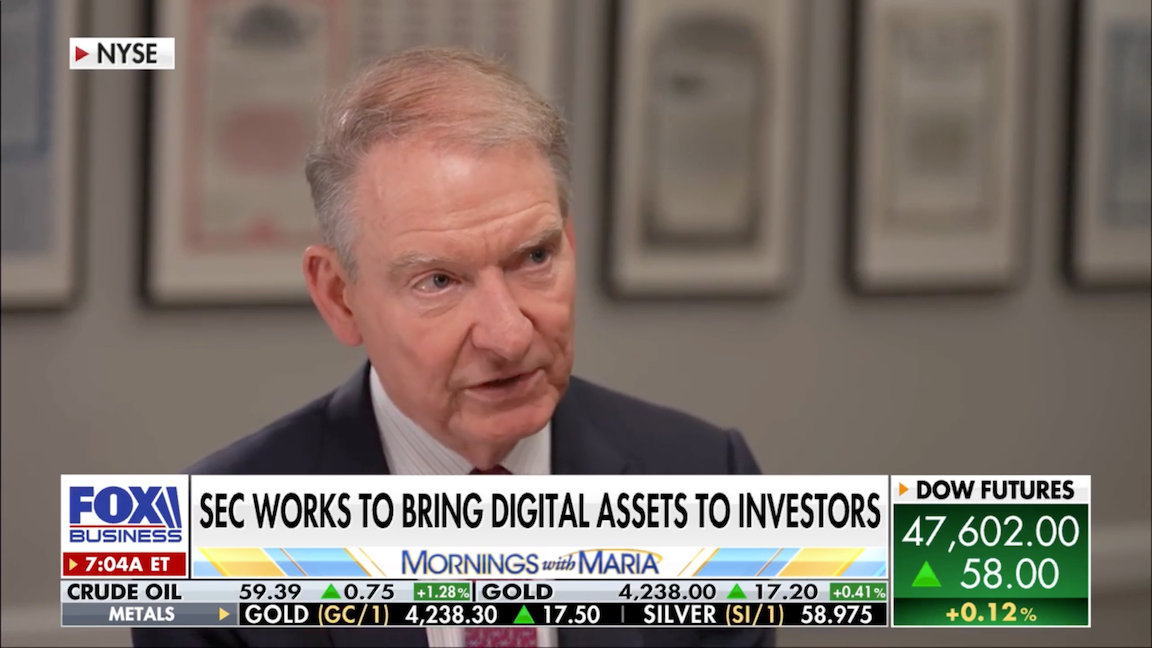
Paul Atkins speaking to Fox Business earlier in December on tokenized US stocks. Source: Fox Business

“In the future, one could see these RWAs being part of DeFi (composability), either as collateral for borrowing, an asset to be lent out, or for trading,” he added. “This will take time as technology develops, infrastructure is built out, and rules and regulations evolve.”

Tokenized assets can “differ greatly”

Cipolaro noted that making composable and interoperable tokenized assets isn’t straightforward, as “their form and function differ greatly” and are hosted on public and non-public networks.

The Canton Network, a non-public blockchain created by the company Digital Asset Holdings, is currently the largest blockchain for tokenized assets with $380 billion, or “91% of the total ‘represented value’ of all RWAs,” Cipolaro explained.

Ethereum, meanwhile, is “by far and away” the most popular public blockchain for tokenized assets, with $12.1 billion of RWAs deployed on it, he added.

Related: US financial markets ‘poised to move onchain’ amid DTCC tokenization greenlight

“But even on an open, permissionless network such as Ethereum, the design of the specific tokenized asset can vary greatly,” Cipolaro said. “These RWAs are often securities, broker-dealers, KYC/investor accreditation, whitelisted wallets, transfer agents, and other structures from traditional finance are required.”

He added that even though tokenized assets still need traditional financial structures, companies are using blockchain technology for the benefit of “near instant settlement, 24/7 operations, programmatic ownership, transparency, auditability, and collateral efficiency.”

“In the future, if things become more open and regulations become more favorable, as Chairman Atkins suggests, access to these assets should become more democratized, and thus these RWAs would enjoy expanded reach,” Cipolaro said.

“Investors should pay attention,” he added, “even if the economic impacts to traditional cryptocurrencies are minimal today.”

Magazine: Can Robinhood or Kraken’s tokenized stocks ever be truly decentralized?

Leituras Relacionadas

You Bet on the News, the Pros Read the Rules: The True Cognitive Gap in Losing Money on Polymarket

The article explains that the key to profiting on Polymarket, a prediction market platform, lies not just predicting real-world events correctly, but in meticulously understanding the specific rules that govern how each market will be resolved. It illustrates this with examples, such as a market on Venezuela's 2026 leader, where the official rules defining "officially holds" the office overruled the intuitive answer of who was in practical control. Other examples include debates over the definition of a "token" or what constitutes an "agreement." The core argument is that a "reality vs. rules" gap creates pricing discrepancies that savvy traders ("车头" or "whales") exploit. The platform has a formal dispute resolution process managed by UMA token holders to settle ambiguous outcomes. This process involves proposal submission, a challenge window, a discussion period, and a final vote. However, the article highlights a critical flaw in this system compared to a traditional court: the lack of separation between the arbiters (UMA voters) and the interested parties (traders with financial stakes in the outcome). This conflict of interest undermines the discussion phase, leads to herd mentality, and results in opaque final decisions without explanatory rulings. Consequently, the system lacks a body of precedent, making it difficult for users to learn from past disputes. The ultimate takeaway is that success on Polymarket requires a lawyer-like scrutiny of the rules to identify and capitalize on the cognitive gap between how events appear and how they are contractually defined for settlement.

marsbitHá 7m

You Bet on the News, the Pros Read the Rules: The True Cognitive Gap in Losing Money on Polymarket

marsbitHá 7m

Will the Fed Still Cut Interest Rates? Tonight's Data Is Crucial

The core debate surrounding the Federal Reserve's potential interest rate cuts is intensifying amid geopolitical conflict and rebounding inflation. The key question is whether high energy prices will cause persistent inflation or weaken consumer demand enough to force the Fed to cut rates. Citigroup presents a bullish case for cuts, arguing that oil supply disruptions from the Strait of Hormuz are temporary and will not lead to lasting inflationary pressure. They point to receding bond yields and oil prices as evidence the market is pricing in a short-lived shock. Citi's data also shows tightening financial conditions, a stabilizing labor market, and healthy tax returns, supporting their view that the path to lower rates remains open. Conversely, Deutsche Bank offers a starkly contrasting, more hawkish outlook. They argue the Fed's current policy is already neutral and expect rates to remain unchanged indefinitely. Their view is based on stalled disinflation progress and a shift toward more hawkish rhetoric from key Fed officials like Waller, who cited risks from prolonged Middle East conflict and tariffs. Other officials, including Williams and Hammack, signaled rates would likely stay on hold for a "considerable time." The market pricing has shifted dramatically, now forecasting zero cuts in 2026. The imminent release of the March retail sales "control group" data is highlighted as a critical test. This metric, which excludes gas station sales, will reveal if high gasoline prices are eroding consumer spending in other areas. A weak reading could support the case for imminent rate cuts, while a strong one would bolster the argument for the Fed to hold steady. This data is pivotal for determining the near-term policy path.

marsbitHá 27m

Will the Fed Still Cut Interest Rates? Tonight's Data Is Crucial

marsbitHá 27m

The Second Half of Macro Influencer Fu Peng's Career

Fu Peng, a prominent Chinese macroeconomist and former chief economist of Northeast Securities, has joined Hong Kong-based digital asset management firm Bitfire Group (formerly New Huo Group) as its chief economist. This move, announced in April 2026, triggered an 11% surge in Bitfire's stock price. Fu, known for his accessible macroeconomic commentary and large social media following, will focus on integrating digital assets into global asset allocation frameworks, particularly combining FICC (fixed income, currencies, and commodities) with cryptocurrencies for institutional clients. His career includes roles at Lehman Brothers and Solomon International, with significant influence gained through public communication. However, in late 2024, Fu faced temporary social media bans after a controversial private speech at HSBC on China's economic challenges, though he denied regulatory sanctions. He later left Northeast Securities citing health reasons. Bitfire, a licensed virtual asset manager serving high-net-worth clients, seeks to build trust and attract traditional capital through Fu’s expertise and credibility. The partnership represents a strategic shift for both: Fu enters the crypto sector after a traditional finance peak, while Bitfire aims to leverage his macro framework for institutional adoption. Outcomes remain uncertain regarding capital inflows and compatibility within corporate structure.

marsbitHá 1h

The Second Half of Macro Influencer Fu Peng's Career

marsbitHá 1h

Trading

Spot
Futuros

Artigos em Destaque

Como comprar T

Bem-vindo à HTX.com!Tornámos a compra de Threshold Network Token (T) simples e conveniente.Segue o nosso guia passo a passo para iniciar a tua jornada no mundo das criptos.Passo 1: cria a tua conta HTXUtiliza o teu e-mail ou número de telefone para te inscreveres numa conta gratuita na HTX.Desfruta de um processo de inscrição sem complicações e desbloqueia todas as funcionalidades.Obter a minha contaPasso 2: vai para Comprar Cripto e escolhe o teu método de pagamentoCartão de crédito/débito: usa o teu visa ou mastercard para comprar Threshold Network Token (T) instantaneamente.Saldo: usa os fundos da tua conta HTX para transacionar sem problemas.Terceiros: adicionamos métodos de pagamento populares, como Google Pay e Apple Pay, para aumentar a conveniência.P2P: transaciona diretamente com outros utilizadores na HTX.Mercado de balcão (OTC): oferecemos serviços personalizados e taxas de câmbio competitivas para os traders.Passo 3: armazena teu Threshold Network Token (T)Depois de comprar o teu Threshold Network Token (T), armazena-o na tua conta HTX.Alternativamente, podes enviá-lo para outro lugar através de transferência blockchain ou usá-lo para transacionar outras criptomoedas.Passo 4: transaciona Threshold Network Token (T)Transaciona facilmente Threshold Network Token (T) no mercado à vista da HTX.Acede simplesmente à tua conta, seleciona o teu par de trading, executa as tuas transações e monitoriza em tempo real.Oferecemos uma experiência de fácil utilização tanto para principiantes como para traders experientes.

340 Visualizações TotaisPublicado em {updateTime}Atualizado em 2025.03.21

Como comprar T

Discussões

Bem-vindo à Comunidade HTX. Aqui, pode manter-se informado sobre os mais recentes desenvolvimentos da plataforma e obter acesso a análises profissionais de mercado. As opiniões dos utilizadores sobre o preço de T (T) são apresentadas abaixo.

活动图片













