Tian Yuandong Announces Startup Venture After Leaving Meta

marsbitPublicado em 2026-05-14Última atualização em 2026-05-14

Resumo

After leaving Meta, Tian Yuan Dong has announced his new venture. The startup Recursive_SI has officially launched with a list of founders including Tian Yuan Dong. The founding team also comprises Richard Socher (CEO), Tim Rocktäschel, Jeff Clune, Tim Shi, Caiming Xiong, and Alexey Dosovitskiy, among others. These members have experience building AI research labs at companies like Salesforce and Uber, and have held leadership roles at OpenAI, DeepMind, Google Brain, and Meta. Recursive_SI aims to develop artificial intelligence capable of conducting experiments autonomously and safely improving itself through an open-ended, automated scientific discovery process. This is seen as a promising path toward superintelligence. The company has raised $650 million at a valuation of $4.65 billion, led by GV (Google Ventures) and Greycroft, with significant investments from AMD Ventures and NVIDIA. The team has grown to over 25 members, including new additions like Zhuge Mingchen. Zhuge, a Founding Member, holds a Ph.D. in Computer Science from KAUST under Professor Jürgen Schmidhuber. His research focuses on Coding Agents, Recursive Self-Improvement (RSI), and next-generation machine paradigms, with contributions including early RSI systems like GPTSwarm and work on agentic AI frameworks. The founders shared their vision on X: building AI that can automatically discover knowledge and recursively self-improve, fundamentally changing the way science and technology advance. The team ...

After leaving Meta, Tian Yuandong has also started his entrepreneurial journey.

Just now, the startup company Recursive_SI officially debuted and disclosed its list of founders, which includes Tian Yuandong.
In addition to Tian Yuandong, the founding team includes Richard Socher (CEO), Tim Rocktäschel, Jeff Clune, Tim Shi, Caiming Xiong, and Alexey Dosovitskiy, among others.
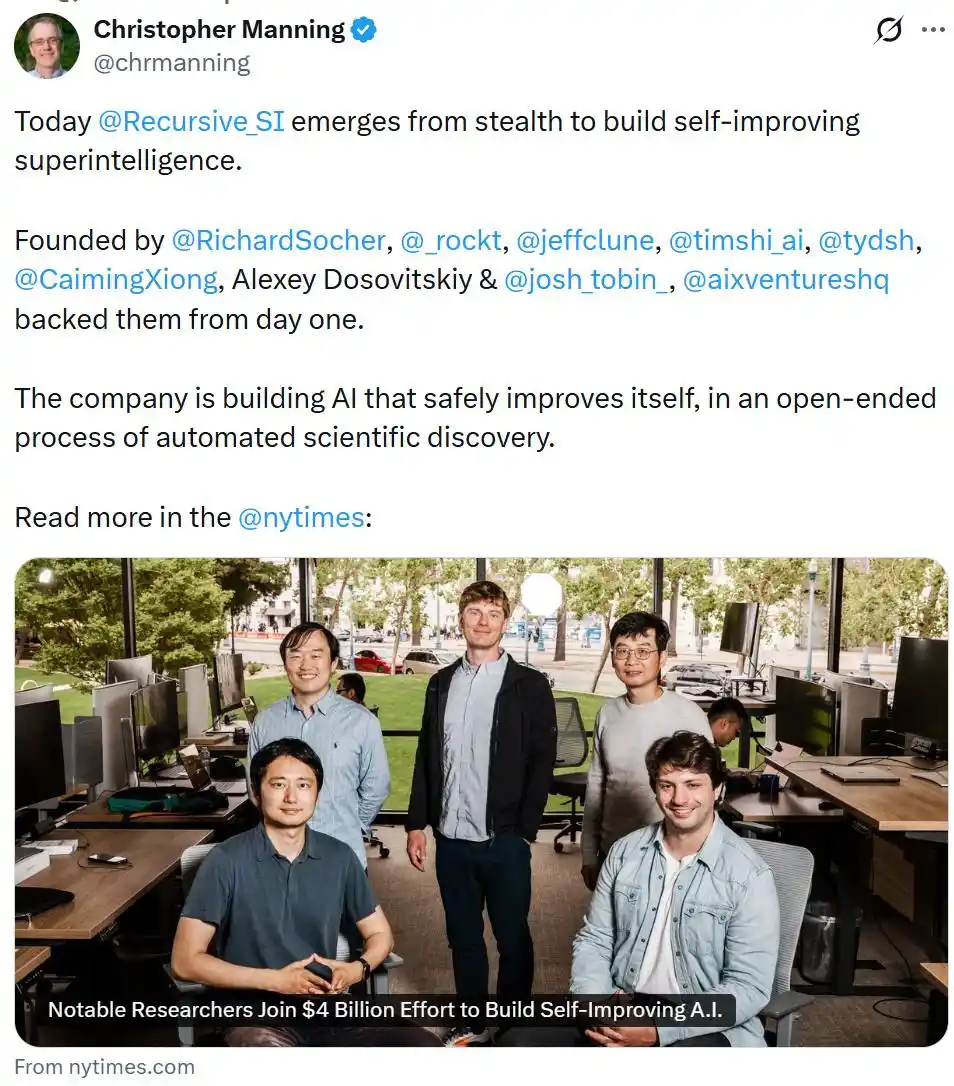
These founding members have previously been involved in establishing AI research labs at Salesforce and Uber, and have held leadership positions at teams such as OpenAI, DeepMind, Google Brain, and Meta, possessing extensive research and entrepreneurial experience.

Recursive_SI is committed to building an artificial intelligence that can autonomously conduct experiments and safely self-improve—continuously evolving within an open-ended, automated scientific discovery process, which is considered the most likely path towards superintelligence.

Currently, Recursive has raised $6.5 billion with a valuation of $46.5 billion, led by GV (Google Ventures) and Greycroft, with significant investments from AMD Ventures and NVIDIA.

The team has grown to over 25 members and continues to expand, having attracted many outstanding talents, including Zhuge Mingchen, who is set to join soon.

Zhuge Mingchen is currently a Founding Member at Recursive. He holds a Ph.D. in Computer Science from King Abdullah University of Science and Technology (KAUST), where he studied under Professor Jürgen Schmidhuber, known as the "Father of LSTM." His research focuses primarily on Coding Agents, Recursive Self-Improvement (RSI), and Next-generation Machine Paradigms.

Since 2023, Zhuge Mingchen has been systematically exploring the direction of Recursive Self-Improvement (RSI).

During the MetaGPT period, he proposed that agents should possess mechanisms for continuous self-optimization and capability evolution, advancing this research direction in subsequent work. Among these, GPTSwarm is considered one of the earliest RSI system paradigms in the LLM era. It was the first to systematically propose and validate a Graph-based Agents framework for self-organizing collaboration, enabling coordination, feedback, and capability evolution among agents through dynamic graph structures. Its core concepts have since been widely adopted by numerous subsequent multi-agent and Agentic AI projects. Agent-as-a-Judge further explored continuous feedback and self-evaluation mechanisms in long-term tasks, attempting to address issues of continuity and stable optimization for agents in complex missions. Research on NeuralComputer further advanced towards next-generation AI system architectures, exploring new machine paradigms that integrate memory, reasoning, and autonomous evolution capabilities.

It can be seen that the research team joining Recursive possesses profound academic experience in the field of recursive self-improvement.

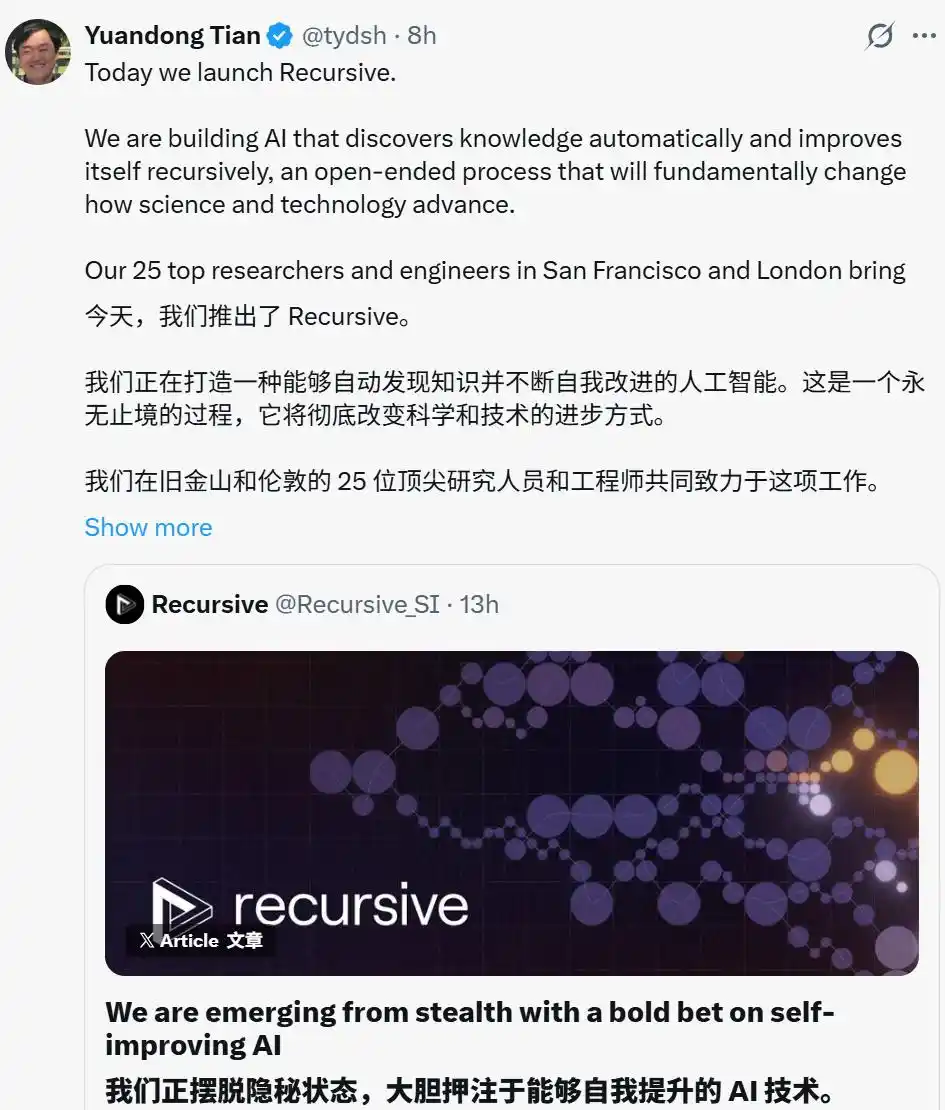
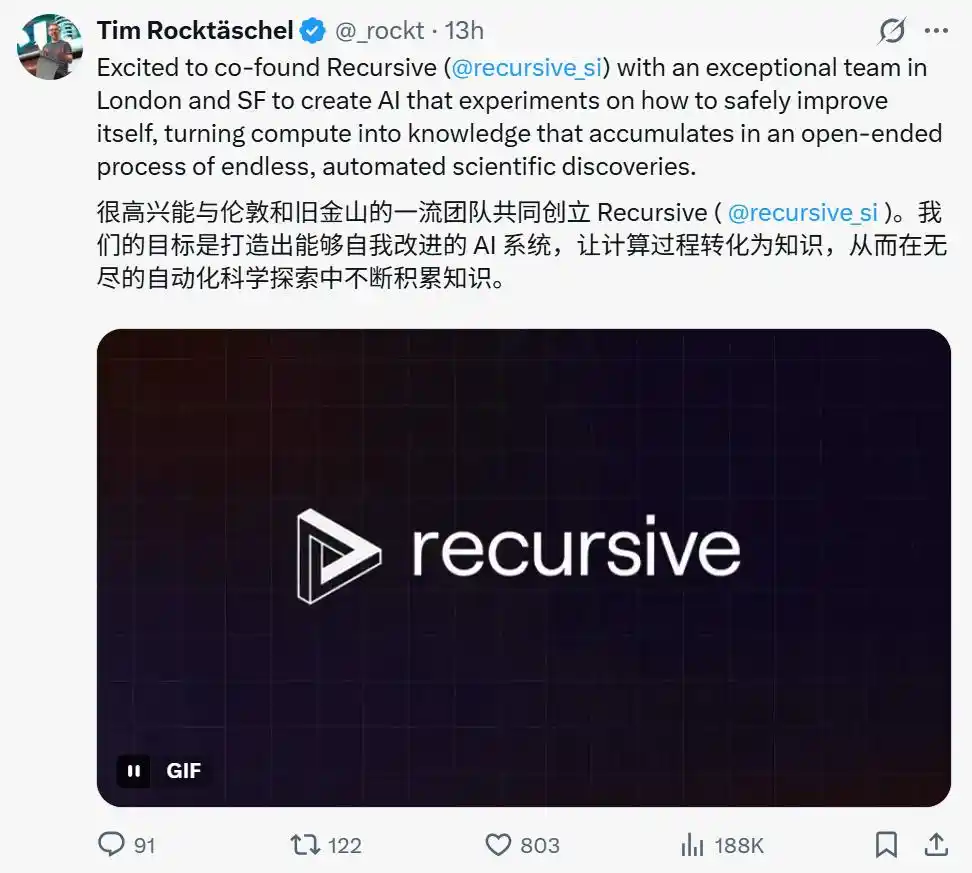
Tian Yuandong and several other founders have promoted the venture on X: "We are building an artificial intelligence that can autonomously discover knowledge and recursively self-improve—this open-ended process will fundamentally change the way science and technology advance."
In several core areas of recursively self-improving artificial intelligence, the team is at the industry forefront.

Members have previously achieved major breakthroughs in fields such as open-ended algorithms, quality-diversity algorithms, AI-generated algorithms, self-improving programming agents, automated red teaming and capability discovery, prompt engineering and its automation, learning challenges and environment generation, foundational world models, deep learning for natural language processing, vision transformers, retrieval-augmented generation, and AI scientists.

Therefore, we are truly filled with anticipation for the upcoming research from Recursive_SI.

This article is from the WeChat public account "机器之心" (Machine Heart), author: 机器之心 (Machine Heart), editor: 机器之心编辑部 (Machine Heart Editorial Department)


Perguntas relacionadas

QWhat is the name of the startup co-founded by Tian Yuan Dong after leaving Meta, and what is its primary mission?

AThe startup is called Recursive_SI. Its primary mission is to build an artificial intelligence that can autonomously conduct experiments and safely self-improve through an open-ended process of automated scientific discovery.

QWho are the key investors in Recursive_SI, and what is the current valuation and funding amount mentioned in the article?

AKey investors include GV (Google Ventures) and Greycroft, with AMD Ventures and NVIDIA also participating in significant funding. The company has raised $6.5 billion with a valuation of $46.5 billion.

QWho is Zhuge Mingchen and what is his research focus, particularly in relation to Recursive Self-Improvement (RSI)?

AZhuge Mingchen is a Founding Member of Recursive_SI, holding a Ph.D. in Computer Science from KAUST under Professor Jürgen Schmidhuber. His research focuses on Coding Agents, Recursive Self-Improvement (RSI), and Next-generation Machine Paradigms. Since 2023, he has systematically explored RSI, contributing to early RSI system paradigms like GPTSwarm and Agent-as-a-Judge.

QWhat are some of the core AI research areas where the Recursive_SI founding team is said to be at the industry forefront?

AThe team is at the forefront in areas including open-ended algorithms, quality-diversity algorithms, AI-generated algorithms, self-improving programming agents, automated red teaming and capability discovery, prompt engineering and automation, learning challenge and environment generation, foundational world models, deep learning for natural language processing, vision Transformers, retrieval-augmented generation, and AI scientists.

QWhich major tech companies' AI research labs have the founders of Recursive_SI been involved in establishing or leading, according to the article?

AThe founding members have been involved in establishing or leading AI research labs at Salesforce and Uber, and have held leadership positions at OpenAI, DeepMind, Google Brain, and Meta.

Leituras Relacionadas

From Banning Doubao to Embracing Honor: Why Did WeChat Suddenly 'Change Its Face'?

The article explores the sudden shift in WeChat's strategy towards AI assistants from mobile phone manufacturers, transitioning from strict opposition to active collaboration. For over a year, WeChat fiercely resisted attempts by phone AI assistants (like ByteDance's Doubao in late 2025) to control its features via GUI automation ("simulated clicking"), citing security and data control concerns. This stance created a significant barrier for system-level AI integration. Now, Tencent has initiated A2A (Agent-to-Agent) partnerships with major phone brands like Honor, Xiaomi, OPPO, and vivo. This model allows a phone's system AI (e.g., Honor's YOYO) to parse a user's voice command and send a structured request directly to WeChat's own internal AI agent via secure APIs. WeChat then executes the action (e.g., sending a message) and returns the result. The article attributes Tencent's "change of face" to strategic pressure. While leading in social app usage, Tencent trails rivals like ByteDance and Alibaba in standalone AI app popularity. WeChat, with its vast mini-program ecosystem, is Tencent's key asset for an AI comeback. The upcoming WeChat AI agent aims to handle tasks like booking and payments within the app. However, phone system assistants remain the primary AI entry point for most users. The A2A collaboration allows Tencent to extend WeChat's AI reach to this crucial system layer while maintaining control over its core functions and data. For phone manufacturers, embracing A2A is a pragmatic move. The GUI route proved unviable due to WeChat's blocks. A2A offers a compliant path to integrate a vital service, enhancing their AI assistants' usefulness. It allows them to focus on developing their own AI ecosystems for other services while cooperating on WeChat access. The collaboration is framed as a mutual, strategic necessity: Tencent gains a distribution channel, and manufacturers gain a key functionality. The partnership relies on a "dual authorization" mechanism for security, requiring both user and app consent for each action. While questions about long-term data privacy practices remain, experts note A2A is more secure and compliant than GUI automation. Ultimately, this cooperation is seen as a tentative, calculated truce. Tencent's long-term goal is to make WeChat an AI-powered "service OS." Phone manufacturers aim to make their system AI the central user interface. Their paths may converge or clash in the future, but for now, the A2A deal represents the opening chapter in the battle for the AI-era user入口, driven by necessity and strategic calculus on both sides.

marsbitHá 38m

From Banning Doubao to Embracing Honor: Why Did WeChat Suddenly 'Change Its Face'?

marsbitHá 38m

On-Chain Figures on the Eve of Kickoff: 1.6 Billion Traded Before the World Cup Even Begins

"On-Chain Numbers on the Eve of the World Cup: $1.6 Billion Traded Before Kick-off" Analysis of on-chain markets before the 2026 FIFA World Cup reveals significant crypto integration into football. The most striking figure is the approximately **$1.6 billion** in total trading volume on the single "World Cup Winner" contract on the Polymarket prediction market platform, accumulated before a single match was played. This represents explosive growth for a sector whose annual volume surged from ~$16B in 2024 to ~$64B in 2025. The ecosystem is maturing beyond speculation. Key developments include: 1) **Infrastructure upgrades** like Polymarket's migration to native, regulated USDC stablecoin for settlements; 2) **Reliable data oracles**, such as Chainlink, being used to resolve real-world match outcomes on-chain; and 3) **Official recognition**, with FIFA appointing its first-ever "Prediction Markets" partner. Over 100 contracts now cover everything from the outright winner to individual match results and even non-sporting risks like venue relocation. This evolution marks a fundamental shift. While crypto firms are absent from FIFA's top-tier sponsor list, the technology has deeply penetrated the tournament's financial and predictive infrastructure through regulated stablecoin settlements, decentralized oracles, and new official partnership categories. The regulatory landscape remains complex and varies by jurisdiction, but on-chain markets for the World Cup are already a multi-billion-dollar reality.

marsbitHá 1h

On-Chain Figures on the Eve of Kickoff: 1.6 Billion Traded Before the World Cup Even Begins

marsbitHá 1h

From SpaceX's IPO to the Future of Crypto: Which Crypto Sectors Will Host the Trillion-Dollar Narrative?

From the SpaceX IPO, which targets a $750 billion raise at a $1.77 trillion valuation, we can extrapolate capital flow trends relevant to crypto. The focus shifts from speculative narratives to foundational infrastructure and real-world asset (RWA) integration. Key crypto sectors poised to benefit include: 1. **AI Infrastructure**: The narrative is moving from consumer-facing AI applications to underlying, scarce resources like compute power and decentralized GPU networks (e.g., TAO, RENDER, AKT, IO). These protocols are positioning as the essential "picks and shovels" providers for the AI economy. 2. **Real-World Assets (RWA)**: Beyond tokenized treasury bonds, RWA's future lies in on-chain equity and pre-IPO assets like SpaceX. This could democratize access to high-growth assets and reshape global capital flows, benefiting infrastructure projects like ONDO, LINK, and Plume that facilitate issuance, data, and liquidity. 3. **Core Financial Infrastructure**: Stablecoins, payment networks, and DePIN (Decentralized Physical Infrastructure Networks) are critical for settling the future on-chain economy. Their role expands from internal trading tools to foundational layers for global finance, AI systems, and real-world asset networks, leading to potential value reassessment. In summary, the next cycle may prioritize long-term infrastructure value—AI compute, asset tokenization networks, and settlement layers—over short-lived application hype, mirroring the broader market's shift towards funding the foundational systems of the future.

marsbitHá 1h

From SpaceX's IPO to the Future of Crypto: Which Crypto Sectors Will Host the Trillion-Dollar Narrative?

marsbitHá 1h

Trading

Spot
Futuros
活动图片