THIS is the stablecoin power angle that nobody is talking about

ambcryptoPublicado em 2026-02-02Última atualização em 2026-02-02

Resumo

Dollar-backed stablecoins are increasingly serving as a tool for the U.S. to extend its monetary influence abroad without physically moving dollars overseas, according to a Rabobank report. When foreign entities demand dollar stablecoins, U.S. issuers convert this demand into Treasury bill purchases, helping fund U.S. deficits at lower rates while digital tokens circulate internationally. This mechanism allows dollars to remain within the U.S. financial system while still facilitating global trade. Non-USD stablecoins are also gaining traction, with their supply surging 260% over the past year to a combined market cap of $1.55 billion, though they remain small compared to dollar-pegged alternatives. A key application driving adoption is crypto-backed payment cards, which have grown into an $18 billion market. Monthly transaction volumes have increased from $100 million in early 2023 to over $1.5 billion, growing at an annual rate exceeding 100%. These cards operate on top of traditional networks like Visa and Mastercard, using stablecoins to settle transactions in the background while maintaining a familiar user experience. In summary, dollar-backed stablecoins are expanding U.S. monetary power digitally without exporting physical dollars, while crypto payment infrastructure accelerates their real-world use.

Dollar-backed stablecoins are now more than just a crypto payment tool. Recent reports say that they may also be helping the U.S. extend dollar influence abroad, in a way that keeps real capital at home.

Here’s what you need to know.

Stablecoins – A secret weapon?

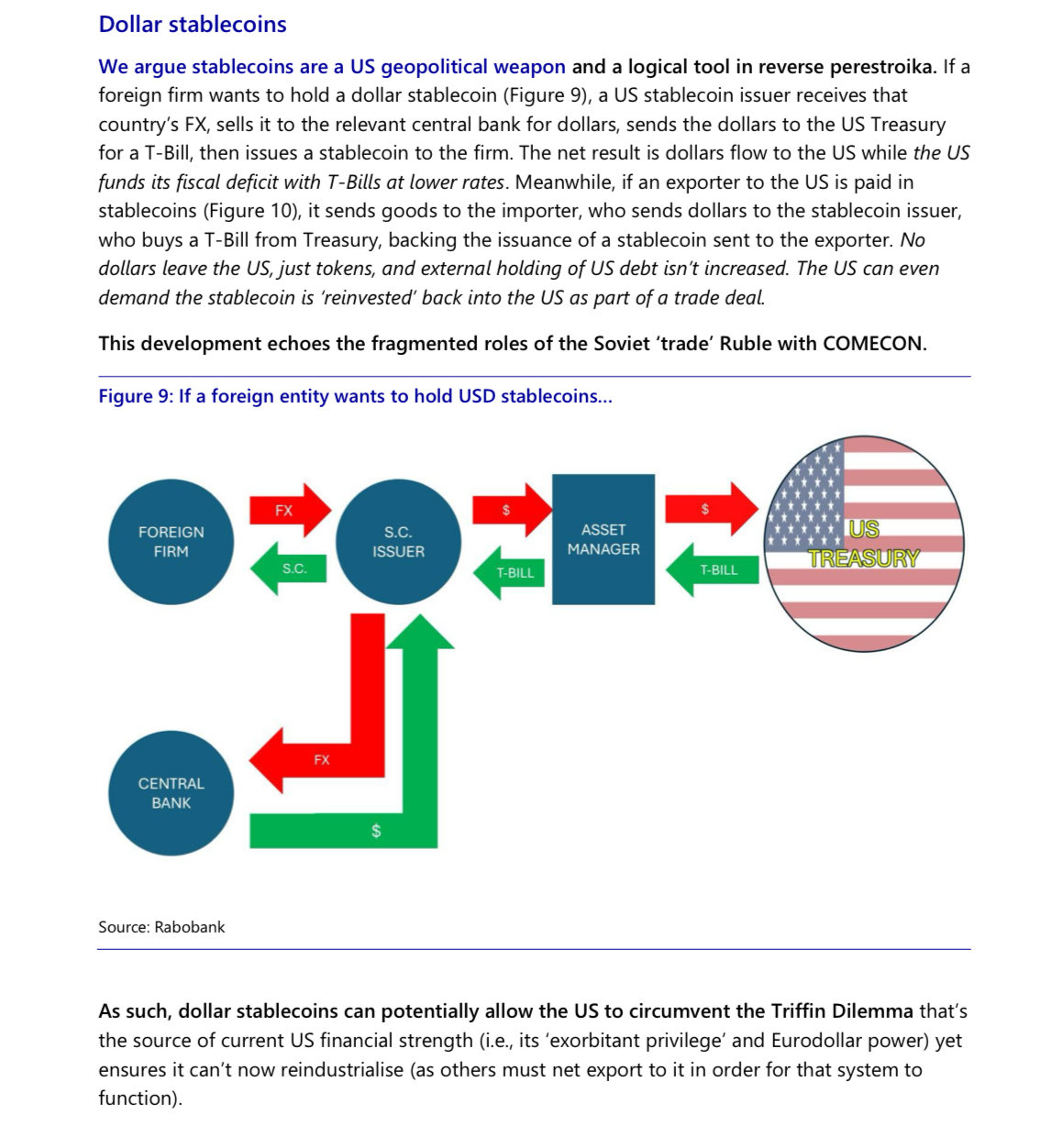
A report by Rabobank has stated that dollar-backed stablecoins are spreading dollar influence, without letting real dollars leave the country.

Source: X

The idea is that when a foreign firm wants a dollar stablecoin, a U.S. issuer converts that demand into Treasury bill purchases. Dollars flow back to the U.S. government, helping fund deficits at lower rates, while the firm gets digital dollars instead of cash.

In trade, it goes a step further. U.S. importers can pay exporters in stablecoins, while the underlying dollars stay parked in Treasuries. Only tokens move across borders.

With comparisons to the Soviet-era trade ruble, dollars are exported digitally… all while keeping the power at home.

Non-dollar stablecoins step up

That growing influence hasn’t gone unnoticed, with non-USD-pegged alternatives gaining ground.

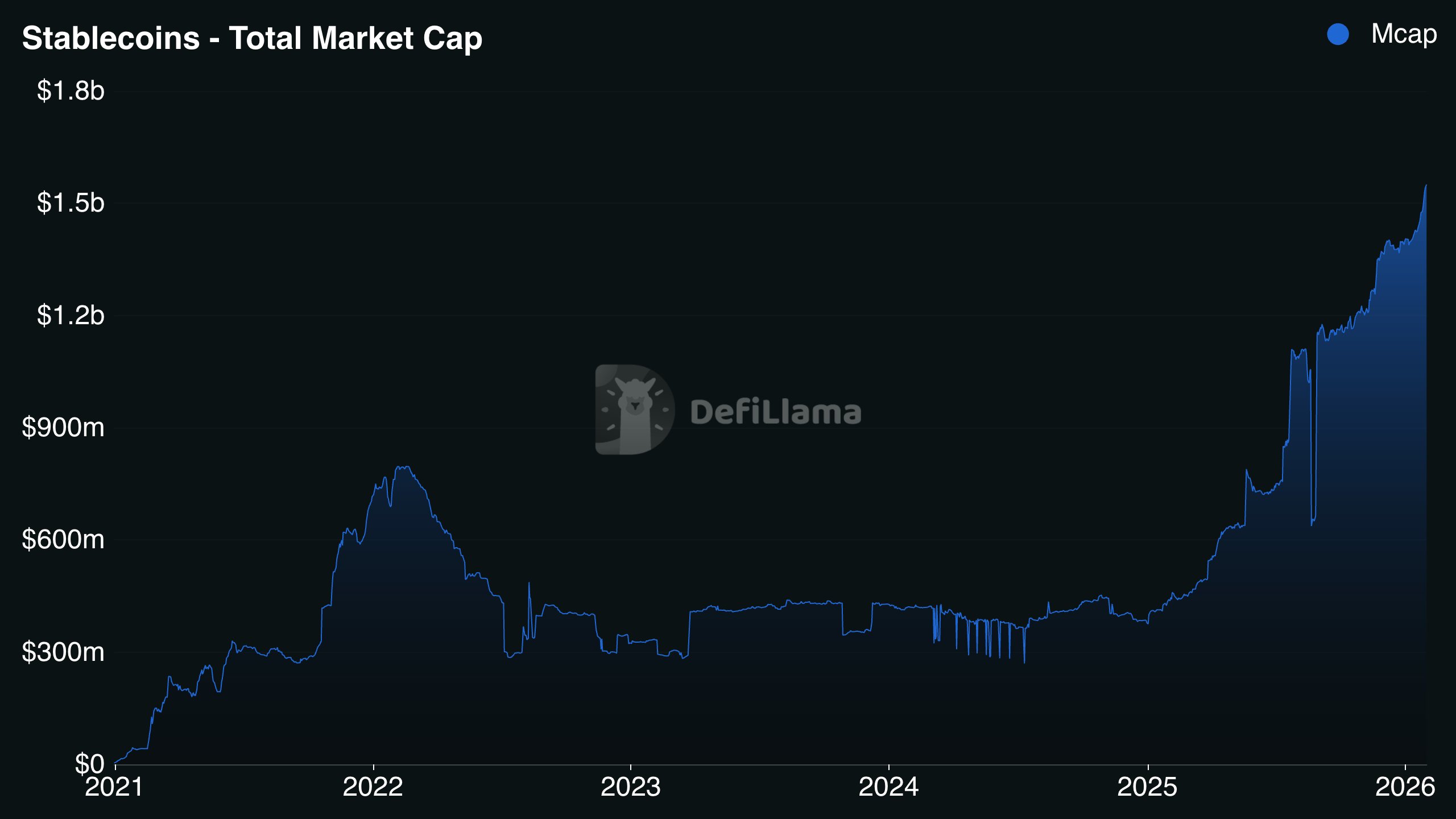
For long, more than 99% of stablecoins were pegged to the U.S. dollar. That number is now decreasing at the margins.

Over the past year, non-USD stablecoins have surged 260% in supply, pushing their combined market cap to about $1.55 billion.

Source: X

It’s still small next to dollar-backed giants, but it certainly matters.

All of this theory matters because…

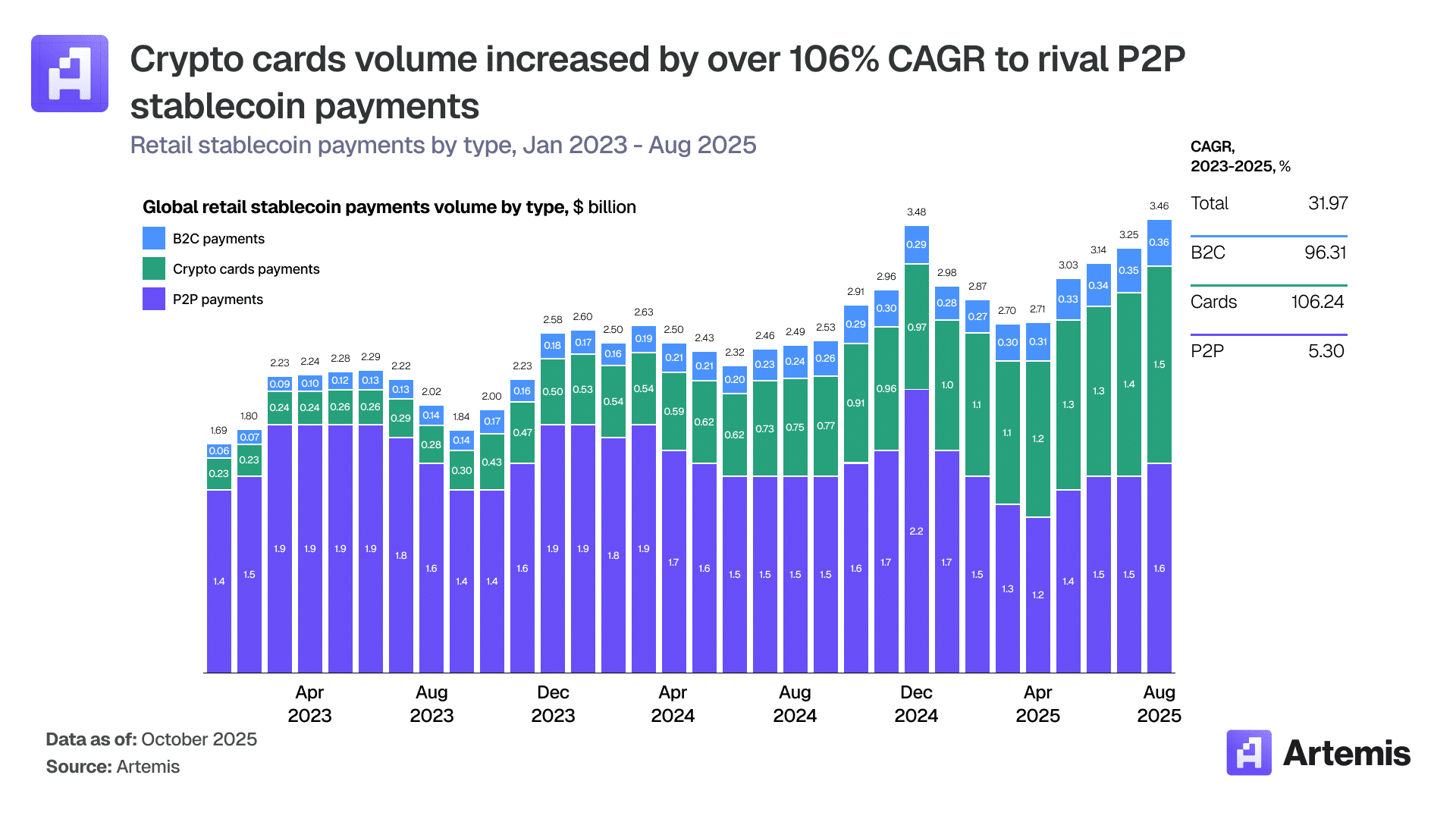
…it’s already showing up in day-to-day payments. One of the fastest-growing payment modes for stablecoins right now is crypto cards.

Source: X

Once a niche product, crypto cards are now an $18 billion market.

Monthly volumes went from about $100 million in early 2023 to over $1.5 billion today, growing at a 100%+ annual rate.

Source: X

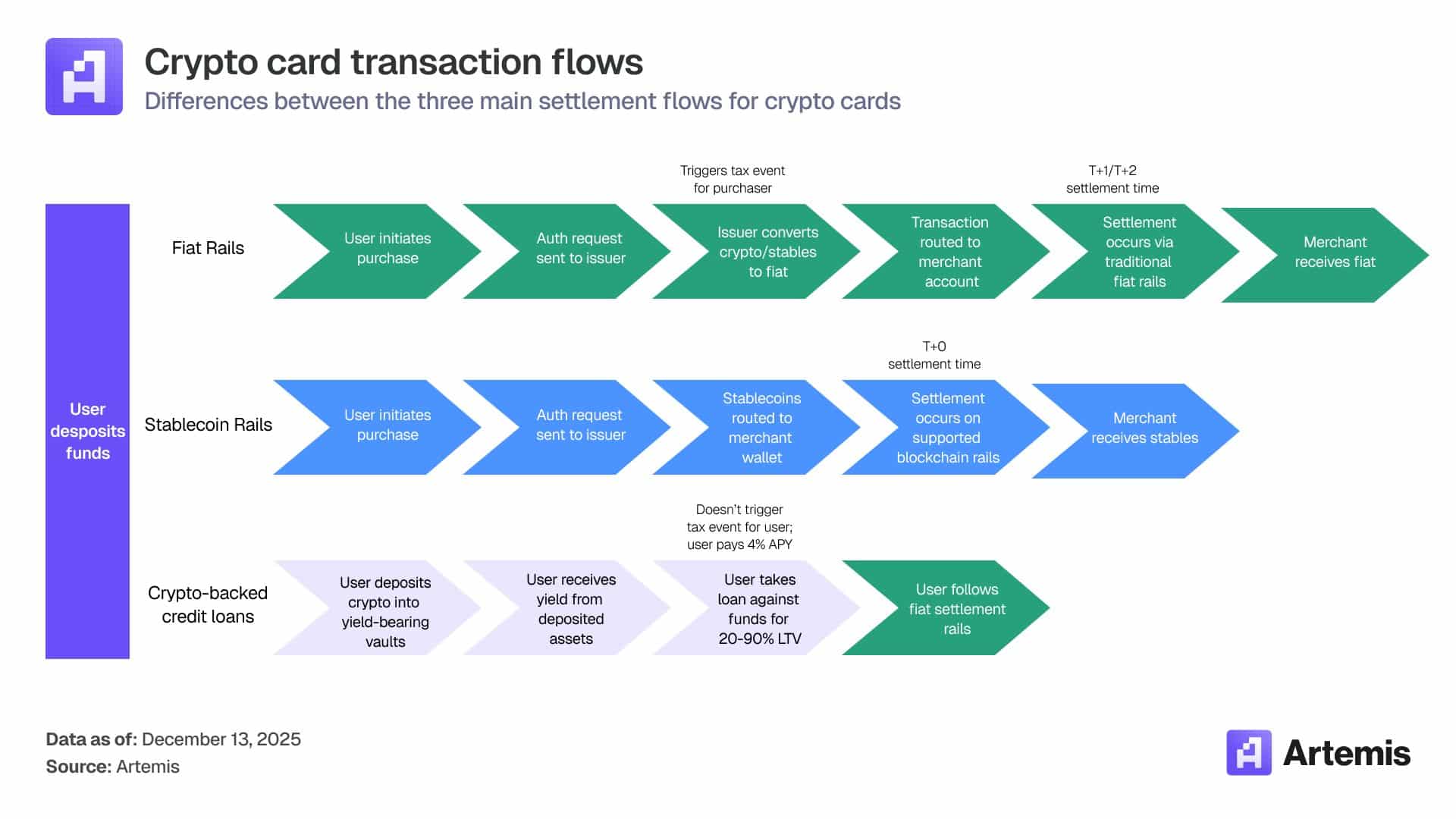
Importantly, these cards don’t replace Visa or Mastercard.

Rather, they sit on top of them. Stablecoins fund the transaction in the background, while card networks handle acceptance. For users and merchants, what looks like normal payments are actually digital dollars doing the work.


Final Thoughts

  • Dollar-backed stablecoins are exporting U.S. monetary power, without exporting actual dollars.
  • As crypto cards grow, digital dollars are moving fast.
Next: BONK drops 18% as memecoins slide – Is another leg down coming?
Share
  • Share
  • Tweet

Perguntas relacionadas

QHow are dollar-backed stablecoins helping the U.S. extend dollar influence abroad without exporting real dollars?

ADollar-backed stablecoins allow foreign firms to obtain digital dollars while U.S. issuers convert that demand into Treasury bill purchases. This keeps actual dollars within the U.S., helping fund deficits at lower rates, while only tokens move across borders.

QWhat is the current market trend for non-USD-pegged stablecoins?

ANon-USD stablecoins have surged 260% in supply over the past year, reaching a combined market cap of approximately $1.55 billion, though they remain small compared to dollar-backed stablecoins.

QHow are crypto cards contributing to the growth of stablecoin payments?

ACrypto cards, now an $18 billion market, use stablecoins to fund transactions in the background while leveraging traditional card networks like Visa or Mastercard for acceptance. Monthly volumes grew from $100 million in early 2023 to over $1.5 billion, with a 100%+ annual growth rate.

QWhat role do U.S. Treasury bills play in the stablecoin ecosystem?

AWhen foreign demand for dollar stablecoins arises, U.S. issuers purchase Treasury bills with the incoming dollars, effectively recycling foreign demand into U.S. government debt and keeping capital domestically parked.

QWhy are non-USD stablecoins gaining traction despite the dominance of dollar-backed options?

ANon-USD stablecoins are growing as alternatives to reduce reliance on U.S. dollar influence, with a 260% supply increase reflecting heightened interest in diversified digital currency pegs.

Leituras Relacionadas

Bitcoin's 'Rally Ends,' Officially Entering the Later Stage of a Bear Market?

Bitcoin prices declined 13% this week, reversing the recent rebound and signaling a likely transition into the later stages of a bear market. Key on-chain metrics deteriorated, with the short-term holder cost basis falling below the Realized Price—a pattern last seen in early 2022, characteristic of bear market maturity. The rally to ~$82k proved to be a bear market bounce, as evidenced by the 90-day realized profit/loss ratio failing to sustain above the bullish threshold of 2. Daily realized losses surged to $1.35B, including significant selling from long-term holders who accumulated near cycle tops, indicating ongoing supply redistribution. Price was rejected almost precisely at the aggregate US spot ETF cost basis of ~$83k, turning that level into resistance and leaving the average ETF investor underwater again. Spot market selling pressure intensified, with the 7-day volume delta turning significantly negative to its weakest level since February. While a major long liquidation event cleared over $400M in leverage, spot demand has not yet stepped in to absorb the resulting supply. Options markets continue pricing in higher future volatility (elevated volatility risk premium) and maintain a skew toward put options, reflecting persistent demand for downside protection, though not yet panic. Overall, market structure remains fragile. Sustained recovery likely requires a reclaim of the ETF cost basis, a shift back to positive spot demand, and a slowdown in realized loss-taking. Until then, the market risks further downside or extended consolidation within the broader bear trend.

Foresight NewsHá 1h

Bitcoin's 'Rally Ends,' Officially Entering the Later Stage of a Bear Market?

Foresight NewsHá 1h

How Risky is the "Death Spiral" of MSTR and STRC?

Summary: This article explores the perceived "death spiral" risk between MicroStrategy (MSTR), its Bitcoin holdings, and its perpetual preferred stock (STRC), drawing comparisons to the LUNA-UST collapse. While both systems feature price anchors, high yields for holders, and potential feedback loops, their core mechanisms differ fundamentally. The MSTR-STRC structure relies on continuous financing to sustain its high dividend payouts, primarily through stock ATM offerings. A negative feedback cycle could occur: falling MSTR stock price makes raising equity capital harder, increasing pressure to sell Bitcoin, which undermines STRC confidence and further depresses MSTR. However, unlike LUNA-UST's automated, direct linkage, the MSTR-STRC loop is weaker and has brakes: STRC dividends can be deferred or rates lowered, and STRC holders have a $100/share liquidation preference in bankruptcy, providing a price floor. The company's sustainability hinges on its ability to continue financing. Its current ~$900 million USD reserves cover only about 6.3 months of its ~$1.71 billion annual interest/dividend burden. The next six months are critical, aligning with both the potential bottom in Bitcoin's four-year cycle and the depletion timeline of its reserves. While a LUNA-style catastrophic collapse is deemed highly unlikely due to structural differences, the key question is whether MicroStrategy can navigate this period through healthy deleveraging to restart its capital engine.

Foresight NewsHá 1h

How Risky is the "Death Spiral" of MSTR and STRC?

Foresight NewsHá 1h

Trading

Spot
Futuros
活动图片