This Generation of East Asian Ordinary People Getting Rich Thanks to TSMC and AI-Related Korean Stocks

marsbitPublicado em 2026-06-22Última atualização em 2026-06-22

Resumo

The article describes how the global AI boom, driven by demand for semiconductors, is creating newfound wealth for ordinary young investors and professionals in East Asia, particularly in South Korea and Taiwan. Fueled by massive capital expenditure from tech giants, the surge in AI-related exports has propelled stock markets in South Korea, Taiwan, and Japan to significant gains. This has led to a widespread retail investing frenzy. In South Korea, individuals like 24-year-old programmer Na Se-bin and 35-year-old teacher Choi Sung-ho are investing heavily and seeing substantial returns, altering their spending habits. In Taiwan, the chipmaker TSMC, a dominant force in advanced manufacturing, is central to the economic euphoria, offering high salaries and social prestige. The company's stock surge has significantly boosted the local market. The phenomenon extends to Japan, where even companies in seemingly unrelated sectors are benefiting from the AI supply chain. The narrative highlights a region capitalizing on its role as the essential hardware provider for the AI "gold rush," with its tech giants acting as the "sellers of shovels." This has translated into rapid wealth accumulation, a booming luxury market, and a pervasive culture of stock trading among everyday people, including younger generations.

Originally fromThe Wall Street Journal

Compiled by / Odaily Planet Daily Golem(@web 3_golem)
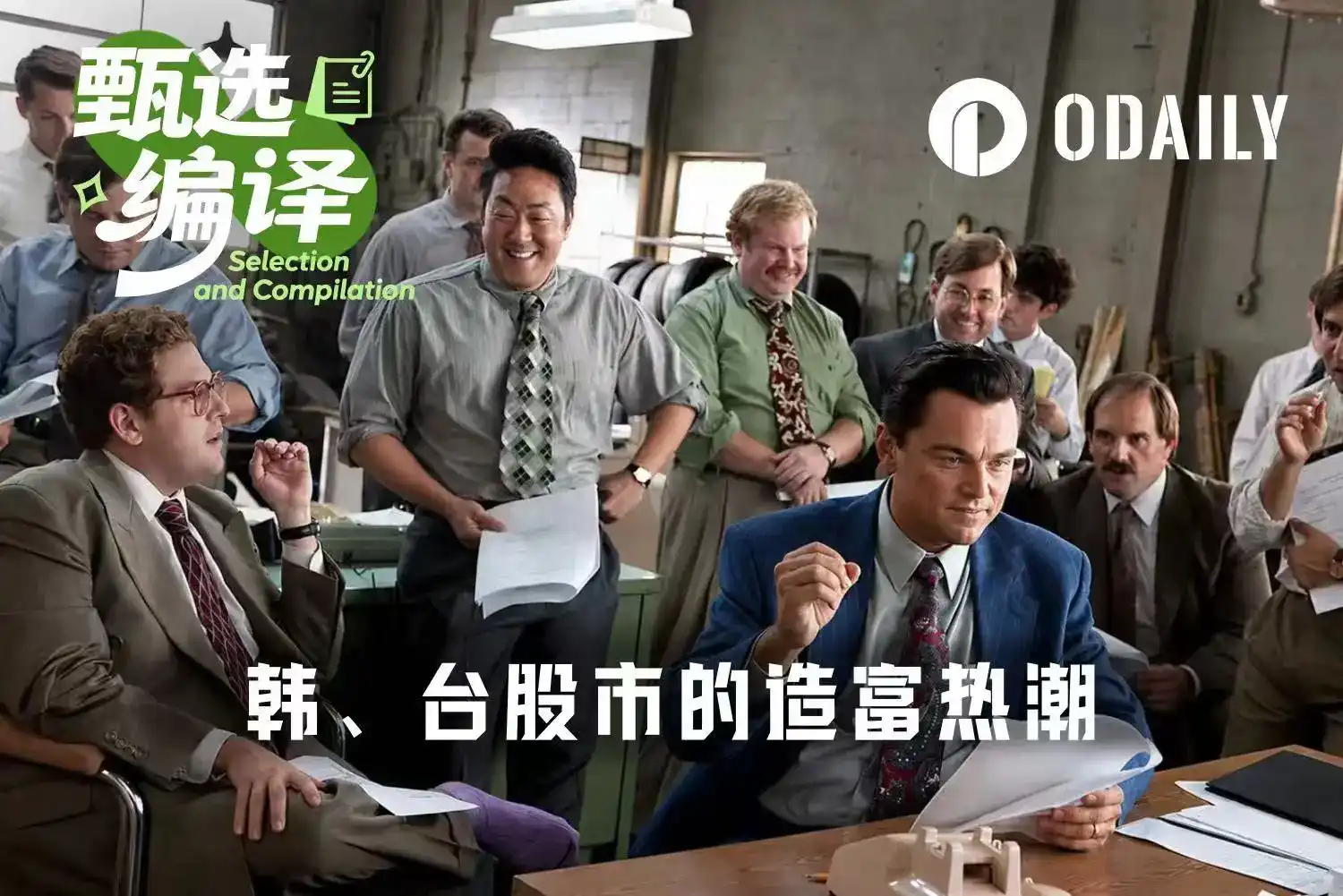
Na Se-bin has completely lost her sense of consumption.

Since January this year, attracted by the global AI boom, she has poured almost her entire life savings (about $47,000) into the stock market, a frenzy that is filling the coffers of tech giants in South Korea, Taiwan, and Japan.

The 24-year-old South Korean programmer says that during sharp market swings, she has made or lost the equivalent of a month's salary in a single second. Despite the huge risks, she can't resist, especially after seeing the stock she holds double in price. South Korea's stock market has been one of the world's best performers over the past 18 months, and Na jokes with her colleagues that they should sell their underwear to buy more stocks.

"Even friends who never touched stocks before are now starting to jump in," Na says. "Everyone is speculating on something."

Na Se-bin, a 24-year-old software developer in Seoul, started investing in January this year and quickly became addicted. (Image credit: Tim Franco for The Wall Street Journal)

Trillions of dollars are pouring into the global construction of AI, which relies on the semiconductors and chip-making technology supplied by a handful of Asian exporters. The surge in global chip demand seems endless, fueling export growth, corporate profits, and wealth for many investors.

Even after recent pullbacks, Taiwan's stock market has still doubled in value over the past year, South Korea's has tripled, and Japan's Nikkei index has risen over 80% in the same period, three times the gain of the S&P 500.

The accelerating demand for AI-related products is stimulating investor enthusiasm and pushing up wages. In Taipei, taxi drivers even trade stocks while driving, and in the job market, the high salaries in the tech industry are enviable. Nowadays, one of the most effective "pick-up lines" in Taiwan is to tell someone you work for Taiwan Semiconductor Manufacturing Co. (TSMC), the world's largest chip foundry and also one of the most generous local employers. Employees in the memory-chip division of South Korea's Samsung Electronics are expecting an average bonus of about $400,000 this year. The company is forecast to generate more profit by 2026 than any global company except Nvidia.

Whether AI services from OpenAI's ChatGPT, Anthropic, and SpaceX can deliver on the promise of commercialization, this part of the tech sector seems destined to benefit. These Asian tech giants, which provide indispensable hardware for the AI industry, are the "shovel sellers" of the AI gold rush.

The four Silicon Valley hyperscale data centers — Microsoft, Meta Platforms, Amazon, and Alphabet's Google — plan to spend up to $670 billion this year on AI-related capital expenditures. This spending far exceeds the inflation-adjusted expenditure of the U.S. railroad expansion in the 1850s and the decades-long construction cost of the U.S. interstate highway system launched a century later.

According to an Allianz Trade report, global exports of AI-related products reached nearly $4 trillion last year, with Asia accounting for two-thirds. These products include semiconductors, data storage servers, and cooling systems.

Market research firm Gartner predicts that direct spending in the AI field (covering services, infrastructure, and software) is expected to reach $2.6 trillion this year, a 47% increase from 2025. Next year, that number is forecast to reach about $3.5 trillion.

Nvidia CEO Jensen Huang recently concluded an 18-day high-profile visit, participating in a series of events, speeches, and business meetings in Taiwan and South Korea.

In Taipei, convenience stores sell lottery tickets with a top prize of 500 shares of Nvidia stock. Huang announced plans to invest $150 billion annually in Taiwan, which he called the center of the AI revolution. In South Korea, Huang signed cooperation agreements with local companies in robotics, memory chips, and AI.

During Huang's visit to Seoul, the KOSPI index halted trading on June 8 after plunging more than 8%, following a sell-off in U.S. chip stocks (including Nvidia). Huang, wearing his signature leather jacket even in Seoul's summer heat, was unfazed by the stock drop.

"People should be very happy with the current stock prices," he said. "Because now you can buy stocks more cheaply."
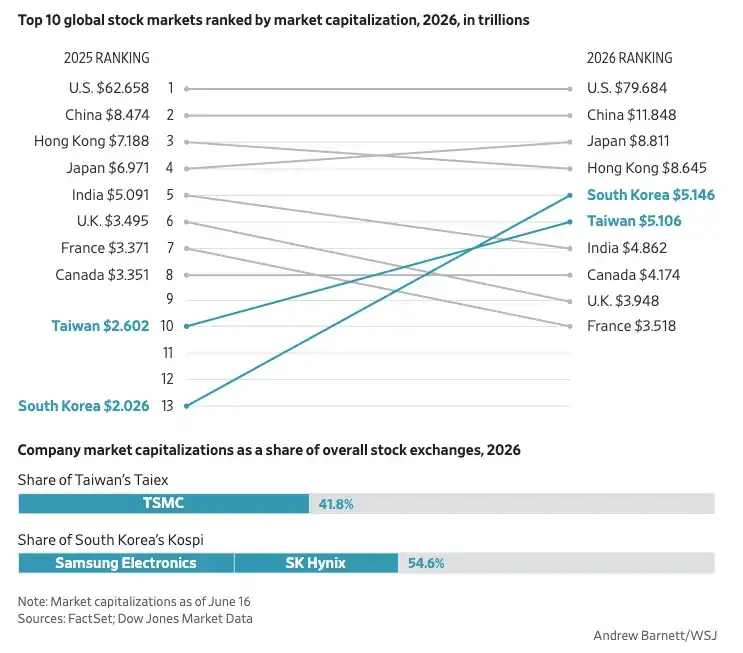
Global Top 10 Stock Market Capitalizations in 2026 and the Share of TSMC and SK Hynix in Their Respective Market's Total Capitalization

Na only started trading stocks this year. She estimates that over 80% of her social circle actively invests, as do her colleagues. One colleague, she says, made enough money from stock investments to spend tens of thousands of dollars on an engagement ring.

Now, Na is "extravagant" when it comes to concert tickets, branded clothing, and treating her parents to meals. She planned to buy a gold ring for her mother to celebrate her parents' 30th wedding anniversary, but her mother declined.

"She told me to just give her cash," Na said, "so she could buy stocks."

TSMC, Put on a Pedestal

Ye Lunhao, a 37-year-old insurance agent, invests more than half of his roughly $2,100 monthly salary in local AI and chip-related companies. His investment returns have quadrupled, and he recently bought a $440,000 four-bedroom apartment in Taichung, Taiwan.

For years, his friends steered clear of stock market investing. Now, they all ask him for investment advice.

37-year-old insurance agent Ye Lunhao sits in the lobby of his apartment building in Taichung, Taiwan. Photo by Lin Yifei for The Wall Street Journal

"Without semiconductors, none of this would have happened," Mr. Ye said. "Investing has freed me from mere drudgery and given me a chance to enjoy the beauty of this world."

TSMC is the main driver of Taiwan's stock market surge. According to tech market research firm Counterpoint Research, the company captured over 90% of revenue share in the most advanced chip manufacturing last year. TSMC is the world's seventh-highest valued company, with a market cap exceeding $2.2 trillion, surpassing Tesla and Meta.

The company's stock price has more than doubled in the past year, pushing Taiwan's benchmark index past markets like France, the U.K., and India.

The chipmaker accounts for over 41% of Taiwan's benchmark index. In comparison, the seven tech giants Apple, Microsoft, Alphabet, Amazon, Nvidia, Meta, and Tesla combined account for about one-third of the S&P 500.

TSMC engineers' salaries can be three times the low end of what other companies pay for similar roles. Choc Chiang, co-founder of Taipei recruitment platform WeFer, said some managers poached by TSMC from smaller companies saw salary increases of up to 30%.

Wang Canlong, owner of an upscale liquor store in Zhubei, Taiwan, has supplied TSMC numerous times. He said he once sold a bottle of Napa Valley whiskey to TSMC founder Morris Chang. Now, his store is too small to meet TSMC's demands. "We look up to them," he said. "With awe and respect in our hearts."

Wang Canlong, owner of a liquor store in Zhubei, Taiwan, has sold large quantities of alcohol to TSMC. (Lin Yifei/The Wall Street Journal)

Wang Weiwen earned an engineering degree in Taiwan. Part of his coursework was visiting a TSMC factory where the base salary was about $62,000 a year. He said such a salary level was simply unheard of. "Every household talks about TSMC."

He is now a graduate student at the University of Michigan, and TSMC recruiters have also called him. Wang Weiwen has concerns about the company's heavy workload, but he sees benefits beyond the hefty paycheck. The social status that comes with being a TSMC engineer is highly attractive to Taiwanese parents who are very picky about their daughters' suitors.

Mr. Wang said, "Your opening line can simply be 'You work at TSMC.'"

Products bearing the TSMC logo also command high prices in the secondary market. A rice cooker with the company logo and circuit board motif sells for about $312 on e-commerce platforms, more than four times the price TSMC employees pay. Buyers scramble for TSMC-branded luggage, thermoses, and shoes. Even the envelope for holiday red packets received by TSMC employees can be sold online for nearly $15 each.

A Carnival for Ordinary People

The South Korean market is dominated by two chip giants, Samsung and SK Hynix, which dominate the production of the two main types of memory chips used in AI computing and data storage.
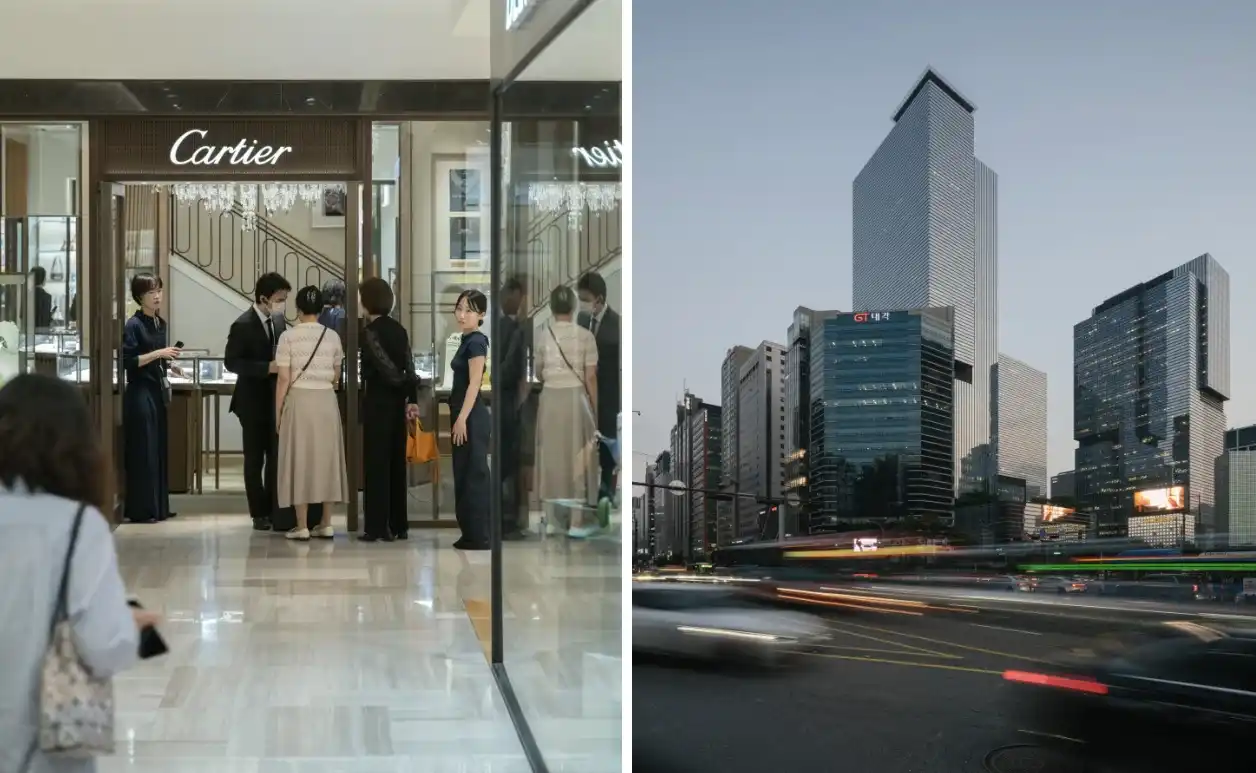
Customers line up outside a Cartier boutique inside the Shinsegae Department Store in Seoul; Samsung Electronics campus. Tim Franco for The Wall Street Journal

Both companies recently surpassed the trillion-dollar market cap mark, accounting for over half of the total market capitalization of South Korea's KOSPI index. KOSPI was the world's best-performing index last year and continues to lead global rankings this year.

Choi Sung-ho, 35, an ordinary elementary school teacher, is another beneficiary of the Korean stock market. Over the past year, his Korean stock portfolio grew nearly fivefold, exceeding $300,000, including investments in ETFs tracking semiconductor stocks. He says he has upgraded his mobile devices and plans to spend six figures on his next car, perhaps a Mercedes S-Class or Tesla Model X.

"Even the kids at my school are saying their parents are happy with stock gains," Choi said.

In the first quarter of this year, South Korean brokerage Toss Securities opened over 180,000 trading accounts for children aged 18 and under. These accounts require parental approval to open and allow children to trade independently. Recently, the company launched a promotion offering $14 in "experience money" to newly opened accounts for high school students.

On YouTube, the "ETF-explaining Bro" channel is one of the emerging "finfluencer" media that offer market advice. Channel owner Park Soo-in says the channel has attracted over 127,000 followers since launching in July last year. "Many people seem to think this rally will continue," she said.

The stock market surge has further boosted an already strong luxury market. The Cartier boutique inside a major Seoul department store is so crowded that part of its "D'Amour" jewelry collection is now only available online.

Lim Chae-hoon, sales manager at a BMW dealership in Seoul, said his customers often mention their profits from the stock market rise. "There are definitely more people with money to spare now," he said.

Lim Chae-hoon, sales manager at a BMW dealership in Seoul, says customers now feel flush with cash. Tim Franco for The Wall Street Journal

In Japan, Toyota Motor held the title of highest-valued company for 22 consecutive years but was surpassed this month by SoftBank Group, which has made huge bets on OpenAI and data centers.

SoftBank's reign didn't last long. Last Friday, a little-known memory chip maker, Kioxia, jumped to the top spot. A year ago, Kioxia's stock was around $14; now it's about $600. Kioxia's success has sparked investor hunting for the next potential stock market blockbuster.

Even Japan's luxury bathroom fixture maker TOTO is profiting from the AI boom. Its high-tech ceramics are used to hold silicon wafers still while circuits are etched. The company's stock has more than doubled.

Another company, Ajinomoto, uses a byproduct from its world-famous umami seasoning to make insulating films for AI chips. Its stock is up 50%.

Ryoki Nao, a 21-year-old top student in semiconductor engineering at a university in Kumamoto, Japan, says his classmates are investing, but he isn't. While he follows market trends, he plans to graduate, find a job, and then consider investing.

"I want to wait until I can earn a decent income before investing," he said, but the stock market frenzy might not wait for him.

Criptomoedas em alta

Perguntas relacionadas

QWhat are the main AI-related companies driving the wealth boom for ordinary people in East Asia, as described in the article?

AThe main companies are TSMC (Taiwan Semiconductor Manufacturing Company) in Taiwan, and Samsung Electronics and SK Hynix in South Korea. These companies are key suppliers of semiconductors and chip manufacturing technology essential for the global AI infrastructure boom.

QWhat evidence does the article provide to show how deeply the stock market and AI investment craze has penetrated everyday life in South Korea and Taiwan?

AThe article provides multiple examples: In Taiwan, telling someone you work at TSMC is a highly effective pickup line, and taxi drivers trade stocks while driving. In South Korea, people are joking about selling their underwear to buy more stocks, a teacher reports his school children talking about their parents' stock gains, and securities firms are opening thousands of trading accounts for minors.

QAccording to the article, what role do TSMC, Samsung, and SK Hynix play in the global AI 'gold rush'?

AThey play the role of the 'shovel sellers' in the AI gold rush. They provide the indispensable hardware—semiconductors and memory chips—that powers AI development and data centers, profiting from the massive capital expenditure by tech giants regardless of which AI service companies ultimately succeed.

QWhat significant statement did NVIDIA's CEO Jensen Huang make about Taiwan during his visit, as mentioned in the article?

AJensen Huang announced plans to invest $150 billion annually in Taiwan, calling it the center of the AI revolution. His high-profile visit underscored Taiwan's critical role in the global AI supply chain.

QHow has the AI boom indirectly benefited seemingly unrelated Japanese companies like TOTO and Ajinomoto?

AThe AI boom has created demand for their specialized materials. TOTO's high-tech ceramics are used to hold silicon wafers steady during chip manufacturing, and Ajinomoto uses a byproduct from its flavor enhancer production to make insulating films for AI chips, leading to significant stock price increases for both companies.

Leituras Relacionadas

Zoomex X Space Recap With Djibril Cissé and the World Cup Trading Panel

Zoomex hosted a World Cup-themed X Space with Champions League winner Djibril Cissé and four crypto traders, discussing pressure management, analysis, and philosophy, and launching a charity pledge. Cissé emphasized embracing pressure in critical moments, drawing from his experience taking a penalty in a Champions League final. The traders agreed that managing stress comes from systematic preparation and clear risk parameters before executing a trade. The conversation explored parallels between football and trading. Cissé highlighted pace as his key weapon, but stressed that output (goals) matters more than tools. The traders debated timing versus speed of execution, concluding that timing is paramount and relative to one's timeframe. Discussing resilience, Cissé shared his mindset after major injuries: focusing on recovery and finding the positive. Similarly, traders emphasized learning from losses rather than avoiding them. Cissé declined to speculate on alternate histories, like France's 2006 World Cup run without his injury, stating one must work only with reality—a principle directly applicable to trading. In a lighter segment, traders mapped cryptocurrencies to national teams (e.g., Bitcoin to Brazil/France). The core lesson was that high performers, in both fields, thrive on uncertainty by relying on tested systems and focusing solely on actionable information. The session was part of Zoomex's World Cup Impact Pledge, which includes charity donations tied to guest predictions.

TheNewsCryptoHá 4m

Zoomex X Space Recap With Djibril Cissé and the World Cup Trading Panel

TheNewsCryptoHá 4m

Fed Turns Hawkish, Wall Street Capitulates, Citi Stands as 'Last Holdout': Insists on Resuming Rate Cuts in October

Amid a surprisingly hawkish shift from the Fed and most of Wall Street capitulating on rate cut expectations, Citigroup stands as a notable outlier, holding firm to its forecast for monetary easing to restart this October. Following the June FOMC meeting, where the "dovish bias" was removed and the dot plot shifted dramatically, markets priced in nearly 37bps of tightening for 2026. Major banks like Deutsche Bank and Goldman Sachs revised their calls, predicting rate hikes as soon as September. Citigroup, however, maintains a baseline scenario for a 25bps rate cut in October, followed by two more cuts in December and January 2027. Its counter-consensus view rests on three key arguments: 1) Plunging oil prices are eliminating a major inflation upside risk. 2) Rising initial jobless claims are mirroring seasonal weakening patterns seen in 2024-2025, signaling a labor market cool-down. 3) The strong core PCE is an "outlier," heavily influenced by AI-related prices and equity market gains rather than broad consumer price pressures, with other inflation metrics showing more moderation. While Wall Street largely "surrenders" to the hawkish Fed narrative, with Deutsche Bank forecasting two hikes and Goldman Sachs warning of potential back-to-back moves, Citigroup remains the "last holdout," betting that disinflationary forces will pave the way for cuts before year-end.

marsbitHá 5m

Fed Turns Hawkish, Wall Street Capitulates, Citi Stands as 'Last Holdout': Insists on Resuming Rate Cuts in October

marsbitHá 5m

Open Systems Will Ultimately Prevail: Why Ethereum Is the Next Linux?

The article "Open Systems Will Ultimately Prevail: Why Ethereum Is the Next Linux?" argues that Ethereum, like Linux before it, will triumph over closed, proprietary systems in finance due to its open, permissionless, and credibly neutral nature. It draws a historical parallel: just as the open internet defeated corporate private networks and Linux outcompeted proprietary Unix systems, open financial infrastructure like Ethereum will surpass private blockchains. The core advantage lies in the "bazaar" development model (as described in Eric Raymond's "The Cathedral and the Bazaar"), where decentralized, permissionless innovation by a global community of developers outpaces the controlled "cathedral" approach of centralized entities. This model fosters rapid innovation, as seen with Ethereum standards like ERC-20 and applications like Uniswap, which were built without needing permission. Ethereum's key, irreplicable strength is its credible neutrality: transparent, equally applicable, immutable rules that allow anyone to participate. This ensures sovereign independence, meaning no single entity (company, government) can control or change its core rules—a critical feature for global financial infrastructure. In contrast, private blockchains and consortium chains (like SWIFT or various bank-led projects) suffer from platform risk, central control, and an inability to attract broad developer ecosystems, leading to frequent failures. The article notes that major institutions (e.g., BlackRock, JPMorgan, Coinbase, Robinhood) are already building on Ethereum or its Layer 2 networks, recognizing its security, developer ecosystem, and network effects. While critics argue finance requires accountable, controlled systems, the response is that compliance (KYC, regulations) can be built at the application layer on top of a neutral settlement layer like Ethereum, just as secure commerce was built on the open internet via HTTPS. Ultimately, the thesis is that attempting to build walled-garden, proprietary financial networks is a flawed strategy that stifles innovation. The winning approach is to build applications on top of open, credibly neutral infrastructure like Ethereum, which is poised to become the foundational settlement layer for global finance.

Foresight NewsHá 16m

Open Systems Will Ultimately Prevail: Why Ethereum Is the Next Linux?

Foresight NewsHá 16m

The Computing Power Dilemma in the Sino-US AI Rivalry

The Sino-US AI rivalry faces a fundamental bottleneck: the widening compute power gap. While Chinese AI chip companies have seen investment surges, their current focus remains largely on the less demanding inference market. The real challenge lies in the high-end training chip sector, crucial for developing cutting-edge large language models (LLMs), where Nvidia holds a near-monopoly. The compute disparity is stark. US tech giants like Meta, Google, and xAI command massive GPU clusters, enabling them to train trillion-parameter models rapidly. Estimates suggest US data center count and total compute capacity significantly outstrip China's. This "brute force" advantage allows for faster model iteration and exploration of larger parameter scales, with top US models reportedly leading their Chinese counterparts by 8 to 15 months. Chinese alternatives, such as Huawei's Ascend and others from companies like Moore Thread and Biren, are emerging. They show promise in inference and some training scenarios, closing the performance gap with mid-range Nvidia products. However, the core hurdle extends beyond raw chip performance to the entrenched software ecosystem, exemplified by Nvidia's CUDA platform. The path forward involves "walking on two legs": navigating import restrictions while heavily investing in the domestic chip industry. Though still in a catch-up phase, China's vast market, talent pool, and capital are fostering progress. The ultimate test is whether Chinese firms can build a competitive hardware-software ecosystem to power the next generation of AI.

marsbitHá 22m

The Computing Power Dilemma in the Sino-US AI Rivalry

marsbitHá 22m

Trading

Spot
Futuros

Artigos em Destaque

Como comprar PEOPLE

Bem-vindo à HTX.com!Tornámos a compra de ConstitutionDAO (PEOPLE) simples e conveniente.Segue o nosso guia passo a passo para iniciar a tua jornada no mundo das criptos.Passo 1: cria a tua conta HTXUtiliza o teu e-mail ou número de telefone para te inscreveres numa conta gratuita na HTX.Desfruta de um processo de inscrição sem complicações e desbloqueia todas as funcionalidades.Obter a minha contaPasso 2: vai para Comprar Cripto e escolhe o teu método de pagamentoCartão de crédito/débito: usa o teu visa ou mastercard para comprar ConstitutionDAO (PEOPLE) instantaneamente.Saldo: usa os fundos da tua conta HTX para transacionar sem problemas.Terceiros: adicionamos métodos de pagamento populares, como Google Pay e Apple Pay, para aumentar a conveniência.P2P: transaciona diretamente com outros utilizadores na HTX.Mercado de balcão (OTC): oferecemos serviços personalizados e taxas de câmbio competitivas para os traders.Passo 3: armazena teu ConstitutionDAO (PEOPLE)Depois de comprar o teu ConstitutionDAO (PEOPLE), armazena-o na tua conta HTX.Alternativamente, podes enviá-lo para outro lugar através de transferência blockchain ou usá-lo para transacionar outras criptomoedas.Passo 4: transaciona ConstitutionDAO (PEOPLE)Transaciona facilmente ConstitutionDAO (PEOPLE) no mercado à vista da HTX.Acede simplesmente à tua conta, seleciona o teu par de trading, executa as tuas transações e monitoriza em tempo real.Oferecemos uma experiência de fácil utilização tanto para principiantes como para traders experientes.

497 Visualizações TotaisPublicado em {updateTime}Atualizado em 2026.06.02

Como comprar PEOPLE

Discussões

Bem-vindo à Comunidade HTX. Aqui, pode manter-se informado sobre os mais recentes desenvolvimentos da plataforma e obter acesso a análises profissionais de mercado. As opiniões dos utilizadores sobre o preço de PEOPLE (PEOPLE) são apresentadas abaixo.

活动图片