
These Vibe Coding Crypto Mini-Games Are So Addictive

marsbitPublicado em 2026-01-20Última atualização em 2026-01-20

Resumo

The article explores the rising popularity of "vibe coding" in the cryptocurrency space, focusing on small, addictive games that deliver rapid dopamine hits through instant feedback. Initially skeptical of such trends, the author was convinced after trying games like *Rug Pull Simulator* (a token launch simulation), a meme-trading escape game, and *Vesting Victim* (an FDV guessing game). These games thrive on immediate, repetitive rewards—whether through strategic decision-making, timing the market, or testing valuation intuition—rather than long-term value or complex narratives. Vibe coding leverages AI tools to quickly turn ideas into playable demos, capitalizing on low development costs and high social media virality. It represents a shift toward instant gratification in a market where long-term promises have lost credibility, offering a form of "industrialized dopamine" that is highly engaging, if not necessarily profound. The author concludes by embracing these fast-paced, addictive experiences as a product of the current environment, even if they lack lasting impact.

Dopamine release can happen in as fast as 0.2 seconds.

That's why vibe coding is so hot in the crypto space right now.

For a long time, the market environment hasn't been great, and I had lost interest in new things, like some of the "little toys" made by vibe coding. Even the "Life K-Line" game, which was so popular it made it to CCTV, didn't change my disappointed view on industry innovation.

In my original perception, the things vibe coding produces now could only be at the level of games like "Emperor's Growth Plan" made by the Flatfish Studio—having little to do with "doing serious work." They create buzz, not accumulation; emotion, not value. I preferred to believe what those who would still impact the world twenty years after their death said, and I'd rather spend my time on products that might still be great two decades from now, not on this noise that looks like it could be washed away by the next wave of trends.

Until today, after Crypto Veda's explanations and my colleagues practically forcing it on me, I spent a few hours playing Rug Pull Simulator (Token Launch Simulator), the meme exit game Rug Pull Simulator (a coincidental同名 with the previous one) by GMGN boss Haze (Brother Chicken), and Tykoo Muscle Bro's FDV guessing game Vesting Victim—all products of this vibe coding wave.
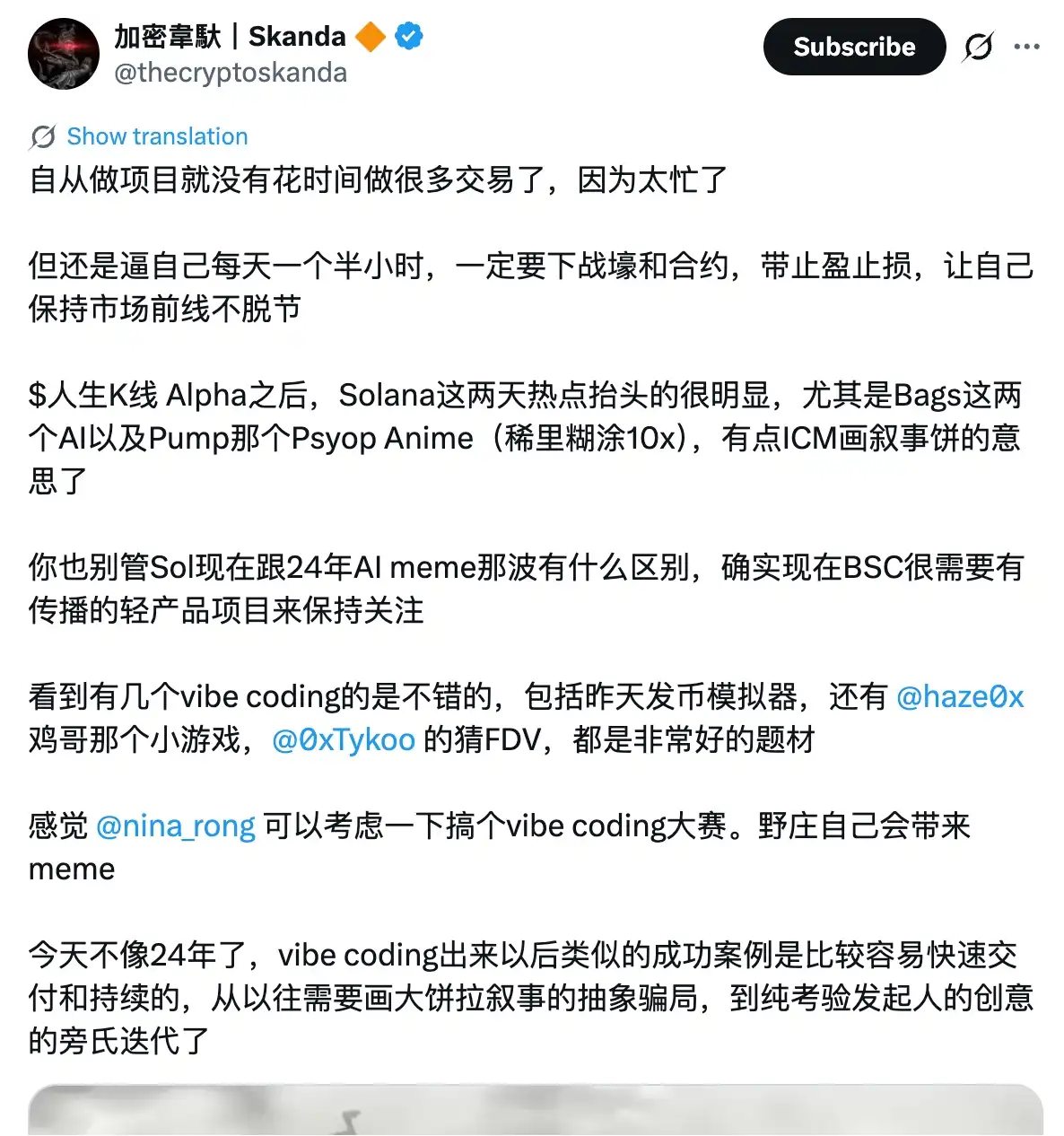
So addictive.

How to describe this kind of pleasure? It's like you've been watching long videos on Bilibili and suddenly try Douyin for the first time; or like being used to a slow-burning relationship and suddenly experiencing fast-food romance; or like someone long suppressed by life getting high on drugs for the first time.

Take the Token Launch Simulator, for example. You start from the perspective of a project side, which isn't exactly moral. You have a limited amount of startup capital, the product is still at the PPT stage, and you decide what to do next, how to play with your users and community.

One operational cycle is a month, and you can only do two things, so resources are limited. You invest your limited resources and money into product development, narrative spreading, community operations, etc. The game doesn't tell you which path is right. Then, uncertain events pop up one after another: sometimes funding comes through, sometimes regulators target you, sometimes the community suddenly spirals out of control, sometimes security risks explode.
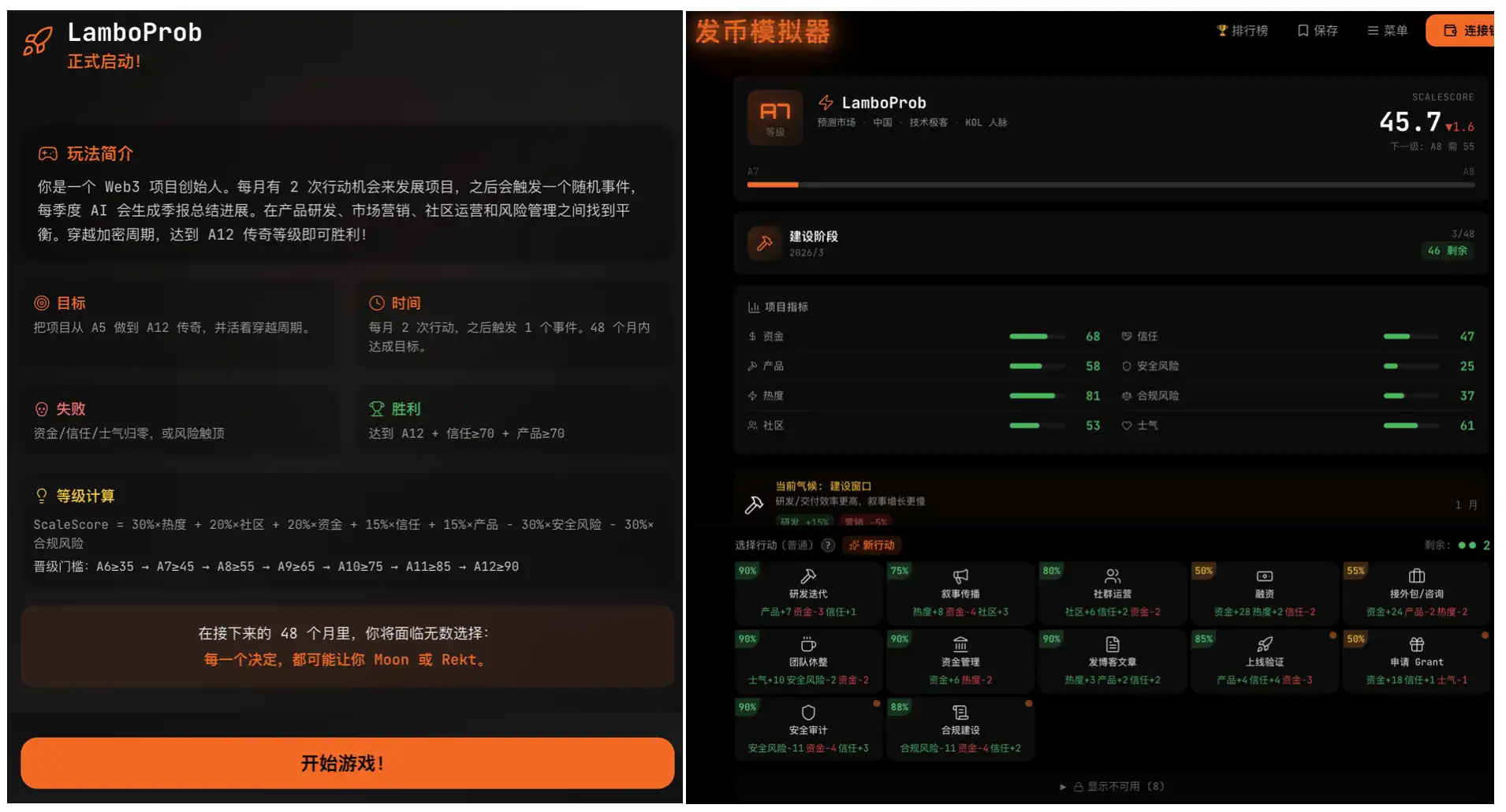
The pleasure emerges right here.

This pleasure doesn't come from eventually winning A9, A10 levels of wealth, but from the constant, continuous, never-ending immediate feedback. You just can't stop.

Another example is Brother Chicken's Rug Pull Simulator, a testing ground for trading memecoins, a speed-run version of GMGN's game. The pleasure lies in the rhythm of "exiting at the top." Buy low, spend marketing points to pump the price. If it pumps too fast, you fear a rug pull; if it's too slow, you get impatient. Successfully exit at the top, and profits are immediately credited—it feels like you've truly mastered the market's rhythm. Fail, and you can immediately try again.

Dopamine release in 0.2 seconds, faster than feedback in real trading.

Then there's Vesting Victim. While it doesn't have high-frequency clicking or the直观刺激 of price charts, it plays on your intuition about valuation. Based on a project's TVL, user count, funding situation, you judge its FDV, input the number, and the next second the system tells you the deviation. This "second-level verification" makes it impossible to stop. You unconsciously want to play another round—this time I'll guess more accurately—your nervous system directly receiving reward signals.
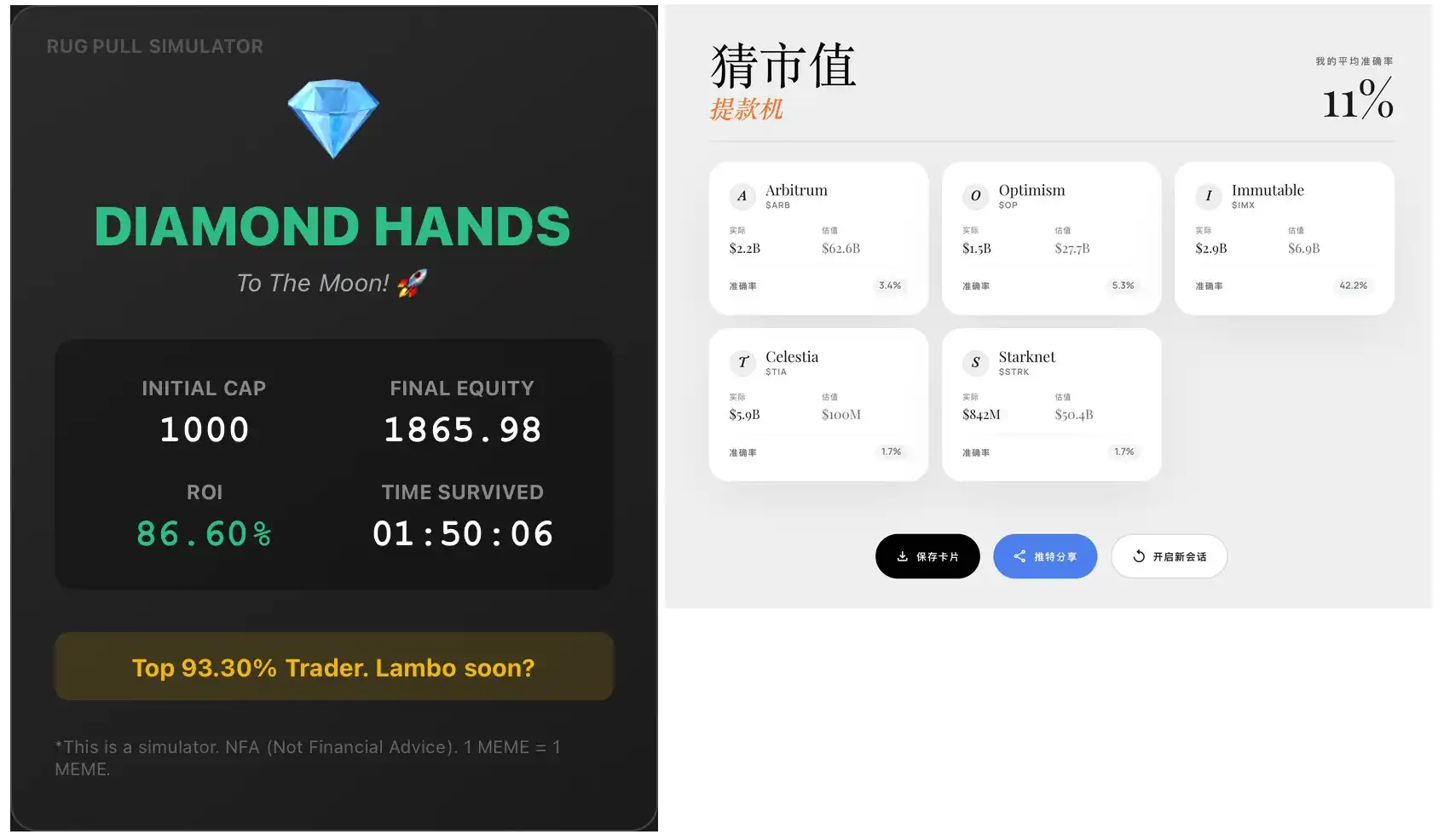
This is also the most addictive part of vibe coding. It doesn't need grand narratives or long-term investment. Copilot, Cursor, AI templates have drastically compressed the time from "an idea to a playable demo." It also doesn't rely on any future promises. No one expects today's vibe coding to produce great projects; being "fun today" is enough.

We just need to make choices in the present, get immediate feedback, and experience the pleasure of operations and results directly mapping onto our nerves. And this kind of pleasure is more direct, real, and easier to spread virally on social media than any complex economic model, long-term strategy, or whiteboard prediction.

The essence of vibe coding is, in a market where no one believes in long-term narratives anymore, monetizing attention with the lowest delivery cost.

It is, in a sense, the industrialization of dopamine—small doses, fast feedback, low addiction threshold, high repeat engagement; a form that is more brutal for project teams and more honest for users; and a natural product of today's market environment.

So when this era arrives, don't resist it, and stop lecturing about profound insights and morality. Let's indulge together in these fast-food toys, enjoy the pleasure of immediate feedback, enjoy the dopamine.

Even if it might never be great.

Perguntas relacionadas

QWhat is the core appeal of Vibe Coding games in the crypto space according to the article?

AThe core appeal is the immediate, continuous feedback loop that triggers dopamine release in as fast as 0.2 seconds, offering a highly addictive and entertaining experience without the promise of long-term value or a grand narrative.

QName two specific Vibe Coding games mentioned in the article and describe their core mechanics.

A1. Rug Pull Simulator (by an unnamed team): Players assume the role of a project founder with limited resources, making monthly decisions on development, marketing, or community management, and dealing with random events. 2. Another Rug Pull Simulator (by Haze from GMGN): A memecoin trading sim where players buy low, use marketing points to pump the price, and attempt to sell at the top for instant profit.

QHow does the article describe the development process of Vibe Coding projects?

AThe article states that the development process is extremely compressed. Using tools like Copilot, Cursor, and AI templates, an idea can be turned into a playable demo very quickly, requiring no long-term investment or complex future promises.

QWhat does the article suggest is the 'essence' of Vibe Coding in the current market?

AThe essence of Vibe Coding is described as the industrialization of dopamine, using the lowest delivery cost to instantly monetize attention in a market where no one believes in long-term narratives anymore.

QWhat was the author's initial opinion on Vibe Coding, and how did it change?

AThe author initially viewed Vibe Coding products as mere noise, creating temporary hype and emotion rather than lasting value, comparable to simple games. Their opinion changed after trying the games themselves, finding the immediate feedback and addictive '爽感' (shuǎng gǎn - pleasurable feeling) to be incredibly compelling.

Leituras Relacionadas

Blocked Its Own Treasure, WeChat AI Steps Up

Tencent's stock surged over 10% on June 2nd amid reports that WeChat, with 1.43 billion monthly users, is finalizing tests for a native AI Agent. The reported feature, accessible by swiping right from the main interface, allows users to issue commands in natural language. The AI then decomposes tasks and automatically calls upon relevant Mini Programs within WeChat to complete actions like ordering food, booking tickets, or making payments, creating a closed-loop service execution system. This strategic shift follows the internal conflict and subsequent "blocking" of Tencent's standalone AI app, Yuanbao, by WeChat for violating sharing rules during a 2026 Spring Festival promotion. The incident highlighted a lack of internal consensus and exposed the weakness of competing in the standalone AI assistant arena against rivals like ByteDance's Doubao (345M MAU) and Alibaba's Qianwen. The new WeChat AI Agent aims to leverage WeChat's unique assets—its massive user base, standardized Mini Program APIs, WeChat Pay, and identity system—to move from simple content generation to actual task execution. Analysts note this changes the competitive landscape from model benchmarks to which AI can connect to more real-world services. However, success depends on key variables: the capability of Tencent's underlying Hunyuan model, managing massive inference costs, and redesigning incentives for Mini Program developers whose traffic might be bypassed. The move is seen as an attempt to keep user service intent within WeChat's ecosystem as AI begins to redefine how users access services.

marsbitHá 12m

Blocked Its Own Treasure, WeChat AI Steps Up

marsbitHá 12m

ByteDance Adopts Arm CPUs, Jensen Huang: So Sad I Didn't Buy Arm

**Summary:** At Computex 2026, Arm CEO Rene Haas announced that ByteDance and Oracle have adopted Arm's self-designed Arm AGI data center CPU. The company expects significant revenue growth from this product, projecting $20 billion in demand for the 2027/2028 fiscal years. Haas noted that restricting AI-capable CPUs from the US to China is nearly impossible due to their widespread applications. Arm's stock has surged dramatically this year, notably rising 16% after NVIDIA's Arm-based Vera CPU and RTX Spark announcements. A highlight was the informal, humorous on-stage conversation between Haas and NVIDIA CEO Jensen Huang. Huang joked about NVIDIA's failed attempt to acquire Arm and playfully lamented selling his Arm shares. Both executives showed a clear sense of camaraderie and shared regret over the missed merger. Key technical topics were discussed: 1. **AI PC Design:** Huang explained NVIDIA's RTX Spark superchip (with a 20-core Arm CPU) is designed for future AI agents that will autonomously run and use tools on PCs, blending local and cloud processing. 2. **Agent vs. OS:** Huang emphasized the operating system remains crucial, as AI agents rely on its APIs and tools to function. 3. **Growth Constraints:** He identified the shift to "useful AI" that generates profitable tokens as a primary driver for immense, almost limitless, computational demand. Haas outlined Arm's strategy across PC and data centers. For PCs, Arm collaborates with partners like NVIDIA and MediaTek, offering its compute subsystem (CSS) for custom SoCs. In data centers, its Arm AGI CPU (built on TSMC's 3nm process) has gained major partners including OpenAI, Meta, and now ByteDance and Oracle. Arm presented a multi-year roadmap for its in-house CPU line. The article concludes that while GPUs dominated the AI training race, the explosion of AI agents is shifting significant focus to CPUs for inference, state management, and tool orchestration. The industry is trending towards vertical integration, with companies like cloud providers designing chips and chip/IP firms offering full solutions, all competing to deliver more efficient computing per watt.

marsbitHá 32m

ByteDance Adopts Arm CPUs, Jensen Huang: So Sad I Didn't Buy Arm

marsbitHá 32m

New Wall Street Play: Yen Shorts Still Adding, But Japan Stocks Don't Rely on Carry Trade Unwinding

On June 3rd, USD/JPY hit 160.44, its highest level since July 2024, while the Nikkei 225 surged past 68,000 points. Contrary to popular narratives of an imminent "carry trade unwind" akin to August 2024, data reveals a more complex picture. Speculative net short positions in yen futures have actually increased, reaching -114,667 contracts by late May, suggesting traders are doubling down rather than retreating. Meanwhile, Japan's Finance Ministry conducted its largest-ever single-round FX intervention (11.73 trillion yen) in April-May but failed to hold the 160 yen line. The Nikkei's rally is not driven by carry trade dynamics. Foreign investors are aggressively buying Japanese stocks, with net purchases in 2026 running nearly 16 times higher than 2025 levels. This inflow is concentrated in AI and semiconductor-related stocks like SoftBank and Socionext, fueled by positive sector outlooks, rather than being a flight from unwinding yen shorts. Furthermore, the Nikkei has continued climbing despite the Bank of Japan's (BOJ) rate hikes to 0.75%. This disconnect exists because the current equity boom is fueled by AI-driven foreign investment, not reliant on cheap yen funding. However, this relationship remains fragile. Should the BOJ hike rates further (e.g., to 1.0%) while dollar weakness increases carry trade costs, the trajectories of the yen and Japanese stocks could reconverge, potentially triggering volatility.

marsbitHá 37m

New Wall Street Play: Yen Shorts Still Adding, But Japan Stocks Don't Rely on Carry Trade Unwinding

marsbitHá 37m

Broadcom's Q3 Guidance Misses Expectations by $12 Billion, After-Hours Trading Plummets Over 13%, AI Narrative "Cooling"?

On June 3, Broadcom released record Q2 FY26 results with revenue of $22.19B, up 48% YoY, and AI chip sales of $10.8B, up 143%. Adjusted EPS of $2.44 beat estimates. However, its Q3 AI semiconductor revenue guidance of $16B, while up over 200% YoY, fell roughly $1.2B (7%) short of analyst consensus expectations of $17.2B. This miss, coupled with slightly weaker-than-expected software revenue, triggered a severe market reaction. CEO Hock Tan maintained the FY26 AI revenue outlook of over $100B but did not raise it, disappointing investors who had priced in more robust growth. The stock plummeted over 13% in after-hours trading, erasing roughly $270B in market cap. The sell-off extended to peers like Marvell. A key concern for markets, particularly for Chinese optical module suppliers, was Tan's comment that the contribution of AI networking (e.g., Ethernet switches, optical interconnect chips) to AI revenue, currently near 40%, is expected to normalize to around 30% over time, signaling a potential peak in growth for that segment. Despite the guidance shortfall, Tan reiterated that AI demand remains "insatiable" and reaffirmed the long-term target of exceeding $100B in AI revenue by FY27. The reaction highlights the heightened sensitivity and premium valuation placed on AI-exposed stocks, where anything less than stellar guidance can prompt significant profit-taking. The broader question is whether this represents a cooling AI narrative or a correction in overstretched valuations.

marsbitHá 37m

Broadcom's Q3 Guidance Misses Expectations by $12 Billion, After-Hours Trading Plummets Over 13%, AI Narrative "Cooling"?

marsbitHá 37m

Trading

Spot
Futuros
活动图片

