The World Cup Has Only Just Begun, But AI Predictions Already Have Models Hailed as 'Godly' and Others Flipping Over

Odaily星球日报Publicado em 2026-06-15Última atualização em 2026-06-15

Resumo

After only a few days of the World Cup, AI models are being widely used for match predictions, with mixed early results. These models analyze details like scores, upsets, red cards, and key players, offering users in prediction markets an extra layer of analysis beyond odds and news. Qwen gained early attention for its remarkably accurate calls on the opening day, correctly predicting Mexico's 2-0 win over South Africa and Korea's 2-1 victory over the Czech Republic, while also highlighting red card risks and match flow. Copilot had its own highlights, accurately forecasting the Mexico 2-0 result, the Korea 2-1 win, and a surprising 1-1 draw between Brazil and Morocco. However, it also misjudged several matches, like predicting a Swiss win that ended in a draw with Qatar and missing Australia's upset over Turkey. ChatGPT provided detailed pre-match analysis and correctly called the Mexico 2-0 score, explaining factors like home-field advantage. Yet, it struggled to anticipate upsets, often siding with the stronger team on paper, as seen in its missed calls for the Australia-Turkey and Japan-Netherlands matches. Social media tests pitted models like Gemini, Grok, and Claude against each other for the same games, revealing different predictive "scripts" even for the same fixture. Overall, while AI models like Qwen and Copilot have shown promising, high-profile successes in early matches, their consistency and ability to predict genuine upsets remain in question. As the tour...

Original | Odaily Planet Daily (@OdailyChina)

Author | Asher(@Asher_ 0210)

The most lively place in this World Cup isn't just on the pitch.

As the heat around World Cup prediction events rises, more and more users are starting to participate in trading with real money. Who will win, what will the score be, will there be an upset, will there be a red card, which player will score—topics that originally belonged to pre-match fan chatter have now been broken down into tradable prediction events.

And when predictions become trades, what users need is more than just emotion and intuition: odds movements, team form, injury news, historical matchups, market sentiment, all become references before a trade. In this process, AI models are being frequently pulled into World Cup prediction scenarios.

Large models like Qwen, ChatGPT, Gemini, Claude, DeepSeek, Qwen, and Copilot can not only answer "which team is more likely to win," but also give score predictions, upset possibilities, red card risks, key player performance, and match flow analysis. For prediction market participants, AI's pre-match deduction is becoming another layer of reference beyond odds, news, team data, and market sentiment.

However, predictions ultimately have to return to the matches themselves.

As the World Cup officially kicks off and the results of the first few matches come out one after another, those AI analyses that users used to aid their judgment before the matches finally have answers to compare against: Was the score predicted, were upsets spotted in advance, how many details like red cards, last-minute winners, and match flow were truly captured by the models.

The First to Go Viral Was, Unexpectedly, Qwen

The most dramatic performance on the first day of the World Cup was undoubtedly Qwen's.

For the opening match between Mexico and South Africa, Qwen's pre-match prediction was Mexico 2:0 South Africa. After the match ended, the score was indeed 2:0. What's more interesting is that the total of three red cards in the match also basically matched Qwen's pre-match risk assessment of "South Africa's overly physical defending, possibly getting into an early one-man-down situation."
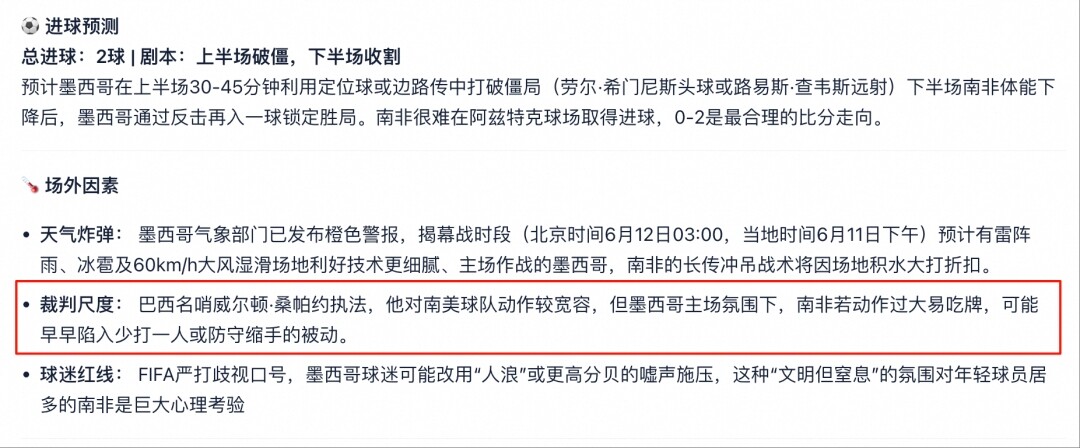
If it were just predicting a Mexico win, that wouldn't be too surprising. As one of the hosts, Mexico was already favored. But what Qwen hit this time were more specific match details: the 2:0 scoreline, South Africa's red card risk, and the gradually widening gap in the latter stages of the match.

Immediately after, for the South Korea vs. Czech Republic match, Qwen gave another prediction of South Korea 2:1.

This match wasn't easy to call pre-match. The Czechs have physicality, set-piece threats, and the usual big-tournament experience of European teams. The match process was indeed not one-sided—the Czechs took the lead first, South Korea equalized later, and the match was deadlocked at 1:1 for a long time. Until the final stage, South Korea scored the winning goal, and the final score became 2:1.

At this point, Qwen's prediction gained a stronger "scripted" feel. Judging the winner can rely on paper strength, score prediction can have luck involved, but it's process details like red cards, comebacks, and last-stage winners that truly make people feel "there's something to it." After two matches on the first day, Qwen first pulled up the attention on AI World Cup predictions.

Copilot: Moments of Genius, and Clear Flops

Before the tournament, USA Today had Copilot predict all 104 matches of this World Cup. Looking at the matches that have concluded so far, this prediction has both highlights and clear misses.

Three match predictions stood out the most.

For the opening match Mexico vs. South Africa, Copilot predicted Mexico 2:0, which hit the final score exactly. For South Korea vs. Czech Republic, it predicted South Korea 2:1, again matching the result. For Brazil vs. Morocco, Copilot gave a 1:1 prediction, and Brazil was indeed held to a draw by Morocco.

Especially the Brazil 1:1 Morocco match, the prediction had considerable merit. Brazil, after all, is a traditional powerhouse, with squad strength and attention in the top tier. Although Morocco reached the semi-finals in the last World Cup, directly predicting a draw against Brazil pre-match wasn't a particularly safe choice. After the match, Brazil didn't get a winning start, and Morocco continued its tournament resilience. Copilot's prediction for this match was indeed a "stroke of genius."

But Copilot's issues also quickly surfaced.

It predicted Canada would beat Bosnia and Herzegovina 2:1, but they drew 1:1; predicted Switzerland would narrowly beat Qatar 1:0, but Switzerland was also held to a draw; predicted the USA would beat Paraguay 2:0—the direction was correct, but the actual score was 4:1, significantly underestimating the offensive intensity.

More obvious flops appeared in several upset matches and matches where strong teams were held back.

For Turkey vs. Australia, Copilot predicted Turkey to win 2:1, but Australia pulled off a 2:0 upset win. For Ecuador vs. Ivory Coast, it predicted Ecuador 2:1, but Ivory Coast won 1:0. For Netherlands vs. Japan, it predicted Netherlands 2:1, but Japan equalized twice, resulting in a 2:2 draw. For Sweden vs. Tunisia, it predicted 1:1, but Sweden directly won 5:1.

That Copilot could nail the exact scores for Mexico, South Korea, and Brazil matches shows it's not just giving answers favoring the favorites. But matches like Australia beating Turkey, Qatar drawing with Switzerland, and Japan drawing with Netherlands also expose that its judgment on upsets and draws is still relatively conservative.

ChatGPT: Analysis Is Comprehensive, But Not Sharp Enough on Upsets

Compared to Copilot's full schedule prediction, ChatGPT is more of a "pre-match analysis player."

In the opening match prediction, ChatGPT predicted Mexico 2:0 South Africa, hitting the final score. The reasoning it gave was also quite comprehensive, including Mexico's home advantage, recent form, South Africa's lack of attacking power, and factors like Mexico City's high altitude and home atmosphere. In this prediction, ChatGPT didn't just give a result; the underlying judgment logic also aligned with the match outcome.
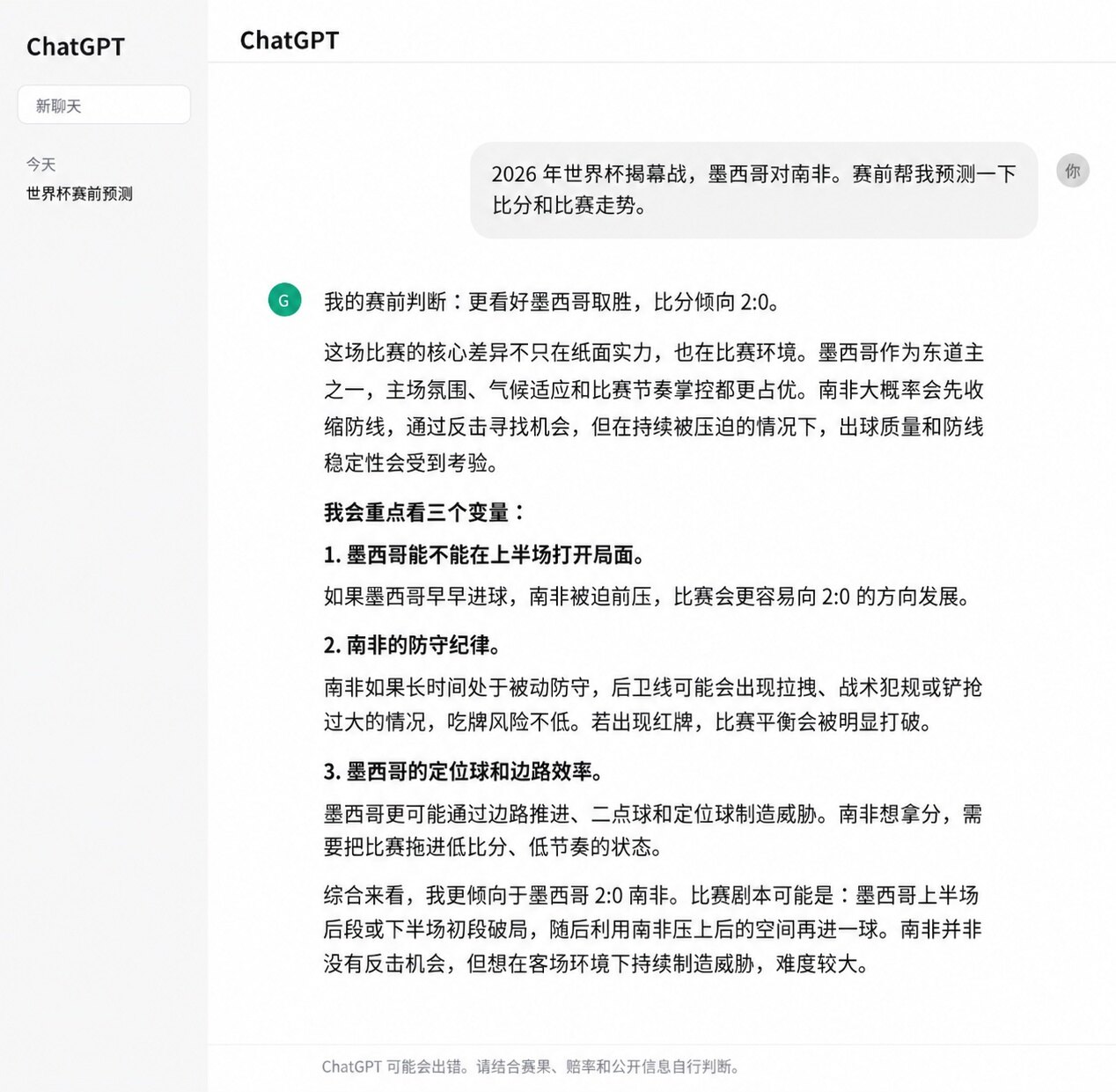
But when it comes to full World Cup schedule predictions, ChatGPT's stability isn't as strong. While it hit Mexico 2:0 South Africa and Brazil 1:1 Morocco, and correctly called the winner in several matches like Scotland, Germany, and Sweden, in matches like South Korea 2:1 Czech Republic, Qatar 1:1 Switzerland, Australia 2:0 Turkey, and Japan 2:2 Netherlands, ChatGPT's judgments all predicted the team with stronger paper strength. For example, Switzerland should beat Qatar, Turkey should beat Australia, the Netherlands should narrowly beat Japan.

ChatGPT isn't without predictive ability; it can break down team strength, home environment, and recent form clearly, and can hit the score in some matches. But based on current results, it's better at explaining "why the favorite is more reasonable" than identifying in advance which matches might deviate from the favorite's script.

Gemini, Grok, Claude: Different Models Write Different Scripts for the Same Match

Besides Qwen, Copilot, and ChatGPT, some social media users fed the same match to multiple models for pre-match predictions.

Taking the opening match Mexico vs. South Africa as an example, a blogger tested four AI models—ChatGPT, Gemini, Grok, and Claude—simultaneously for pre-match predictions. The results showed that ChatGPT and Gemini both predicted Mexico 2:0 South Africa, hitting the final score exactly; Grok predicted Mexico 2:1, Claude predicted Mexico 3:1; while both correctly saw Mexico winning, they didn't nail the exact score.

For this opening match prediction, different models gave three different "scripts." ChatGPT and Gemini Pro were closer to the actual match: Mexico dominant, South Africa lacking in attack, eventually kept scoreless. Grok seemed to give a more open scoreline, thinking South Africa would get a goal back from a counter. Claude Sonnet raised expectations for Mexico's attack higher, giving a more open 3:1 result.

Summary

Since the currently reviewable sample of AI predictions is still limited, we can't directly judge which model is the most "football-savvy" at this stage.

But just looking at the few matches that have concluded, differences are starting to show. Qwen currently has the most memorable performance, hitting Mexico 2:0 South Africa and South Korea 2:1 Czech Republic on the first day, and also stepping on red card risks and match flow, a highlight in a small sample. However, whether it can sustain accuracy needs more matches to verify.

Copilot and ChatGPT both have highlights of hitting exact scores, but also expose a common problem—their judgment still isn't sensitive enough when facing matches that deviate from paper strength, like Australia beating Turkey, Qatar drawing Switzerland, or Japan drawing the Netherlands.

As for models like Gemini, Grok, and Claude, currently public samples are more concentrated on single matches or social media comparisons, having reference value but not yet suitable for direct ranking.

AI can already serve as a layer of reference for World Cup prediction market users, but it's far from a standard answer. Next, Odaily Planet Daily will continue to collect pre-match predictions from various models and keep reviewing them as the tournament progresses: which models just had good luck at the start, and which models can truly withstand the test of results across more matches.


Perguntas relacionadas

QWhich AI model achieved a notable success in predicting the first two matches of the World Cup, including specific scores and details like red cards?

AThe AI model Qwen (千问) successfully predicted the exact scores of Mexico 2:0 South Africa and South Korea 2:1 Czech Republic in the first two matches. It also correctly identified the risk of red cards for South Africa.

QWhat were the major strengths and weaknesses of Copilot's World Cup match predictions according to the article?

ACopilot's strengths included accurately predicting the exact scores of Mexico 2:0 South Africa, South Korea 2:1 Czech Republic, and Brazil 1:1 Morocco. Its weaknesses were significant misses on several matches, such as incorrectly predicting wins for Turkey against Australia and for Switzerland against Qatar, showing a conservative bias against upsets and draws.

QHow did ChatGPT's approach to World Cup prediction differ from a model like Copilot?

AChatGPT functioned more as a 'pre-match analytical player,' providing detailed reasoning behind its predictions (e.g., considering Mexico's home advantage and altitude). While it accurately predicted some scores like Mexico 2:0, its full-tournament predictions showed less stability and a tendency to favor the stronger team on paper, missing several upsets and draws.

QWhat were the different predictions made by ChatGPT, Gemini, Grok, and Claude for the opening match between Mexico and South Africa?

AFor the opening match Mexico vs. South Africa, ChatGPT and Gemini predicted a 2:0 win for Mexico. Grok predicted a 2:1 win for Mexico, and Claude predicted a 3:1 win for Mexico. Only ChatGPT and Gemini predicted the exact final score of 2:0.

QWhat is the article's overall conclusion about the current reliability of AI models for World Cup predictions?

AThe article concludes that while AI models can provide an additional layer of reference for prediction market participants, they are far from being a standard answer. Their reliability varies, with some showing promising initial results but needing more matches for validation, and most models currently showing a lack of sensitivity in predicting upsets and unexpected draws.

Leituras Relacionadas

The Value Distribution of Stablecoins

**Summary: The Value Distribution of Stablecoins** The article argues that stablecoins are evolving from mere trading tools into broader channels for dollar access. It divides the stablecoin ecosystem into four layers to analyze how value is distributed: 1. **Issuance Layer:** Mints stablecoins, holds reserve assets, and captures the spread between reserve yield and user costs (e.g., Tether, Circle). This layer currently earns the largest profit margin. 2. **Infrastructure Layer:** Connects stablecoins to the traditional financial system, handling fiat on/off-ramps, banking integration, compliance (KYC/AML), and asset management (e.g., Bridge, BVNK). This is the "unglamorous" but critical work, building the essential bridges between crypto and real-world finance. 3. **Acquiring/Distribution Layer:** Integrates stablecoins into merchant systems, manages payment flows, and provides enterprise financial software (e.g., Stripe, Coinbase). They act as the access point for businesses. 4. **Application Layer:** The end-users and businesses that ultimately use stablecoins for payments, settlements, or as a store of value. They benefit from convenience but have little pricing power. The core thesis is that while the issuance layer currently dominates profits, the often-overlooked **infrastructure layer holds significant long-term potential**. The real challenge and barrier to mass adoption is not the on-chain transfer of stablecoins (which is simple), but the complex "last mile" integration into existing business workflows, banking systems, and regulatory frameworks across different countries. Companies in this layer are currently in a "land grab" phase, investing heavily to build networks, secure bank partnerships, and establish compliance pathways. While their position is currently pressured by the profitable issuers above and distribution platforms below, the article suggests that if stablecoins become a default financial rail for businesses, the infrastructure providers who have done the hard work of integration will ultimately gain strong pricing power and become entrenched, essential players.

marsbitHá 1h

The Value Distribution of Stablecoins

marsbitHá 1h

The Value Distribution of Stablecoins

The Value Distribution of Stablecoins The article argues that stablecoins are evolving from a mere trading tool into a broad "dollar channel." It analyzes the industry's value chain through four layers: 1. **Issuance Layer (e.g., Tether, Circle):** The top layer that mints stablecoins, holds reserve assets, and captures the thickest interest rate spread. 2. **Infrastructure Layer (e.g., Bridge, BVNK):** Connects stablecoins to the traditional financial system, handling critical but complex "dirty work" like fiat on/off-ramps, banking integration, compliance (KYC/AML), and cross-border settlement. 3. **Acquiring/Distribution Layer (e.g., Stripe, Coinbase):** Embeds stablecoins into merchant systems, manages payment flows, and integrates with enterprise software. 4. **Application Layer:** End-users and businesses that ultimately use stablecoins for payments, settlement, or storing value. The author posits that while the issuance layer currently captures the most profit, the most overlooked and potentially critical layer is infrastructure. The core challenge for stablecoin adoption isn't the on-chain transfer (which is simple), but bridging the gap between blockchain and the real-world financial system. This involves solving practical problems for businesses: fiat conversion, reconciliation, tax handling, and user onboarding. Infrastructure companies are currently in a difficult "land-grab" phase—building networks, securing banking relationships, and achieving compliance country-by-country. They face pressure from both the profitable issuance layer above and distribution platforms below. However, the author suggests this layer is building a crucial moat. Once stablecoins become a default business rail, the infrastructure players who have done the hard work of integration may gain significant, durable value and pricing power.

链捕手Há 1h

The Value Distribution of Stablecoins

链捕手Há 1h

How to Do Research Well: Deliberately Practice the Real Skills That Matter

No one truly teaches you how to do research. You're often given a desk, a pre-selected problem, and vague instructions to "create something new." Consequently, many people reverse-engineer the job based on visible outputs—papers, posts, announcements—learning only how to *appear* like a researcher rather than how to *become* one. True research capability is built from stacking small, trainable skills, nearly all of which can be developed through deliberate practice. **Pick Your Own Problem:** Most researchers absorb problems from advisors or trends, lacking the underlying reasoning. Choosing a problem you genuinely care about, as John Schulman advises, leads to original work. Develop "taste" like a muscle: predict experiment outcomes, guess paper results from methods, and track which findings remain important over time. **Upgrade Your Inputs:** Relying on shared reading lists (arXiv hot lists, filtered group chats) leads to unoriginal conclusions. Undervalued old literature often holds crucial insights (e.g., MoE, LSTM, backpropagation). Richard Sutton's "The Bitter Lesson" or Claude Shannon's 1952 talk on creative thinking are more predictive than lengthy modern surveys. Breadth matters as much as depth: draw from neuroscience, mechanism design, hardware knowledge, and honest statistics. Read papers directly, especially appendices and limitations sections. **Write Everything Down:** As Paul Graham noted, writing exposes flaws in seemingly mature ideas. Writing is the cheapest defense against self-deception. Following Feynman's principle, Darwin programmatically wrote down facts contradicting his theory to combat memory bias. Maintain a detailed log of hypotheses, setups, predictions, results, and updated understandings. Reviewing past logs fosters essential humility.

marsbitHá 4h

How to Do Research Well: Deliberately Practice the Real Skills That Matter

marsbitHá 4h

Trading

Spot
Futuros
活动图片




