The Value Distribution of Stablecoins

链捕手Publicado em 2026-06-15Última atualização em 2026-06-15

Resumo

The Value Distribution of Stablecoins The article argues that stablecoins are evolving from a mere trading tool into a broad "dollar channel." It analyzes the industry's value chain through four layers: 1. **Issuance Layer (e.g., Tether, Circle):** The top layer that mints stablecoins, holds reserve assets, and captures the thickest interest rate spread. 2. **Infrastructure Layer (e.g., Bridge, BVNK):** Connects stablecoins to the traditional financial system, handling critical but complex "dirty work" like fiat on/off-ramps, banking integration, compliance (KYC/AML), and cross-border settlement. 3. **Acquiring/Distribution Layer (e.g., Stripe, Coinbase):** Embeds stablecoins into merchant systems, manages payment flows, and integrates with enterprise software. 4. **Application Layer:** End-users and businesses that ultimately use stablecoins for payments, settlement, or storing value. The author posits that while the issuance layer currently captures the most profit, the most overlooked and potentially critical layer is infrastructure. The core challenge for stablecoin adoption isn't the on-chain transfer (which is simple), but bridging the gap between blockchain and the real-world financial system. This involves solving practical problems for businesses: fiat conversion, reconciliation, tax handling, and user onboarding. Infrastructure companies are currently in a difficult "land-grab" phase—building networks, securing banking relationships, and achieving compliance...

Author:@0xjiawei

Previous chapters discussed the broad trend: stablecoins are evolving from mere trading instruments into a generalized channel for US dollars.

This chapter examines how the stablecoin pie is divided.
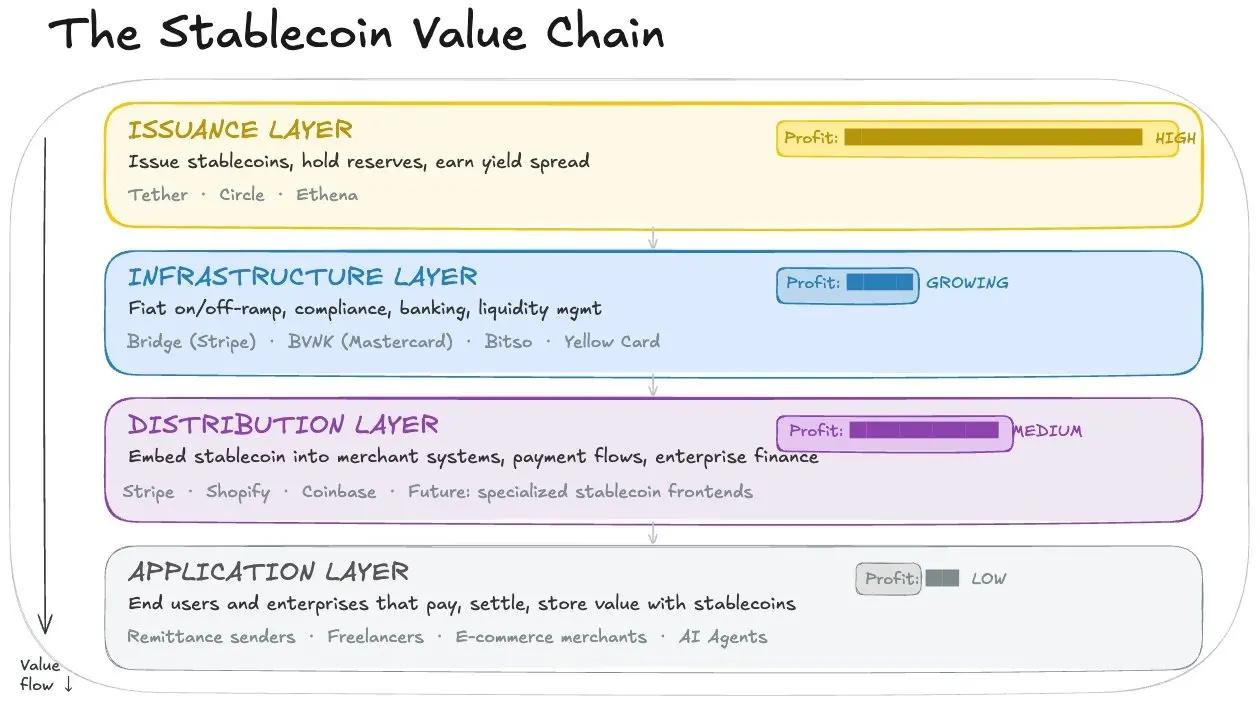
I categorize stablecoins into four layers:

  1. Issuance Layer: Mints stablecoins, holds reserve assets, earns the spread. Representatives: Tether and Circle;
  2. Infrastructure Layer: Connects stablecoins to the real-world financial system—fiat on/off ramps, bank integrations, asset management, compliance. Representatives: Bridge (acquired by Stripe), BVNK (acquired by Mastercard), Bitso, Yellow Card, etc.
  3. Acquiring/Distribution Layer: Embeds stablecoins into merchant systems, manages payment flows, enterprise financial software. Representatives: Stripe, Infini, Coinbase.
  4. Application Layer: End-users and businesses that use stablecoins for payments, settlement, and storage of value.

The Issuance Layer receives user funds and captures the thickest spread; the middle two layers profit from volume, distribution fees, and underlying infrastructure; the Application Layer enjoys convenience but has little bargaining power.

I believe the Infrastructure Layer is currently underappreciated.

It handles the "dirty work": integrating with banks, handling KYC/AML, processing local fiat on/off ramps, connecting merchants, APIs, card networks, and solving settlement and regulatory issues across different countries.

Conversely, this is also where its moat lies. Because technically, transferring USDC on-chain is not the hard part. The real difficulty is penetrating the real world—getting a Latin American company, an African payment provider, or an overseas platform to incorporate stablecoins into their daily cash flows. Someone has to do this dirty work.

The On-Chain Part is Easiest, the Bridge to Reality is Hardest

At first glance, stablecoin payments seem straightforward: fast on-chain transfers, low fees—isn't it just about distributing the product to users?

But the real challenge for stablecoins is the vast gap between the chain and the real-world financial system. Businesses have decision and migration costs; they won't switch their entire workflow just because they heard stablecoins settle in 1 second.

A series of questions arise: How to convert fiat to stablecoins? How to convert back? How to handle reconciliation and taxation? Will the bank block us later? Do users still need to learn how to use a wallet?

The core work of the Infrastructure Layer is bridging the two sides: connecting to the chain and wallets on one end, and to banks, local payment networks, enterprise systems, and compliance on the other.

Stripe's acquisition of Bridge in 2025 bought its stablecoin orchestration system—helping businesses integrate stablecoin capabilities into their operations. Mastercard's announced acquisition of BVNK in March 2026 had similar reasoning.

In other words, traditional payment companies are competing to become the default gateway for businesses using stablecoins.

The key to scaling stablecoin payments lies here.

Paving the Way

Looking further into the Infrastructure Layer:

  1. On/Off Ramps + Currency Exchange. Most business scenarios involve the process "local currency → stablecoin → local currency." This involves banking relationships, compliance, liquidity, and other issues.
  2. API + Account Layer. Businesses need a set of financial capabilities embedded into their workflows—account opening, payments, fund splitting, clearing, reconciliation. This is somewhat like financial SaaS, similar to the Neobank concept.
  3. Payment Network Connectivity. The more payment rails, banks, and regions connected, the more dependent clients become, gradually increasing switching costs.
  4. Capital Efficiency. Helping businesses reduce idle funds, waiting times, and FX losses.

I believe its characteristics dictate a path of initial hardship followed by reward.

  • Grunt Work: It requires connecting banks, achieving compliance, obtaining licenses, and building local teams country by country.
  • Front-loaded Investment to Capture Entry Points: Businesses won't easily switch their payment infrastructure. Those who first secure large clients, banking relationships, compliance pathways, and local fiat rails will later benefit from network effects. Currently, these companies are in a "land grab" phase, far from harvest time.
  • Squeezed by Upstream and Downstream: Upstream issuers take the spread first, while downstream platforms want to control the user interface. The infrastructure layer is in the middle, in an awkward position—"everyone needs you, but no one wants you to earn too much."

Currently, it is in the intermediate stage of moving toward "bargaining power formation."

If we only look at today, the Issuance Layer takes the largest profit, while the Infrastructure Layer is thinner and more capital-intensive.

But if we're talking about how to invest in stablecoins, the seigniorage logic of the Issuance Layer is already well understood by the market, with pricing increasingly revolving around interest rates, regulation, and profit sharing. The Infrastructure Layer is less noticeable today, often simply because it's still in the early investment phase. Bargaining power and user habits haven't fully solidified yet.

Once stablecoins further become the default rails for enterprise funds, the true beneficiaries will be those who, over the years, successfully bridged stablecoins into real-world commercial systems.


Perguntas relacionadas

QAccording to the article, how many layers is the stablecoin ecosystem divided into? Name them.

AThe stablecoin ecosystem is divided into four layers: 1. Issuance Layer, 2. Infrastructure Layer, 3. Acquirer/Distribution Layer, and 4. Application Layer.

QWhich layer does the author believe is currently undervalued or underappreciated, and why?

AThe author believes the Infrastructure Layer is currently undervalued. It's considered less glamorous because it involves difficult 'dirty work' like bank integration, KYC/AML, local fiat on/off-ramps, merchant onboarding, and solving cross-border regulatory issues. However, this complexity also creates its moat.

QWhat is the core challenge for enabling widespread stablecoin payment adoption, as described in the article?

AThe core challenge is bridging the gap between the blockchain and the real-world financial system. While moving tokens on-chain is technically simple, the real difficulty lies in integrating stablecoins into business workflows, handling fiat conversions, accounting, tax compliance, and overcoming enterprise decision and switching costs.

QWhat strategic moves by traditional payment companies (Stripe and Mastercard) does the article mention, and what is their goal?

AThe article mentions Stripe's acquisition of Bridge in 2025 and Mastercard's announcement to acquire BVNK in 2026. Their goal is to secure the role of becoming the default gateway/entry point for businesses wanting to integrate stablecoin capabilities into their operations.

QWhat are the three key characteristics of the Infrastructure Layer that make it a 'first bitter, then sweet' business?

A1. It involves hard 'dirty work' requiring country-by-country bank integrations, compliance, licensing, and local team building. 2. It requires significant upfront investment to capture market entry points (clients, banking relationships, compliance paths) before network effects can develop. 3. It is squeezed between the profitable upstream Issuance Layer and the downstream platforms that want to control user access, making its position initially precarious.

Leituras Relacionadas

From Gold to Bitcoin: Fixed Supply + Institutional Frenzy, Might It Repeat the 'Explosive' Price Trend?

"From Gold to Bitcoin: Fixed Supply and Institutional Frenzy May Lead to 'Explosive' Price Rally Analysts suggest Bitcoin's price action could mirror gold's over the past two decades, following the launch of spot Bitcoin ETFs. Gold ETFs, introduced in 2004, drove gold's price surge to a current market cap near $28 trillion. Both gold and Bitcoin are non-yielding stores of value, with prices driven purely by investor sentiment rather than cash flows or credit. Gold ETFs experienced dramatic cycles: explosive growth, painful drawdowns, and slow recoveries, with each cycle reaching higher peaks. Bitcoin ETFs, approved in early 2024, saw rapid institutional adoption but are now facing similar volatility. Recent warnings highlight the risk of significant ETF outflows disrupting the current rebound. BlackRock's IBIT, a leading Bitcoin ETF, has sold nearly 100,000 BTC to meet redemptions while still holding over 733,000. The core parallel is fixed supply: when demand surges, prices explode, but demand is often volatile and wave-like, not steady. Institutional interest, through ETFs and corporate adoption, remains a key support pillar, helping to cushion sell-offs. If Bitcoin captures even a fraction of gold's role as a store of value, its upside potential is immense, though the path will be marked by high volatility. For investors, focusing on long-term trends and managing risk is crucial as this 'price explosion' narrative unfolds."

Foresight NewsHá 33m

From Gold to Bitcoin: Fixed Supply + Institutional Frenzy, Might It Repeat the 'Explosive' Price Trend?

Foresight NewsHá 33m

Why Is AI Agent Shopping Hard to Popularize?

The article argues that the popular narrative of "AI agent shopping" – equipping AI with a wallet to autonomously handle purchases – is fundamentally flawed and oversimplifies the complexity of shopping. It deconstructs shopping into two core actions: **information retrieval** (standardized, easily automated) and **value judgment** (deeply subjective and human-centric). The narrative mistakenly assumes AI can fully handle both. Value judgment itself has two layers: **evaluation** (assessing options against criteria) and **demand definition** (setting the criteria, weights, and values). The latter is inherently human and dynamic, as preferences are not fixed but constructed during the decision-making process ("constructive preferences"). The real dividing line for automation is not product standardization, but whether the **act of choosing** itself holds experiential value. For mundane purchases (e.g., printer paper), full AI delegation works. For experiential goods (e.g., wine, furniture), the joy of selection is core to consumption, so AI should act as an assistant that narrows options, leaving the final choice to humans. The "AI wallet" concept confuses three separate elements: decision-making, execution, and fund custody. Current payment industry solutions (e.g., from Stripe, Mastercard, Google, Visa) show that limited, scoped payment authorization tokens are sufficient for most consumer scenarios, not full fund custody. The true use case for autonomous AI wallets is in **B2B procurement** and **machine-to-machine (M2M) settlements** for standardized, high-frequency, low-value transactions. The real bottlenecks for AI shopping are not payment technology, but **1) the lack of trusted data sources** (e.g., fake reviews, counterfeit goods) and **2) the impossibility of automating human demand definition**. The conclusion is that the focus should be on safely automating the assessment and filtering process while reserving for humans the rights to define their criteria and enjoy the final act of choice. For experiential goods, the platform's competitive advantage shifts to providing a superior selection experience.

Foresight NewsHá 1h

Why Is AI Agent Shopping Hard to Popularize?

Foresight NewsHá 1h

After Nine Months of Shorting, a Full Turn to Long: Renowned Trader Opens Bitcoin Positions Around 64K, Crypto Market Long-Short Divergence Intensifies

After nine months of being short, prominent crypto trader Doctor Profit has closed all his bearish positions and started buying Bitcoin near $64,000, signaling a complete bullish reversal. He argues that structural market changes—such as impending U.S. regulation (CLARITY Act) and institutional adoption via securities tokenization—are rewriting the traditional four-year cycle script, potentially bringing the market bottom forward from the widely expected September/October timeframe. This view finds some technical support from on-chain analyst gumsays, who notes a bullish divergence on Bitcoin's weekly chart has persisted for 147 days, nearing the 161-day duration seen before the 2022 cycle low. However, cycle researcher Jake Pahor presents a counter-argument based on historical data. Analyzing patterns since 2014, he identifies three common features of past bear market bottoms: a ~12-month duration from peak to trough, a sustained period of extreme fear (with a proprietary risk score below 20), and the price falling below Bitcoin's realized price (~$53,000 currently). The current cycle, only nine months from its October 2025 peak, meets none of these conditions. The debate highlights a market torn between "front-running" a potential early bottom driven by new fundamentals and waiting for confirmation through traditional on-chain and sentiment metrics. While Doctor Profit opts for aggressive buying, Pahor maintains a disciplined, tiered accumulation strategy, continuing weekly buys at current risk levels but reserving larger orders for if more extreme fear emerges.

marsbitHá 1h

After Nine Months of Shorting, a Full Turn to Long: Renowned Trader Opens Bitcoin Positions Around 64K, Crypto Market Long-Short Divergence Intensifies

marsbitHá 1h

Trading

Spot
活动图片