The V5 That Never Came: Uniswap Stuck in an Innovation Dilemma

marsbitPublicado em 2026-04-11Última atualização em 2026-04-11

Resumo

ChainCatcher author Gu Yu analyzes Uniswap's perceived slowdown in innovation. Despite its history of rapid iteration—from V1 in 2018 to V4 in 2023—the protocol has not announced a new version since. V4 introduced Hooks, a programmable plugin system allowing custom functions like dynamic fees and MEV protection, but its mainnet launch was delayed to January 2025 due to security audits. V4’s TVL peaked at $1.2 billion but has since fallen to $650 million, only 40% of V3’s TVL. Uniswap expanded to new blockchains and API partnerships but faced challenges with newer initiatives: its appchain, Unichain, saw TVL drop from $900 million to $36 million, and its token auction product (CCA) entered a crowded market. High-profile departures and a 74% drop in UNI token price over the past year reflect operational and growth struggles. A proposal to enable fee mechanisms and burn tokens briefly boosted UNI’s price, but Uniswap’s annualized revenue remains behind competitors like PancakeSwap and Aave. The article concludes that Uniswap’s situation mirrors broader DeFi stagnation but notes its strong security record and leading position in decentralized trading. The future of V5 and its role in driving the next DeFi wave remain uncertain.

Author: Gu Yu, ChainCatcher

In the crypto industry, the pace of innovation is often a key measure of a protocol's vitality. However, Uniswap, which once single-handedly kicked off the DeFi Summer, seems to be slowing down.

Looking back at Uniswap's evolution, its iteration rhythm has always been known for its fast pace: V1, featuring the AMM mechanism, was born in 2018; V2 introduced ERC-20/ERC-20 pairs in 2020; V3 launched concentrated liquidity in 2021; and V4 proposed programmable Hooks in 2023. On average, every 1.5 years, Uniswap would introduce a highly innovative mechanism, reshaping the flow paths of tens of billions of dollars.

However, as of April 2026, nearly three years have passed since the announcement of the V4 proposal, and the market has yet to see any updates on Uniswap's next version.

Currently, Uniswap's product developments still revolve around Uniswap V4, which aims to transform Uniswap from a fixed-function AMM into a highly programmable liquidity platform. The core innovation of this version is Hooks, which are modular, programmable plugins that allow developers to insert custom logic throughout a pool's lifecycle, enabling almost limitless functions such as dynamic fees, limit orders, TWAMM (Time-Weighted Automated Market Maker), MEV protection, loss hedging, custom oracles, continuous clearing auctions (CCA), and more.

In other words, whereas developers previously had to fork Uniswap to implement certain specific functions, leading to the fragmentation of Uniswap's liquidity across many forked DEXs, now developers only need to write a Hook contract to significantly enhance the customizability of Uniswap's liquidity pools.

Although Uniswap announced the specific concept of the V4 version in June 2023, due to security concerns, the version underwent 9 independent audits and a large-scale security competition, delaying its mainnet launch from the initial Q3 2024 to the end of January 2025.

After its launch, the total value locked (TVL) in Uniswap V4 peaked at over $1.2 billion but has since fallen to $650 million, which is still only 40% of the V3 version and also lags behind the V2 version.
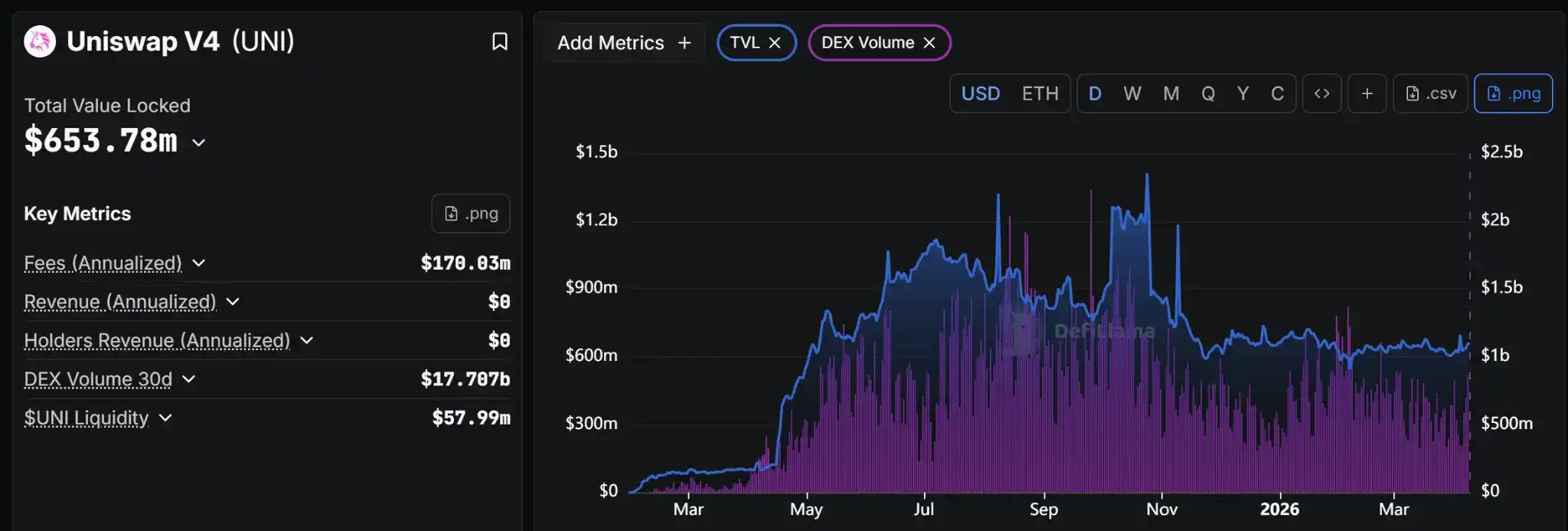
Meanwhile, Uniswap has also been "following the rules" in accelerating its expansion in use cases and markets. Over the past six months, Uniswap has launched on blockchains such as Linea, Tempo, X Layer, and Monad to seize market opportunities on emerging chains. On the other hand, Uniswap has been全力 expanding its API partnerships, with recent announcements including adopters like Anchorage Digital, Ledger, Privy, and MetaMask.

Of course, Uniswap has not been without new moves at the product level in recent years. For example, the appchain Unichain and the CCA token auction product have both generated significant market反响.

In February 2025, Uniswap's appchain, Unichain, officially launched on the mainnet, attracting over 90 DeFi protocol integrations. Its TVL peaked at $900 million but has since fallen to $36 million.

At the end of 2025, Uniswap announced the launch of its Continuous Clearing Auction (CCA) function, specifically designed for price discovery and liquidity bootstrapping of new assets, and subsequently partnered with Aztec and Rainbow to complete token sales.

However, it must be pointed out that by 2025, both appchains and token auctions were very "stale" business models in the crypto space. Many projects with stagnant core businesses were exploring "chain issuance" and Launchpad services. Uniswap also "followed suit" and joined this trend, but the practical impact has been very limited.

In earlier years, Uniswap also explored areas like NFT marketplaces and on-chain games through heavy acquisitions of products like Genie and Crypto: The Game. Subsequent data reflected that these were two failed acquisitions.

In the past year, the departures of key personnel such as Growth Lead Sarina Siddhanti, COO Mary Catherine Lader, Head of Strategy & Operations Zach Wong, Chief Legal Officer Katherine Minarik, and Venture Lead Julia Rosenberg also reflect Uniswap's efforts to control operational costs and its struggles with growth.

Uniswap's overall decline is also reflected in the price of its governance token, UNI. Over the past year, the price of UNI fell by over 74% at its worst, dropping below $2 at its lowest point, significantly exceeding the overall decline of mainstream cryptocurrencies. This has sparked criticism from market analysts who call the UNI token "completely worthless."

In September 2025, Arca Chief Investment Officer Jeff Dorman responded to a tweet by Uniswap founder Hayden Adams about the protocol's performance data on X, saying: "We are not bearish on Uniswap, but we are bearish on UNI. In today's market and evolving regulatory environment, it is just a completely meaningless token. Your stance and that of your venture capitalists don't matter. Either switch to a model that distributes revenue or conducts buybacks, or just don't have a token."

In response to market doubts and to赋予 UNI more value, the Uniswap Foundation proposed in November last year to activate the protocol fee switch for Uniswap V2 and V3 and use the fees to buy back and burn UNI, while also burning 100 million UNI from the treasury. Subsequently, UNI's price surged nearly 38% in a short time, reaching over $9 at its peak.

According to DeFillama data, Uniswap's recent daily fee income ranges between $100,000 and $200,000, with nearly $3.93 million in revenue over the past 30 days. The annualized revenue is approximately $46 million, still lagging behind other DeFi protocols like PancakeSwap, Jupiter, Lido, and Aave.
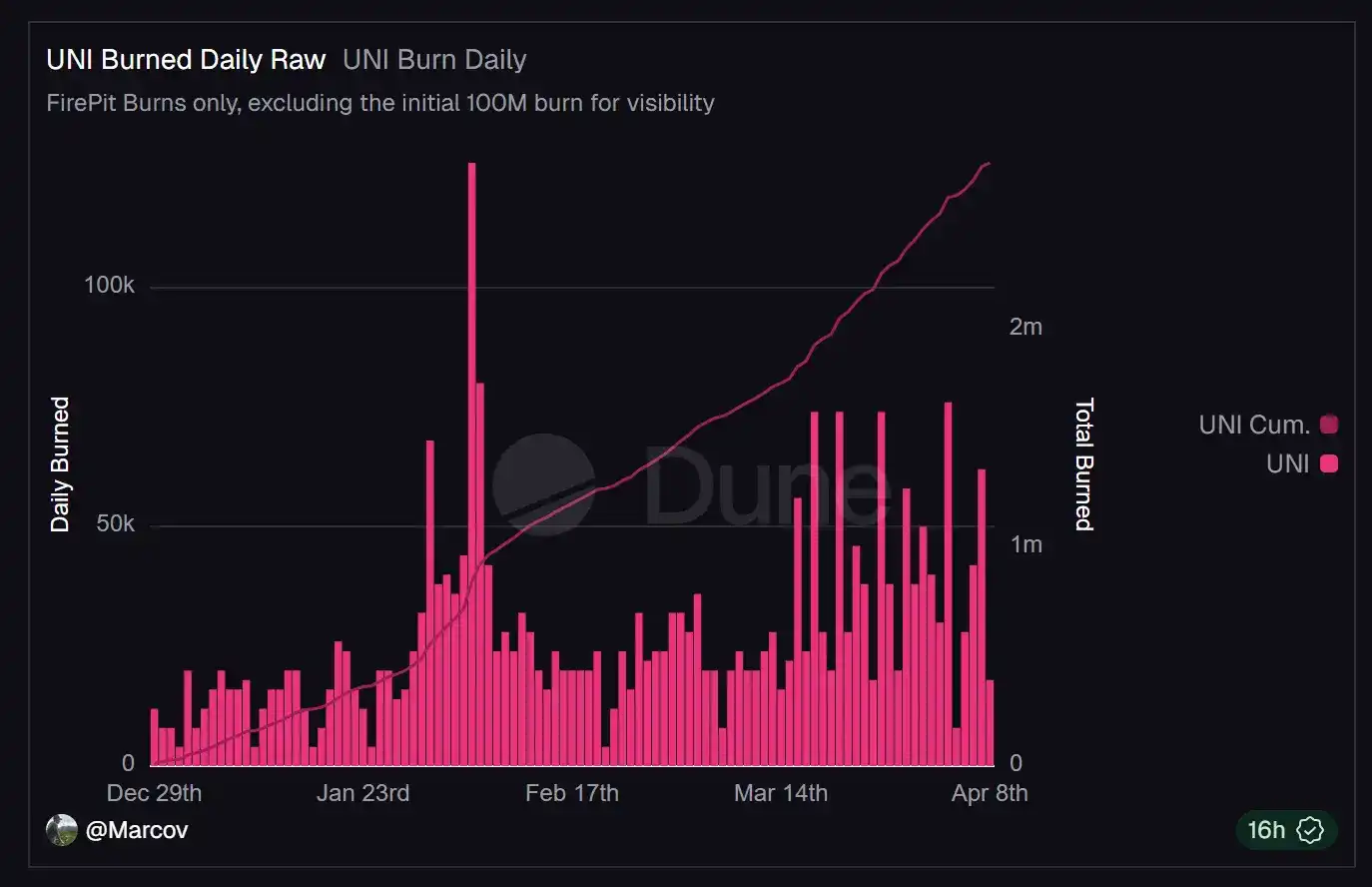
Uniswap's awkward situation is actually a projection and reflection of the bleak现状 of the DeFi industry: a lack of underlying innovation, exhausted industry narratives, and liquidity being consumed in fragmentation and存量博弈.

However, Uniswap remains one of the very few top DeFi protocols that has not suffered a hack, with no protocol-level fund theft incidents ever occurring. It is also the decentralized exchange protocol with the highest total value locked, and its industry status and user trust remain intact.

But, will there be a Uniswap V5? If so, when will it arrive? Can Uniswap continue to be the engine of the next DeFi Summer?


Perguntas relacionadas

QWhat is the core innovation of Uniswap V4 and how does it aim to transform the protocol?

AThe core innovation of Uniswap V4 is Hooks, which are modular, programmable plugins that allow developers to insert custom logic throughout a pool's lifecycle. This transforms Uniswap from a fixed-function AMM into a highly programmable liquidity platform, enabling features like dynamic fees, limit orders, TWAMM, MEV protection, and more without requiring a protocol fork.

QAccording to the article, what are the main factors contributing to Uniswap's perceived slowdown in innovation?

AThe main factors include the nearly three-year gap since the V4 announcement with no news of a V5, the delayed mainnet launch of V4 due to extensive security audits, the relatively low TVL adoption of V4 compared to older versions, and the pursuit of 'older' business models like appchains and token auctions instead of groundbreaking new mechanisms.

QHow has the performance of Uniswap's governance token, UNI, reflected the protocol's recent challenges?

AThe UNI token price fell by over 74% in a year, dropping below $2, which was a steeper decline than the overall market for major cryptocurrencies. This performance sparked criticism that the token lacked real value, leading to a proposal to activate fee switches for revenue generation and a token burn to try and increase its value.

QWhat two major initiatives did Uniswap launch in 2025, and how successful were they?

AIn 2025, Uniswap launched the Unichain appchain, which initially attracted over 90 DeFi integrations but saw its TVL plummet from a high of $900 million to $36 million. It also launched a Continuous Clearing Auction (CCA) feature for token launches, partnering with projects like Aztec and Rainbow.

QDespite its current challenges, what key strengths does the article acknowledge that Uniswap still possesses?

AThe article acknowledges that Uniswap remains one of the few major DeFi protocols to have never suffered a hack, has the highest Total Value Locked (TVL) among decentralized exchanges, and maintains its industry status and user trust.

Leituras Relacionadas

STRC Breaks Below $95: Why Does It Continue to Depeg? Is There Default Risk?

"STRC Falls Below $95: Why the Persistent Depegging and Is There Default Risk?" The article discusses the recent decline in the price of STRC, a perpetual preferred stock issued by Strategy (MSTR) designed to trade around a $100 par value. As of publication, STRC traded at $94.65, raising market concerns. STRC is described as a high-yield cash flow product, offering an 11.50% annual dividend paid monthly. Its "preferred" status grants it priority over common stock for dividends and in liquidation. Key reasons cited for the price depegging include: 1. **Bitcoin's Price Drop:** MSTR's assets are heavily tied to Bitcoin (BTC), which fell over 21% from its recent high, pressuring all Strategy-related products. 2. **Competitive Pressure:** Rival Strive Asset Management's similar product, SATA, offers daily dividends and has maintained its $100 par value with a ~13% yield. In response, Strategy has proposed changing STRC's dividend frequency from monthly to bi-weekly, pending shareholder vote. 3. **Technical Selling:** A break below $100 may have triggered algorithmic selling and stop-losses, exacerbating the decline. Regarding default risk, the analysis suggests it is currently low. Strategy founder Michael Saylor confirmed the June 2026 dividend rate remains at 11.50% with no cuts or suspensions. The company's massive reserve of 843,706 BTC provides a significant backstop for its obligations. Industry opinions are mixed. Some analysts view the BTC holdings as reliable support for dividends, while critics like Peter Schiff warn of potential dividend cuts leading to price crashes and lawsuits. Others highlight inflation risk and the company's ability to reduce dividends without a formal default. In summary, STRC's drop is attributed to BTC volatility, competition, and technical factors. While immediate default risk appears contained, the product faces challenges from market conditions and competitive dynamics.

marsbitHá 2m

STRC Breaks Below $95: Why Does It Continue to Depeg? Is There Default Risk?

marsbitHá 2m

AI Trading Cools, South Korean Stocks Plunge 1.8%, Spot Gold Rises 1%, Bitcoin Dives

A sell-off in AI-related stocks, triggered by Broadcom's disappointing earnings forecast, sent shockwaves through global markets. South Korea's KOSPI led Asia's decline, plunging 1.8% as the risks from concentrated chip stock gains and surging leveraged investments came to the fore. The tech-heavy Nasdaq 100 futures fell 0.5% following Broadcom's 14% after-hours plunge, which signaled a slower-than-expected transition to AI clients. This pullback extended Wall Street's weakness, halting the S&P 500's nine-day rally amid hawkish Fed signals and renewed Middle East tensions. South Korean authorities convened an emergency meeting, pledging "immediate measures" against market volatility and warning of record-high stock margin debt. The adjustment rippled across assets: Bitcoin fell to around $64,000, its lowest since February, while safe-haven gold rose 1% on bargain hunting. Oil prices dipped on Middle East ceasefire news. Market analysts noted the sell-off was driven by profit-taking after massive gains, particularly in chip stocks like Samsung and SK Hynix, which now dominate the KOSPI. Wall Street banks are divided on Korea's outlook, with Goldman Sachs raising its target while Citigroup and others warn of overvaluation and a potential bubble. Bridgewater's Ray Dalio noted that great technological shifts often create bubbles. Meanwhile, Fed officials' hints at potential future rate hikes added to the cautious mood ahead of key U.S. jobs data.

华尔街日报Há 28m

AI Trading Cools, South Korean Stocks Plunge 1.8%, Spot Gold Rises 1%, Bitcoin Dives

华尔街日报Há 28m

Seeking Alpha's Hot Article: Why Might the U.S. Stock Market Crash in June?

In a recent Seeking Alpha article, financial professor and analyst Damir Tokic argues that the US stock market may be poised for a significant crash in June 2026. The core thesis centers on a "mega-bubble" in equities, particularly within the technology sector, which has driven the S&P 500 to near-record valuations, with a Shiller P/E ratio exceeding 40—a level comparable to the 2000 dot-com bubble. Tokic identifies two primary catalysts for a potential collapse. First, he points to unsustainable market exuberance fueled by what he terms the "Trump Stimulus"—massive AI capital expenditure by tech giants, which he believes is politically driven and cannot last. Second, and more urgently, he highlights the escalating Iran war as a critical threat. The ongoing closure of the Strait of Hormuz has created a severe global energy supply crunch. Strategic petroleum reserves are projected to hit critically low operational levels by June, potentially causing oil prices to spike above $200 per barrel and triggering a severe, supply-driven inflationary shock. This scenario, Tokic warns, would force the Federal Reserve's hand. Despite currently maintaining a dovish bias, the Fed would likely be compelled to officially pivot to a hawkish stance at its June FOMC meeting to combat soaring inflation and bond yields. He contends that such a shift—or even a failure to act, which would destroy Fed credibility—could be the trigger that punctures the market bubble. The resulting downturn, he concludes, could rival the bear markets of 2000 and 2008, advising investors to prepare for a major correction.

marsbitHá 51m

Seeking Alpha's Hot Article: Why Might the U.S. Stock Market Crash in June?

marsbitHá 51m

AI PC Battle: Bet on the Toll Booth, Not the Camp

**Title:** The AI PC Battle: Don't Bet on Sides, Bet on the Tollbooth **Summary:** The AI PC competition is moving beyond simple "x86 vs. Arm" narratives. The core investment thesis should focus on identifying which players can sustain margins, cash flow, and pricing power throughout the upgrade cycle, rather than backing a particular architecture. The opportunity is analyzed in three layers: 1. **The Advanced Foundry Tollbooth:** TSMC is positioned to collect "tolls" regardless of which chip designer wins, due to its dominant ~70% share in advanced semiconductor manufacturing, which is essential for high-end AI PC chips. 2. **Compute & Platform Spillover:** AMD represents an offensive in the x86 CPU+GPU space, while NVIDIA leverages its GPU and CUDA software stack dominance. Both benefit from the demand for increased local AI compute. 3. **Architecture Diffusion & Turnaround Plays:** ARM and Intel offer potential for significant upside (elasticity), but investments here require stricter discipline due to higher execution risks and competitive challenges. The industry is transitioning from concept to shipment validation. While short-term forecasts for AI PC adoption have been revised down slightly due to tariffs and procurement delays, the long-term trend towards AI becoming a standard PC feature remains intact. The key driver for upgrade cycles will be whether compelling enterprise applications (e.g., privacy-sensitive computing, low-latency inference) emerge beyond consumer-focused features like meeting summarization. Investment strategy should prioritize companies with platform-level advantages and recurring revenue streams. TSMC offers high certainty as the foundational tollbooth. AMD presents a strong offensive play within the established ecosystem. ARM and Intel are higher-risk, higher-potential-reward turnaround bets. The report cautions against chasing short-term hype and emphasizes a disciplined, long-term approach focused on buying ecosystem strength and cash-flow certainty after market enthusiasm subsides. **Key Risks:** Underwhelming AI PC applications slowing upgrade cycles; slow improvement in Windows on Arm compatibility; macro/tariff impacts on PC demand; potential advanced node supply-demand mismatches affecting TSMC; high overall AI sector valuations making stocks vulnerable to a risk-off shift in markets.

marsbitHá 1h

AI PC Battle: Bet on the Toll Booth, Not the Camp

marsbitHá 1h

Trading

Spot
Futuros
活动图片

