The Trillion-Dollar Stablecoin War: Binance Decides to Re-enter the Fray

marsbitPublicado em 2025-12-24Última atualização em 2025-12-24

Resumo

The stablecoin market, with $27.6 trillion in on-chain transfers in 2024, has surpassed the combined volume of Visa and Mastercard. This marks a shift from a niche crypto product to a critical piece of global financial infrastructure. The article outlines the evolution of stablecoins. The 1.0 era was defined by first-mover advantage and passive monopolies. Tether's USDT dominates with a 60% market share, while Circle's USDC, despite its compliance focus, faced a crisis during the 2023 Silicon Valley Bank collapse, proving that network effect is the ultimate moat. Binance's journey reflects this competitive landscape. Its first stablecoin, the regulated BUSD, was shut down by U.S. regulators in 2023. It then pivoted to supporting FDUSD and has now taken a strategic stake in a new model with the launch of $U. Unlike traditional stablecoins, $U is a "stablecoin ETF" or "套娃" (nesting doll), backed by a basket of existing stablecoins: USDT, USDC, and the politically-connected USD1 from the Trump family. USD1's rapid growth, including a $2 billion investment into Binance from an Abu Dhabi fund, highlights a new dimension: stablecoins. The article argues that stablecoins are no longer just financial tools but vehicles for political capital and a new front in the battle for monetary influence, as evidenced by the U.S. passing the GENIUS Act to establish a federal regulatory framework. The "nesting doll" structure of $U aims to mitigate single-point risks (e.g., USDT's opacity, US...

In 2024, the total on-chain transfer volume of stablecoins reached $27.6 trillion, surpassing the combined total of Visa and Mastercard for the first time.

This figure was $300 billion five years ago and close to zero a decade ago.

On December 18, a project named United Stables launched a new stablecoin, $U, in Dubai. Its reserves are not U.S. dollar cash or treasury bonds but a combination of three stablecoins: USDC, USDT, and USD1. Using stablecoins to collateralize stablecoins is known in the industry as "nesting."

Binance Wallet integrated immediately, with official endorsement from BNB Chain, and full support from PancakeSwap and Four.Meme.

This configuration sends a clear message in the crypto circle: Binance is personally entering the fray.

$U itself may be insignificant. But the trend it represents is clear: stablecoins are moving from wild growth to a state of rival regimes, and a new battle is beginning.

Stablecoin 1.0 Era: The Monopoly of First Movers

The essence of stablecoins is "on-chain dollars." Users deposit $1 with the issuer and receive 1 token, which can circulate on any blockchain globally, 24/7, with second-level settlement and fees of just a few cents.

Compared to Alipay or bank transfers, the core advantage of stablecoins is that they require no real-name verification, no bank account, and no regulatory approval. A wallet address is the only barrier to entry.

When Tether issued USDT in 2014, the entire crypto market's capitalization was less than $50 billion. So Tether seized the opportunity window: traditional banks generally refused to provide services to cryptocurrency companies. The only way to cash out profits after trading cryptocurrencies was to exchange crypto assets for USDT, locking in dollar-denominated gains.

USDT's rise was not just due to a superior product but also because users had no other choice. This "passive monopoly" has continued to this day. As of December 2025, USDT's market capitalization is approximately $199 billion, accounting for 60% of the stablecoin market.

In 2018, Circle, in partnership with Coinbase, launched USDC, emphasizing compliance: monthly reserve audit reports, funds custodied with regulated financial institutions, and adherence to the U.S. securities regulatory framework. The subtext was that Tether's black-box model would eventually cause problems.

By 2022, USDC's market cap once approached 70% of USDT's. Wall Street bet that the compliant faction would ultimately prevail.

In March 2023, Silicon Valley Bank collapsed. Circle had $3.3 billion in reserves deposited there. USDC briefly depegged to $0.87—an asset promised to always equal $1 had lost 13% of its value.

The lesson the market drew was: compliance is a plus, but not a moat. Banks can fail, regulators can change course; the real barrier is network effects—when your user base and liquidity are large enough, you become the de facto standard.

The survival rule of the Stablecoin 1.0 era was simple: first-mover advantage trumps everything.

Binance's Three Pivots

Exchanges are the traffic hubs of the crypto world, and stablecoins are the unit of account for trading. Whoever controls the mainstream stablecoin holds pricing power. Binance cannot afford to give up this position.

In 2019, Binance partnered with Paxos, a New York-licensed trust company, to issue BUSD. This was a compliant stablecoin regulated by the New York Department of Financial Services, with a peak market cap of $16 billion, second only to USDT and USDC.

BUSD once accounted for 40% of Binance's trading volume. It was a core tool for Binance to establish its autonomous "monetary sovereignty."

In February 2023, the SEC issued a Wells Notice to Paxos, alleging that BUSD was an unregistered security. On the same day, the New York Department of Financial Services ordered Paxos to stop minting new BUSD. Nine months later, Binance founder CZ pleaded guilty in the U.S., and Binance paid a $4.3 billion fine.

$16 billion in stablecoin assets was reduced to zero under regulatory pressure.

Binance reacted quickly. Shortly after BUSD was halted, the Hong Kong company First Digital launched FDUSD,恰好 coinciding with the launch window of Hong Kong's virtual asset licensing system. FDUSD quickly became one of the main stablecoins on the Binance platform, although the two parties never publicly confirmed a partnership.

The move from BUSD to FDUSD was passive survival; the move from FDUSD to $U is active positioning.

The design logic of $U is fundamentally different from the previous two: it does not directly compete with USDT, USDC, or USD1 but incorporates them all into its reserve pool. In a sense, $U is a "stablecoin of stablecoins" or a "stablecoin ETF."
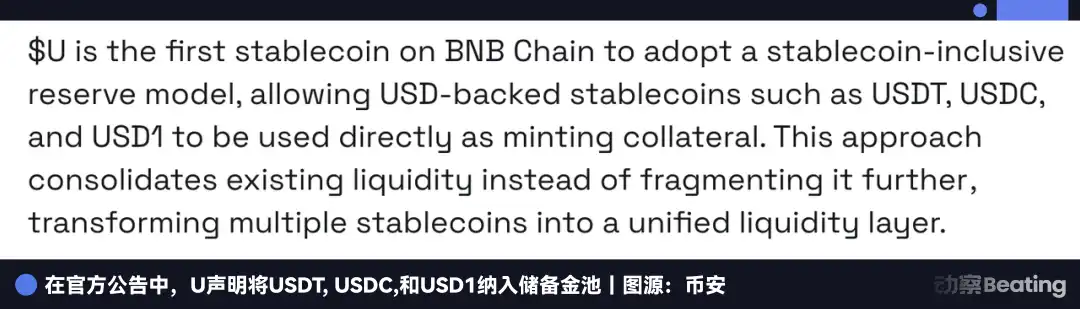
Binance's lesson is: stablecoins reliant on a single regulatory framework always have their lifelines held by others.

The Presidential Family Enters the Fray

The most noteworthy component in $U's reserves is USD1.

In March 2025, the Trump family issued the USD1 stablecoin through World Liberty Financial. According to public disclosures, Trump family-related entities hold 60% of the parent company's equity and receive 75% of the net income share. Trump himself serves as the "Chief Cryptocurrency Advocate," while his sons Eric and Donald Jr. serve as "Web3 Ambassadors."

By December 2025, the Trump family had already profited over $1 billion from the project.

Two months after its issuance, USD1 received its first major order: the Abu Dhabi sovereign wealth fund MGX invested $2 billion in Binance, using USD1 as the payment tool.

This was the largest cryptocurrency payment in history, instantly providing the nascent stablecoin with $2 billion in "practical endorsement."

As of December, USD1's market cap is approximately $2.7 billion, ranking seventh among stablecoins and becoming one of the fastest-growing.

Now, USD1 has been included in $U's reserves. This implies a hidden chain of interests: part of Binance's ecosystem trading volume is converted into usage scenarios for USD1; part of USD1's usage scenarios is converted into income for the Trump family.

The deeper game lies in the monetization of political capital. After Trump returned to the White House, the SEC suspended investigations into several crypto projects, including cases involving Sun Yuchen, a major investor in World Liberty Financial. Treasury Secretary Besant stated clearly at the White House Crypto Summit: "We will use stablecoins to maintain the dollar's status as the world's reserve currency."

Stablecoins are no longer just financial tools; they are becoming carriers of political resources.

The Logic of Nesting

Using stablecoins to collateralize stablecoins might seem redundant. But this design is based on three considerations.

Risk Diversification. USDT's hidden danger lies in its opaque reserves; USDC's隐患在于 its over-reliance on the U.S. banking system, as the Silicon Valley Bank incident warned; USD1's隐患在于 its deep binding with Trump's political fate. Holding any one alone means bearing its specific risk. Combining the three theoretically allows for risk hedging.

Liquidity Aggregation. The pain point of the stablecoin market is fragmented liquidity. USDT has its liquidity pools, USDC has its own, and funds are scattered across dozens of public chains and hundreds of DeFi protocols. $U attempts to connect these isolated pools, providing users with a unified liquidity entry point.

Narrative Upgrade. The competitive dimension of Stablecoin 1.0 was "who is more transparent" and "who is more compliant"—a rhetoric repeated for a decade. $U attempts to provide a new narrative framework: "settlement currency designed for the AI era," "supporting gasless signature transfers."

Of course, gasless transfers are part of the EIP-3009 standard, which existed in 2020, and USDC already supports it. So "AI-native" is more of a universal label; any on-chain stablecoin can be called by smart contracts and enable automatic machine-to-machine payments. $U's real differentiation lies not in technology but in its ecosystem and aggregated architecture.

Naturally, the nested structure also implies risk transmission: if one layer has a problem, the effects ripple through.

If USDT were to collapse one day, $U would not go to zero completely but would certainly承受 the impact: reserves shrinking, redemption pressure surging, depegging risk rising.

所谓 "Risk diversification" is more accurately "diversifying the intensity of impact from a single point of failure," ensuring that holders don't lose everything if any underlying asset fails. It's a bottom-protection mindset, not a risk-free design.

From Gray Zone to Great Power Game

2025 is the first year of stablecoin regulation.

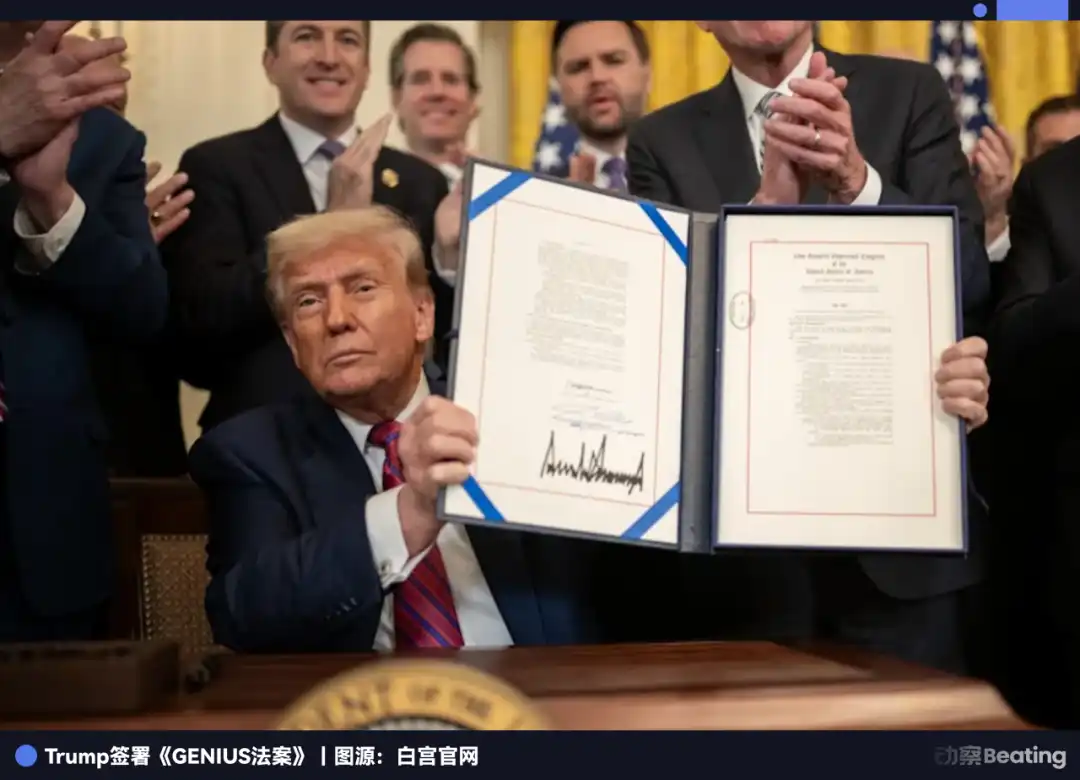
In June, Circle listed on the NYSE, with an IPO price of $31, closing at $69 on the first day, its market cap approaching $20 billion, becoming the "first stablecoin stock." In the same month, the U.S. Senate passed the GENIUS Act with 68 votes in favor, establishing a federal regulatory framework for stablecoins for the first time. The EU's MiCA regulations came into full effect, and Hong Kong, Japan, and Singapore相继 introduced licensing systems.

Over the past decade, stablecoins existed in a gray area, with regulators lacking grounds for intervention. Now, with an annual transfer volume exceeding the world's largest payment network, no government can continue to pretend not to see it.
Data shows: 34% of adults in Turkey hold USDT to hedge against the lira's depreciation; nearly 30% of remittances in Nigeria are completed via stablecoins; tech workers in Argentina普遍 use USDC to receive salaries, bypassing local currency inflation. In these countries, stablecoins are already the de facto "shadow dollar."

The foundation of dollar hegemony is not the Fed's money-printing ability but the inertia of global trade being denominated and settled in dollars. If stablecoins become the next-generation cross-border payment infrastructure, controlling stablecoins means controlling dollar hegemony in the digital age.

This is the underlying logic behind the Trump family's entry and the reason why the GENIUS Act passed with rare bipartisan consensus: in Washington, stablecoins are no longer a小众 issue for the crypto circle but a strategic resource concerning national interests.

The Imminent Battle

Whether $U will succeed is still uncertain. Its current circulating market cap is negligible compared to USDT's nearly $200 billion and USDC's nearly $80 billion.

But it represents a new paradigm in stablecoin competition.

Competition in the 1.0 era was about going it alone: Tether established a monopoly with first-mover advantage, Circle tried to leverage compliance to撬动 the market, and Binance fought for pricing power through BUSD. The core question was "who can survive."

Competition in the 2.0 era is about forming alliances. PayPal issued PYUSD, Ripple launched RLUSD, Robinhood teamed up with Galaxy Digital and Kraken to form the USDG alliance. Traditional financial giants, crypto-native players, sovereign capital, and political forces have all entered the arena.

The new core question becomes "who can tie more players together."

$U's strategy is to achieve aggregation through "nesting": not making enemies with any party, but turning everyone into its "underlying asset." Binance's intention is to build a "decentralized centralization": using an aggregated architecture to分散 regulatory risk while maintaining control over the core ecosystem.

This hundred-army battle has no final outcome. The regulatory balance is still swaying, technological boundaries are still expanding, and political variables are still accumulating.

The only certainty is: stablecoins have moved from being supporting actors in cryptocurrency to key infrastructure in the global financial system. An annual trading volume of $27 trillion is enough to make anyone who underestimates it pay the price.


Perguntas relacionadas

QWhat is the total on-chain transfer volume of stablecoins in 2024, and how does it compare to Visa and Mastercard?

AIn 2024, the total on-chain transfer volume of stablecoins reached $27.6 trillion, surpassing the combined total of Visa and Mastercard for the first time.

QWhat is the unique feature of the new stablecoin $U launched by United Stables, and what is this structure called in the industry?

AThe unique feature of $U is that its reserves are not US dollars or treasury bonds but a combination of three other stablecoins: USDC, USDT, and USD1. This structure is referred to as a 'nested doll' or '套娃' in the industry.

QWhat was the major event in March 2023 that caused USDC to depeg, and what was the market's lesson from this incident?

AIn March 2023, the collapse of Silicon Valley Bank caused USDC to depeg, briefly dropping to $0.87. Circle had $3.3 billion in reserves held at the bank. The market learned that compliance is an advantage but not a moat; the real barrier is network effect—when a stablecoin has enough users and liquidity, it becomes the de facto standard.

QHow did the Trump family get involved in the stablecoin market, and which major transaction significantly boosted the credibility of their stablecoin USD1?

AThe Trump family entered the stablecoin market in March 2025 by issuing USD1 through World Liberty Financial. A major transaction that significantly boosted its credibility was the Abu Dhabi sovereign fund MGX's $2 billion investment in Binance, which was paid using USD1.

QWhat are the three main considerations behind the design of the 'nested doll' stablecoin $U, as mentioned in the article?

AThe three main considerations behind the design of $U are: 1) Risk diversification by combining multiple stablecoins to hedge against specific risks; 2) Liquidity aggregation to connect fragmented liquidity pools across different blockchains and DeFi protocols; 3) Narrative upgrade, positioning it as a settlement currency for the AI era and promoting features like gasless transfers.

Leituras Relacionadas

$292 Million KelpDAO Cross-Chain Bridge Hack: Who Should Foot the Bill?

On April 18, 2026, an attacker stole 116,500 rsETH (worth ~$292M) from KelpDAO’s cross-chain bridge in 46 minutes—the largest DeFi exploit of 2026. The stolen assets were deposited into Aave V3 as collateral, causing $177–200M in bad debt and triggering a cascade of losses across nine DeFi protocols. Aave’s TVL dropped by ~$6B overnight. This legal analysis argues that KelpDAO and LayerZero Labs share concurrent liability, with fault apportioned 60%/40%. KelpDAO negligently configured its bridge with a 1-of-1 decentralized verifier network (DVN)—a single point of failure—despite LayerZero’s explicit recommendation of a 2-of-3 setup. LayerZero, which operated the compromised DVN, failed to secure its RPC infrastructure against a known poisoning attack vector. Both protocols’ terms of service cap liability at $200 (KelpDAO) or $50 (LayerZero), but these limits are likely unenforceable due to unconscionability, gross negligence exceptions, and potential securities law invalidation (if rsETH is deemed a security under the Howey test). Aave’s governance also faces fiduciary duty claims for raising rsETH’s loan-to-value ratio to 93%—far above competitors’ 72–75%—without adequately assessing bridge risks, amplifying the systemic fallout. Practical recovery targets include LayerZero Labs (a registered Canadian entity), KelpDAO’s founders, auditors, and identifiable Aave governance delegates. The incident underscores escalating legal risks for DeFi protocols, infrastructure providers, and governance participants.

marsbitHá 58m

$292 Million KelpDAO Cross-Chain Bridge Hack: Who Should Foot the Bill?

marsbitHá 58m

Insider Trading in War: 5 People Involved, the Highest Earner Was Arrested

On April 24, the U.S. Department of Justice arrested U.S. Army Special Forces Staff Sergeant Gannon Ken Van Dyke for insider trading related to the capture of Venezuelan President Nicolás Maduro on January 3. Van Dyke allegedly profited over $400,000 by placing bets on a prediction market, Polymarket, using insider knowledge of the covert operation. According to the indictment, Van Dyke registered an account (0x31a5) on December 26 and made a series of bets predicting Maduro’s capture and U.S. military involvement in Venezuela. He withdrew most of his funds on the day of the operation and attempted to obscure his tracks by transferring assets through crypto and brokerage accounts. This case marks the first time the DOJ has prosecuted insider trading on Polymarket. PolyBeats had previously identified five suspicious accounts, including Van Dyke’s—the highest earner—in January. The other accounts, with profits ranging from $34,000 to $145,000, remain under unofficial scrutiny but have not been charged. Their lower profits, indirect access to information, and unclear legal boundaries may complicate prosecution. Polymarket has since strengthened its market integrity rules, explicitly prohibiting trading based on confidential or insider information. Van Dyke’s arrest, nearly four months after his trades, signals increased regulatory attention and the persistent traceability of blockchain-based transactions.

marsbitHá 1h

Insider Trading in War: 5 People Involved, the Highest Earner Was Arrested

marsbitHá 1h

Bitwise: Bullish on Bitcoin's Performance in the Second Half of the Year, AI and Regulation Will Spark a New Altcoin Season

Bitwise CIO Matt Hougan and Research Lead Ryan Rasmussen express strong bullish sentiment on Bitcoin's long-term prospects, suggesting that its $1 million price target may be too conservative. They argue Bitcoin serves a dual role: as digital gold and a potential global settlement asset, especially amid declining trust in traditional monetary systems. Despite a weak Q1 2026 where nearly all crypto assets and prices saw double-digit declines, the analysts remain optimistic due to strong forward-looking catalysts, including institutional adoption via Bitcoin ETFs from major firms like Morgan Stanley and Goldman Sachs. Geopolitical instability, such as Iran’s mention of using Bitcoin for international payments, increases the value of Bitcoin’s “out-of-the-money call option” as a non-political, global settlement currency. This enhances its appeal beyond a mere store of value. . Additionally, Hougan highlights that a clearer regulatory token framework under current SEC leadership, combined with AI efficiency gains and high-performance blockchains, could fuel a new “altseason” by late 2026. This may lead to a wave of legitimate, value-capturing token projects, unlike the earlier ICO boom. . Bitwise also announced an Avalanche ETF, citing its unique architecture and rapid growth in real-world asset (RWA) tokenization, which has surged 10x to nearly $30 billion in two years. The firm believes Layer 1 blockchains are still early in their growth cycle, with significant potential ahead.

marsbitHá 1h

Bitwise: Bullish on Bitcoin's Performance in the Second Half of the Year, AI and Regulation Will Spark a New Altcoin Season

marsbitHá 1h

Trading

Spot
Futuros

Artigos em Destaque

O que é BNB WHALES

Compreender as Baleias BNB: Um Mergulho Profundo na Paisagem das Criptomoedas Introdução às Baleias BNB No vibrante mundo das criptomoedas, novos projetos emergem regularmente, muitas vezes prometendo soluções inovadoras e experiências únicas. Um desses projetos é o BNB Whales, lançado em 2023 e construído na BNB Smart Chain (BEP20). O BNB Whales propõe estabelecer uma presença distinta dentro do ecossistema das criptomoedas, focando na criação de uma plataforma envolvente que combina os benefícios da tecnologia blockchain com interações sociais e de jogos. Este artigo tem como objetivo aprofundar-se no BNB Whales, explorando seus componentes principais, mecânicas e trajetória de desenvolvimento. O que são as Baleias BNB? As Baleias BNB são uma iniciativa em criptomoeda que busca proporcionar uma variedade diversificada de características e oportunidades para os seus utilizadores no emergente ambiente Web3. Utilizando o padrão BEP20, o projeto opera com um suprimento total de tokens de 100 trilhões (100.000.000.000.000.000). Apesar deste número significativo, é notável que não existem tokens atualmente em circulação, indicando que o projeto pode ainda estar nas suas fases iniciais de desenvolvimento. O objetivo principal do BNB Whales é criar uma plataforma onde os utilizadores possam participar em várias atividades interativas, beneficiando-se da segurança e transparência proporcionadas pela tecnologia blockchain. Ao fomentar um ambiente único e envolvente, o BNB Whales visa construir uma forte comunidade de utilizadores que estão investidos no projeto e no seu desenvolvimento. Quem é o Criador do BNB Whales? A identidade do criador do BNB Whales permanece não divulgada neste momento, apresentando um desafio para aqueles que procuram entender os princípios fundacionais e as perspetivas visionárias do projeto. Esta ausência de informação disponível publicamente acerca da liderança do projeto pode levantar questões entre potenciais investidores e utilizadores sobre a sua estrutura de governança e responsabilidade. Quem são os Investidores do BNB Whales? À medida que o BNB Whales continua a evoluir, a informação sobre investidores específicos ou apoio de fundações de investimento está atualmente indisponível. A documentação oficial do projeto, incluindo o seu whitepaper, não divulga apoiantes financeiros individuais ou institucionais. A falta de transparência neste aspeto pode, por vezes, levantar questões sobre a legitimidade e sustentabilidade de novos projetos dentro do ecossistema das criptomoedas. Como Funciona o BNB Whales? O BNB Whales opera na BNB Smart Chain utilizando o padrão BEP20, que é conhecido pela sua eficiência e baixas taxas de transação, atraindo uma variedade de desenvolvedores e projetos. O aspeto único do BNB Whales reside no seu foco na criação de uma plataforma orientada pela comunidade. Embora detalhes operacionais precisos sejam escassos, o projeto enfatiza a interação e o envolvimento, potencialmente incorporando elementos gamificados nas suas ofertas. A ênfase na comunidade é fundamental, uma vez que se alinha com as tendências predominantes no espaço das criptomoedas, onde a contribuição e participação do utilizador frequentemente ditam o sucesso de um projeto. Mais inovações podem ser antecipadas, mas, neste momento, os mecanismos e características específicos que diferenciam o BNB Whales de outras iniciativas de criptomoedas permanecem por elucidar totalmente. Sem informações detalhadas sobre a sua funcionalidade, é desafiador avaliar abrangentemente os diferenciais do projeto. Cronologia do BNB Whales O desenvolvimento do BNB Whales desenrolou-se ao longo de marcos importantes, marcando a sua jornada na paisagem das criptomoedas. Abaixo está uma cronologia de eventos significativos relacionados com o projeto: 2023: Lançamento do BNB Whales, marcando a entrada do projeto no mercado. 2023: Publicação do whitepaper do projeto, que estabelece os objetivos gerais e a estrutura operacional. Em andamento: O BNB Whales continua a desenvolver as suas características, visando construir uma base de utilizadores robusta e expandir as suas ofertas. Pontos Chave Sobre o BNB Whales Plataforma: BNB Smart Chain (BEP20) Suprimento Total: 100 trilhões de tokens (100.000.000.000.000.000) Suprimento Circulante: 0 tokens (indicando uma fase incipiente) Objetivo do Projeto: Fomentar uma plataforma de criptomoedas envolvente para interação e construção de comunidade. Criador: Desconhecido Investidores: Não divulgados Status Operacional: Ativo com desenvolvimento e expansão em curso Conclusão À medida que o BNB Whales navega pela competitiva paisagem das criptomoedas, oferece uma visão do potencial de projetos orientados pela comunidade construídos sobre as bases da tecnologia blockchain. Ao focar no envolvimento e interação, a iniciativa encontra-se na vanguarda da inovação no espaço Web3. No entanto, o sucesso do projeto depende, em última instância, da clareza das suas mecânicas operacionais, da divulgação da sua governança e do estabelecimento de uma sólida comunidade de utilizadores. Para potenciais utilizadores e investidores, o BNB Whales representa um estudo de caso na natureza em evolução dos projetos de criptomoedas — um que ilustra tanto as possibilidades emocionantes como as complexidades associadas a novas iniciativas. À medida que a paisagem continua a evoluir, será essencial monitorar o progresso do BNB Whales e o seu impacto no ecossistema mais amplo das criptomoedas.

360 Visualizações TotaisPublicado em {updateTime}Atualizado em 2024.12.03

O que é BNB WHALES

Como comprar BNB

Bem-vindo à HTX.com!Tornámos a compra de Binance Coin (BNB) simples e conveniente.Segue o nosso guia passo a passo para iniciar a tua jornada no mundo das criptos.Passo 1: cria a tua conta HTXUtiliza o teu e-mail ou número de telefone para te inscreveres numa conta gratuita na HTX.Desfruta de um processo de inscrição sem complicações e desbloqueia todas as funcionalidades.Obter a minha contaPasso 2: vai para Comprar Cripto e escolhe o teu método de pagamentoCartão de crédito/débito: usa o teu visa ou mastercard para comprar Binance Coin (BNB) instantaneamente.Saldo: usa os fundos da tua conta HTX para transacionar sem problemas.Terceiros: adicionamos métodos de pagamento populares, como Google Pay e Apple Pay, para aumentar a conveniência.P2P: transaciona diretamente com outros utilizadores na HTX.Mercado de balcão (OTC): oferecemos serviços personalizados e taxas de câmbio competitivas para os traders.Passo 3: armazena teu Binance Coin (BNB)Depois de comprar o teu Binance Coin (BNB), armazena-o na tua conta HTX.Alternativamente, podes enviá-lo para outro lugar através de transferência blockchain ou usá-lo para transacionar outras criptomoedas.Passo 4: transaciona Binance Coin (BNB)Transaciona facilmente Binance Coin (BNB) no mercado à vista da HTX.Acede simplesmente à tua conta, seleciona o teu par de trading, executa as tuas transações e monitoriza em tempo real.Oferecemos uma experiência de fácil utilização tanto para principiantes como para traders experientes.

885 Visualizações TotaisPublicado em {updateTime}Atualizado em 2025.03.21

Como comprar BNB

O que é BNB CARD

Compreender o BNB Card: Revolucionando a Identidade Digital no Web3 No panorama em rápida evolução da tecnologia blockchain e das criptomoedas, o BNB Card ou $BNBCARD destaca-se como um projeto notável. Este token meme utilitário, impulsionado pela comunidade, aproveita a BNB Smart Chain (BSC), visando integrar a cultura meme com soluções inovadoras de identidade digital. À medida que mais utilizadores mergulham nos domínios da descentralização, é crucial dissecar o que o BNB Card oferece, as suas nuances operacionais e o seu potencial impacto no mercado. O que é o BNB Card ($BNBCARD)? No seu cerne, o BNB Card representa um token meme com utilidade substancial. É projetado para capacitar os utilizadores, permitindo a criação de cartões de identidade digital personalizados que são tanto expressivos quanto funcionais. O projeto encapsula várias características-chave: Cartões de Identidade Personalizáveis: Os utilizadores têm a capacidade de desenhar cartões de identidade digital com o tema da Binance, proporcionando-lhes uma plataforma para autoexpressão e interação comunitária aprimorada. Estrutura Descentralizada: Desenvolvido na BSC, o BNB Card enfatiza atributos chave como segurança, transparência e soberania do utilizador. A natureza descentralizada da estrutura permite transações que são tanto eficientes quanto seguras. Modelo Centrado na Comunidade: A ênfase na participação de base em vez de modelos financeiros impulsionados por laboratórios cria um ambiente envolvente para os seus utilizadores. Ao aproveitar a viralidade inerente da cultura meme, o BNB Card promove um movimento comunitário robusto. O objetivo principal do BNB Card é democratizar as ferramentas de identidade digital no Web3, oferecendo soluções acessíveis que beneficiam os utilizadores sem os encargos normalmente associados aos sistemas tradicionais de gestão de identidade. Criador e Investidores Ao explorar a identidade por trás do BNB Card, é importante notar que nenhum criador singular é explicitamente creditado. Em vez disso, o projeto parece ser impulsionado pela comunidade, sugerindo um esforço coletivo inspirado pela noção do “Cartão de Construtor Precoce” da Binance. Esta abordagem de desenvolvimento orgânico é comum entre projetos dentro do espectro dos tokens meme, onde o desenvolvimento é frequentemente influenciado pela paixão da comunidade em vez de uma autoridade central. Em termos de investimento, a ausência de apoiantes institucionais divulgados publicamente destaca ainda mais a fundação de base do projeto. Ele prospera com apoio comunitário orgânico, refletindo uma característica usual de projetos impulsionados por memes que frequentemente envolvem o seu público através de canais sociais em vez de rotas de investimento formais. Como Funciona O BNB Card emprega vários mecanismos que delineiam o seu funcionamento e espírito inovador: Utilidade do Token: O token BNBCARD permite aos utilizadores aceder a um conjunto de ferramentas de criação de ID, ao mesmo tempo que fornece uma plataforma para a governança comunitária. O token serve como o elemento central que possibilita essas funcionalidades. Integração Blockchain: Ao utilizar a BSC, o BNB Card garante compatibilidade com aplicações baseadas na Ethereum Virtual Machine (EVM). Esta integração oferece aos utilizadores os benefícios de baixas taxas de transação, ao mesmo tempo que melhora a acessibilidade. Ecossistema DIY: Central para o apelo do BNB Card é a sua abordagem faça você mesmo (DIY) para a geração de cartões de identidade digital. Este elemento participativo incentiva os utilizadores a envolverem-se na expressão criativa, promovendo uma cultura inclusiva que prospera na contribuição e colaboração. Cronologia A cronologia é vital para compreender a trajetória do BNB Card. Marcos importantes na história do projeto incluem: 18 de Março de 2025: O BNB Card foi listado na LBank, marcando um passo significativo na sua jornada de troca e abrindo portas para liquidez e acessibilidade para os utilizadores. 19 de Março de 2025: Um momento crucial ocorreu quando o token experimentou um aumento astronómico de 26.000% em 24 horas, atraindo atenção pelo seu potencial e pelo entusiasmo da comunidade. Desenvolvimentos em Curso: O projeto está continuamente a expandir as suas parcerias com exchanges descentralizadas (DEXs) como a PancakeSwap, melhorando ainda mais a liquidez e o envolvimento dos utilizadores. Inovação e Diferenciação Compreender o que distingue o BNB Card envolve uma exploração mais profunda da sua estrutura inovadora: Híbrido Meme-Utilitário: O BNB Card combina com sucesso o apelo lúdico da cultura meme com aplicações práticas na gestão de identidade digital. Esta abordagem de nicho atende efetivamente a uma ampla demografia, apelando tanto a utilizadores experientes em tecnologia quanto àqueles novos no mundo das criptomoedas. Governança Descentralizada: Operar sem controle centralizado permite ao projeto aproveitar diretamente a contribuição da comunidade. O processo de tomada de decisão coletiva, sustentado pela participação da comunidade, capacita os utilizadores, garantindo que as suas vozes contribuam para o desenvolvimento e direção do projeto. Escalabilidade: O BNB Card pode beneficiar imensamente das atualizações do roteiro de 2025 para a BNB Chain, que incluem melhorias como aumento da velocidade das transações e a integração de ferramentas de inteligência artificial. Estas melhorias posicionam o projeto de forma vantajosa dentro de um ambiente altamente competitivo. Conclusão O BNB Card é emblemático de uma nova onda de soluções de identidade digital dentro do ecossistema Web3. Ao misturar diversão, envolvimento comunitário e utilidade prática, convida os utilizadores a participar ativamente na formação das suas personas digitais. À medida que o projeto navega pelo dinâmico panorama das criptomoedas, o seu sucesso dependerá provavelmente de manter um forte apoio comunitário enquanto se adapta aos avanços tecnológicos e às necessidades dos utilizadores. A integração da descentralização com a cultura meme serve não apenas como um meio para o envolvimento impulsionado pelos utilizadores, mas também como uma base para a narrativa em evolução em torno da identidade digital na era da blockchain. Em suma, o BNB Card não só exemplifica a convergência de criatividade e utilidade dentro do espaço cripto, mas também sublinha a importância da comunidade na orientação do futuro das tecnologias descentralizadas.

323 Visualizações TotaisPublicado em {updateTime}Atualizado em 2025.03.26

O que é BNB CARD

Discussões

Bem-vindo à Comunidade HTX. Aqui, pode manter-se informado sobre os mais recentes desenvolvimentos da plataforma e obter acesso a análises profissionais de mercado. As opiniões dos utilizadores sobre o preço de BNB (BNB) são apresentadas abaixo.

活动图片